

Accountability and Psychological Safety: Holding Both
A project is falling behind.
Several people can see the risk, but the status report remains green.
Each person has a reason to wait: the figures are still being checked, the owner may already know, or raising the issue could make them appear unable to deliver.
Eventually, the delay becomes impossible to hide.
The leader asks why nobody spoke up earlier.
In a different team, the risk would have been raised promptly.
People can discuss difficulties openly, and the leader listens without assigning blame.
Yet the project still falls behind.
The same issues are discussed at each meeting, while ownership and decisions remain unclear.
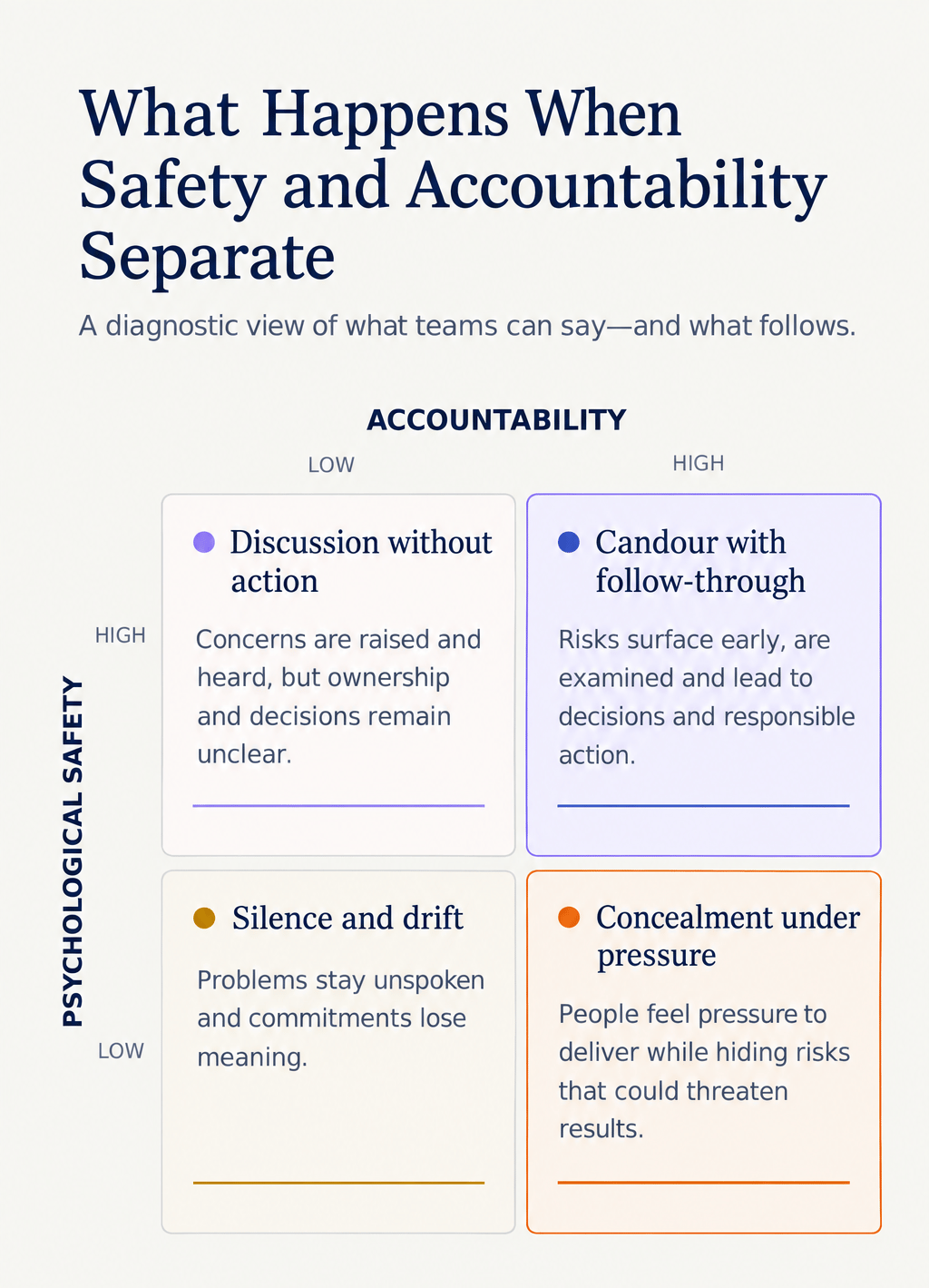
The first team has accountability without enough psychological safety.
The second has psychological safety without enough accountability. Both lose the ability to respond effectively.
The leadership task is to hold both: people must be able to tell the truth about the work, and the organisation must act on what it learns.
When accountability makes the truth costly
Accountability gives commitments meaning.
People need to know what they are responsible for, how their work affects others and what happens when an agreement is missed.
The difficulty begins when reporting a problem carries a greater personal cost than allowing it to develop.
A leader may ask for early warnings, then respond to one with visible frustration.
A team member who admits uncertainty may be judged as unprepared.
Someone who questions a deadline may be described as lacking commitment.
People notice these responses.
They learn which information is welcome and which information is better managed privately.
This does not necessarily produce deliberate lies.
It often produces carefully limited truths.
A risk becomes “something we are monitoring.” A missed dependency disappears into a general progress update.
A deadline remains unchanged even though the people doing the work no longer believe it is achievable.
From the leader’s perspective, the team may appear focused and accountable. In reality, the reporting system has begun to filter out the information leaders most need.
By the time the problem becomes visible, the question is no longer whether it could have been prevented.
It is whether anyone still has enough time or flexibility to respond.
That is why accountability cannot be assessed only by asking whether people delivered.
Leaders must also ask whether people could speak honestly while delivery was still at risk.
When safety ends at the conversation
Psychological safety gives people room to ask questions, challenge assumptions, admit mistakes and raise concerns. It helps the team see what is happening beyond the formal report.
But a concern that is heard and repeatedly left unresolved eventually sends its own signal.
Imagine a team that regularly discusses a failing handover process. Everyone agrees it causes delays.
People share examples without fear of blame, and the leader acknowledges the pressure involved. The meeting ends on a supportive note.
The next month, the handover fails again.
Nobody was assigned to change the process.
No decision was made about competing priorities.
No one checked whether the proposed improvement worked.
The team can speak, but its candour has little effect on the system it works within.
Over time, this can weaken trust as surely as a harsh reaction to bad news.
The people who keep compensating for the problem carry the cost.
Those who raise it begin to wonder whether speaking up is worth the effort.
Psychological safety makes a difficult conversation possible.
Accountability gives that conversation a consequence for the work.
The connection leaders can miss
These two conditions are sometimes treated as opposing management styles: one firm, the other supportive.
That framing obscures how they depend on each other.
If people cannot raise a risk early, accountability is applied to an incomplete picture.
Leaders may judge the final outcome without understanding what was known along the way, which decisions were delayed or which constraints were ignored.
If people can raise a risk but nobody is responsible for addressing it, the organisation gains insight without changing its behaviour.
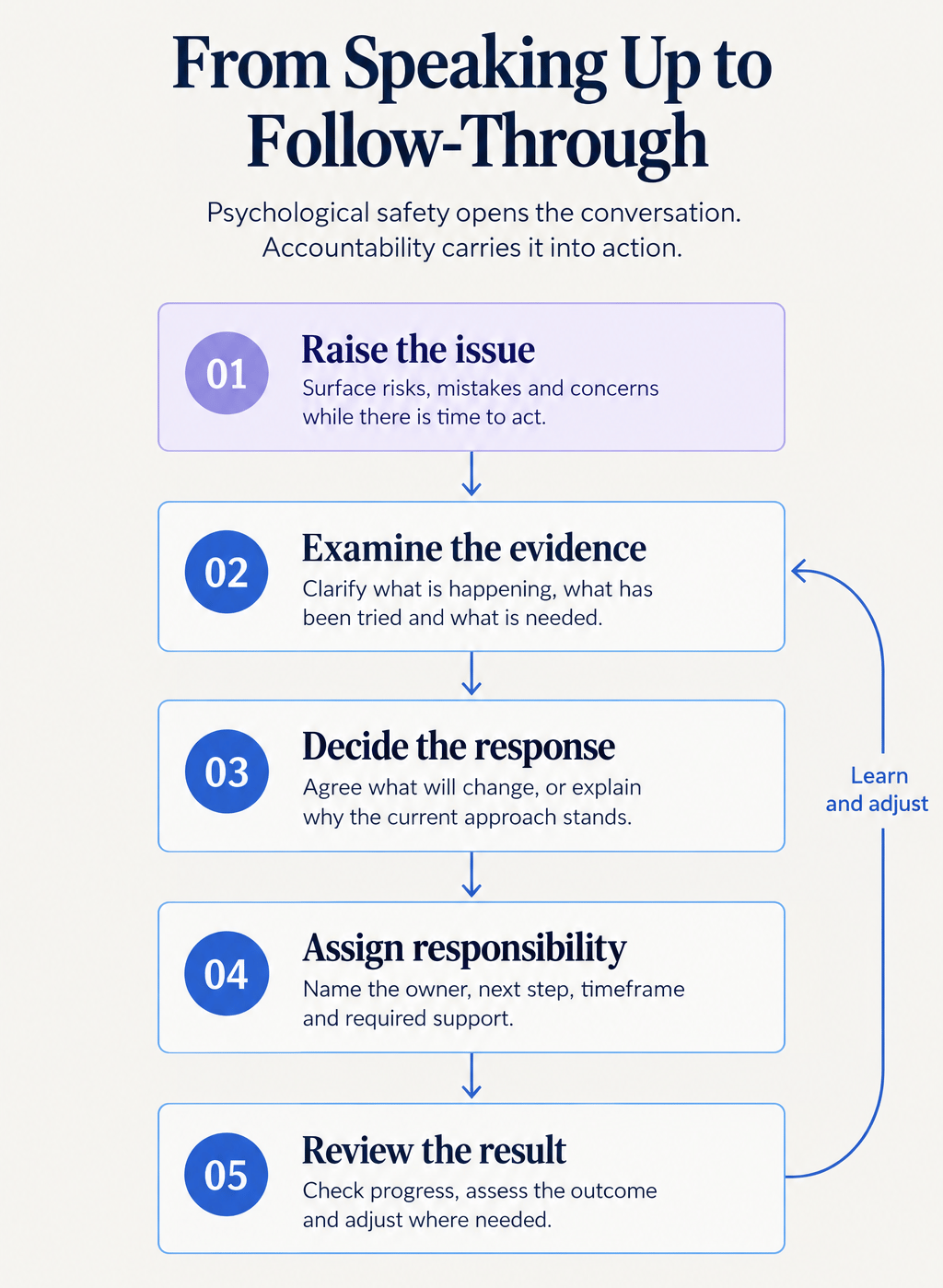
The useful sequence is straightforward:
Raise the issue. Examine it. Decide what to do. Assign responsibility. Review the result.
Each step matters. If the team cannot raise the issue, the process never begins.
If the team cannot move from discussion to action, the process never closes.
Consider a project owner who says,
“We will miss the deadline unless another team confirms the data by Friday.”
A response that protects psychological safety would take the warning seriously and examine the evidence.
A response that maintains accountability would establish what the owner has already done, who will resolve the dependency and when the plan will be reviewed.
The leader might say:
“Thank you for raising this now. Show me what depends on the data, what you have tried and the decision you need.
Let’s agree on the next step and update the timeline if the risk remains.”
The warning is treated as useful information. The commitment is still being managed.
Distinguishing a missed outcome from a missed responsibility
Holding both requires more than being kind when something goes wrong. Leaders need to understand how the outcome came about.
Two people may miss the same deadline for very different reasons.
One identified the risk early, tried to resolve it, asked for a decision and kept others informed.
The other knew the work was slipping, avoided the conversation and allowed others to plan around an unrealistic date.
The outcome matters in both cases. So does the conduct leading up to it.
There is another possibility: the organisation created conditions in which delivery was unlikely.
Priorities changed without being reconciled.
A dependency had no clear owner.
The team lacked authority to make a decision, yet remained responsible for the result.
An accountability conversation that examines only the individual can miss these conditions.
A safety conversation that examines only the conditions can miss choices the individual could have made.
A credible review asks both:
- What was within the person’s responsibility and control?
- What in the wider system helped or hindered delivery?
The purpose is to make a fair decision and reduce the chance of the problem recurring.
That may require support, a change in process, clearer ownership, direct feedback or a consequence.
The response should follow the diagnosis.
What the team learns from the leader’s response
Culture is shaped in the moments after someone shares information that is inconvenient.
Does the leader ask enough questions to understand it?
Do they make a decision or explain when one will be made?
Do they return with an answer?
When a commitment is missed, do they examine the evidence consistently?
People are watching for coherence between the invitation to speak and the response they receive.
A leader who says “Tell me early” but punishes early warnings teaches people to wait.
A leader who says “We take ownership” but allows the same unresolved issue to return at every meeting teaches people that ownership is optional.
The formal message matters less when daily experience contradicts it.
This applies to leaders’ own commitments as well. If a manager promises to remove a barrier and does not follow through, the team sees an accountability gap.
If the manager has made a mistake but cannot acknowledge it, the team learns that candour has limits.
People are more likely to accept difficult conversations when expectations are clear and applied consistently, including upward.
A practical diagnostic for leaders
Leaders can look for the balance between psychological safety and accountability in ordinary work, without relying on a culture survey alone.
When do risks become visible?
If concerns emerge only after a deadline has passed, examine how earlier warnings have been received.
What happens after someone speaks up?
Look beyond whether the person was allowed to speak. Was the concern examined? Was a decision made? Did anyone explain what happened next?
Are commitments clear before performance is judged?
People need to understand the outcome, owner, timeframe and relevant dependencies. Ambiguous expectations make later accountability feel arbitrary.
Do recurring problems lead to changes?
A repeated issue may indicate that the team is identifying symptoms without addressing the decision, process or behaviour that keeps producing them.
Are different situations treated differently?
A timely warning, a hidden risk and a poorly designed process should not receive the same response simply because they led to the same missed target.
These questions help leaders identify where the connection breaks. The remedy depends on the point of failure.
Holding both
A healthy team will still miss targets, disagree and face difficult conversations.
Psychological safety does not make every outcome acceptable.
Accountability does not require leaders to treat every problem as a personal failure.
What matters is whether people can bring forward the truth while there is time to act, and whether that truth leads to clear decisions and responsible follow-through.
When people fear the response, problems become harder to see. When no one owns the response, problems become harder to resolve.
Leaders hold both by making it possible to speak honestly about the work—and making what follows that honesty count.
Part of the Leadership & Culture Series from LUCID Methods.
Explore more frameworks, diagnostic perspectives, and systems-thinking insights through the LUCID Method — developed to help organisations build clarity, coherence, and transformation that holds over time.