

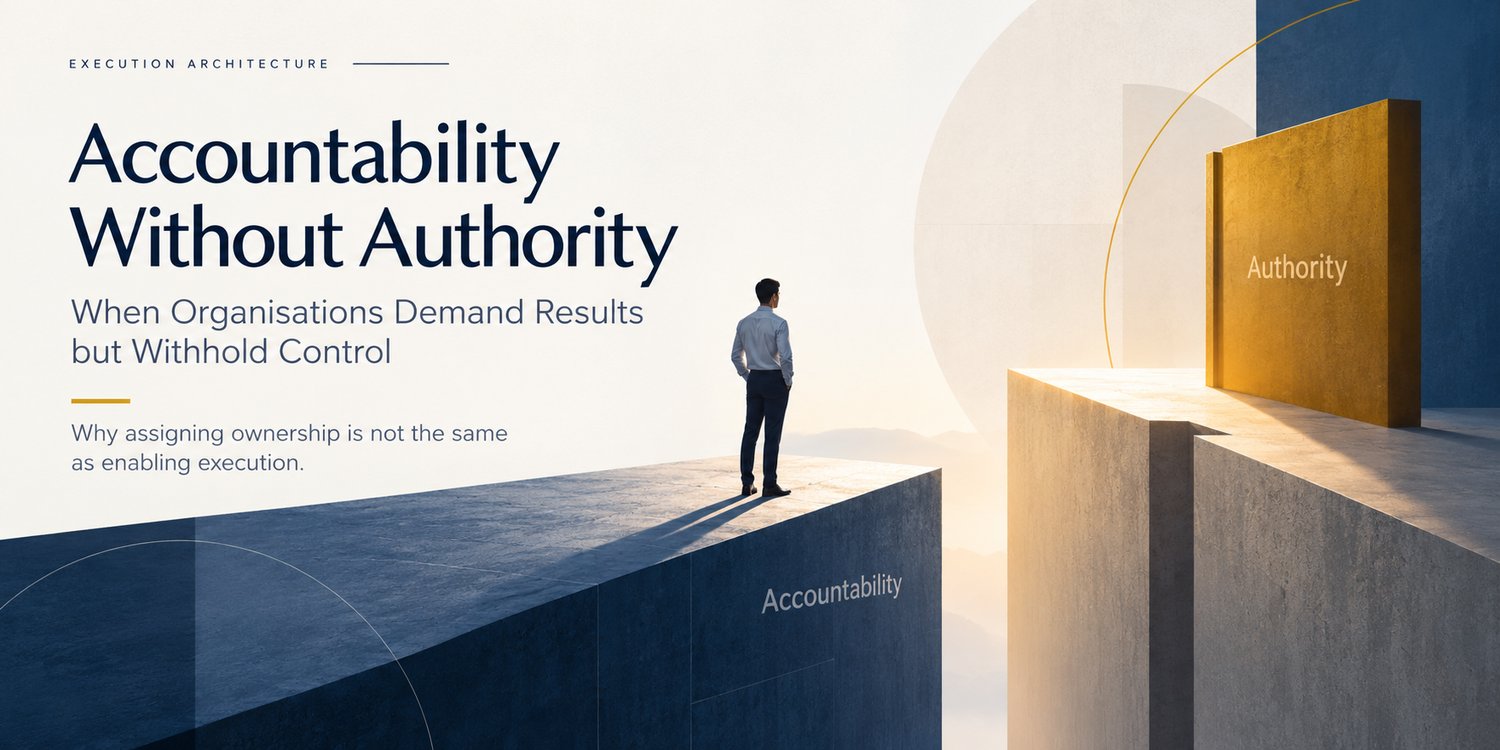
Accountability Without Authority: When Organisations Demand Results but Withhold Control
Why assigning ownership is not the same as enabling execution.
The Accountability Paradox
A project manager is held responsible for delivering a project on time but cannot allocate the people needed to complete it.
A department head is expected to improve performance but cannot approve the resources required to address persistent operational problems.
A change manager is accountable for employee adoption of a new system but has no authority to require departments to participate in training or change established practices.
In each case, accountability is clear. What is missing is the authority necessary to act.
When results fall short, the organisation may interpret the failure as a problem of individual performance, leadership capability or commitment.
Yet the underlying problem may be structural.
The person expected to deliver the outcome does not control the decisions, resources or dependencies that determine whether the outcome can be achieved.
This creates a fundamental contradiction.
The organisation demands accountability while withholding the means to exercise it.
The problem is not that accountability is unnecessary.
Accountability remains essential to effective execution.
The problem arises when accountability is assigned without examining whether the organisational architecture supports it.
Responsibility, Accountability and Authority Are Not the Same
These three concepts are frequently used interchangeably, although they serve different purposes.
Responsibility concerns the obligation to perform an activity or complete a task.
Accountability concerns ownership of an outcome and the obligation to explain the results, including decisions, performance and consequences.
Authority concerns the legitimate power to make decisions, approve actions, allocate resources or direct activities within defined boundaries.
An individual may be responsible for performing work without being accountable for the overall outcome.
Similarly, someone may be accountable for an outcome while depending on decisions made by others.
These distinctions are particularly important in complex organisations, where execution rarely occurs within a single reporting line.
Consider a project manager responsible for implementing a new customer management system.
The project manager coordinates activities, monitors progress and reports delivery risks.
However, the IT Director controls technical resources, Finance approves additional expenditure, and department heads determine when their employees can participate in testing and training.
The project manager may be accountable for the implementation schedule but possess limited authority over the factors that determine it.
This does not automatically make the arrangement ineffective.
Cross-functional work necessarily involves shared resources and distributed authority.
The problem emerges when these dependencies are not accompanied by clear decision rights, agreed commitments and reliable escalation mechanisms.
Accountability then becomes an expectation unsupported by the structure needed to fulfil it.
Why RACI Alone Does Not Resolve the Problem
Many organisations use the RACI framework to clarify roles and responsibilities.
RACI distinguishes between those who are Responsible for performing work, Accountable for the outcome, Consulted before decisions or actions, and Informed of progress or results.
It is a useful tool for reducing confusion about participation and ownership.
However, identifying who is accountable does not necessarily establish what that person is authorised to decide.
A RACI matrix may identify a project manager as accountable for implementation.
It does not automatically grant the project manager authority to reassign employees, approve additional expenditure, change departmental priorities or resolve competing resource demands.
These decision rights may remain elsewhere in the organisation.
As a result, a project can have a completed RACI matrix, clearly assigned responsibilities and regular progress reporting while still experiencing persistent execution delays.
The roles are documented, but the authority required to perform them remains fragmented.
This reveals an important limitation.
Role clarity is not the same as decision clarity.
RACI answers who is involved and who owns the outcome.
An effective execution architecture must also establish who can make which decisions, within what boundaries, and what happens when agreement cannot be reached.
Without these additional arrangements, RACI may clarify who will be questioned when delivery fails without resolving why delivery is difficult in the first place.
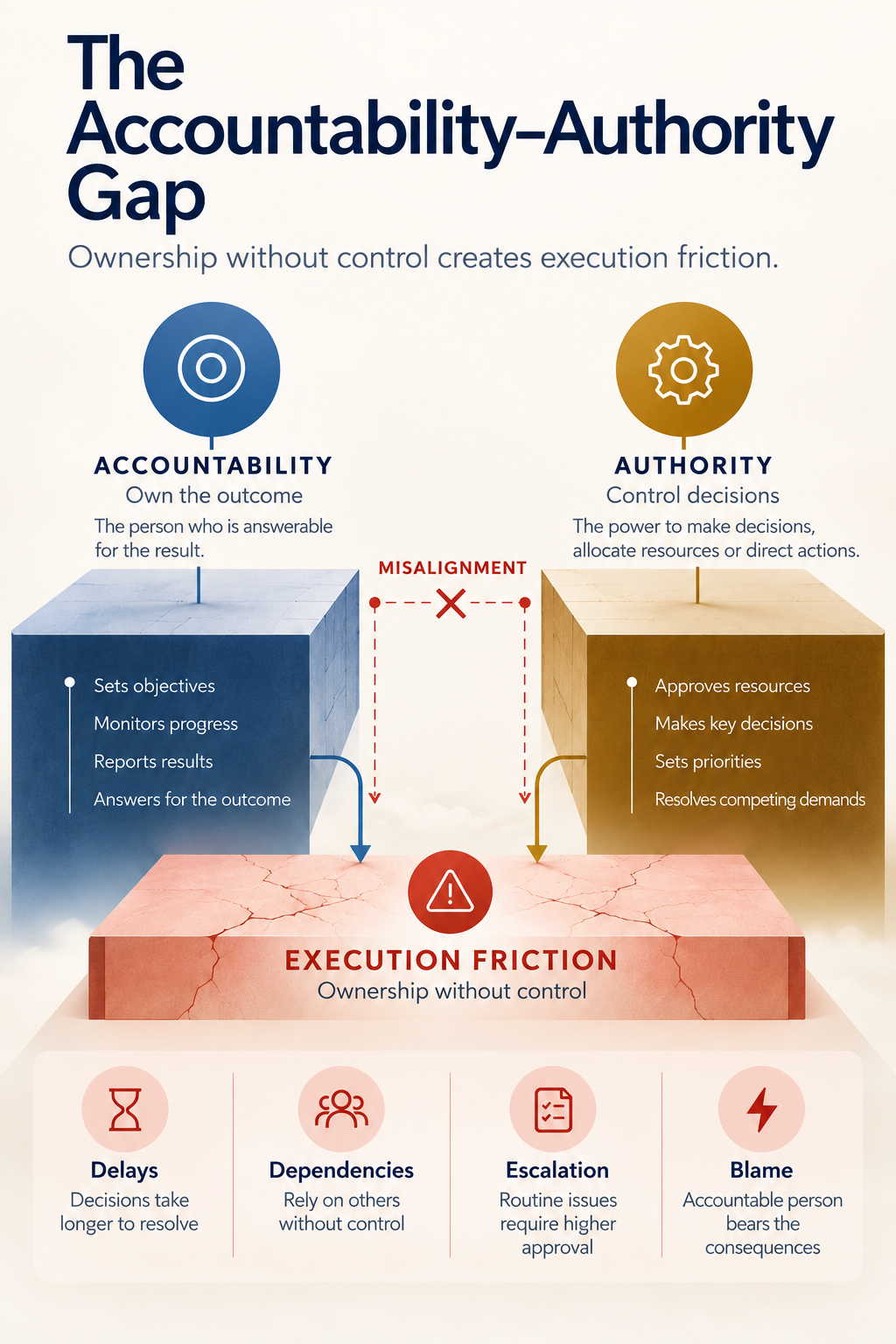
How Accountability and Authority Become Misaligned
Misalignment rarely appears as an explicit organisational policy.
Few organisations deliberately announce that managers will be accountable for outcomes while being denied the authority needed to achieve them.
Instead, the mismatch develops through established reporting structures, approval processes, governance arrangements and competing departmental priorities.
Several patterns are particularly common.
1. Outcome ownership without resource control
A project manager is accountable for meeting a delivery deadline, but the employees assigned to the project remain under the authority of their functional managers.
When operational priorities change, those employees are redirected to departmental work.
The project manager remains accountable for the original deadline but cannot restore the lost capacity.
The organisation has assigned ownership of the outcome without establishing sufficient control over the resources required to deliver it.
2. Performance targets without decision rights
A customer service manager is expected to improve customer satisfaction.
However, the causes of dissatisfaction may involve outdated policies, insufficient staffing, system limitations or service processes controlled by other departments.
The manager can monitor complaints, coach employees and report performance, but cannot independently address the underlying causes.
The performance target remains unchanged even though the authority to influence it is limited.
3. Change accountability without behavioural authority
A change manager is accountable for achieving high adoption of a new system.
Yet participation in training, reinforcement of new procedures and enforcement of operating standards remain under departmental management.
Some department heads actively support the change. Others prioritise existing operational targets.
The change manager can communicate, facilitate and encourage adoption but cannot ensure that departments consistently reinforce the required behaviours.
The organisation has assigned accountability for a collective behavioural outcome to a role without sufficient mechanisms to secure collective commitment.
4. Operational accountability constrained by excessive approvals
An Executive Director is accountable for organisational performance but requires board approval for routine operational decisions.
Governance oversight is necessary, particularly for significant financial, strategic and regulatory matters.
However, when approval requirements extend into ordinary operational management, the distinction between governance and execution becomes blurred.
The Executive Director remains accountable for organisational results while the authority to respond promptly to operational needs is restricted.
The problem is not oversight itself. It is the failure to establish appropriate boundaries between oversight, delegated authority and operational responsibility.
5. Cross-functional outcomes without shared decision mechanisms
A department is accountable for improving customer experience, but the outcome depends on Sales, Operations, Finance, IT and Customer Service.
Each department has its own targets, reporting lines and priorities.
When competing demands arise, no single manager has sufficient authority to resolve them, and no agreed cross-functional mechanism exists to make the necessary trade-offs.
Every department may fulfil its assigned responsibilities while the overall customer experience continues to deteriorate.
The organisation has distributed the work without adequately designing how collective decisions will be made.
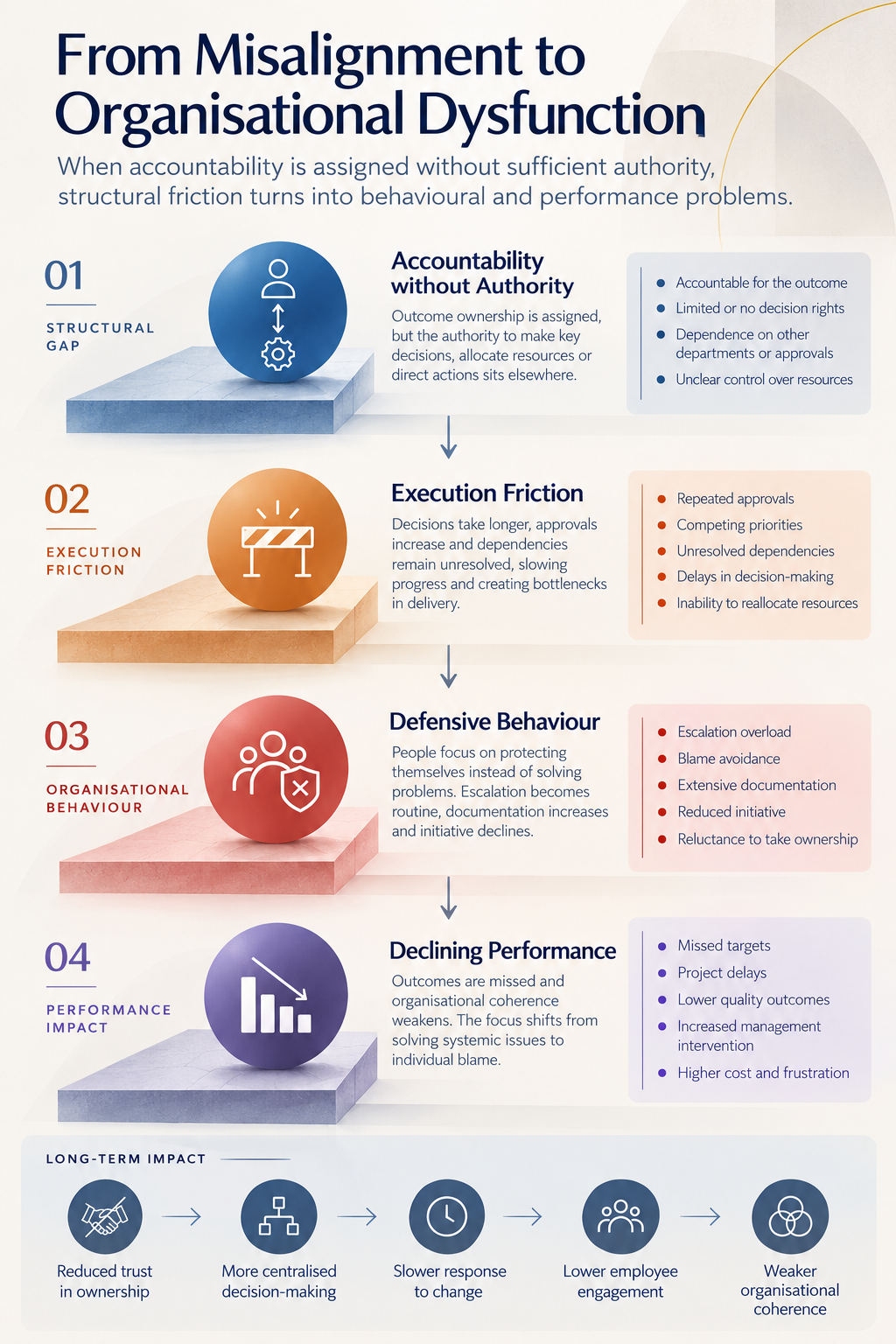
The Hidden Costs of Misalignment
The consequences of accountability without authority extend beyond missed deadlines and underperforming KPIs.
Over time, the mismatch changes how people work, communicate and make decisions.
Decision-making becomes slower
When accountable individuals cannot make necessary decisions, issues move through multiple approval layers.
Routine problems become escalation matters. Meetings multiply. Progress depends increasingly on obtaining permission rather than resolving the underlying issue.
The organisation may appear highly controlled while becoming less responsive.
Escalation becomes a substitute for authority
Escalation is a legitimate governance mechanism when decisions exceed delegated boundaries.
However, when ordinary execution repeatedly requires senior intervention, escalation is no longer an exception.
It becomes the operating model.
Senior leaders become involved in decisions that could otherwise be resolved closer to the work.
This creates bottlenecks and reduces the organisation's ability to operate independently of particular individuals.
Accountability becomes defensive
When people are held answerable for outcomes they cannot adequately influence, they may begin protecting themselves against blame.
Emails become records of warnings.
Meetings focus on documenting dependencies.
Reports emphasise which decisions remain outstanding and which departments have not responded.
Some documentation is necessary and valuable.
The problem arises when its primary purpose shifts from supporting execution to establishing who should not be blamed.
The organisation may interpret this behaviour as a lack of ownership.
Yet it may be a rational response to an accountability system that exposes individuals to consequences without giving them sufficient control.
Employees become reluctant to take ownership
When accountability consistently carries risk without corresponding authority, employees may become less willing to accept responsibility for difficult outcomes.
They learn that initiative does not necessarily translate into the ability to act.
Over time, capable employees may stop proposing improvements, avoid complex assignments or seek explicit approval for decisions they might otherwise have made.
What appears to be declining initiative may partly reflect an organisational environment in which taking ownership has become increasingly costly.
Leadership attention shifts from causes to individuals
Perhaps the most damaging consequence is the misdiagnosis of failure.
When an outcome deteriorates, management may focus immediately on the person identified as accountable.
Why was the target missed?
Why was the project delayed?
Why did the manager fail to intervene?
These questions may be legitimate, but they are incomplete.
A more useful examination also asks whether the accountable person possessed the authority, resources and decision pathways necessary to deliver the expected result.
Without this examination, the organisation risks repeatedly replacing or correcting individuals while preserving the structural conditions that contributed to failure.
The LUCID Diagnostic Lens: Is Accountability Executable?
The central diagnostic question is not simply whether accountability has been assigned.
It is whether that accountability can be exercised within the organisation's actual operating arrangements.
Five questions help reveal the distinction.
Diagnostic Questions and What They May Reveal
1. Who is accountable for the outcome, and what decisions can that person make independently?
What it may reveal: Gaps between outcome ownership and delegated authority.
2. Which critical resources or decisions remain under the control of others?
What it may reveal: Dependencies that may constrain execution.
3. What happens when departments disagree on priorities?
What it may reveal: Missing decision rights or ineffective conflict resolution.
4. How quickly can decisions beyond the accountable person's authority be escalated and resolved?
What it may reveal: Approval bottlenecks and escalation weaknesses.
5. When performance falls short, does the organisation examine structural constraints alongside individual actions?
What it may reveal: Whether accountability is being used for learning or primarily for blame.
These questions shift attention from the individual to the relationship between the individual and the organisational system.
A manager may have clear objectives, measurable KPIs and regular performance reviews. None of these establishes that the manager has sufficient authority to achieve the expected results.
The diagnostic task is to examine whether the organisation has created a workable relationship between expected outcomes and the decisions required to produce them.
Designing Accountability That Can Be Exercised
The solution is not to grant every accountable individual unrestricted authority.
Organisations require financial controls, regulatory safeguards, segregation of duties and appropriate governance oversight.
Nor is it realistic to expect one person to control every factor influencing a complex organisational outcome.
Effective execution requires something more precise: authority and accountability must be aligned through deliberate organisational design.
1. Define outcomes before assigning accountability
Begin by clarifying the outcome the organisation expects.
Distinguish between activities that individuals can directly perform, outputs they can reasonably control and broader outcomes that depend on several functions.
Accountability should reflect these differences.
An individual may reasonably be accountable for completing a defined implementation activity while a broader leadership group remains accountable for organisational adoption.
Assigning a single owner to a complex outcome does not eliminate the dependencies involved in achieving it.
2. Identify the decisions required for success
For each significant outcome, determine which decisions must be made during execution.
These may include resource allocation, prioritisation, expenditure, scope changes, risk acceptance and operational adjustments.
Then identify who possesses the authority to make each decision.
This makes visible the difference between assigning accountability and enabling action.
3. Delegate authority within appropriate boundaries
Where possible, place routine decision-making authority close to the people accountable for execution.
Delegation should include clearly defined limits, such as expenditure thresholds, operational boundaries and conditions requiring escalation.
The objective is not to eliminate oversight but to avoid unnecessary dependence on higher levels of management.
Authority becomes effective when individuals understand both what they can decide and where their authority ends.
4. Establish reliable cross-functional decision mechanisms
Where outcomes depend on several departments, authority cannot always be consolidated under one individual.
Instead, organisations need explicit mechanisms for resolving competing priorities and resource demands.
These may include agreed resource commitments, cross-functional governance forums, designated decision owners and time-bound escalation procedures.
The essential requirement is that dependencies are recognised and managed rather than left to informal negotiation.
5. Evaluate performance in its structural context
Accountability must remain meaningful.
Individuals should still be expected to act within their authority, communicate risks, make appropriate decisions and escalate issues when necessary.
However, performance evaluation should distinguish between failures of execution within an individual's control and failures arising from organisational constraints.
This does not remove accountability. It makes accountability more accurate.
It also creates opportunities for organisational learning rather than repeated cycles of blame.
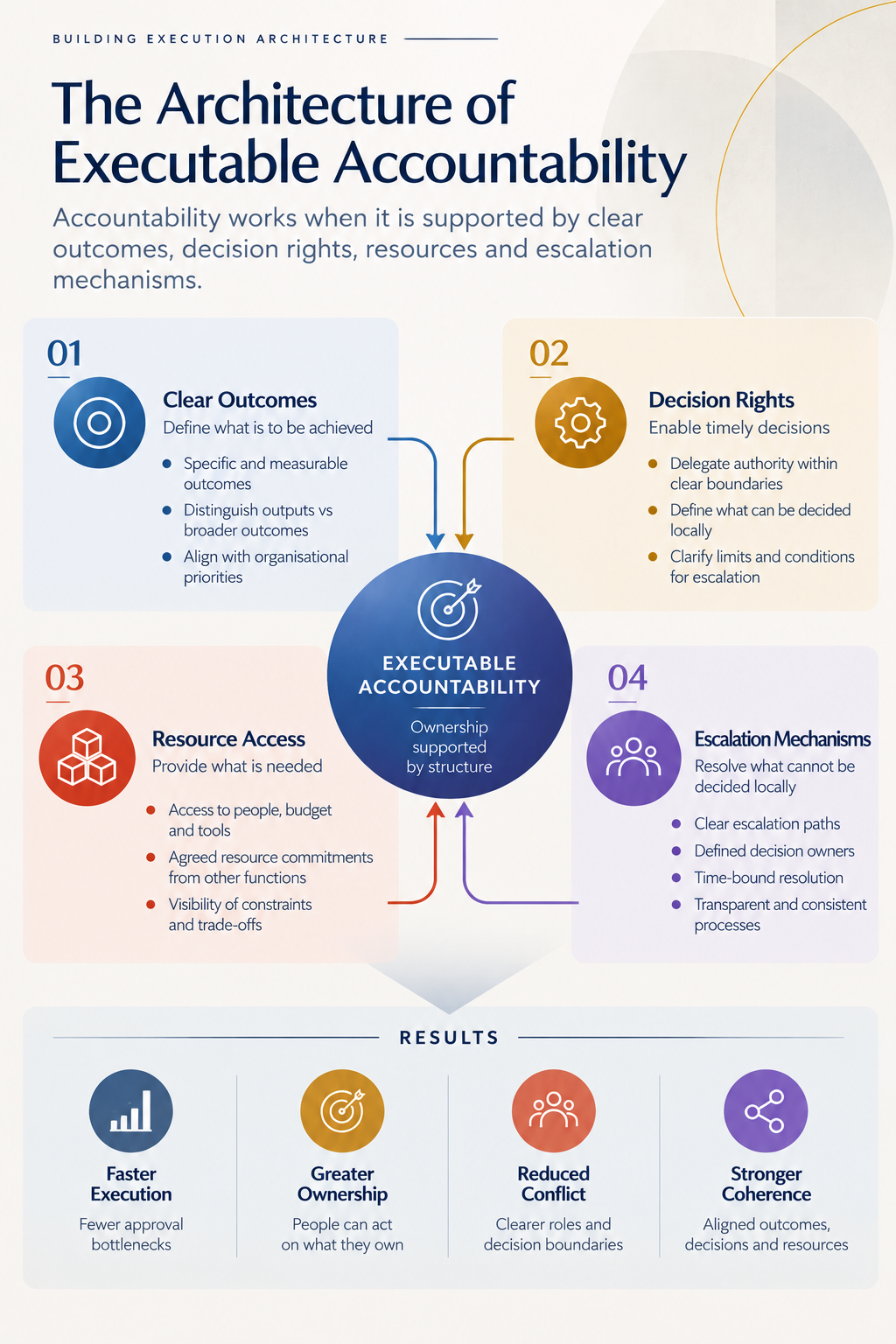
The Difference Between Control and Influence
An important distinction must be preserved.
Not every accountable person needs direct control over every contributing factor.
In complex organisations, much of leadership involves influence, coordination, negotiation and the management of dependencies.
A project manager may not have formal authority over functional employees but can still be effective through agreed resource commitments, clear sponsorship and established escalation pathways.
Similarly, a change manager may not control departmental reporting lines but can achieve adoption when senior leaders actively reinforce the change and departmental managers accept their respective responsibilities.
The issue is therefore not simply whether formal authority exists.
It is whether the accountable person has sufficient decision-making authority, organisational support and reliable mechanisms of influence to make the expected outcome realistically achievable.
This distinction matters because it prevents an overly simplistic interpretation of accountability.
An organisation does not need to centralise every decision under one person.
It needs to ensure that distributed authority does not become fragmented execution.
From Individual Accountability to Organisational Coherence
Accountability is often treated as a matter of personal ownership.
Managers are encouraged to take responsibility, demonstrate commitment and deliver results.
These expectations have value, but they do not replace organisational design.
An individual cannot consistently overcome unclear decision rights, competing priorities, inaccessible resources and unresolved dependencies through commitment alone.
When these conditions persist, the organisation may become increasingly dependent on personal relationships, informal influence and exceptional effort to achieve ordinary outcomes.
Some individuals succeed because they know whom to approach, how to negotiate exceptions or when to involve senior leadership.
Others struggle despite having comparable capabilities.
Execution becomes dependent on individual navigation rather than institutional clarity.
This is a sign of structural incoherence.
A coherent organisation does not eliminate complexity or disagreement. It establishes sufficiently clear relationships between objectives, responsibilities, authority, resources and decisions so that complexity can be managed without constant improvisation.
In such an organisation, accountability is not merely assigned. It is made executable.
A Practical Reflection for Leaders
When a manager fails to deliver an expected outcome, the instinctive response is often to examine the manager's performance.
That examination is necessary, but it should not be the only one.
Leaders should also ask:
Did we give this person the authority to make the decisions required?
Were the necessary resources genuinely available?
Were cross-functional commitments clear?
Could unresolved issues be escalated and decided within a reasonable timeframe?
Did competing priorities make the expected outcome difficult or impossible to achieve?
And, perhaps most importantly:
Are we holding someone accountable for an outcome while retaining control over the decisions that determine it?
These questions do not excuse poor performance.
They help distinguish poor performance from poor organisational design.
That distinction is essential if organisations want to improve execution rather than merely redistribute blame.
The LUCID Perspective
Accountability without authority is not simply a management frustration.
It is an execution architecture problem.
It arises when organisations separate ownership of outcomes from the decisions, resources and mechanisms required to achieve them.
The resulting failures may appear to be problems of leadership, commitment or individual capability.
Yet the underlying causes can remain embedded in reporting structures, approval processes and fragmented decision rights.
Effective accountability requires more than naming an owner.
It requires a coherent relationship between what people are expected to achieve, what they are empowered to decide, and how decisions beyond their authority are resolved.
Accountability defines who must answer for an outcome.
Authority determines what they can do to influence it.
Execution architecture determines whether the two can work together.
When these elements are aligned, accountability supports performance and learning.
When they are misaligned, accountability risks becoming a mechanism for assigning blame rather than enabling results.
The question for leaders is therefore not only who should be held accountable.
It is whether the organisation has made that accountability possible.
Part of the Execution Architecture Series from LUCID Methods.
Explore more frameworks, diagnostic perspectives, and systems-thinking insights through the LUCID Method — developed to help organisations build clarity, coherence, and transformation that holds over time.