

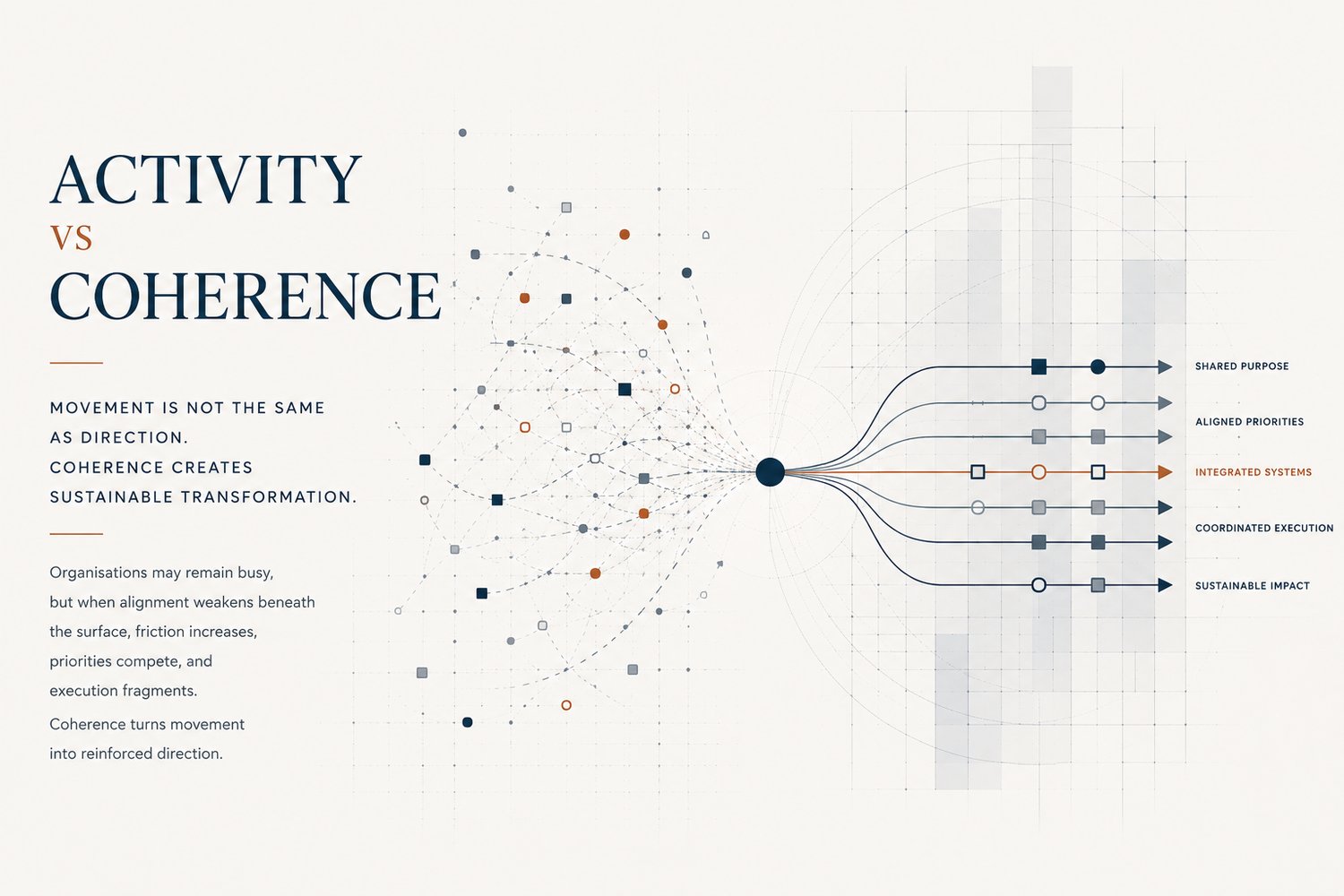
Activity vs Coherence
Why Organisations Can Stay Busy While Quietly Losing Alignment
Many organisations mistake activity for progress.
Meetings increase.
Projects multiply.
Communication intensifies.
Dashboards remain active.
People appear busy.
From the surface, the organisation looks productive and engaged.
Yet underneath the visible activity, execution quality may already be deteriorating.
Coordination becomes heavier.
Priorities quietly compete.
Interpretations begin diverging.
Rework increases.
Friction accumulates.
The organisation continues moving.
But it no longer moves coherently.
This is one of the most important — and least understood — dynamics inside transformation work.
Because activity creates visible motion.
Coherence creates sustainable direction.
The Illusion of Productive Movement
Most organisations naturally gravitate toward activity during periods of uncertainty.
When pressure increases, organisations often respond by increasing:
- communication
- meetings
- reporting
- coordination
- escalation
- initiatives
This response feels rational.
More activity creates the feeling that the organisation is “doing something.”
But activity alone does not guarantee alignment.
In fact, high activity can sometimes conceal fragmentation.
The organisation becomes increasingly occupied with managing movement rather than reinforcing direction.
This is why some organisations appear highly energetic while simultaneously becoming less effective over time.
The issue is not necessarily effort.
The issue is whether the effort reinforces a coherent direction.
What Coherence Actually Means
Coherence is often misunderstood as:
- agreement
- harmony
- collaboration
- organisational culture
But coherence is something more structural than emotional.
Coherence is:
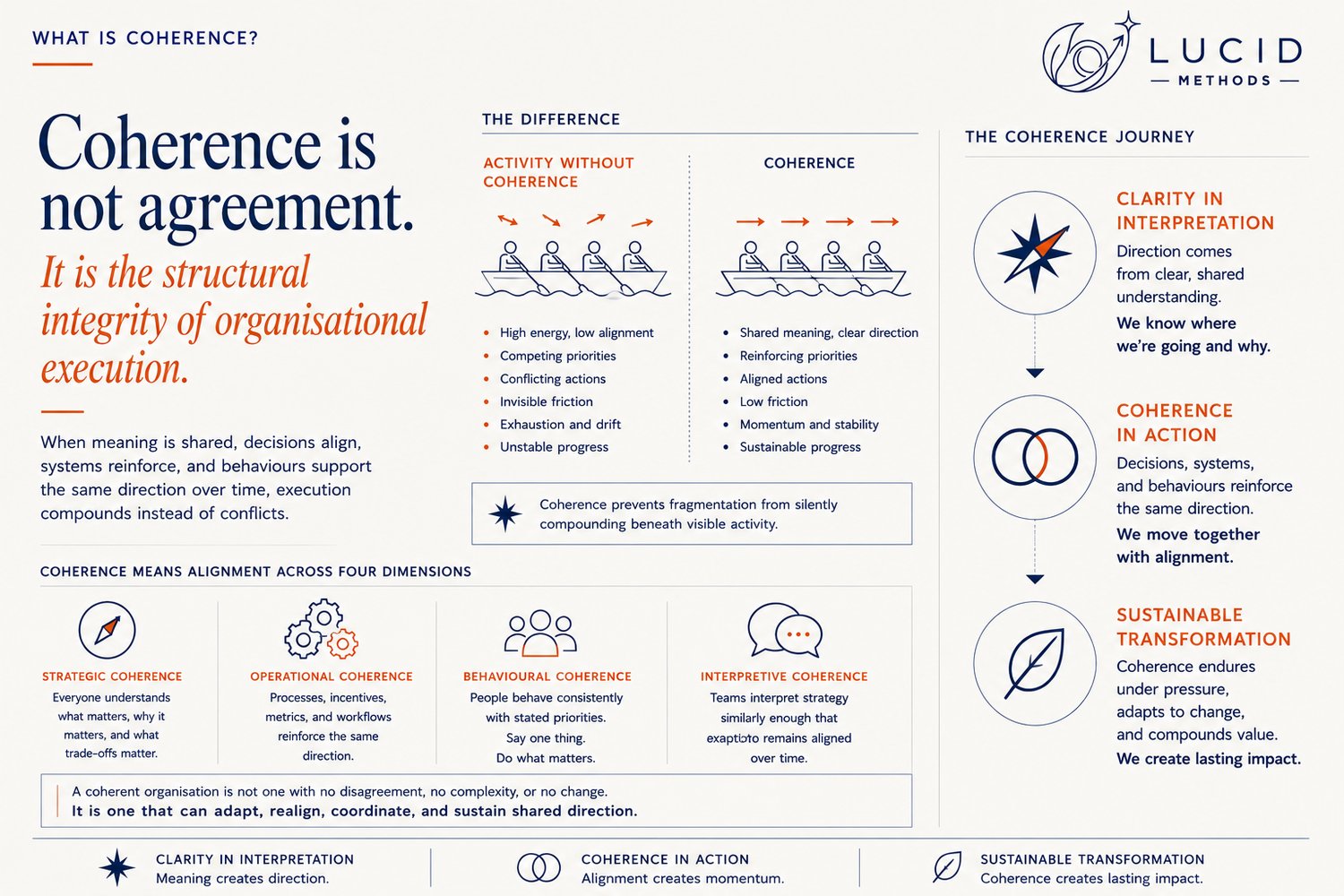
The degree to which people, decisions, systems, priorities, and behaviours reinforce the same direction over time.
A coherent organisation does not avoid complexity.
It coordinates complexity.
Different teams may still:
- disagree
- interpret differently
- operate in different environments
- adapt locally
But enough shared meaning exists for execution to remain aligned under pressure.
Without coherence, organisations slowly begin competing with themselves internally.
Activity Without Coherence
An organisation can remain extremely active while coherence weakens beneath the surface.
This often appears through:
- duplicated work
- conflicting priorities
- inconsistent decisions
- escalating coordination costs
- slower execution
- growing frustration
- strategic confusion
At first, these problems appear isolated.
But over time, a deeper pattern emerges:
The organisation no longer shares sufficiently aligned interpretation.
Different parts of the system begin optimising for different realities.
This creates a dangerous condition where:
- visible activity remains high
- but organisational energy becomes fragmented
The system expends increasing effort simply trying to maintain coordination.
Why Coherence Quietly Decays
Most transformation initiatives begin with relatively high alignment.
There is:
- a shared launch
- executive communication
- strategic enthusiasm
- clear directional intent
At that moment, coherence feels stable.
But organisations are dynamic systems.
Over time:
- assumptions evolve
- local pressures emerge
- incentives diverge
- information changes
- context shifts
- interpretation fragments
Without deliberate reinforcement, coherence naturally drifts.
This is not necessarily caused by incompetence or resistance.
It is often the normal result of complexity interacting with human interpretation over time.
This is why organisations can remain highly active externally while internally becoming increasingly fragmented.
The Cost of Low Coherence
Low coherence creates hidden operational costs long before visible failure appears.
These costs often include:
- duplicated effort
- rework
- coordination fatigue
- conflicting execution
- slow decision-making
- rising friction
- unstable priorities
Eventually:
teams spend more energy managing internal complexity than creating external value.
This is one of the reasons transformation fatigue emerges so frequently.
People become exhausted not only from workload — but from navigating contradictory movement inside the system itself.
Activity Feels Faster Than Coherence
One reason organisations overvalue activity is because activity creates immediate visibility.
You can quickly:
- schedule meetings
- launch initiatives
- send communications
- create reporting structures
- increase oversight
Coherence develops more slowly.
It requires:
- clarification
- shared interpretation
- integration
- alignment
- recalibration
- reinforcement
This slower process can initially feel inefficient.
But over time, coherence dramatically reduces:
- friction
- duplication
- escalation
- confusion
- coordination burden
The organisation spends less energy correcting itself internally.
Execution begins compounding instead of conflicting.
Coherence Under Pressure
Weak coherence often remains hidden during stable periods.
Pressure exposes it quickly.
Under stress:
- ambiguity increases
- communication compresses
- local optimisation rises
- decision speed accelerates
- assumptions diverge faster
When coherence is weak:
fragmentation compounds rapidly.
When coherence is strong:
organisations adapt without collapsing into internal conflict.
This is why coherence is not simply an operational advantage.
It is a resilience capability.
The Difference Between Activity and Coherence
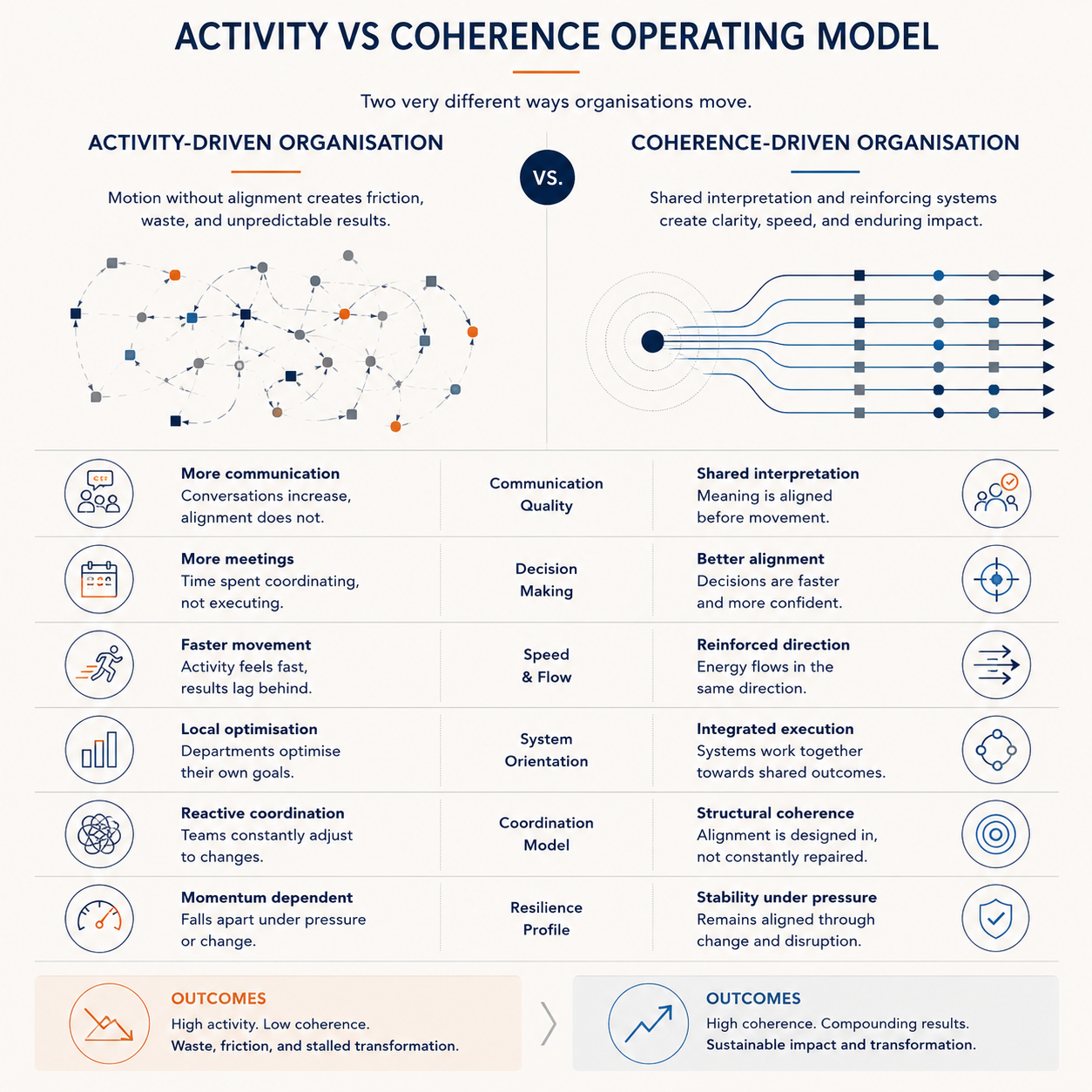
Activity-driven organisations often optimise for:
- responsiveness
- movement
- communication volume
- rapid coordination
- visible action
Coherence-driven organisations optimise for:
- shared interpretation
- reinforcing systems
- aligned execution
- structural clarity
- sustainable coordination
The difference is subtle but critical.
An activity-driven organisation reacts continuously.
A coherence-driven organisation reinforces direction continuously.
One depends heavily on momentum.
The other builds structural stability.
What Coherent Organisations Do Differently
Coherent organisations intentionally reinforce:
- shared meaning
- aligned priorities
- integrated systems
- decision clarity
- behavioural consistency
- cross-functional visibility
They recognise that transformation does not fail only through lack of effort.
It fails when execution fragments faster than alignment can recover.
This means coherence cannot be treated as a one-time communication exercise.
It must become an ongoing organisational discipline.
Coherence Is Structural Integrity
The strongest organisations are not necessarily the fastest-moving.
They are the organisations capable of:
- adapting without fragmenting
- scaling without confusion
- coordinating without excessive friction
- sustaining direction under pressure
In other words:
Coherence is the structural integrity of organisational execution.
Without it, activity eventually becomes noise.
With it, execution compounds into sustainable transformation.
Final Reflection
Many organisations continue moving long after coherence has already begun weakening underneath.
This is why transformation failure often feels confusing.
Because visible effort still exists.
People are still working hard.
But the organisation no longer moves in a sufficiently shared direction.
Activity can sustain motion temporarily.
Only coherence sustains transformation over time.
Part of the Transformation Failure Dynamics Series from LUCID Methods.
Explore more frameworks, diagnostic perspectives, and systems-thinking insights through the LUCID Method — developed to help organisations build clarity, coherence, and transformation that holds over time.