


Agreement Is Not Alignment: How Leadership Misalignment Creates Interpretation Drift
Leadership teams often spend considerable time trying to reach agreement.
They debate priorities.
Clarify strategy.
Agree on values.
Approve plans.
Leave the room believing everyone is on the same page.
And sometimes, they are.
Until they start making decisions.
One leader protects quality while another prioritises speed.
One encourages people to challenge decisions while another treats disagreement as resistance.
One says wellbeing matters while another praises the employee who works through the weekend.
None of these actions needs to be dramatic.
But employees notice them.
Because culture is not simply what leaders communicate.
Culture is what people interpret from what leaders repeatedly do.
And when leadership behaviour sends different signals, agreement at the top can become ambiguity everywhere else.
Agreement Is Not Alignment
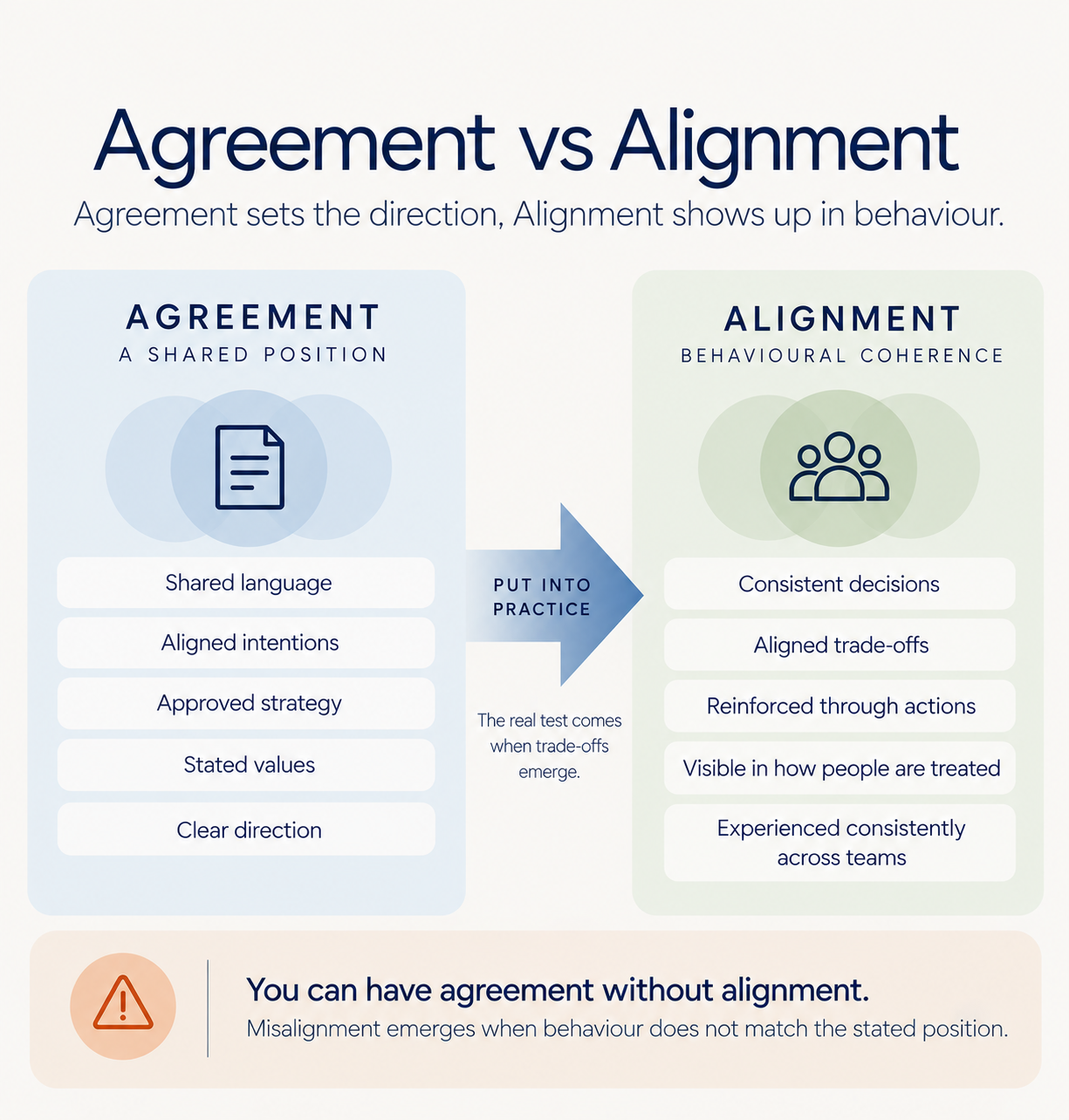
Agreement and alignment are related, but they are not the same thing.
Agreement is a shared position.
We agree that customer experience matters.
We agree that employees should speak up.
We agree that collaboration is important.
We agree that this is the strategy.
Alignment is behavioural coherence around that position.
It becomes visible in how leaders make decisions, allocate resources, resolve trade-offs, reward behaviour and respond when the stated principle becomes inconvenient.
A leadership team may therefore agree intellectually while remaining misaligned operationally.
The difference often appears when competing priorities emerge.
Everyone supports psychological safety until someone challenges a senior leader.
Everyone values collaboration until a deadline makes unilateral action faster.
Everyone supports employee wellbeing until performance targets are at risk.
Everyone believes in customer centricity until serving the customer requires absorbing additional cost.
The principle was agreed.
The trade-off reveals whether it was aligned.
Alignment Becomes Visible Under Pressure
It is relatively easy for leaders to appear aligned when nothing important is being contested.
Pressure exposes the hierarchy of values.
When two legitimate priorities collide, leaders have to choose.
Those choices tell employees which principle actually carries more weight.
Consider a leadership team that says:
“We want people to raise concerns early.”
One leader responds to bad news with curiosity.
Another immediately asks who caused the problem.
A third quietly removes the person who raised the issue from future discussions.
The organisation technically has one message.
Employees experience three.
And employees rarely resolve that contradiction by studying the official statement more carefully.
They watch what happens to people.
Then they adjust their behaviour accordingly.
This is where leadership misalignment begins to become cultural.
Culture Is Interpreted, Not Communicated
Organisations often approach culture as a communication problem.
Define the values.
Explain the behaviours.
Launch the programme.
Repeat the message.
Communication matters.
But communication does not determine culture on its own.
People continuously interpret the organisation through experience.
They ask, consciously or otherwise:
What actually gets rewarded here?
What happens when someone disagrees?
Whose mistakes are tolerated?
Which deadlines can be challenged?
What does leadership protect when something has to give?
What happens when stated values become inconvenient?
The answers become an informal operating manual.
Employees may never see it written down.
Yet they learn it remarkably quickly.
When One Message Produces Multiple Meanings
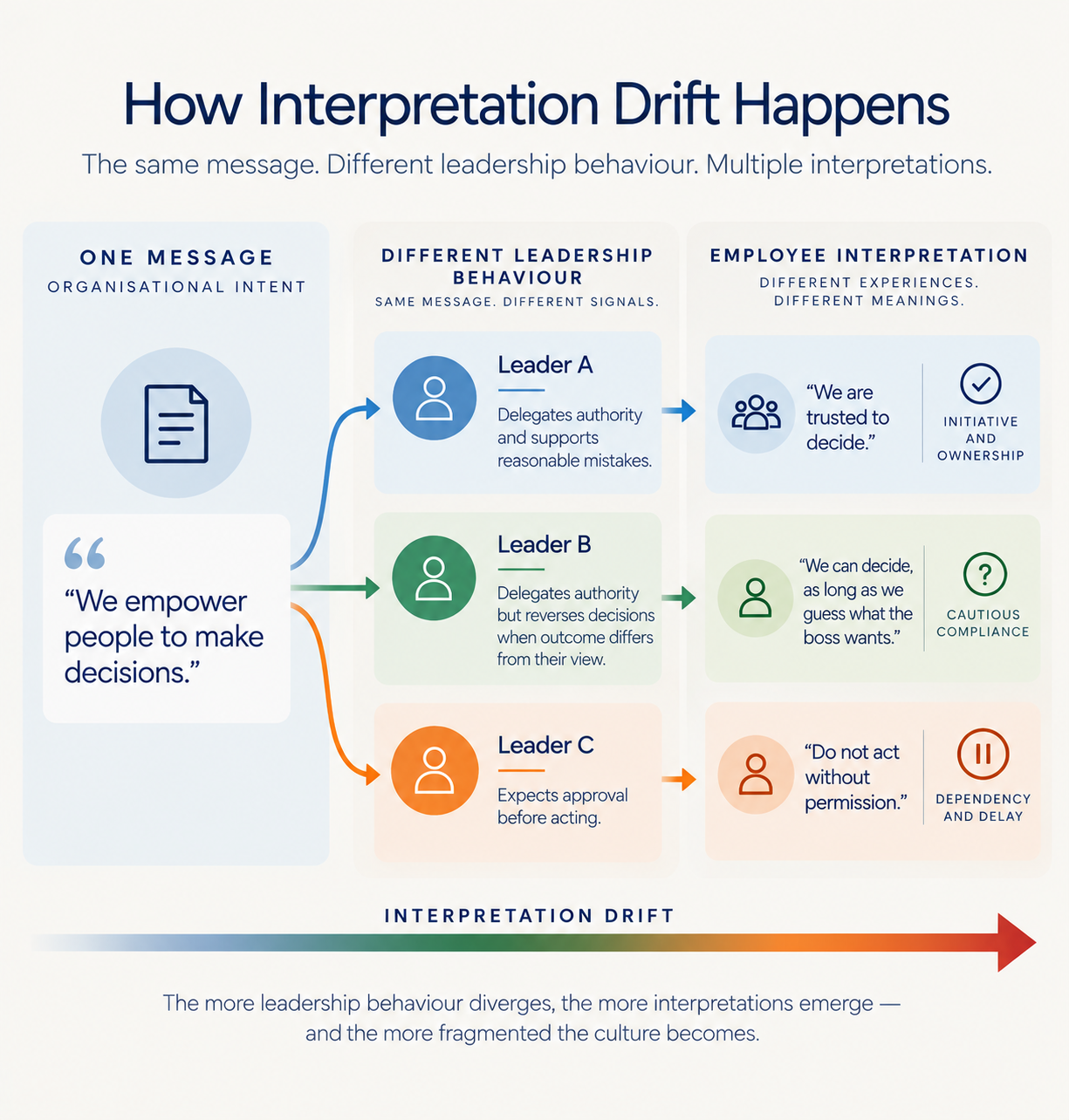
Leadership misalignment creates what we might call interpretation drift.
A message begins with one intended meaning at leadership level but acquires different meanings as employees encounter different leadership behaviours.
Imagine the organisation announces:
“We empower people to make decisions.”
Leader A delegates authority and supports reasonable mistakes.
Leader B delegates authority but reverses decisions whenever the outcome differs from what they would have chosen.
Leader C expects employees to seek approval before acting.
The formal message remains unchanged.
But three local interpretations emerge:
Team A: “We are trusted to decide.”
Team B: “We can decide, as long as we guess what the boss wants.”
Team C: “Do not act without permission.”
One organisation.
One stated value.
Three lived cultures.
That is interpretation drift.
Interpretation Drift Is Often Local
This helps explain something that can puzzle senior leadership.
They look at the organisation and see one culture.
Employees experience several.
The organisation may have the same values, policies, strategy and leadership communications across every department.
Yet working in Finance may feel entirely different from working in Operations, Technology or Marketing.
People sometimes describe this simply as differences in management style.
But the consequences can run deeper.
Each leader becomes an interpreter of organisational intent.
Their decisions tell employees what corporate language means here.
“Accountability” may mean ownership in one team and blame in another.
“Agility” may mean experimentation somewhere and constant urgency elsewhere.
“High performance” may mean excellence in one department and exhaustion in another.
“Speak up” may mean genuine challenge under one leader and carefully managed agreement under another.
Over time, local interpretation can become stronger than organisational communication.
Because lived experience usually carries more credibility than a slide deck.
Employees Learn Through Consequences
People do not interpret culture only through what leaders themselves do.
They also observe what happens to others.
Who gets promoted?
Who gets interrupted?
Who gets forgiven?
Who gets blamed?
Who receives access to senior leaders?
Who can challenge a decision without consequence?
Who works unreasonable hours and is described as committed?
Who protects their boundaries and is quietly described as lacking ambition?
These moments teach.
Often more effectively than formal training.
Every visible consequence provides another piece of evidence about how the organisation actually works.
Employees accumulate that evidence.
Then they form hypotheses:
This is what leadership really wants.
This is what is safe.
This is what gets rewarded.
This is what I should avoid.
Once those interpretations become shared, they begin functioning as culture.
Misalignment Creates an Interpretation Burden
When leadership signals are coherent, employees spend less effort figuring out what leaders really mean.
When signals conflict, interpretation becomes work.
Employees have to ask:
Does this instruction override the previous one?
Which leader's priority matters more?
Is the stated policy actually followed?
Can I make this decision, or should I seek approval?
What does “urgent” mean when everything is urgent?
Which version of the culture applies in this situation?
This creates an interpretation burden.
Instead of directing cognitive energy towards customers, problems and performance, employees use some of it navigating contradictions.
The more politically complex the organisation becomes, the greater that burden can be.
Experienced employees may learn to navigate it.
New employees often struggle.
They were told how the organisation works during onboarding.
Now they have to discover how it actually works.
People Eventually Choose the Least Risky Interpretation
Ambiguity does not remain neutral for long.
When employees receive conflicting signals, they eventually develop ways to protect themselves.
If one leader says “take initiative” while another punishes mistakes, people may wait for approval.
If leadership says “challenge us” but disagreement occasionally carries consequences, people may remain silent.
If collaboration is encouraged but individual performance is rewarded, people may protect their own results.
These behaviours can later be labelled resistance, passivity, bureaucracy or lack of ownership.
But sometimes they are rational adaptations to inconsistent signals.
When organisational expectations are unclear, people often choose the interpretation with the lowest perceived personal risk.
That interpretation may not be what leadership intended.
But intention does not eliminate consequence.
Alignment Does Not Require Uniformity
Leadership alignment should not be confused with identical personalities, management styles or opinions.
Healthy leadership teams disagree.
They should.
Different perspectives improve decisions and reduce the risk of groupthink.
The goal is not behavioural sameness.
The goal is coherence around the principles that matter.
Leaders can communicate differently while maintaining consistent expectations.
They can disagree privately while providing clarity once a decision is made.
They can adapt to different circumstances without contradicting the organisation's underlying commitments.
Alignment therefore does not mean:
Everyone behaves the same way.
It means:
Employees do not have to reverse-engineer which version of the organisation they are dealing with.
The Leadership Question Is Not “Did We Agree?”
Many leadership conversations end when agreement is reached.
Perhaps they should go one step further.
After deciding what the organisation believes or intends to do, leaders can ask:
What would this look like in practice?
What behaviours would contradict what we have just agreed?
How will we handle predictable trade-offs?
What decisions should employees reasonably expect us to make?
Where might different leaders interpret this differently?
What will employees conclude if they observe our behaviour?
These questions move the conversation from conceptual agreement towards behavioural alignment.
Because a statement can sound perfectly clear in the boardroom while becoming ambiguous once dozens of leaders begin interpreting it independently.
Look for Variation, Not Only Violations
Organisations often look for obvious breaches of values.
That matters.
But leadership misalignment may be visible much earlier through variation.
If employees receive dramatically different responses to similar situations depending on which leader is involved, something deserves attention.
If one department experiences a value differently from another, ask why.
If leaders give contradictory guidance around the same organisational priority, investigate the underlying interpretation.
If employees frequently ask, “Who said that?” before deciding whether an instruction matters, the organisation may have developed competing sources of authority.
These are not merely communication problems.
They can be signals that leadership has agreed on the language without aligning on its meaning.
Coherence Reduces the Need for Interpretation
Strong cultures are not created because employees memorise organisational values.
They emerge when employees repeatedly encounter enough consistency that they no longer need to guess what those values mean.
They know what accountability looks like because they have seen it practised.
They know disagreement is safe because they have watched people disagree without being punished.
They know customer focus matters because they have seen leaders protect it when doing so was inconvenient.
They know wellbeing matters because deadlines do not automatically erase it.
Over time, repeated leadership
behaviour reduces ambiguity.
Employees no longer need to interpret every signal independently.
The organisation becomes more predictable.
And predictability is one of the foundations of trust.
From Agreement to Alignment
Leadership teams will never eliminate every inconsistency.
Nor should organisations attempt to script every leadership response.
But they can become more conscious of the distance between what they agree, what they do and what employees consequently interpret.
That requires looking beyond communication.
A leadership team can communicate perfectly and still create confusion.
A value can be beautifully articulated and inconsistently experienced.
A strategy can be unanimously approved and differently enacted.
The real test of alignment is therefore not whether leaders can repeat the same message.
It is whether employees encountering different leaders can still recognise the same organisation.
Because culture does not live in the message alone.
It lives in the interpretation that follows.
And when leadership behaviour is inconsistent, employees will fill the gaps themselves.
Agreement creates a shared statement.
Alignment creates a shared experience.
The distance between the two is where interpretation drift begins.
Part of the Leadership & Culture Series from LUCID Methods.
Explore more frameworks, diagnostic perspectives, and systems-thinking insights through the LUCID Method — developed to help organisations build clarity, coherence, and transformation that holds over time.