

Introduction
Most organisations treat alignment as a communication problem.
When execution begins to drift, leaders often respond with more meetings, more presentations, more town halls, and more reminders of the original strategy.
The assumption is simple:
If people understand the message, alignment will follow.
Yet many transformation efforts fail despite extensive communication.
The strategy is clear.
The objectives are documented.
The stakeholders attended the meetings.
And still execution diverges.
The problem is that alignment is not primarily a communication outcome.
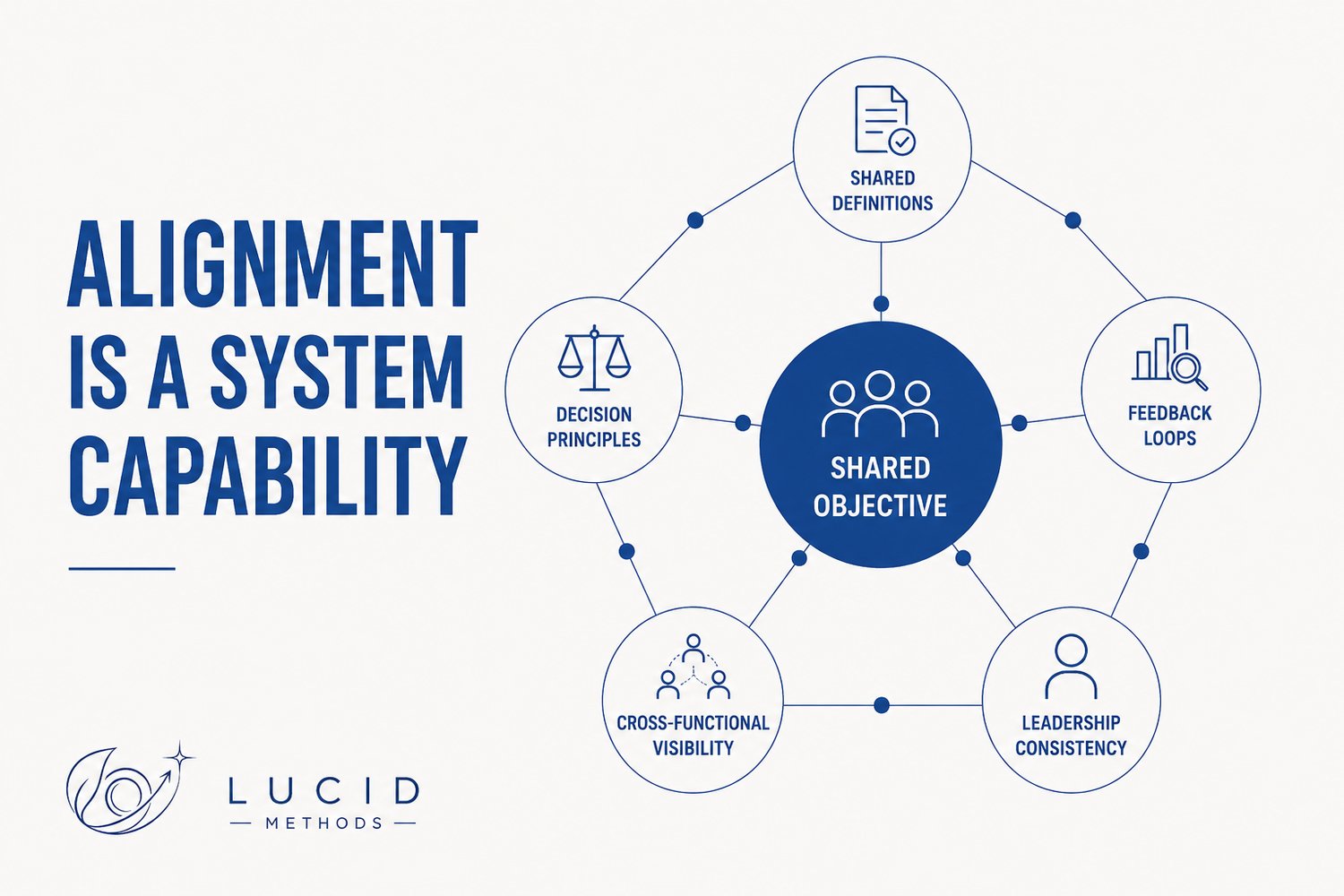
Alignment is a system capability.
It emerges from the structures, mechanisms, and conditions that allow people to consistently interpret, decide, and act in ways that support a shared objective.
Without these conditions, alignment becomes temporary, fragile, and dependent on constant intervention.
The Misconception of Alignment
Many organisations define alignment as agreement.
If people nod during a meeting, alignment is assumed.
If stakeholders endorse a plan, alignment is declared.
If teams repeat the same strategic language, leaders feel reassured.
But agreement and alignment are not the same thing.
Agreement exists at the point of discussion.
Alignment reveals itself during execution.
The true test is not whether people say they understand.
The true test is whether different individuals make consistent decisions when facing uncertainty.
When teams encounter ambiguity, deadlines, competing priorities, and local pressures, interpretation begins to matter more than communication.
That is where alignment either survives or collapses.
Alignment Exists in Behaviour, Not Messaging
Consider a transformation programme involving multiple departments.
Each department receives the same strategic objective.
Each manager attends the same briefing.
Each team receives the same documentation.
On paper, alignment appears strong.
Yet several months later:
- Different teams prioritise different outcomes.
- Resources are allocated inconsistently.
- Success is measured differently across functions.
- Decisions begin to conflict.
Nobody deliberately resisted the strategy.
People simply interpreted it differently.
The organisation had communication.
It did not have alignment.
Alignment is demonstrated when behaviour remains coherent even when supervision is absent.
Why Alignment Decays
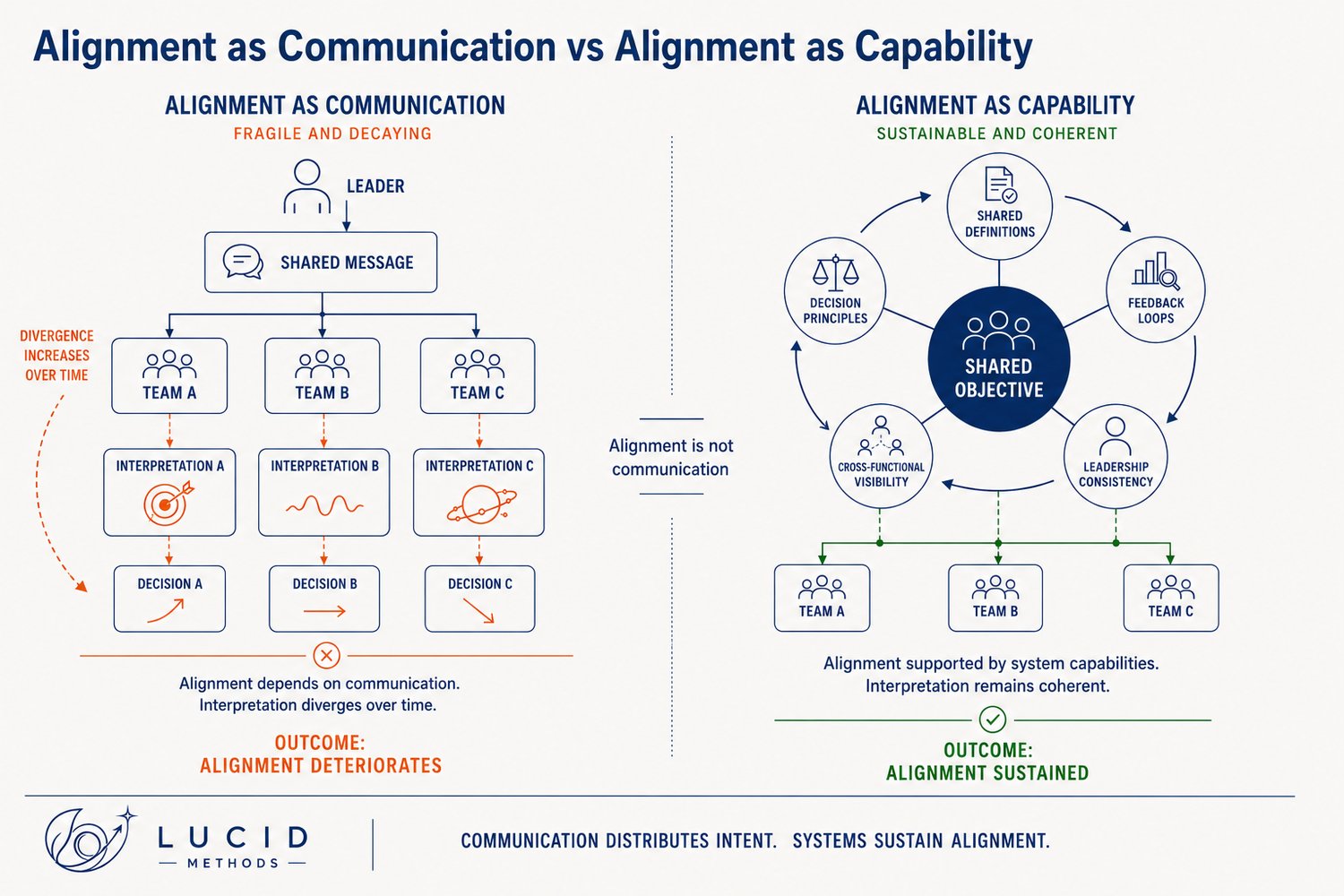
Alignment naturally weakens over time because organisations are interpretation systems.
Information does not travel unchanged.
Every handoff introduces the possibility of reinterpretation.
Every department views objectives through its own priorities.
Every manager translates strategy into local decisions.
Over time, small variations accumulate.
What began as a single strategic intention evolves into multiple operational realities.
This phenomenon is closely linked to interpretation drift.
The further execution moves from the original intent, the greater the risk that teams are pursuing different versions of success.
Without mechanisms to maintain coherence, alignment gradually deteriorates.
Alignment Requires Structural Support
Sustainable alignment does not emerge from motivation alone.
It requires systems that continuously reinforce shared understanding.
These systems often include:
Shared Definitions
People must attach the same meaning to key concepts.
Words such as "customer-centricity," "efficiency," "quality," or "innovation" are often interpreted differently across teams.
When definitions vary, execution diverges.
Consistent Decision Principles
Teams need common rules for resolving ambiguity.
When priorities conflict, people should know how decisions are expected to be made.
Without decision principles, individuals optimise for local objectives.
Feedback Mechanisms
Organisations need ways to detect when interpretation begins to drift.
Regular reviews should examine not only progress but also whether teams remain aligned in their understanding.
Cross-Functional Visibility
Teams must understand how their actions affect others.
When functions operate in isolation, local optimisation often creates organisational misalignment.
Leadership Consistency
Leaders play a critical role in reinforcing shared meaning.
Contradictory messages from leadership create competing interpretations that rapidly undermine alignment.
Alignment Under Pressure
The strength of alignment is often invisible until pressure arrives.
When resources become constrained, deadlines tighten, or unexpected disruptions occur, organisations reveal their true level of alignment.
Under pressure:
- Teams revert to local priorities.
- Decision-making accelerates.
- Communication decreases.
- Assumptions replace clarification.
If alignment depends solely on meetings and reminders, it quickly collapses.
If alignment is embedded within the system itself, coherent action continues even when conditions become difficult.
This is why resilience and alignment are closely connected.
Resilient organisations do not remain coherent because they communicate more.
They remain coherent because their systems support consistent interpretation during periods of stress.
The Difference Between Coordinated Activity and Alignment
Many organisations mistake coordinated activity for alignment.
Projects continue moving.
Meetings occur regularly.
Status reports are delivered.
Tasks are completed.
From the surface, everything appears aligned.
Yet coordination can exist without coherence.
People can work hard while moving in different directions.
Activity creates motion.
Alignment creates meaningful progress.
One measures effort.
The other measures collective effectiveness.
The distinction becomes particularly important during transformation initiatives, where execution depends on numerous interconnected decisions made across different functions.
Without alignment, activity increases while outcomes become unpredictable.
Alignment as an Organisational Capability
The most effective organisations do not rely on individual heroics to remain aligned.
They build alignment into the operating system itself.
Shared interpretation is reinforced through governance.
Decision-making is guided by common principles.
Feedback loops reveal emerging drift.
Structures support coherence across functions.
Alignment becomes repeatable rather than accidental.
This is why alignment should be viewed as a capability rather than a communication exercise.
Capabilities can be designed.
Capabilities can be strengthened.
Capabilities can be measured.
And capabilities can endure beyond the presence of any individual leader.
Conclusion
Alignment is often discussed as though it were a matter of communication.
In reality, communication is only one component.
True alignment emerges when organisational systems enable people to consistently interpret, decide, and act in support of a common objective.
Without these supporting structures, alignment becomes temporary and fragile.
With them, coherence can persist even under pressure.
The question is therefore not whether people have heard the strategy.
The more important question is:
Does the system help people interpret and execute it in the same way?
That is where sustainable alignment begins.
Part of the Foundations Thinking Series from LUCID Methods.
Explore more frameworks, diagnostic perspectives, and systems-thinking insights through the LUCID Method — developed to help organisations build clarity, coherence, and transformation that holds over time.