

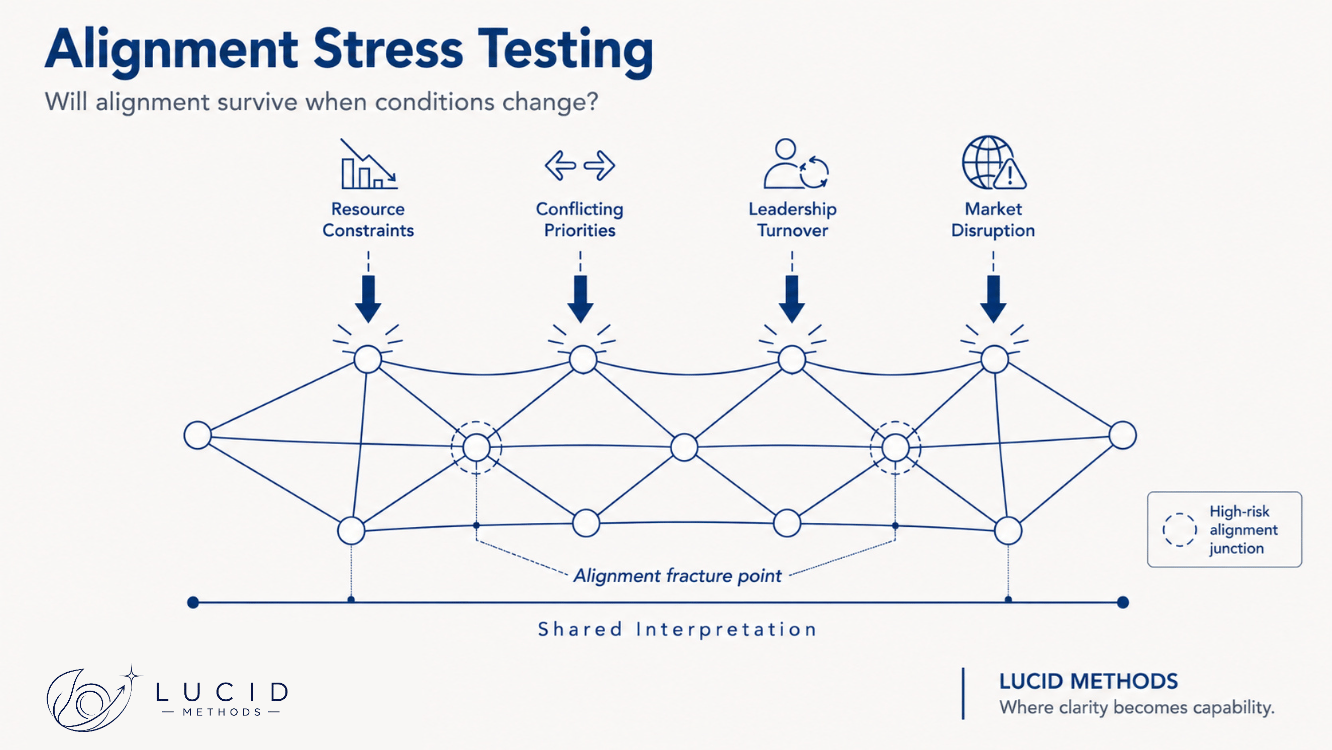
Alignment Stress Testing
Alignment Is Easy When Conditions Are Stable
Most transformation initiatives appear aligned during workshops.
People nod.
Roadmaps are approved.
Stakeholders agree on objectives.
Plans are documented.
At that moment, alignment looks complete.
Yet many initiatives that appear aligned at launch begin to fragment once execution begins.
Priorities shift.
New information emerges.
Resources become constrained.
Deadlines tighten.
Stakeholders reinterpret decisions.
Teams revert to local optimisation.
What seemed aligned under ideal conditions proves incapable of surviving operational reality.
The problem is not that alignment never existed.
The problem is that alignment was never tested.
Just as engineers stress test bridges before opening them to traffic, transformation leaders should stress test alignment before execution begins.
The question is not:
"Are we aligned?"
The more useful question is:
"Will alignment survive pressure?"
The Hidden Assumption Behind Alignment
Many organisations treat alignment as an event.
A workshop.
A strategy session.
A town hall.
A planning exercise.
Once people agree, leaders assume alignment has been achieved.
This assumption creates a dangerous blind spot.
Agreement under stable conditions does not guarantee coherence under stress.
A team may agree on priorities today and still make contradictory decisions tomorrow when confronted with uncertainty.
A stakeholder may support a strategy until resources become scarce.
A department may embrace collaboration until conflicting incentives emerge.
Alignment is not proven when conditions are easy.
Alignment is proven when conditions become difficult.
Why Alignment Fails Under Pressure
Pressure exposes weaknesses that remain invisible during planning.
Common stressors include:
- Budget reductions
- Resource shortages
- Leadership changes
- Conflicting priorities
- Market disruptions
- Customer escalation
- Regulatory changes
- Schedule compression
- Organisational restructuring
When these conditions emerge, teams reveal their true operating logic.
People stop relying on documented intentions and start relying on personal interpretations.
Local priorities begin to dominate.
Decision-making fragments.
The organisation experiences what appears to be sudden misalignment.
In reality, the misalignment was always present.
The pressure simply exposed it.
Stress does not create alignment failure.
Stress reveals alignment weakness.
The Concept of Alignment Stress Testing
Alignment stress testing is the deliberate practice of evaluating whether strategic coherence can survive realistic operational pressures.
Instead of asking whether people agree today, leaders explore what happens when assumptions break.
Questions include:
- What happens if funding is reduced by 30%?
- What happens if delivery timelines are cut in half?
- What happens if a key stakeholder leaves?
- What happens if demand suddenly doubles?
- What happens if departments compete for the same resources?
The goal is not to predict the future perfectly.
The goal is to identify where coherence is likely to fracture.
Stress testing shifts attention from declared alignment to demonstrated resilience.
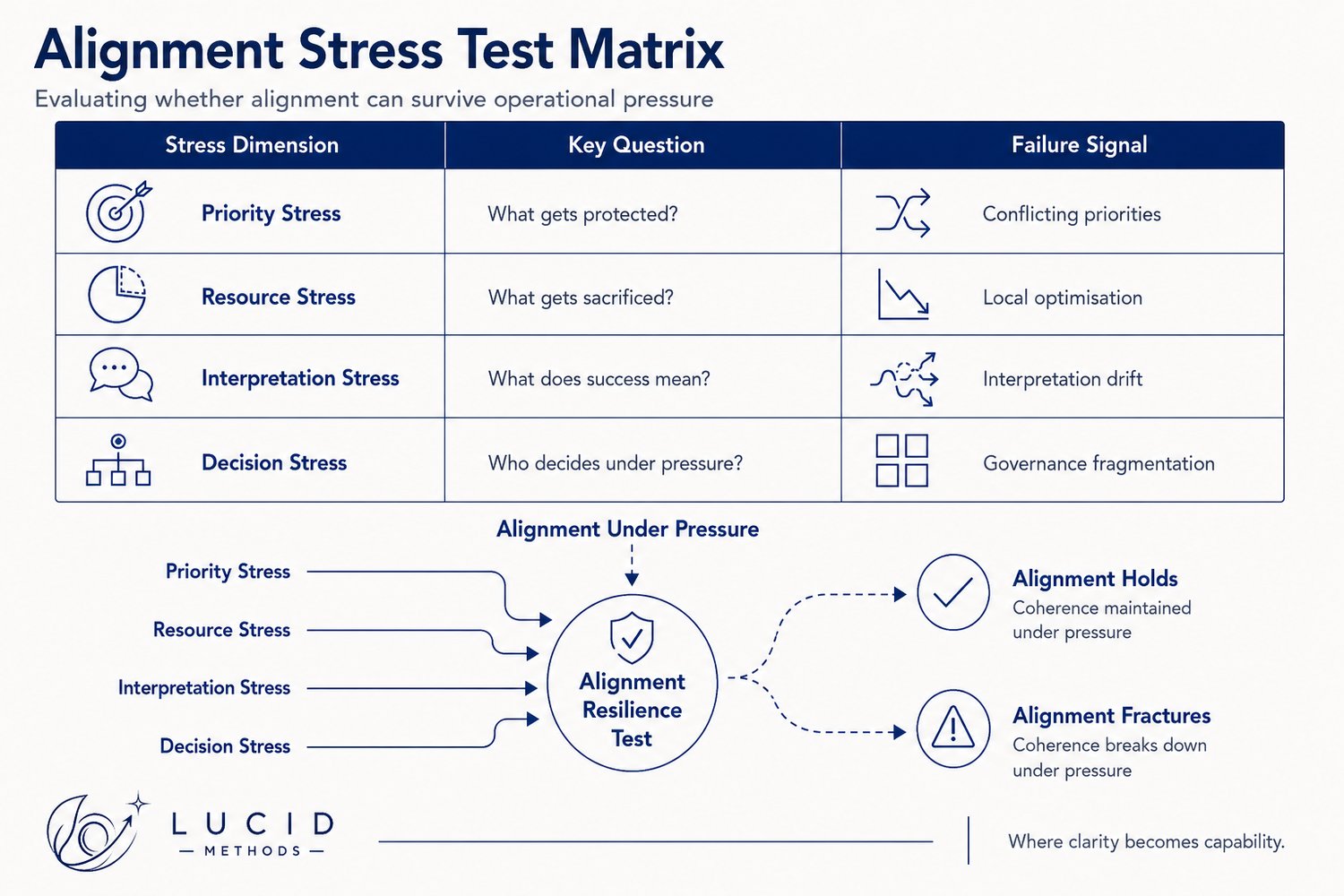
Four Dimensions of Alignment Stress Testing
1. Priority Stress
This tests whether teams maintain shared priorities when trade-offs become necessary.
Questions include:
- Which initiative gets protected first?
- Which deliverables can be delayed?
- What is considered non-negotiable?
If different groups answer differently, alignment may be weaker than assumed.
2. Resource Stress
This tests behaviour when resources become constrained.
Questions include:
- What happens if headcount is reduced?
- What happens if funding is withdrawn?
- Which activities are sacrificed first?
Resource pressure often reveals hidden priorities that were never explicitly discussed.
3. Interpretation Stress
This examines whether stakeholders continue to interpret objectives consistently when ambiguity increases.
Questions include:
- How would different teams define success?
- How would they prioritise competing objectives?
- What decisions would they make independently?
Diverging answers often indicate latent interpretation drift.
4. Decision Stress
This evaluates whether governance structures remain effective during rapid decision-making.
Questions include:
- Who makes decisions during uncertainty?
- What happens when stakeholders disagree?
- How quickly can conflicts be resolved?
Many transformation efforts fail not because decisions are wrong, but because decision-making becomes fragmented.o see.
What Alignment Stress Testing Reveals
Effective stress testing often uncovers issues that traditional planning misses.
Examples include:
Hidden Priority Conflicts
Different leaders may support the same strategy while protecting different outcomes.
Alignment appears strong until trade-offs emerge.
Dependency Concentration
Critical decisions may rely on a small number of individuals.
Alignment collapses when those individuals become unavailable.
Governance Weaknesses
Decision rights may appear clear on paper but become ambiguous during rapid execution.
Incentive Misalignment
Teams may support transformation goals while being rewarded for contradictory behaviours.
Interpretation Drift
Different groups may use the same language while attaching different meanings to key concepts.
These weaknesses rarely emerge through normal planning discussions.
Stress testing makes them visible. to see.
From Alignment Confidence to Alignment Capability
Many organisations seek confidence.
They want assurance that alignment exists.
Stress testing seeks something more valuable.
Capability.
Confidence asks:
"Do people agree?"
Capability asks:
"Can people stay aligned when conditions change?"
The distinction matters.
Transformation success depends less on initial agreement and more on the organisation's ability to preserve coherence through uncertainty.
Stable environments rarely test alignment.
Transformation environments test it continuously.
Practical Stress Testing Workshop
A simple alignment stress test can be conducted before major execution phases.
Step 1: Define the Intended Alignment
Document:
- Strategic objectives
- Priorities
- Success measures
- Governance rules
Step 2: Introduce Stress Scenarios
Create realistic disruptions such as:
- Budget cuts
- Resource loss
- Timeline compression
- Stakeholder conflict
- Market changes
Step 3: Observe Responses
Ask teams:
- What decisions would you make?
- What would you protect?
- What would you sacrifice?
Document differences.
Step 4: Identify Fracture Points
Look for:
- Conflicting priorities
- Divergent interpretations
- Governance ambiguity
- Dependency concentration
Step 5: Strengthen Alignment Mechanisms
Clarify:
- Decision rights
- Escalation paths
- Priority hierarchy
- Shared definitions
- Success criteria
The objective is not to eliminate uncertainty.
The objective is to increase coherence under uncertainty. to see.
Alignment Is Not Proven by Agreement
Many transformation efforts fail because leaders mistake agreement for resilience.
People can agree in workshops.
They can agree in planning sessions.
They can agree in presentations.
None of these prove alignment will survive execution.
Real alignment is demonstrated when pressure increases and coherence remains intact.
This is why alignment should not only be created.
It should be tested.
Because the true measure of alignment is not whether people move together when conditions are easy.
It is whether they continue moving together when conditions become difficult.
Part of the Execution Architecture Series from LUCID Methods.
Explore more frameworks, diagnostic perspectives, and systems-thinking insights through the LUCID Method — developed to help organisations build clarity, coherence, and transformation that holds over time.