

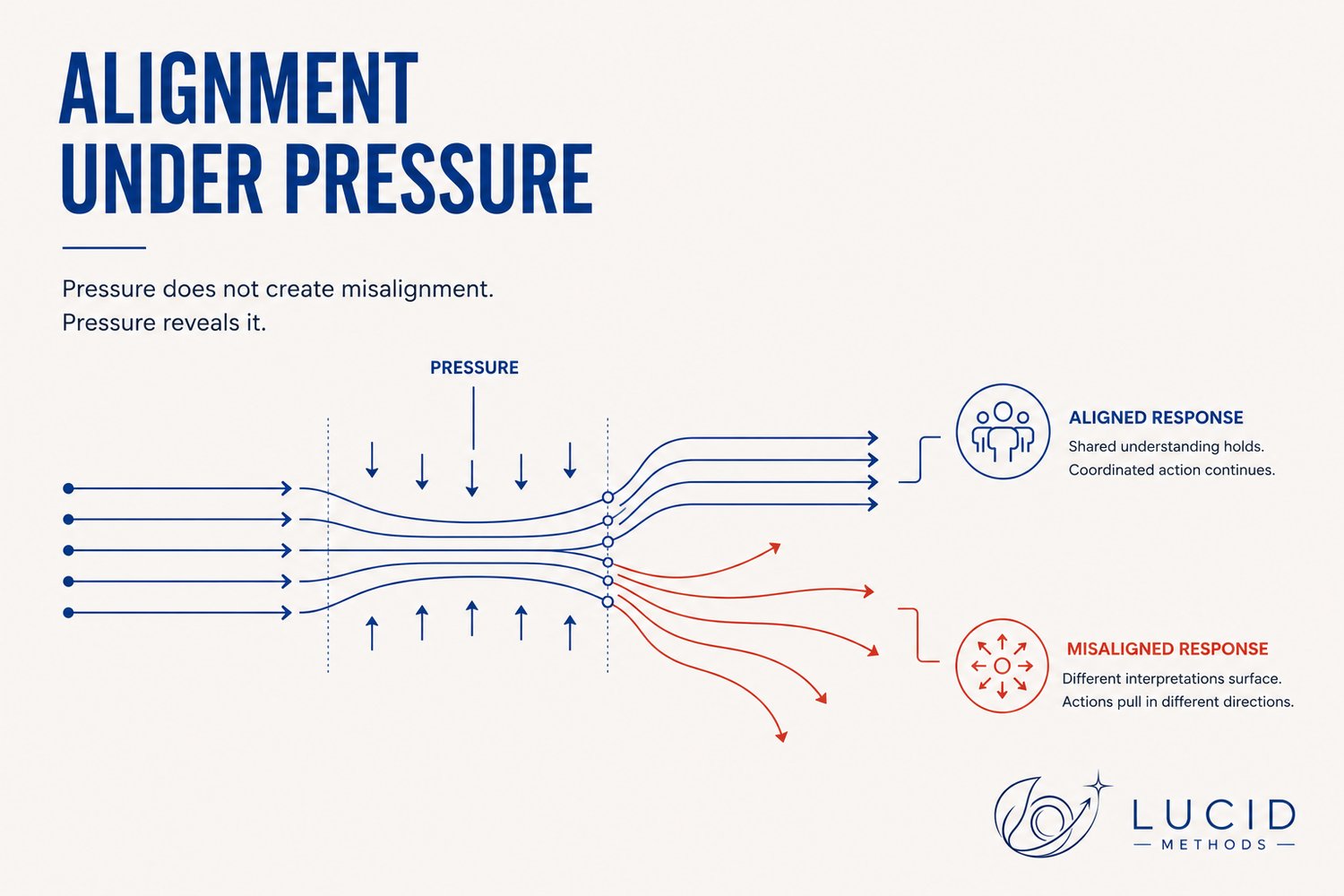
Alignment Under Pressure
When conditions become difficult, alignment is tested.
Most organisations appear aligned when conditions are stable.
Objectives are clear.
Teams understand priorities.
Stakeholders agree on direction.
Execution proceeds with relatively little resistance.
During these periods, alignment often feels self-evident.
Leaders may assume the organisation possesses strong alignment capabilities because few visible conflicts emerge.
Yet stability can be deceptive.
Many alignment problems remain hidden until conditions change.
Pressure exposes what normal operations conceal.
Deadlines tighten.
Resources become constrained.
Unexpected events disrupt plans.
Competing priorities emerge.
Stakeholders become anxious.
Decision-making accelerates.
Under these conditions, the organisation reveals whether alignment truly exists or merely appeared to exist during calmer periods.
The difference is significant.
Alignment is not demonstrated when circumstances are easy.
Alignment is demonstrated when circumstances become difficult.
The Illusion of Stable Alignment
Many transformation initiatives begin with broad agreement.
Leadership teams endorse the vision.
Business units support the strategy.
Project teams understand the intended outcomes.
Communication materials are distributed.
Workshops are conducted.
Plans are approved.
Everything appears aligned.
However, agreement under stable conditions does not necessarily indicate shared interpretation.
Often, alignment exists only at a superficial level.
People support the same words.
They do not necessarily share the same meaning.
When pressure remains low, these differences remain largely invisible.
Because stakeholders are not forced to make difficult trade-offs, hidden interpretation gaps remain dormant.
As long as circumstances remain predictable, the illusion survives.
Pressure changes this.
The moment difficult decisions arise, differing interpretations begin influencing behaviour.
The organisation discovers that what appeared to be alignment was often agreement without coherence.
Why Pressure Creates Divergence
Pressure changes how people think and behave.
Under stress, individuals naturally rely on familiar assumptions.
They revert to local priorities.
They focus on immediate risks.
They protect objectives they perceive as most important.
This behaviour is understandable.
Yet when interpretations are not fully aligned, these responses create divergence.
Different groups begin making different decisions.
Each decision may appear reasonable locally.
Collectively, however, they begin pulling the organisation in different directions.
What emerges is not deliberate resistance.
It is fragmentation.
The organisation becomes increasingly difficult to coordinate precisely when coordination becomes most necessary.
Pressure Amplifies Existing Misalignment
Pressure rarely creates alignment problems.
It amplifies problems that already exist.
A useful analogy is structural engineering.
A bridge does not become weak because a storm occurs.
The storm reveals weaknesses that already existed within the structure.
Similarly, organisational pressure exposes weaknesses within shared understanding.
Misaligned assumptions that seemed insignificant during stable periods suddenly become operational risks.
Unclear decision rights become bottlenecks.
Conflicting priorities become visible.
Interpretation drift accelerates.
Local optimisation increases.
Execution coherence begins deteriorating.
The pressure itself is not the root cause.
The underlying alignment weakness is.
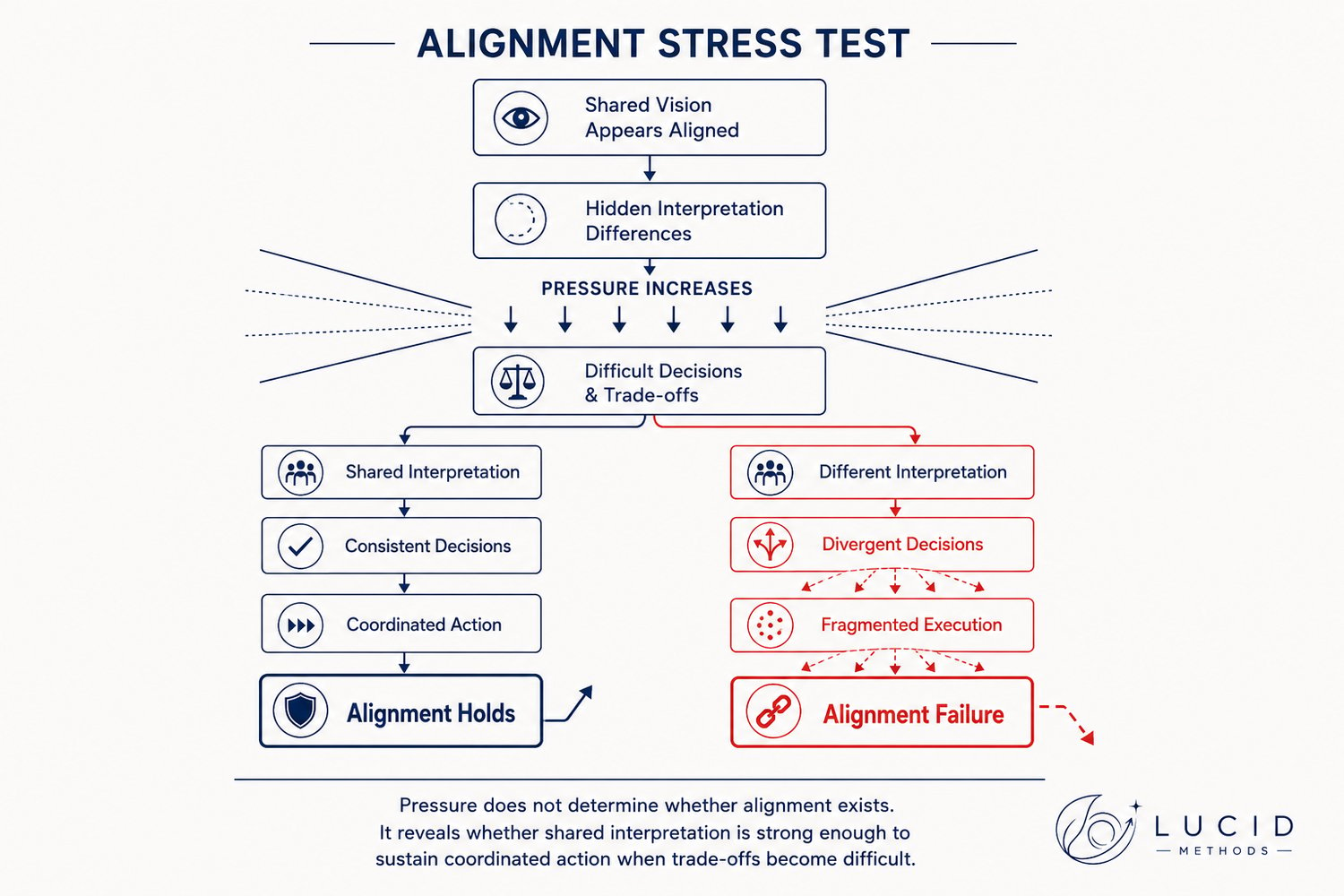
Common Signs of Alignment Failure Under Pressure
Several patterns frequently emerge when alignment deteriorates under pressure.
Decision Inconsistency
Teams facing similar situations make different decisions.
Each believes they are acting correctly.
Yet outcomes become increasingly inconsistent.
This often indicates differing interpretations of priorities, objectives, or success criteria.
Escalating Coordination Costs
Meetings increase.
Clarifications increase.
Approvals increase.
Cross-functional discussions multiply.
The organisation spends growing amounts of effort maintaining coordination.
Execution slows despite increased activity.
Local Optimisation
Functions begin protecting their own goals.
Departments focus on their own performance metrics.
Teams optimise for local success rather than system outcomes.
While individually rational, these decisions reduce overall coherence.
Conflicting Narratives
Different stakeholders describe the same initiative differently.
Different explanations emerge regarding priorities, risks, and intended outcomes.
This indicates that shared interpretation is weakening.
Increased Reliance on Authority
When alignment weakens, organisations often compensate through hierarchy.
More decisions require executive intervention.
More issues require escalation.
Leaders become coordination mechanisms.
This may restore short-term control but does not address the underlying alignment problem.
The Difference Between Compliance and Alignment
Pressure often reveals whether an organisation operates through compliance or genuine alignment.
Compliance depends upon instructions.
People execute because they are told what to do.
When situations change, they seek further direction.
Alignment operates differently.
People understand intent.
They understand priorities.
They understand trade-offs.
They understand the reasoning behind decisions.
As conditions evolve, they can adapt while remaining coherent with organisational objectives.
Compliance creates dependence.
Alignment creates adaptability.
This distinction becomes critically important during transformation.
No transformation plan survives unchanged.
Unexpected conditions always emerge.
The question is whether people can adapt while maintaining coherence.
Alignment as Organisational Resilience
Many organisations view alignment as a communication challenge.
In reality, alignment is a resilience capability.
Resilience is often misunderstood as the ability to withstand disruption.
More accurately, resilience is the ability to maintain functional coherence during disruption.
This is where alignment becomes essential.
When alignment is strong:
- Teams make compatible decisions.
- Priorities remain stable.
- Stakeholders interpret events consistently.
- Adaptation occurs without fragmentation.
- Execution remains coherent despite uncertainty.
The organisation bends without breaking.
Pressure becomes manageable because people share sufficient understanding to respond consistently.
Without alignment, pressure generates confusion.
Confusion generates divergence.
Divergence generates systemic instability.
Building Alignment That Survives Pressure
Organisations frequently attempt to improve alignment through additional communication.
Communication matters.
Yet communication alone is insufficient.
Sustainable alignment requires deeper conditions.
Shared Interpretation
People must not merely hear the same message.
They must interpret it similarly.
This requires dialogue, clarification, and continuous sense-making.
Explicit Priorities
Pressure forces trade-offs.
If priorities remain ambiguous, different groups will make different decisions.
Clear prioritisation reduces interpretation variability.
Decision Principles
Not every situation can be anticipated.
Shared decision principles provide guidance when unforeseen circumstances arise.
These principles help maintain coherence during uncertainty.
Cross-Functional Understanding
Teams must understand how their actions affect the broader system.
Alignment weakens when functions operate within isolated perspectives.
Continuous Diagnosis
Alignment is not a one-time achievement.
Interpretations evolve.
Contexts change.
New pressures emerge.
Organisations must continuously monitor coherence and address emerging drift before it becomes operational failure.
Alignment Is Revealed, Not Declared
Perhaps the most important lesson is this:
Alignment cannot be confirmed through statements of agreement.
It cannot be measured solely through presentations, workshops, or communication campaigns.
Alignment is revealed through behaviour.
Particularly under pressure.
When uncertainty increases, how do people make decisions?
When priorities conflict, how do teams respond?
When plans change, do stakeholders remain coherent?
When disruption occurs, does execution fragment or remain coordinated?
These questions reveal the true condition of alignment.
Pressure does not create organisational reality.
Pressure reveals it.
And what it reveals often determines whether transformation succeeds or fails.
Closing Reflection
Many organisations believe they are aligned because conflict is absent during stable periods.
Yet genuine alignment is not measured during calm conditions.
It is measured during turbulence.
When pressure rises, organisations discover whether they have built shared understanding or merely temporary agreement.
The strongest organisations are not those that avoid pressure.
They are those that maintain coherence when pressure arrives.
Because alignment is not tested when everything goes according to plan.
Alignment is tested when nothing does.
Part of the Alignment & Interpretation Series from LUCID Methods.
Explore more frameworks, diagnostic perspectives, and systems-thinking insights through the LUCID Method — developed to help organisations build clarity, coherence, and transformation that holds over time.