


Authority Without Accountability: When Decision-Makers Do Not Own the Consequences
Why decision-making power without ownership of outcomes weakens organisational coherence.
The Other Side of the Accountability Paradox
A senior executive approves an aggressive project deadline despite concerns raised by the implementation team.
When the project falls behind schedule, the project manager is questioned about the delay.
A department head redirects employees from a transformation initiative to meet departmental targets.
When the transformation fails to achieve its objectives, the change management team is held responsible for poor adoption.
A senior leader rejects a proposal to address an operational risk because of cost concerns.
When the risk materialises, the operational manager is expected to explain why the problem was not prevented.
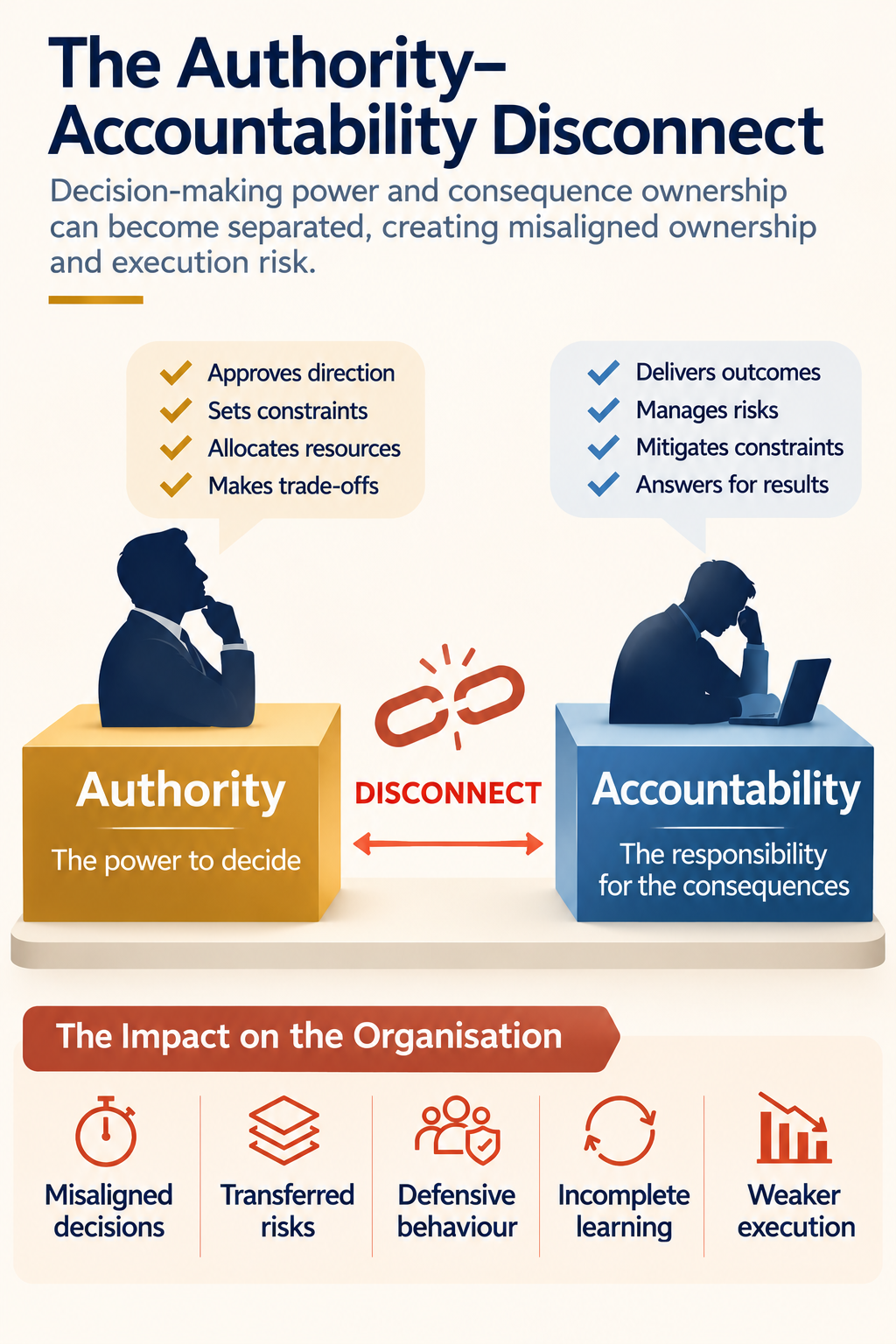
In each situation, the authority to make a consequential decision sits with one person, while responsibility for managing its consequences falls on someone else.
The decision-maker may have acted within their formal authority.
The decision itself may even have been reasonable given the information available at the time.
The structural problem arises when the organisation does not establish a clear relationship between the authority exercised, the reasoning behind the decision and accountability for its consequences.
Those who control decisions can become disconnected from the outcomes those decisions create.
This is the opposite of accountability without authority, but the two conditions share the same underlying weakness.
The organisation has failed to align decision rights with outcome ownership.
Authority Is Not the Same as Accountability
Authority gives an individual or governing body the legitimate power to make decisions within defined boundaries.
Accountability requires an individual or governing body to explain and answer for decisions, actions and outcomes within their assigned remit.
The distinction is important because authority and accountability do not always operate at the same organisational level.
A project manager may be accountable for delivering a project within approved constraints.
A steering committee may have authority to approve changes to scope, funding and deadlines.
An executive sponsor may have authority to resolve competing departmental priorities.
These arrangements are not inherently problematic. They reflect the distribution of decision-making responsibilities across a complex organisation.
However, problems arise when the consequences of decisions made at one level are treated entirely as failures of execution at another.
Consider a steering committee that declines a request for additional resources despite a documented risk to the delivery schedule.
The project manager remains responsible for managing the project, communicating the implications and taking reasonable mitigating action.
But the steering committee also has accountability for its resource decision and the risks it has chosen to accept.
If the project subsequently misses its deadline, an effective review should examine both the execution of the project and the decisions that shaped its constraints.
Without this distinction, accountability becomes concentrated on those implementing decisions rather than those making them.
How Authority Becomes Detached from Accountability
Authority without accountability does not necessarily result from deliberate avoidance of responsibility.
It can emerge through ordinary governance practices, reporting arrangements and organisational habits.
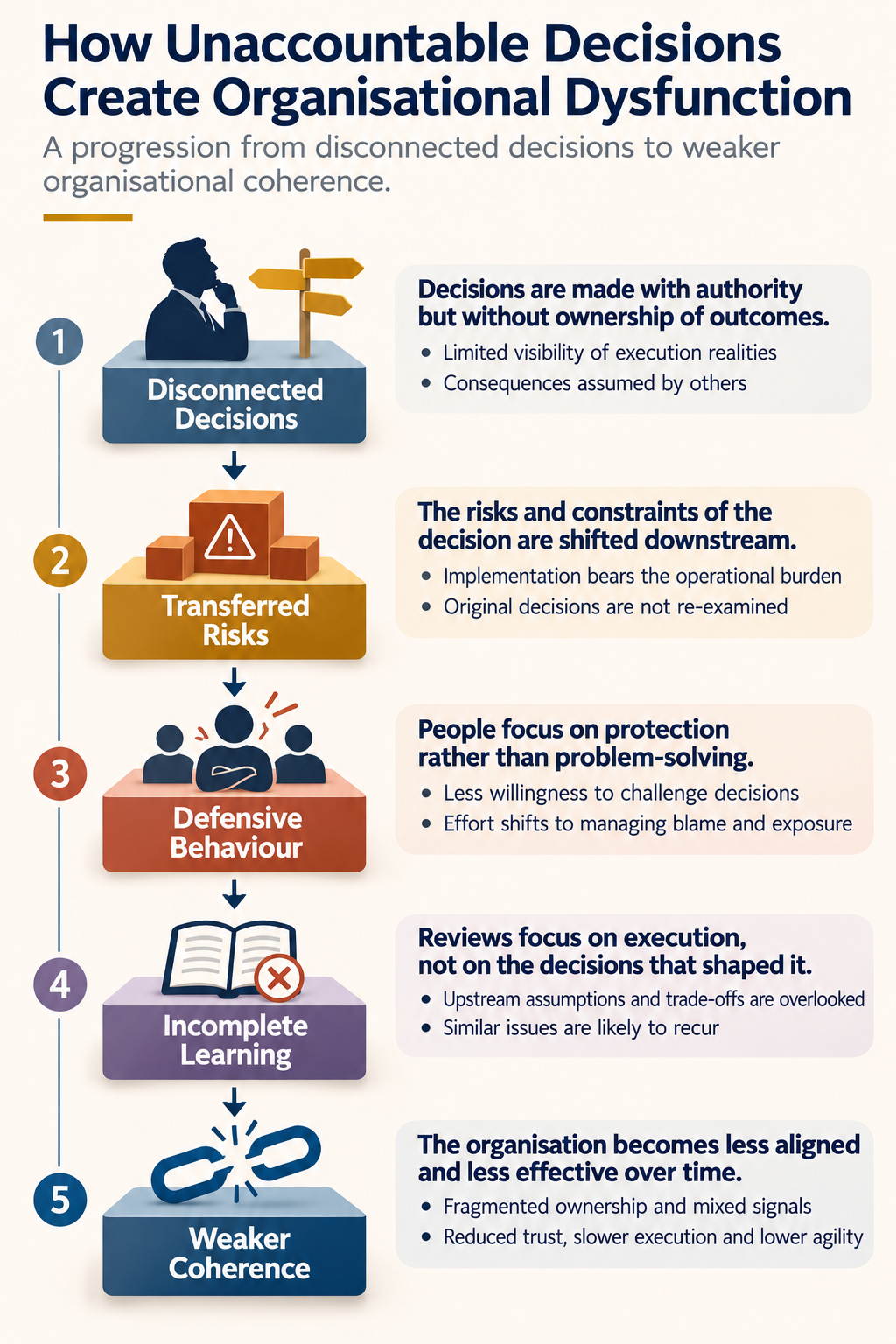
1. Decisions are made above, but consequences are managed below
Senior leaders establish targets, approve budgets and determine strategic priorities.
Middle managers and operational teams are expected to translate those decisions into results.
This division is necessary in most organisations.
The problem arises when leaders retain control over major decisions but evaluate performance as though managers below them possessed complete discretion over the outcome.
For example, senior management may approve a substantial reduction in staffing while maintaining existing service targets.
Operational managers must then manage the consequences of reduced capacity.
If service quality deteriorates, the organisation may attribute the problem to poor operational management without examining the original staffing decision.
The authority to change operating conditions and the accountability for those conditions have become disconnected.
2. Approval authority is mistaken for effective governance
Many organisations rely on approval processes to maintain control.
Expenditure, recruitment, procurement and project changes may require authorisation from designated individuals or committees.
Approval processes are necessary for managing financial, regulatory and operational risks.
However, approving a decision does not necessarily mean that the decision-maker remains engaged with its consequences.
A committee may approve a project scope reduction without examining whether the remaining solution can still achieve the intended business outcome.
The project may subsequently be delivered on time and within budget but fail to provide the expected organisational benefit.
The approval process was followed.
The decision was formally authorised.
Yet the governance system may not have established who should review whether the approved trade-off remained appropriate.
A decision can be procedurally compliant while producing an organisationally damaging outcome.
Effective governance therefore requires more than approval.
It requires visibility of the assumptions, trade-offs and consequences associated with consequential decisions.
3. Decision-making is fragmented across organisational boundaries
Cross-functional initiatives frequently involve decisions made by multiple departments.
Finance determines funding availability.
IT determines technical feasibility and architecture.
Operations determines implementation capacity.
HR influences workforce policies and capability development.
Each function may exercise legitimate authority within its domain.
However, decisions that are individually reasonable may collectively undermine an organisational objective.
A department may decline to release employees for training because doing so would affect its operational KPI.
Another may postpone system enhancements to protect its existing delivery commitments.
A third may reduce expenditure to meet its budget target.
Each decision can be justified locally.
Yet their combined effect may compromise the transformation programme.
When no mechanism exists to examine the collective consequences, decision-making authority becomes fragmented and organisational accountability becomes unclear.
This is not simply a problem of departmental cooperation.
It is a weakness in the architecture connecting local decisions to shared outcomes.
4. Seniority shields decisions from examination
Organisational hierarchy establishes legitimate authority, but it can also influence how decisions are questioned.
Employees may be expected to justify their actions in detail, while decisions made by senior leaders receive less scrutiny.
A manager may be required to explain a missed target, but the strategic assumptions behind the target may remain unexamined.
A project team may be criticised for failing to manage a risk, even though its earlier recommendation to address the risk was rejected.
When authority is associated with exemption from scrutiny, organisational learning becomes selective.
Failures are investigated at the level of implementation while the decisions that shaped implementation remain outside the discussion.
This does not mean senior leaders should be blamed whenever an initiative fails.
It means their decisions should be subject to the same principles of evidence, reflection and accountability expected elsewhere in the organisation.
The Hidden Organisational Costs
The consequences of authority without accountability extend beyond individual decisions.
Over time, the separation between decision-making power and outcome ownership can influence organisational behaviour.
Decision quality deteriorates
When decision-makers are not expected to examine the consequences of their choices, there may be less incentive to test assumptions, understand dependencies or consider implementation constraints.
Decisions can become increasingly focused on immediate priorities rather than systemic outcomes.
This does not necessarily reflect poor intentions. It may result from a governance environment that rewards decisions being made without adequately evaluating their effects.
Risk is transferred rather than managed
A senior leader may accept a delivery risk by declining additional resources.
The implementation team must then operate within that constraint.
If the risk materialises, the consequences may be treated as an execution failure rather than a combination of risk acceptance and subsequent risk management.
The organisation has not eliminated the risk.
It has transferred its operational burden to another level.
Employees become reluctant to challenge decisions
When employees observe that raising concerns does not influence decisions, but they may still be held responsible for the consequences, they can become less willing to speak up.
Some may continue to document concerns primarily to protect themselves.
Others may stop raising issues they believe will not be considered.
This creates a dangerous feedback pattern.
Decision-makers receive less challenging information, while employees become increasingly detached from the decisions they must implement.
The organisation may interpret the resulting silence as agreement.
Yet silence does not necessarily indicate alignment.
Organisational learning becomes incomplete
When an initiative fails, organisations often conduct reviews to identify lessons learned.
However, if the review focuses primarily on implementation activities, it may overlook the assumptions, approvals and strategic choices that shaped the outcome.
The organisation learns how teams could have executed differently but not necessarily how leaders could have decided differently.
As a result, similar failures may recur despite improvements in project management practices, reporting procedures and employee capability.
The organisation improves its execution processes while leaving its decision architecture unchanged.
The LUCID Diagnostic Lens: Is Authority Accountable?
The central question is not whether decision-making authority has been formally assigned.
It is whether those exercising that authority remain answerable for the decisions they make and the consequences they can reasonably influence.
Five questions help identify potential weaknesses.
1. Who has the authority to make decisions that materially affect an organisational outcome?
What it may reveal: Concentrated or fragmented decision rights that are not reflected in accountability arrangements.
2. When a decision creates additional risks, constraints or dependencies, who owns the decision and its consequences?
What it may reveal: Gaps between risk acceptance, decision ownership and operational responsibility.
3. Are significant decisions accompanied by documented assumptions, trade-offs and expected outcomes?
What it may reveal: Approval processes that record authorisation without preserving the reasoning necessary for subsequent evaluation.
4. When performance falls short, are the decisions that shaped the operating conditions examined alongside implementation performance?
What it may reveal: Selective accountability that focuses on execution while excluding upstream decisions.
5. Can employees challenge consequential decisions without being perceived as resistant, disloyal or unwilling to take ownership?
What it may reveal: Cultural conditions that weaken feedback, challenge and organisational learning.
These questions are not intended to identify someone to blame.
They help determine whether the organisation has designed a credible relationship between the authority to decide and the obligation to account for those decisions.
Designing Authority That Remains Accountable
The solution is not to make every decision-maker personally responsible for every downstream consequence.
Complex organisational outcomes are influenced by many factors, including uncertainty, changing circumstances and the actions of multiple stakeholders.
A sound decision can produce an unfavourable result.
Equally, a poor decision may occasionally produce a favourable result.
Accountability must therefore consider both the quality of the decision-making process and how decision-makers respond to emerging evidence.
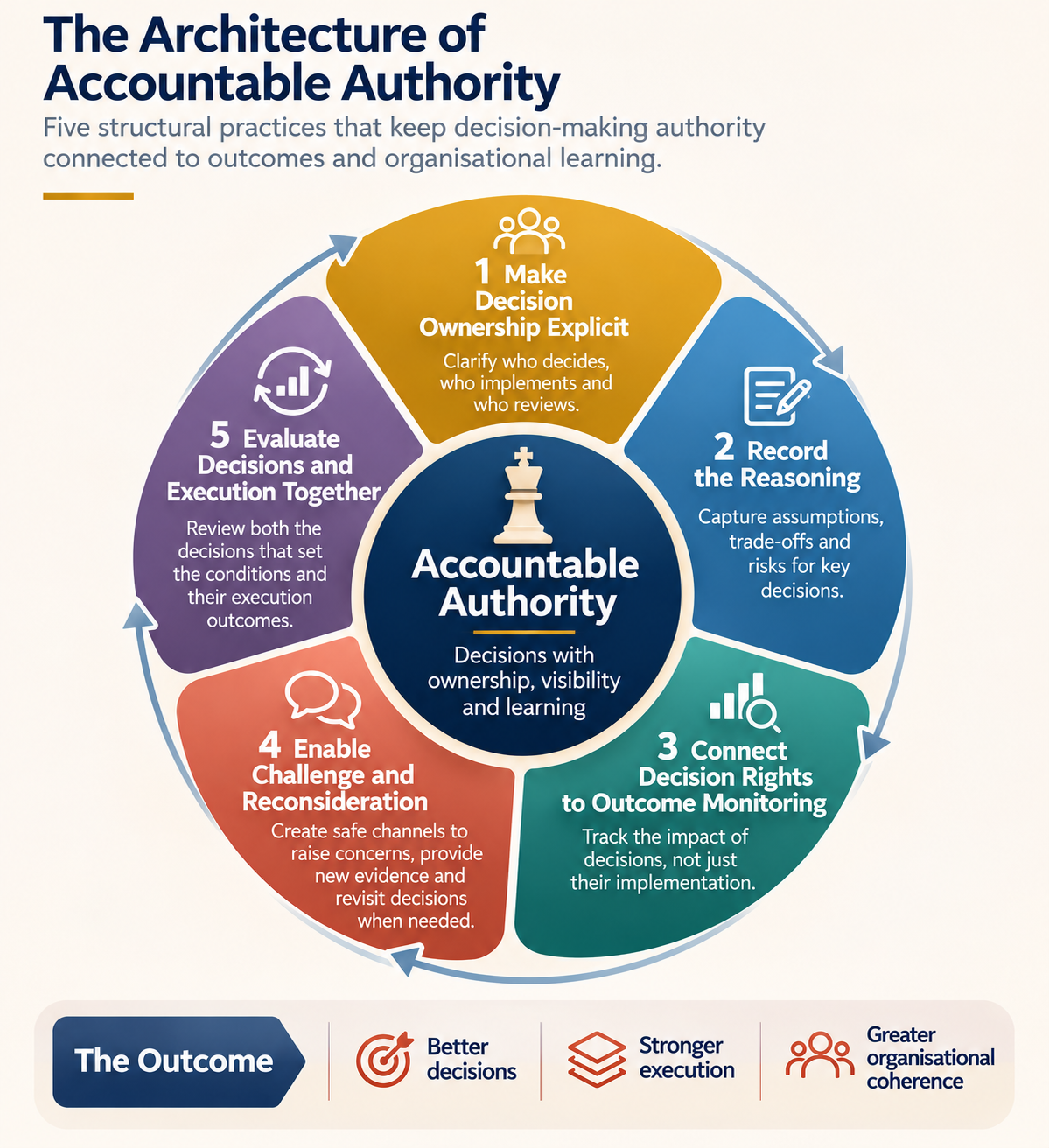
Five structural practices can strengthen this relationship.
1. Make decision ownership explicit
Significant decisions should have an identifiable owner.
This includes decisions made by committees, where collective participation can sometimes obscure individual responsibilities.
The organisation should establish who is authorised to decide, who is responsible for implementation and who must review the consequences.
Decision ownership should not disappear once approval has been granted.
2. Record the reasoning behind consequential decisions
For major decisions, organisations should document the assumptions, alternatives, trade-offs and risks considered.
The objective is not to create unnecessary paperwork.
It is to preserve enough context to evaluate whether the decision remained reasonable as circumstances evolved.
This allows subsequent reviews to distinguish between flawed assumptions, inadequate execution and genuinely unpredictable developments.
3. Connect decision rights to outcome monitoring
Decision-makers should receive relevant information about the consequences of significant decisions within their remit.
For example, a committee approving a reduction in project scope should also understand whether the revised scope continues to support the intended business benefits.
Monitoring should not be limited to whether the decision was implemented.
It should examine whether the decision produced, or continues to support, the intended organisational outcome.
4. Establish mechanisms for challenge and reconsideration
Authority should not make decisions immune to new evidence.
Employees and managers need appropriate channels to raise concerns, present alternative interpretations and request reconsideration when circumstances change.
These mechanisms should distinguish constructive challenge from refusal to execute legitimate decisions.
An organisation that cannot revisit decisions without threatening someone's status or credibility risks preserving decisions long after their original assumptions have become invalid.
5. Evaluate decisions and execution together
When results fall short, organisational reviews should examine both the decisions that established the operating conditions and the actions taken during implementation.
This creates a more complete understanding of causality.
It also supports fairer accountability.
Implementation teams remain answerable for how they acted within their responsibilities.
Decision-makers remain answerable for the quality of their decisions, the risks they accepted and their responses to relevant information.
Neither group is automatically blamed for an unfavourable outcome.
Both contribute to organisational learning.
Accountability Must Not Become a Search for Blame
There is an important distinction between holding decision-makers accountable and punishing them whenever a decision produces an undesirable result.
Organisations operate under uncertainty.
Leaders must sometimes make difficult trade-offs with incomplete information.
A decision may be appropriate at the time it is made and still lead to an unexpected outcome.
If accountability is interpreted purely as punishment for negative results, decision-makers may become excessively cautious, delay decisions or avoid accepting legitimate risks.
This would create another form of execution friction.
Effective accountability should instead examine whether the decision-maker exercised appropriate judgement, considered relevant evidence, understood material risks and responded responsibly as new information emerged.
It should also examine whether the organisation provided the conditions necessary for sound decision-making.
The objective is not to eliminate failure.
It is to ensure that authority is exercised transparently, responsibly and with a willingness to learn.
From Hierarchical Control to Organisational Coherence
Authority is often understood through organisational hierarchy.
Senior leaders decide.
Managers coordinate.
Employees execute.
Although this arrangement provides formal structure, it does not adequately describe how complex organisations achieve results.
Decisions interact across functions, reporting lines and operational boundaries.
A financial decision can affect service quality.
A staffing decision can affect project delivery.
A technical decision can affect employee adoption.
A strategic decision can alter the feasibility of operational targets.
These relationships mean that authority cannot be evaluated solely within the boundaries of the role exercising it.
Its consequences must also be understood within the wider organisational system.
A coherent organisation recognises that decision rights, accountability and execution are interconnected.
It establishes mechanisms through which decisions are informed by operational realities, implementation constraints are made visible, and consequences are examined at the appropriate level.
This does not weaken leadership authority.
It makes authority more effective by connecting decisions to the organisational outcomes they are intended to support.
The LUCID Perspective
Authority without accountability is not simply a leadership problem.
It is a structural weakness in the relationship between decision-making power, outcome ownership and organisational learning.
When decision-makers are disconnected from the consequences of their choices, organisations risk creating environments in which decisions are made at one level while their effects are absorbed at another.
Over time, this can produce fragmented ownership, defensive behaviour, incomplete learning and declining organisational coherence.
Effective execution requires more than clearly assigned decision rights.
It requires those rights to be accompanied by appropriate accountability for the decisions made, the risks accepted and the consequences that follow.
Authority determines who has the right to decide. Accountability ensures that those decisions remain open to explanation, examination and learning. Execution architecture connects both to organisational outcomes.
In a coherent organisation, authority is neither unrestricted nor disconnected from responsibility.
It is exercised within a system that makes decisions transparent, consequences visible and learning possible.
The question for leaders is therefore not simply who has the authority to decide.
It is whether the organisation ensures that those decisions remain accountable.
Part of the Execution Architecture Series from LUCID Methods.
Explore more frameworks, diagnostic perspectives, and systems-thinking insights through the LUCID Method — developed to help organisations build clarity, coherence, and transformation that holds over time.