

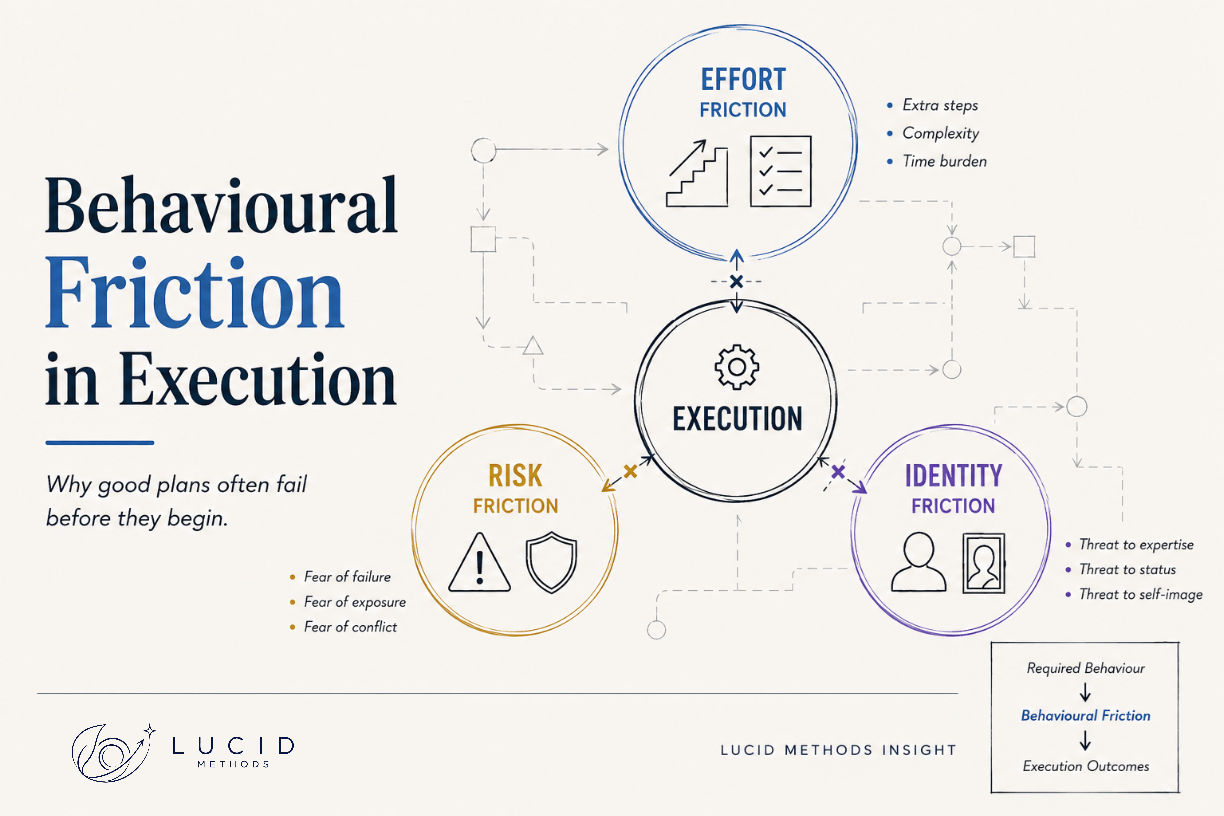
Behavioural Friction in Execution
Why Good Plans Often Fail Before They Begin
Most execution problems are not caused by poor strategy.
They are caused by people.
Not because people are incompetent.
Not because people are resistant.
Not because people do not care.
Execution often slows, degrades, or collapses because human behaviour does not naturally move in the direction the system expects.
This is behavioural friction.
Just as mechanical friction consumes energy within a machine, behavioural friction consumes energy within an organisation.
The strategy may be sound.
The objectives may be clear.
The resources may be available.
Yet progress remains slower than expected because the behaviours required for execution are harder than leaders assume.
Many transformation efforts fail not because the destination is wrong, but because the human behaviours necessary to reach that destination were never properly understood.
What Is Behavioural Friction?
Behavioural friction is the gap between what a system requires people to do and what people naturally tend to do.
Every organisation operates through behaviours.
People communicate.
People make decisions.
People escalate issues.
People share information.
People collaborate.
People prioritise work.
Execution occurs through these behaviours.
When required behaviours align with natural behaviours, execution flows smoothly.
When required behaviours conflict with natural tendencies, friction emerges.
The greater the conflict, the greater the friction.
This friction often remains invisible until deadlines slip, quality declines, or transformation initiatives stall.
Behaviour Is Not Rational
Many execution models assume people behave rationally.
Reality suggests otherwise.
People do not always choose the most logical option.
They choose what feels safest.
They choose what feels familiar.
They choose what minimises effort.
They choose what reduces uncertainty.
They choose what protects identity.
This is not a flaw.
It is human nature.
A transformation programme may require cross-functional collaboration.
Yet people naturally optimise for their own department.
A project may require transparency.
Yet people naturally avoid exposing mistakes.
A new operating model may require experimentation.
Yet people naturally prefer certainty.
The issue is not that people are irrational.
The issue is that organisations frequently design execution systems that assume people will behave differently from how they actually behave.
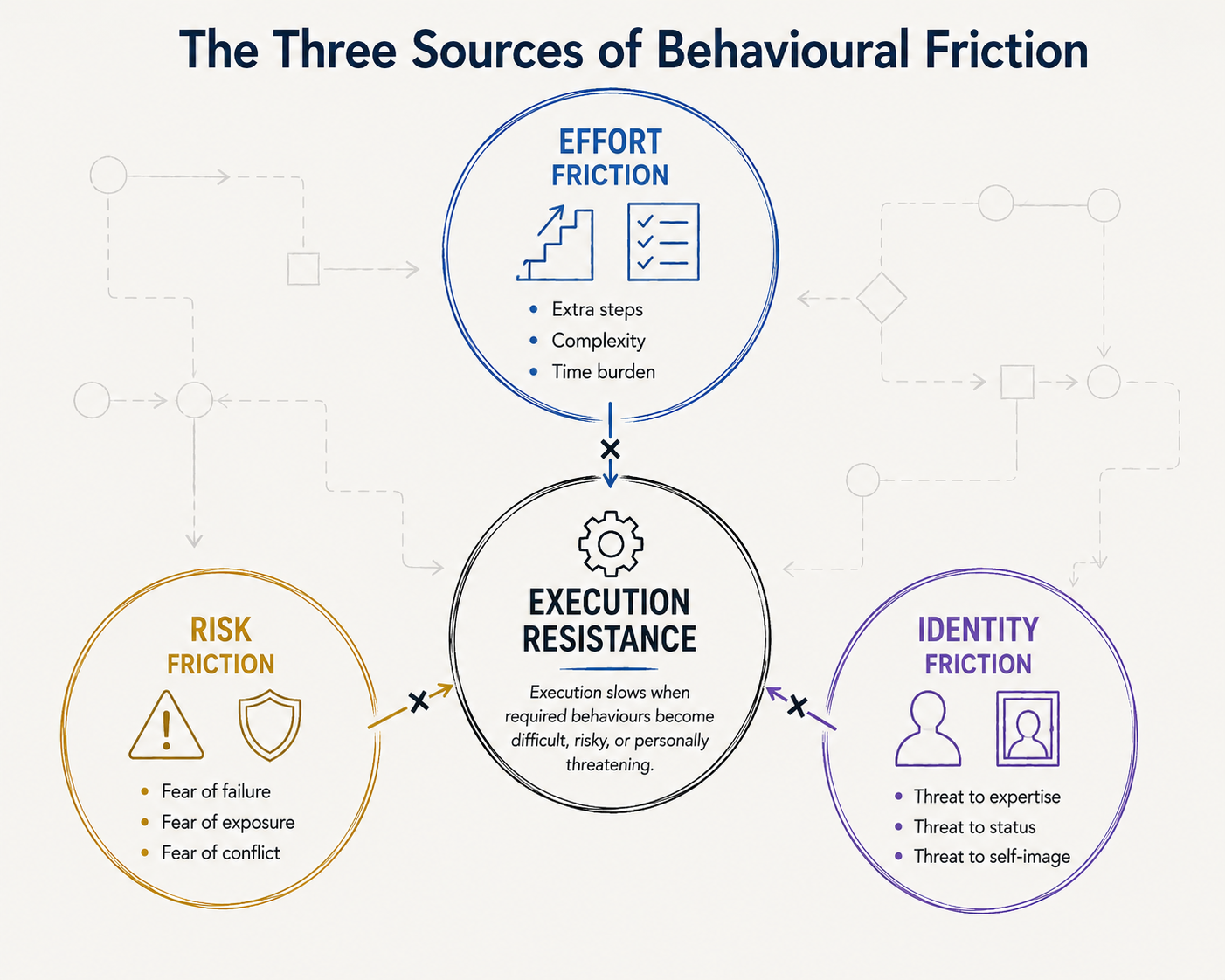
The Three Sources of Behavioural Friction
Behavioural friction generally emerges from three sources.
1. Effort Friction
People gravitate toward the path requiring the least effort.
This is neither laziness nor incompetence.
It is efficiency.
If a new process requires ten additional steps compared to the old process, adoption will struggle.
If documentation takes thirty minutes while verbal communication takes five, documentation will often be skipped.
If obtaining alignment requires six meetings, people may bypass alignment entirely.
Every additional behavioural requirement creates resistance.
Not because people oppose the goal.
Because effort accumulates.
2. Risk Friction
People naturally avoid behaviours that increase personal risk.
Even when those behaviours benefit the organisation.
For example:
- Escalating a problem may expose mistakes.
- Challenging assumptions may create conflict.
- Reporting delays may damage reputation.
- Experimenting may create visible failure.
From a leadership perspective, these behaviours appear desirable.
From an employee's perspective, they may feel dangerous.
Execution stalls whenever organisational incentives reward caution while organisational goals require courage.
3. Identity Friction
People protect their self-image.
Often more strongly than leaders realise.
A transformation may require managers to become coaches rather than controllers.
Engineers may need to become collaborators rather than specialists.
Experts may need to admit uncertainty.
Long-serving employees may need to abandon methods that defined their professional identity.
These changes are not procedural.
They are personal.
Identity friction frequently creates the strongest resistance because people experience the change as a threat to who they are.
Not simply to what they do.see.
The Hidden Cost of Behavioural Friction
Most organisations measure execution outcomes.
Few measure execution effort.
This creates a dangerous blind spot.
Imagine two teams delivering identical results.
Team A requires constant escalation, monitoring, and intervention.
Team B progresses naturally with minimal supervision.
Both appear successful.
Yet Team B possesses greater execution capability.
Behavioural friction consumes:
- Management attention
- Coordination effort
- Emotional energy
- Decision-making capacity
- Organisational trust
These costs rarely appear on dashboards.
Yet they determine whether execution remains sustainable.
Why Communication Alone Rarely Solves It
When execution slows, leaders often respond with more communication.
More town halls.
More emails.
More presentations.
More reminders.
This rarely addresses the underlying problem.
Behavioural friction is not primarily an information problem.
People usually understand what they are supposed to do.
The challenge is that understanding does not automatically create behaviour.
Knowledge and behaviour are different things.
An employee may fully understand the importance of documenting lessons learned.
That does not mean they will do it.
A manager may fully understand the value of delegation.
That does not mean they will delegate.
Communication can create awareness.
Behavioural change requires something more.
Designing for Behaviour
High-performing systems do not rely on motivation.
They rely on design.
Instead of asking:
"Why won't people do this?"
Ask:
"What makes this behaviour difficult?"
This shifts the focus from blaming individuals to improving systems.
Effective organisations:
- Reduce unnecessary effort
- Lower perceived risk
- Align incentives
- Reinforce desired behaviours
- Remove contradictory signals
- Simplify decision pathways
In other words, they design execution around human reality rather than idealised behaviour.
Behavioural Friction and Transformation Failure
Many transformation programmes focus heavily on structure.
New governance.
New processes.
New technology.
New reporting lines.
These changes are visible and measurable.
Behavioural friction is less visible.
Therefore it receives less attention.
Yet behavioural friction often determines whether transformation succeeds.
A perfectly designed process can fail if people avoid using it.
A powerful technology platform can fail if adoption remains low.
A compelling strategy can fail if leaders continue rewarding old behaviours.
Transformation succeeds when system design and human behaviour reinforce one another.
Transformation struggles when they conflict.
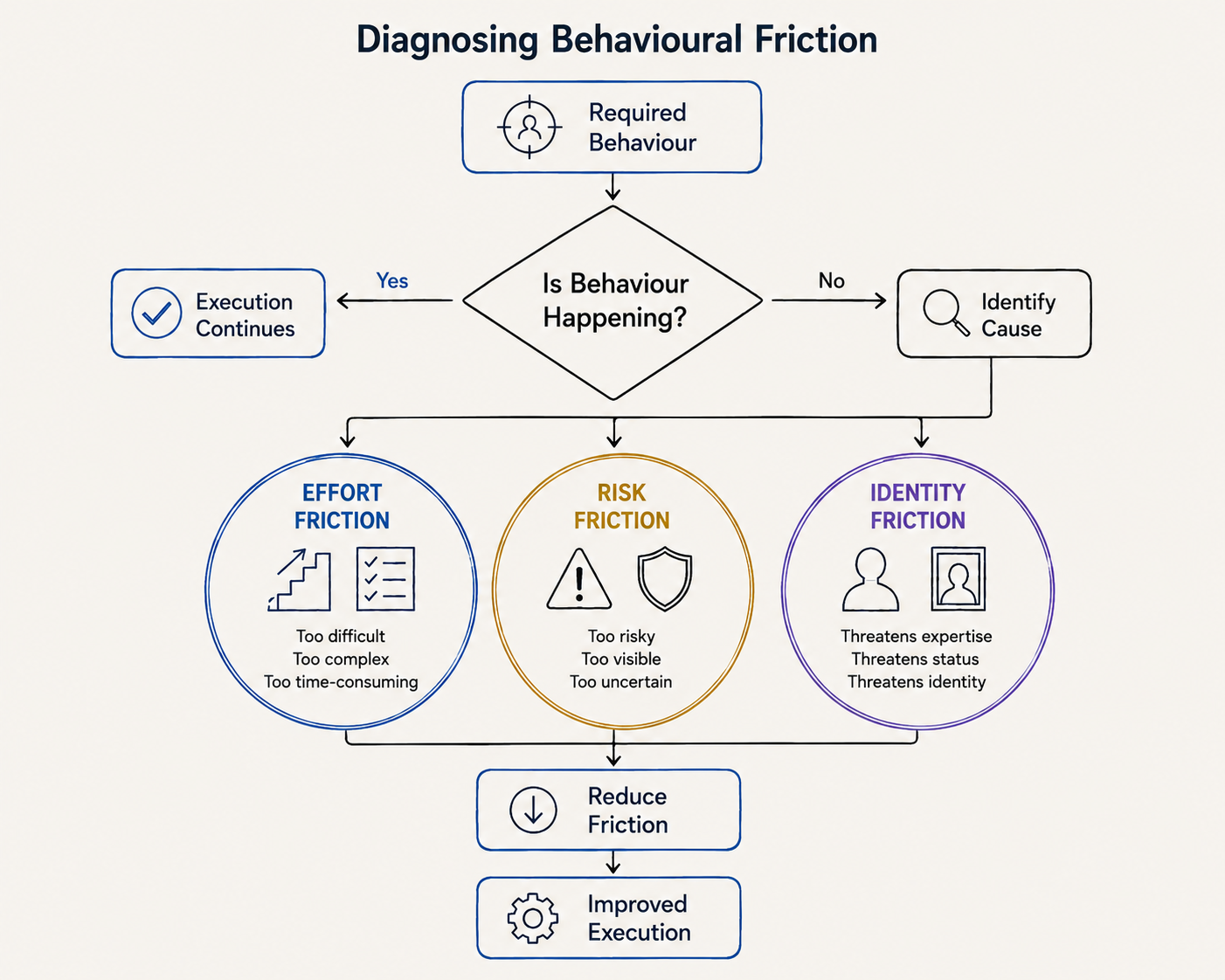
The LUCID Perspective
Within the LUCID framework, behavioural friction is rarely viewed as an individual problem.
It is treated as diagnostic information.
Friction reveals where execution requirements conflict with human realities.
The goal is not to eliminate all friction.
Some friction is necessary.
Challenge creates growth.
Accountability creates discipline.
Standards create consistency.
The objective is to identify unnecessary friction.
The friction that consumes energy without creating value.
When organisations reduce unnecessary behavioural friction, execution becomes easier.
Alignment becomes more sustainable.
Change becomes more durable.
And transformation becomes significantly more likely to succeed.
Because ultimately, execution does not happen through plans.
Execution happens through people.
And every system performs at the speed of the behaviours it requires.
Part of the Change & Human Systems Series from LUCID Methods.
Explore more frameworks, diagnostic perspectives, and systems-thinking insights through the LUCID Method — developed to help organisations build clarity, coherence, and transformation that holds over time.