

Clarity Is Structural
Most organisations treat clarity as a communication problem.
When execution begins to drift, leaders often respond by increasing communication.
More meetings.
More updates.
More presentations.
More town halls.
More alignment sessions.
The assumption is simple:
If people understand the message more clearly, execution will improve.
Sometimes it does.
Often it doesn't.
Because many execution problems are not caused by a lack of information.
They are caused by a lack of structure.
The Common Misunderstanding About Clarity
When organisations discuss clarity, they usually focus on communication quality.
Was the strategy explained clearly?
Did everyone receive the same information?
Were expectations communicated effectively?
These are important questions.
But they overlook a deeper reality.
People do not execute based on information alone.
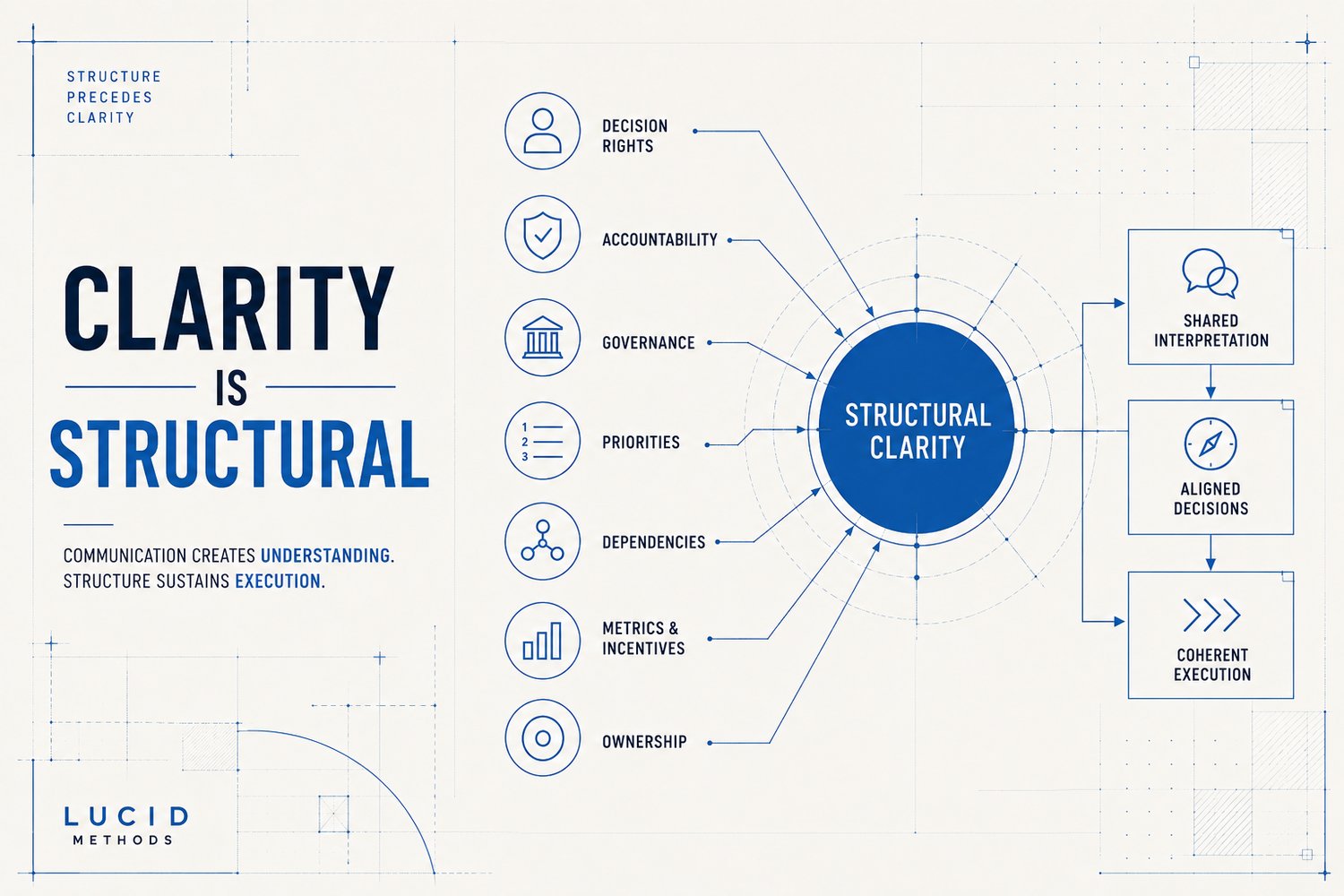
They execute through the structures surrounding their work.
Roles.
Responsibilities.
Decision rights.
Incentives.
Dependencies.
Priorities.
Governance.
Escalation paths.
Resource allocation.
These structures shape behaviour far more consistently than communication alone.
An organisation can communicate perfectly and still generate confusion if its structures send conflicting signals.
Why Communication Alone Cannot Create Clarity
Imagine a leadership team announcing a strategic priority.
Everyone hears the message.
Everyone agrees.
Everyone leaves the meeting aligned.
Yet three months later execution begins to diverge.
Different teams are pursuing different interpretations.
Priorities start competing.
Decisions slow down.
Resources become contested.
Ownership becomes unclear.
What happened?
The communication was successful.
The structure was not.
The organisation understood the strategy.
But it lacked the structural mechanisms necessary to sustain shared interpretation during execution.
This distinction is important.
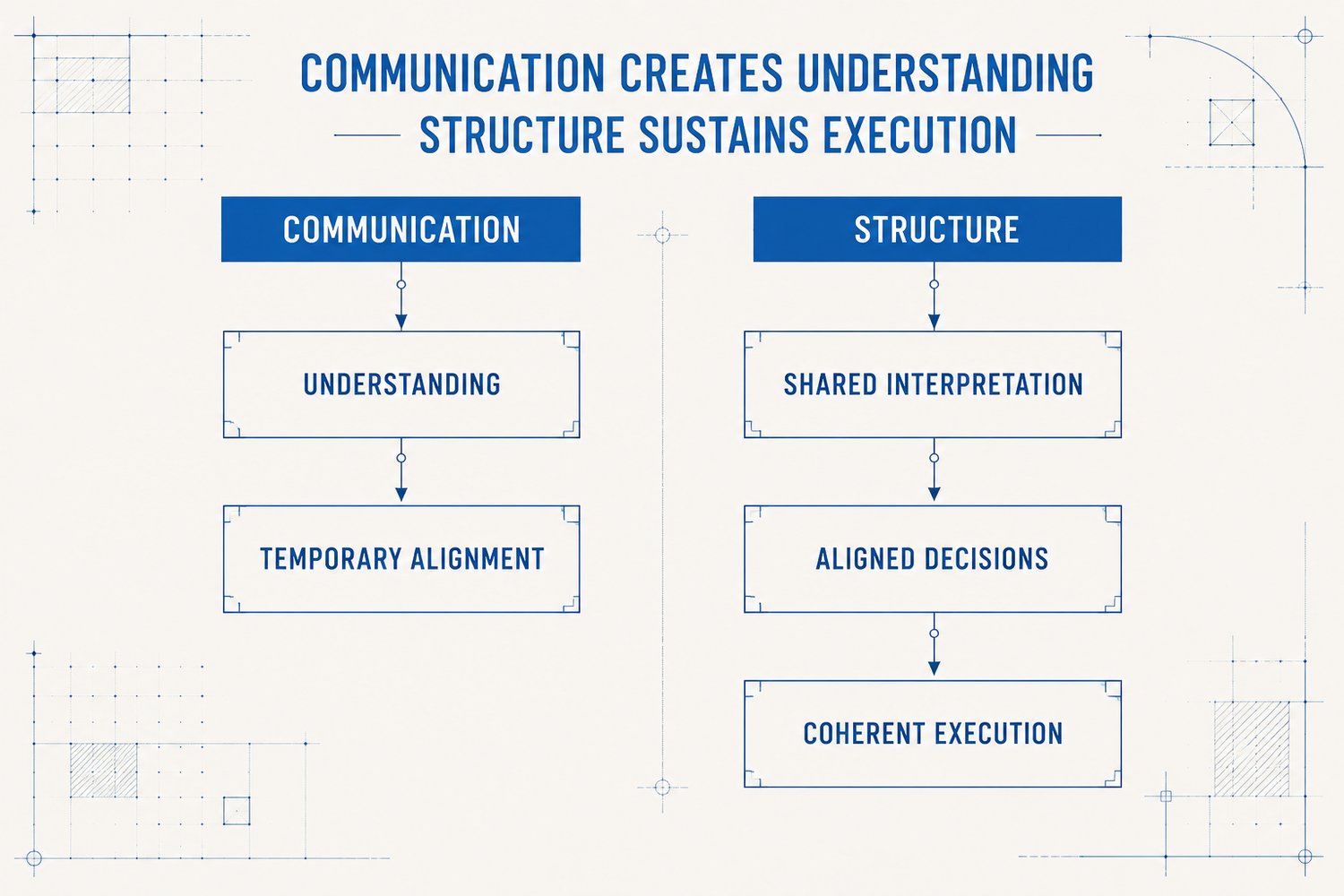
Communication creates understanding.
Structure sustains it.
Behaviour Follows Structure
A useful principle in organisational design is simple:
People pay attention to what systems reward, measure, and reinforce.
If collaboration is encouraged but performance metrics remain individual, competition often emerges.
If cross-functional alignment is expected but accountability remains fragmented, silo behaviour often persists.
If strategic priorities change but resource allocation does not, old behaviours frequently continue.
The issue is rarely capability.
The issue is usually structural coherence.
People are responding rationally to the system surrounding them.
The organisation may be communicating one message while its structures communicate another.
When that happens, behaviour usually follows structure.
Clarity Is Embedded in Design
Sustainable clarity is rarely achieved through explanation alone.
It is embedded into organisational design.
Clear organisations typically possess several structural characteristics:
- Decision ownership is visible.
- Escalation paths are understood.
- Priorities are consistently reinforced.
- Accountability is aligned with authority.
- Dependencies are identified and managed.
- Success measures support desired behaviour.
- Governance mechanisms reduce ambiguity.
These elements create an environment where interpretation remains relatively stable even under pressure.
People do not need constant clarification because the structure itself provides guidance.
The organisation becomes easier to navigate.
The Cost of Structural Ambiguity
Structural ambiguity often remains invisible until execution becomes stressed.
During stable periods, teams compensate.
Experienced employees fill gaps.
Managers provide informal coordination.
Relationships bridge unclear responsibilities.
The system appears functional.
However, when complexity increases, ambiguity becomes more visible.
Projects slow.
Decisions stall.
Ownership becomes contested.
Work is duplicated.
Escalations increase.
Alignment weakens.
Leaders often interpret these symptoms as communication failures.
In reality, they may be signs of structural weakness.
The organisation lacks the architecture necessary to maintain clarity as conditions become more demanding.
Clarity Under Pressure
The true test of organisational clarity is not whether people understand the strategy during a presentation.
The true test is whether shared understanding survives complexity.
Can teams make consistent decisions without constant intervention?
Can priorities remain stable when pressure increases?
Can work continue effectively when leaders are absent?
Can different functions interpret objectives similarly?
These are structural questions.
An organisation that requires continual clarification may not have a communication problem.
It may have a design problem.
Clarity as an Organisational Capability
Many transformation initiatives focus heavily on communication planning.
Far fewer examine whether the organisation's structures can sustain the clarity being communicated.
This distinction matters.
Communication can create temporary alignment.
Structure creates durable alignment.
Communication can introduce direction.
Structure determines whether that direction survives execution.
Communication explains intent.
Structure governs behaviour.
For this reason, clarity should not be viewed as a leadership skill alone.
It should be viewed as an organisational capability.
One that is deliberately designed, reinforced, and maintained through the systems that shape everyday work.
Final Reflection
When organisations struggle with alignment, the instinct is often to communicate more.
Sometimes that is necessary.
But before creating another presentation, another workshop, or another alignment meeting, a more important question should be asked:
Is the organisation unclear because people lack information?
Or is it unclear because the structure itself creates ambiguity?
The answer often determines whether clarity becomes temporary understanding or sustainable execution.
Because clarity is not merely something people hear.
Clarity is something organisations design.
Part of the Foundations Thinking Series from LUCID Methods.
Explore more frameworks, diagnostic perspectives, and systems-thinking insights through the LUCID Method — developed to help organisations build clarity, coherence, and transformation that holds over time.