

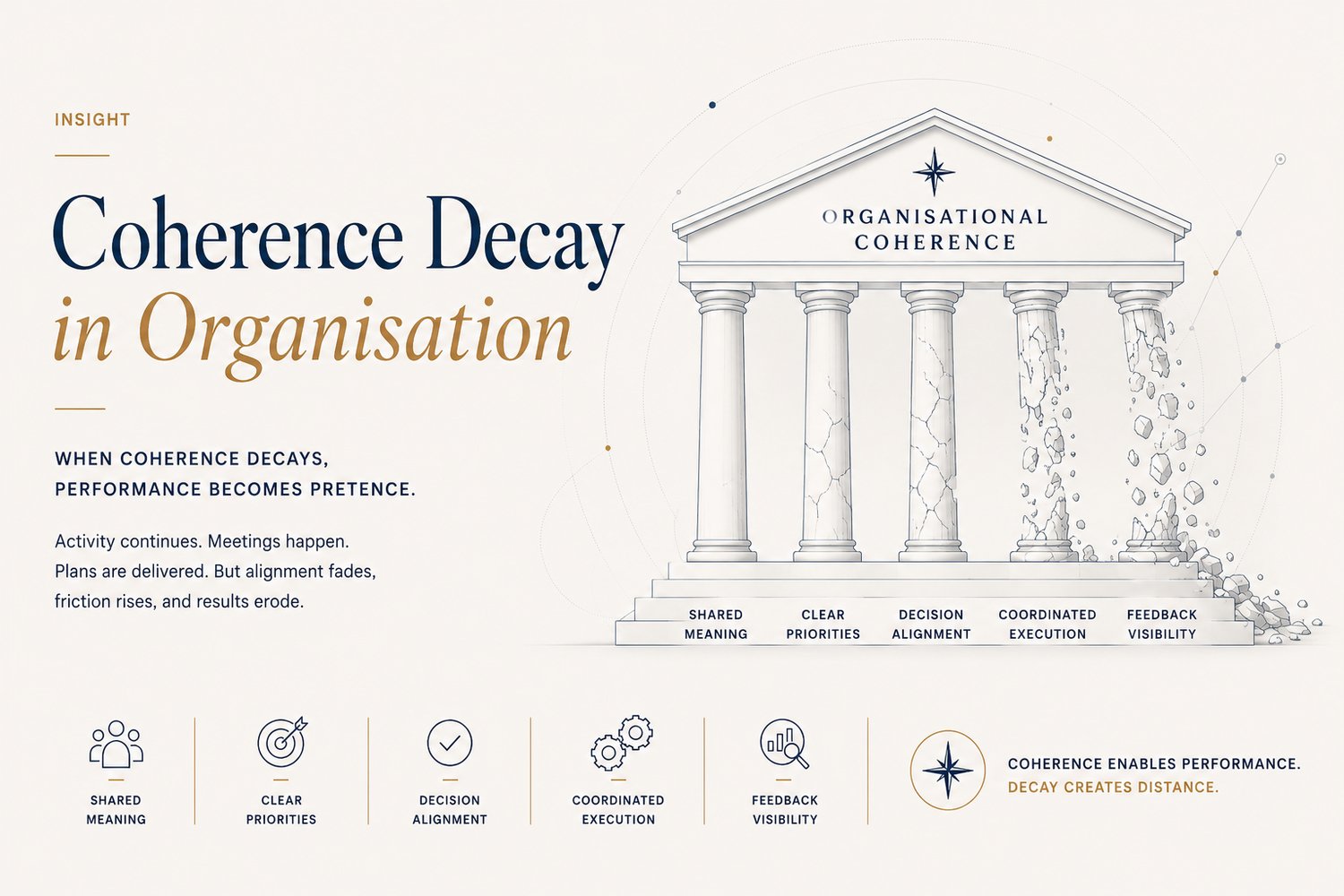
Coherence Decay: The Slow Erosion Beneath Organisational Activity
Modern organisations rarely collapse without warning.
More often, deterioration begins quietly beneath periods of apparent momentum — long before visible performance failure appears.
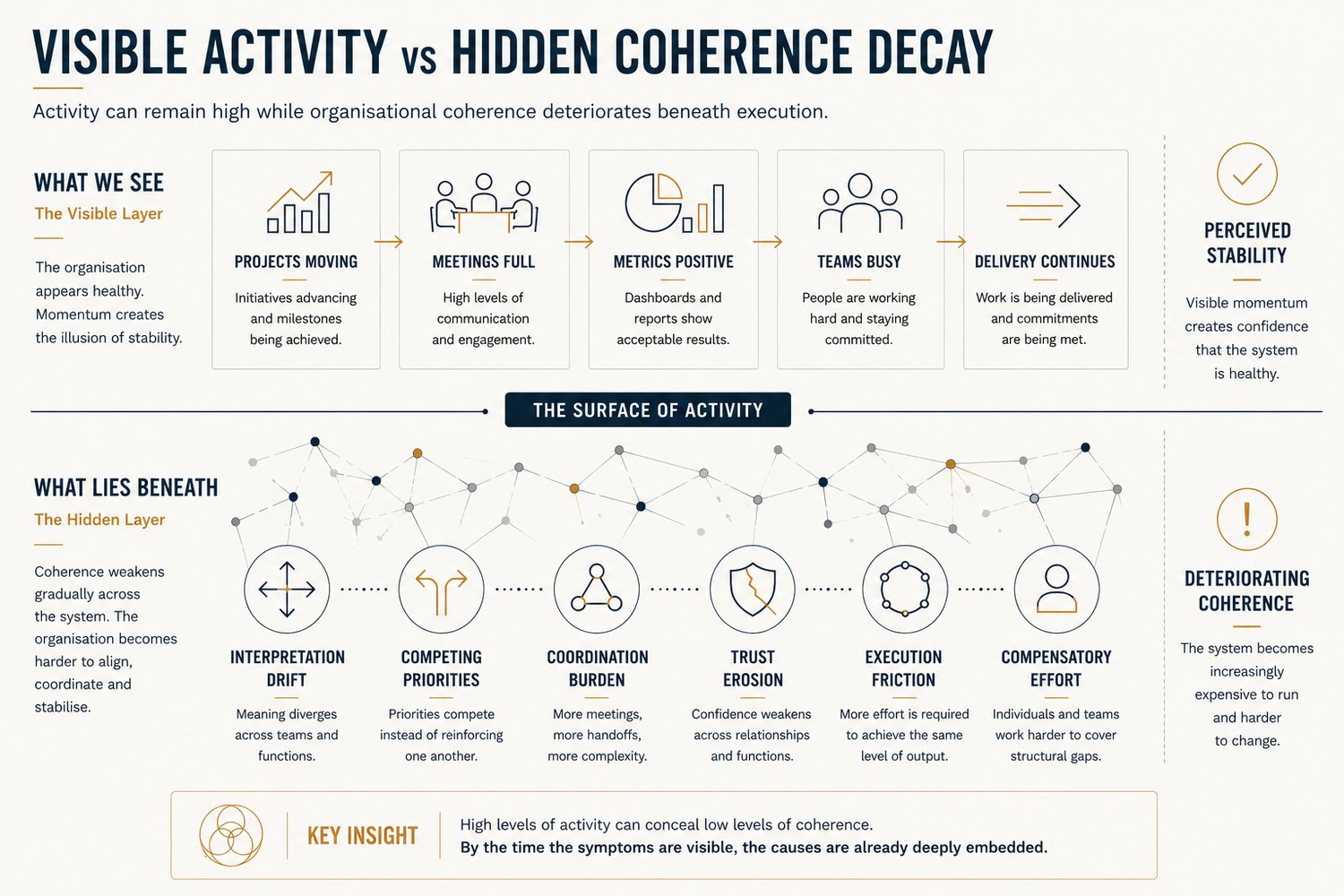
Projects continue advancing.
Meetings remain full.
Teams stay occupied.
Metrics still look acceptable.
Delivery continues moving forward.
From the surface, the organisation appears functional.
But beneath ongoing activity, something more subtle may already be weakening.
Alignment begins fragmenting.
Interpretation diverges across teams.
Priorities compete instead of reinforcing one another.
Coordination becomes heavier.
Trust slowly erodes.
Execution requires increasing effort simply to maintain stability.
This is coherence decay.
And in many organisations, it begins long before leadership recognises that anything is wrong.
When Activity Is Mistaken for Stability
One of the most dangerous organisational assumptions is the belief that visible activity automatically reflects structural health.
Busy systems often feel stable.
Frequent meetings create reassurance.
High communication volume creates the perception of alignment.
Ongoing delivery creates confidence that execution remains under control.
Movement itself becomes psychologically persuasive.
As long as projects continue progressing and teams remain active, organisations often assume the underlying system remains coherent.
But activity alone does not guarantee organisational stability.
A system can remain highly productive while becoming increasingly fragmented internally.
Teams may continue executing while operating from different interpretations of strategic priorities. Departments may remain cooperative while optimising against competing incentives. Leaders may believe alignment exists because communication remains constant, even though meaning has already begun diverging beneath the surface.
For a period of time, capable people can compensate for weakening coherence through effort alone.
But effort-based compensation is rarely sustainable indefinitely.
Over time, the organisation becomes progressively harder to stabilise.
Why Coherence Decays Quietly
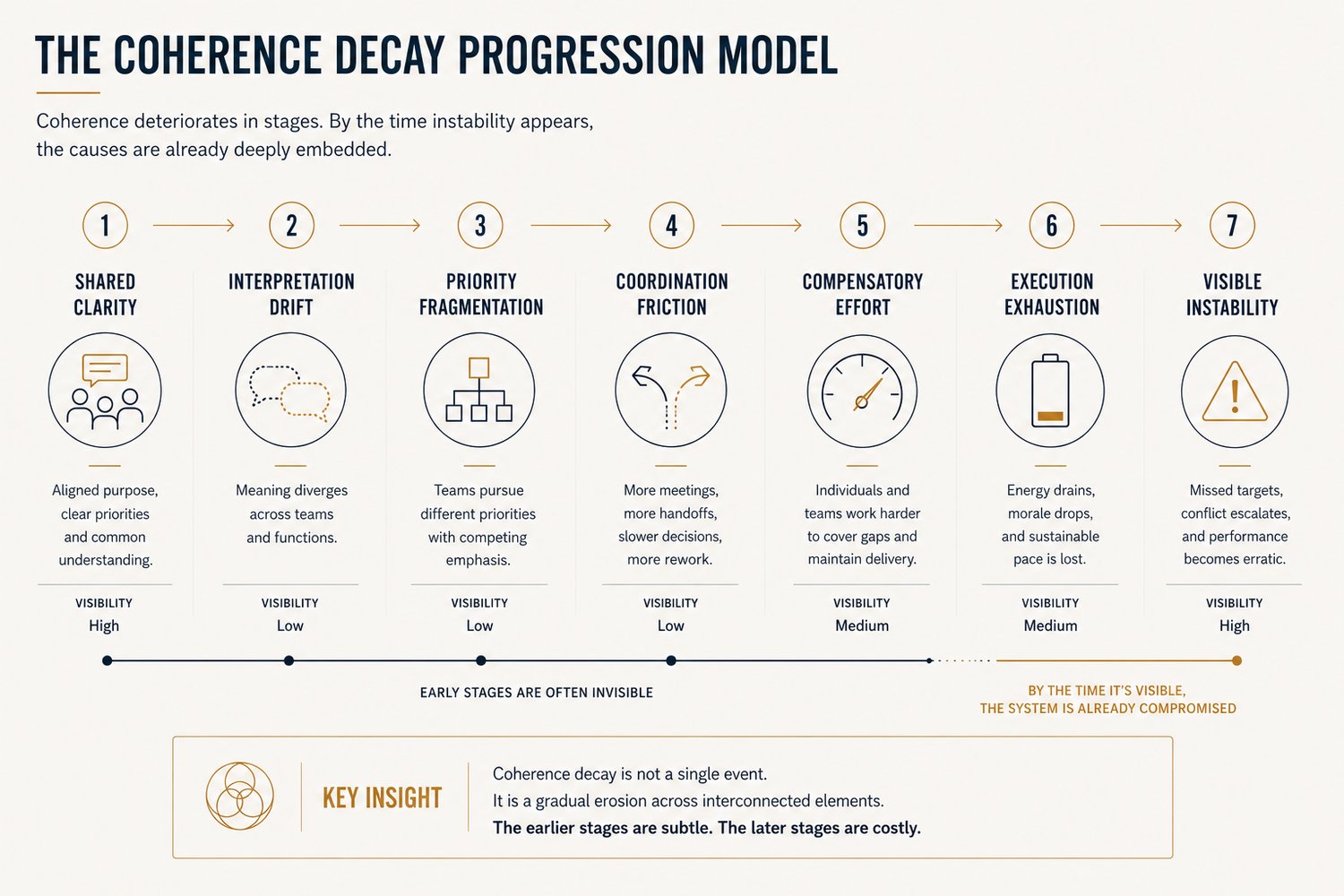
Coherence decay rarely begins through a single catastrophic event.
Instead, deterioration accumulates gradually through small layers of unresolved fragmentation.
Interpretation begins drifting between leadership, teams, and operational functions. Strategic intent becomes translated differently across different parts of the organisation. Decisions made locally no longer reinforce system-wide outcomes consistently.
As this occurs, execution friction increases.
Coordination requires more meetings.
Clarification becomes increasingly necessary.
Dependencies become harder to manage.
Decision-making slows.
Small misunderstandings create disproportionate operational consequences.
Eventually, organisations begin consuming increasing energy simply to maintain baseline functionality.
The danger is that these conditions often emerge slowly enough to normalise themselves.
People adapt to the friction.
Workarounds become routine.
Compensatory behaviours become embedded into daily operations.
The organisation remains functional — but at growing systemic cost.
The Illusion of Organisational Resilience
Many organisations do not recognise coherence decay because operational momentum can temporarily conceal structural deterioration.
Strong individuals often compensate for weak systems.
Experienced managers absorb coordination failures manually. High-performing teams carry organisational ambiguity through personal effort. Informal relationships temporarily bridge structural gaps that formal systems no longer manage effectively.
From the outside, the organisation still appears resilient.
But resilience built primarily on compensatory effort is fragile.
Because the system itself is no longer carrying the operational load consistently.
The burden shifts onto individuals instead.
Over time, this creates exhaustion across leadership and execution layers alike.
Teams begin experiencing:
- decision fatigue
- coordination overload
- increasing ambiguity
- rising emotional friction
- slower execution cycles
- declining psychological ownership
Yet because visible activity continues, leadership may still interpret the organisation as fundamentally healthy.
This is what makes coherence decay difficult to detect early.
The collapse itself often appears sudden.
But the underlying deterioration rarely is.
The Hidden Cost of Fragmented Alignment
When organisational coherence weakens, the effects extend far beyond operational inefficiency.
Misalignment creates systemic instability.
Strategic priorities begin competing instead of reinforcing one another. Departments optimise locally while weakening broader organisational coherence. Transformation initiatives become harder to sustain because execution no longer operates from shared interpretation.
Eventually, organisations enter a state where increasing effort produces diminishing stability.
More meetings are introduced to solve communication breakdowns. Additional governance layers are added to control inconsistency. Reporting structures expand in an attempt to restore visibility.
But structural fragmentation cannot be solved through activity volume alone.
In many cases, excessive coordination becomes a symptom of declining coherence rather than a solution to it.
The organisation becomes increasingly busy while becoming progressively harder to move.
This is often the point where leaders begin feeling that transformation efforts are “slowing down” despite significant ongoing work.
But the problem is not necessarily lack of capability.
The system itself may already be struggling to maintain coherence beneath execution.
Healthy Systems Are Sustained Through Coherence
Healthy organisations are not sustained through momentum alone.
They are sustained through coherence:
- shared understanding
- aligned priorities
- coordinated execution
- adaptive feedback
- structural clarity
- operational trust
Coherence allows distributed teams to move consistently without requiring constant correction. It reduces friction before execution begins. It enables systems to absorb complexity without fragmenting under pressure.
Importantly, coherence is not created through communication volume alone.
It is created through shared interpretation.
Teams must not only hear the same words. They must understand priorities, intent, constraints, and outcomes in sufficiently aligned ways for execution to remain structurally coordinated.
Without this, organisations gradually drift into hidden fragmentation even while activity remains high.
The Earlier Signal Most Organisations Miss
By the time visible performance deterioration appears, coherence decay is often already deeply embedded within the system.
This is why many organisational failures feel sudden to leadership.
The visible collapse arrives late.
The structural deterioration began much earlier.
Often the earliest signals are not dramatic operational failures, but subtle increases in friction:
- repeated clarification cycles
- inconsistent execution decisions
- growing coordination burden
- rising dependency strain
- emotional exhaustion across teams
- slowing alignment despite increasing communication
These signals are frequently interpreted as temporary operational stress rather than indicators of weakening systemic coherence.
But organisations rarely fail from inactivity alone.
More often, they become exhausted compensating for coherence that has already begun to decay.
Closing Reflection
Modern organisations are highly capable of generating activity.
What they struggle to sustain is coherence beneath that activity.
Momentum can temporarily conceal fragmentation.
Effort can temporarily compensate for misalignment.
Strong individuals can temporarily stabilise weakening systems.
But over time, unresolved coherence decay accumulates operational cost beneath execution itself.
Eventually, the organisation becomes harder and harder to move — even while everyone continues working hard within it.
Because healthy systems are not held together by activity alone.
They are held together by shared clarity, aligned interpretation, and structural coherence that remains stable under pressure.
Part of the Transformation Failure Dynamics Series from LUCID Methods.
Explore more frameworks, diagnostic perspectives, and systems-thinking insights through the LUCID Method — developed to help organisations build clarity, coherence, and transformation that holds over time.