

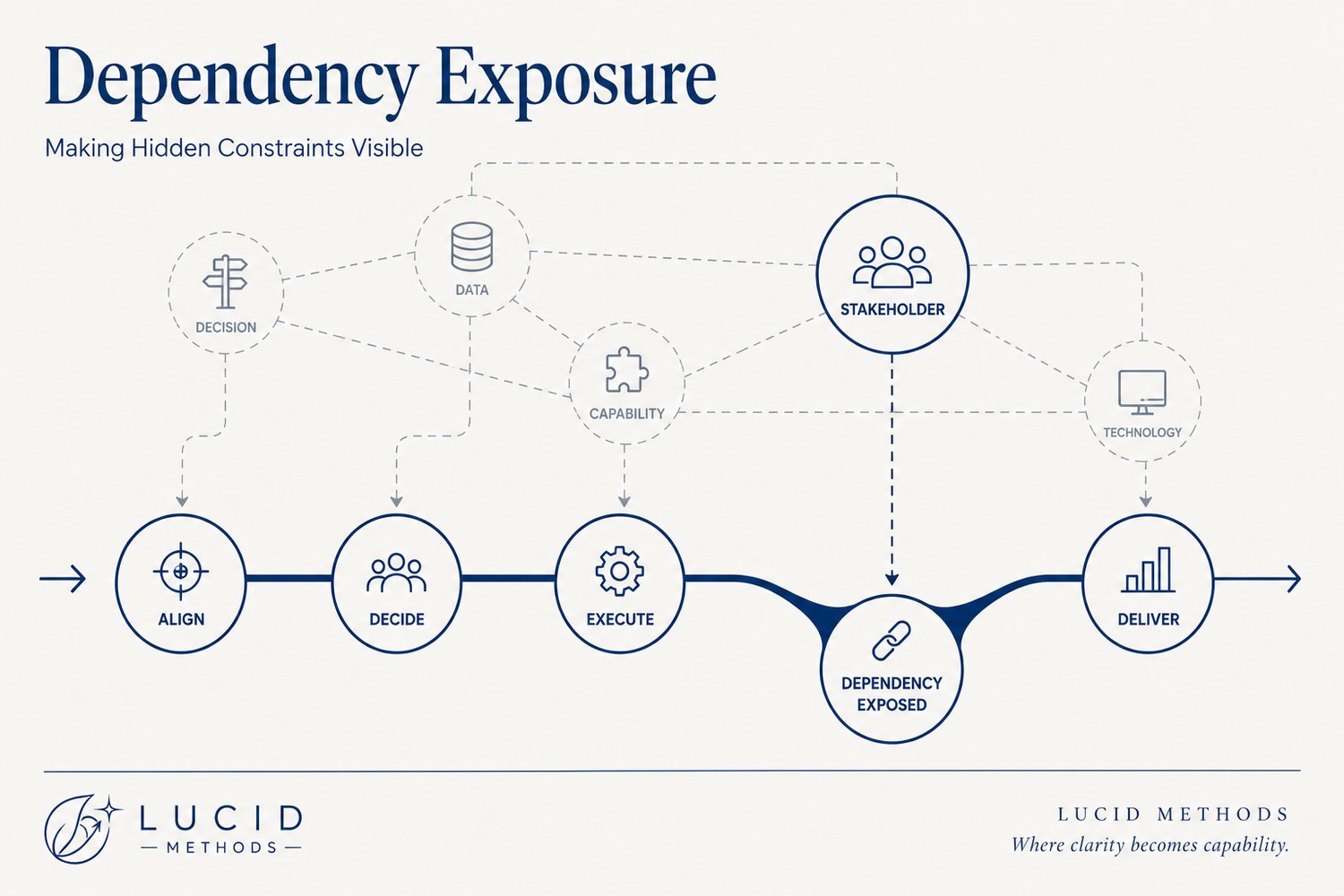
Dependency Exposure
Most Transformation Risks Already Exist
When transformation programmes fail, leaders often attribute the failure to resistance, poor execution, changing priorities, or insufficient resources.
Yet many execution failures originate elsewhere.
They emerge from dependencies that were always present but never made visible.
A team commits to a timeline.
A programme launches with confidence.
Milestones appear achievable.
Then progress stalls because a decision was never made, a capability was never developed, a system integration was never completed, or a stakeholder group was never aligned.
The dependency was not created during execution.
It was simply exposed.
Transformation does not create dependency.
Transformation reveals it.
The Illusion of Independent Work
Many organisations plan work as though activities can proceed independently.
Teams receive objectives.
Projects receive timelines.
Functions receive responsibilities.
On paper, each group appears capable of progressing on its own.
Reality is different.
Most meaningful work depends on something else happening first.
A technology team may require business requirements.
The business may require policy decisions.
Policy decisions may require executive alignment.
Executive alignment may require stakeholder consultation.
What appears to be a simple task is often embedded within a larger network of dependencies.
The more complex the transformation, the more interconnected the work becomes.
Execution rarely fails because people stop working.
Execution fails because work reaches a dependency that was never acknowledged.
Dependencies Are Not Problems
Organisations often treat dependencies as weaknesses.
They are not.
Dependencies are natural features of complex systems.
Every organisation relies on:
- Information dependencies
- Decision dependencies
- Capability dependencies
- Resource dependencies
- Technology dependencies
- Stakeholder dependencies
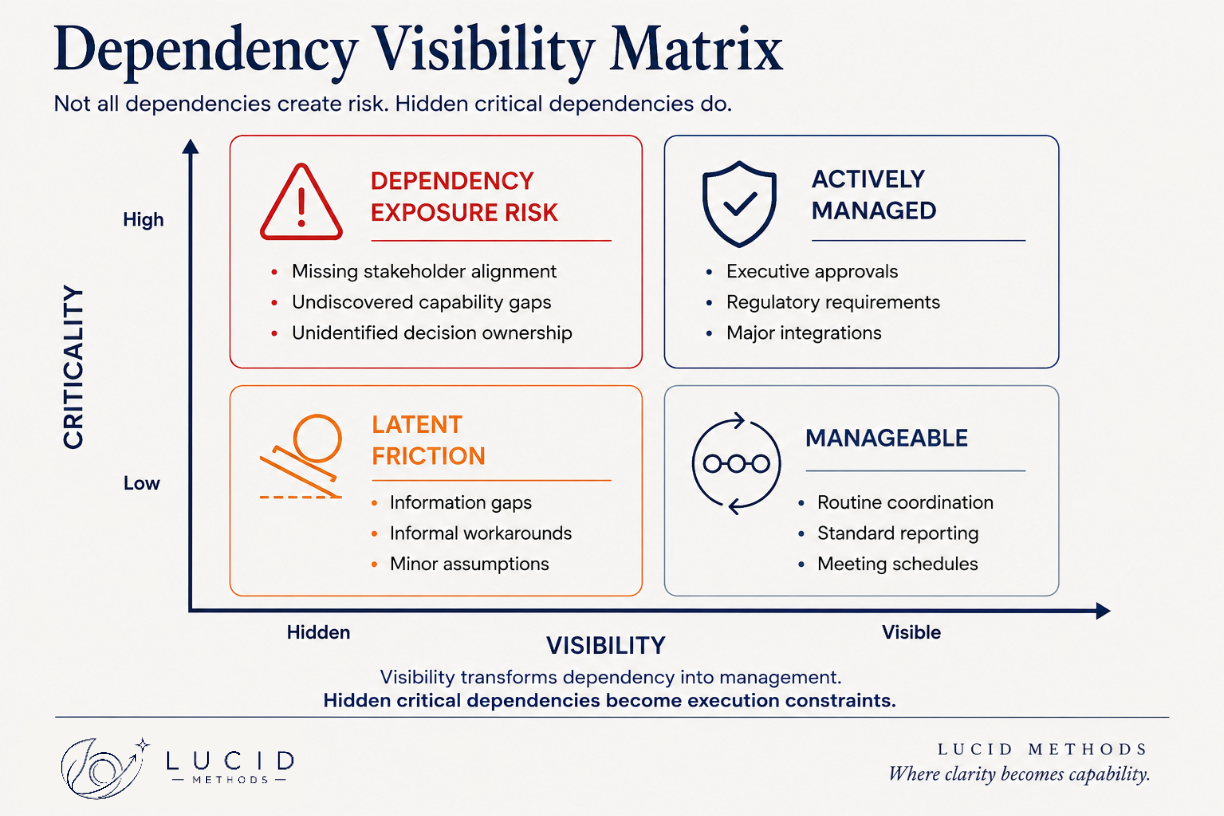
The existence of dependencies is not the risk.
The risk is not knowing they exist.
A dependency that is visible can be managed.
A dependency that remains hidden becomes an execution surprise.
The Three Stages of Dependency Exposure
Dependency exposure typically unfolds in predictable stages.
Stage 1: Assumed Independence
Teams believe work can proceed.
Plans are built around local activities.
Dependencies remain invisible because progress has not yet reached them.
Confidence is often highest during this stage.
Stage 2: Dependency Discovery
Execution reaches a point where progress requires something external.
A decision is missing.
A system is unavailable.
A stakeholder has not agreed.
A process owner has not been identified.
The dependency suddenly becomes visible.
The programme experiences its first signs of friction.
Stage 3: Dependency Constraint
Progress can no longer continue at the expected pace.
Teams wait.
Escalations increase.
Workarounds emerge.
Schedules begin slipping.
The dependency shifts from hidden condition to active constraint.
At this stage many organisations mistakenly believe execution has failed.
In reality, execution has simply revealed a structural condition that was already present.see.
Why Dependencies Remain Hidden
Most dependencies remain invisible for one of three reasons.
Local Planning
Teams plan within their own boundaries.
Work outside those boundaries is assumed rather than verified.
The resulting plan appears complete but reflects only part of the system.
Premature Optimism
Transformation programmes often begin with pressure to demonstrate momentum.
Questions about dependencies are perceived as obstacles.
As a result, uncertainty is accepted without examination.
The plan progresses before conditions are understood.
Fragmented Ownership
Many dependencies sit between teams rather than within teams.
No single owner feels responsible for managing them.
As a result, the dependency remains unexamined until it disrupts delivery.see.
Dependency Exposure Is a Diagnostic Signal
When a dependency suddenly blocks progress, organisations often react by accelerating activity.
Additional meetings are scheduled.
More reporting is introduced.
Escalations increase.
Pressure rises.
These actions address the symptom rather than the condition.
The appearance of a dependency should instead be treated as diagnostic information.
It reveals something important about how the system operates.
The question is not:
"How do we push through this obstacle?"
The more useful question is:
"What does this dependency tell us about the structure of execution?"
Every exposed dependency provides insight into the architecture of the organisation.
The Relationship Between Dependencies and Coherence
Dependency exposure is often a coherence issue rather than a project issue.
When interpretation is aligned, priorities are shared, and decisions are clear, dependencies can be managed effectively.
When coherence deteriorates, dependencies become amplified.
A simple dependency becomes a bottleneck.
A manageable coordination requirement becomes organisational friction.
A straightforward decision becomes a prolonged negotiation.
The dependency did not become larger.
The organisation became less coherent.
This is why two organisations with identical dependencies can experience dramatically different execution outcomes.
One manages them.
The other becomes trapped by them.
Designing for Dependency Visibility
Mature organisations do not attempt to eliminate dependencies.
They make them visible.
They ask:
- What must happen before this work can succeed?
- Who controls that condition?
- What assumptions are embedded within the plan?
- Which dependencies create the highest execution risk?
- What happens if the dependency fails?
These questions transform dependencies from hidden risks into manageable conditions.
Visibility does not remove complexity.
It removes surprise.
Dependency Exposure as an Early Warning System
Many transformation failures provide warning signals long before visible breakdown occurs.
Dependency exposure is one of the most reliable signals.
When teams repeatedly encounter unexpected blockers, the issue is rarely individual performance.
It often indicates that the organisation's dependency structure is poorly understood.
The earlier these dependencies become visible, the more options leaders have to respond.
By the time delivery stops, most corrective options have already narrowed.
Dependency exposure therefore serves as an early warning mechanism.
It reveals where the system is vulnerable before failure becomes unavoidable.
Conclusion
Transformation does not create organisational dependencies.
It exposes them.
What appears to be an execution problem is often the discovery of a condition that existed long before the programme began.
The challenge is not eliminating dependencies.
The challenge is making them visible early enough to manage.
Organisations that understand their dependency landscape experience fewer surprises, more predictable execution, and greater resilience under pressure.
Because sustainable execution depends not on how fast work moves, but on how clearly the conditions that enable work are understood.
Part of the Execution Architecture Series from LUCID Methods.
Explore more frameworks, diagnostic perspectives, and systems-thinking insights through the LUCID Method — developed to help organisations build clarity, coherence, and transformation that holds over time.