

Designing Sustainable Execution
Most transformation efforts do not fail because people are unwilling to work.
They fail because the system requires more energy to sustain than the organisation can continuously provide.
For a period of time, almost any initiative can appear successful.
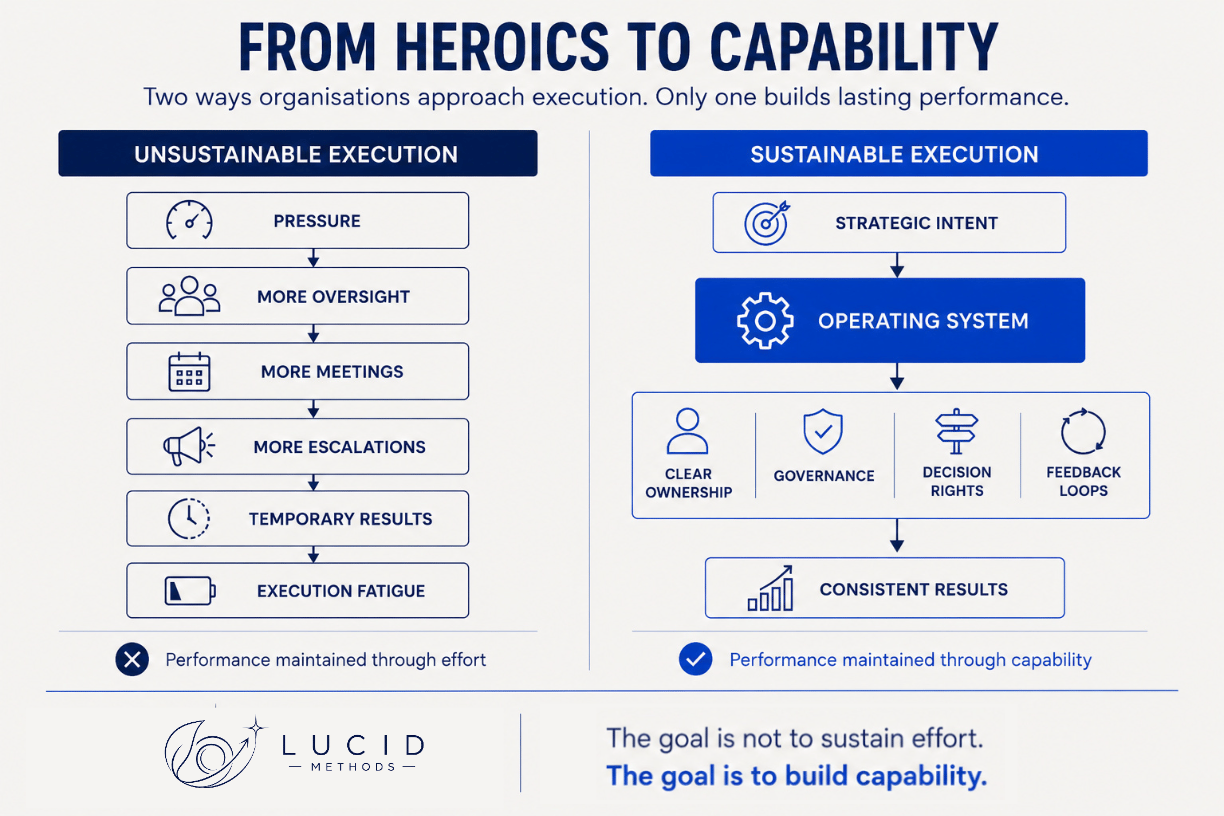
Leaders increase oversight.
Teams work longer hours.
Additional meetings are scheduled.
Exceptions are manually managed.
Escalations become normal.
Progress continues.
From the outside, execution appears healthy.
Yet beneath the surface, the organisation is consuming increasing amounts of attention, effort, and coordination simply to maintain momentum.
The problem is not execution.
The problem is sustainability.
The Hidden Cost of Momentum
Many organisations unknowingly operate through what can be described as borrowed execution.
Results are achieved through extraordinary effort rather than system capability.
When enough pressure is applied, almost any system can produce output.
The question is whether that output remains possible when pressure is removed.
A useful diagnostic question is:
If leadership attention disappeared tomorrow, would execution continue at the same level?
If the answer is no, the organisation may not have created a sustainable system.
It has created a temporary performance surge.
This distinction matters because transformation is rarely a short-term event.
Most strategic initiatives require months or years of coordinated execution.
Systems that depend on constant intervention eventually exhaust both leaders and teams.
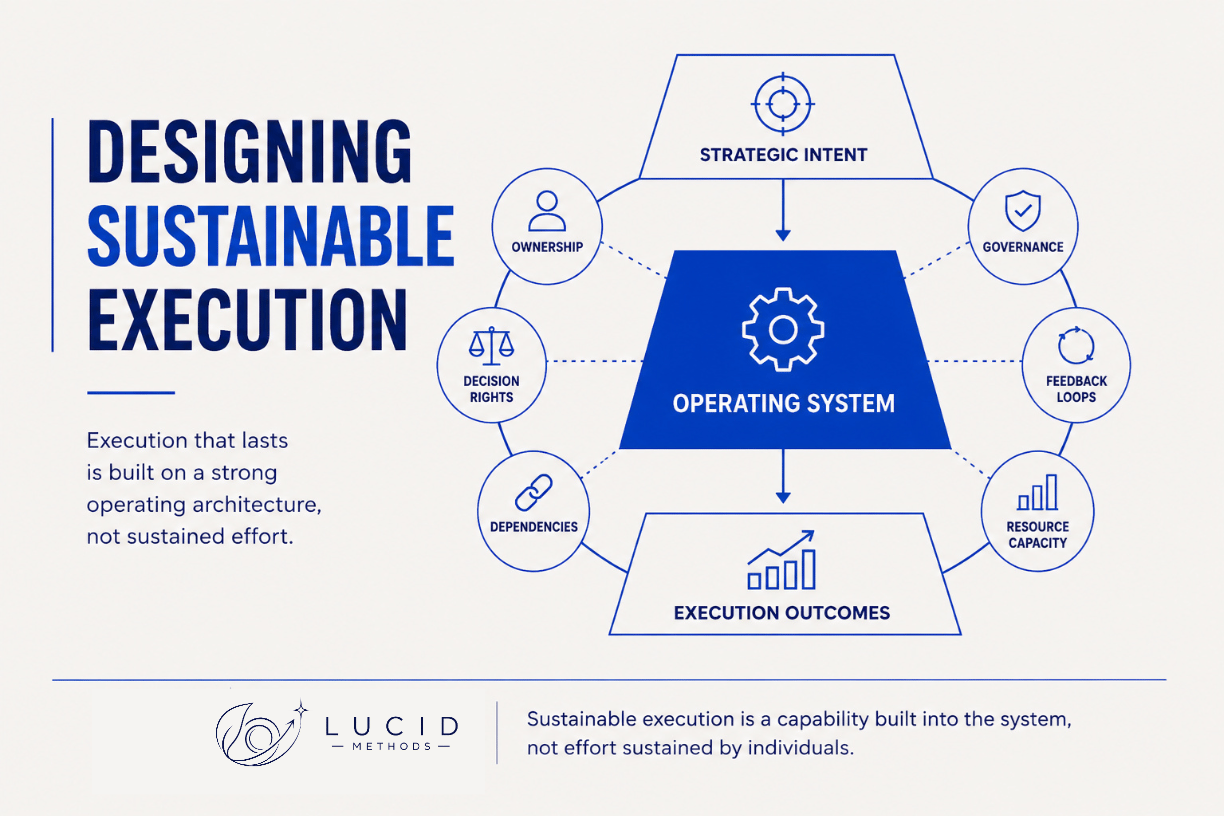
Sustainable Execution Is Designed
Many leaders assume sustainability emerges naturally after implementation.
In reality, sustainable execution is intentionally designed.
It occurs when desired behaviours become supported by the operating environment rather than individual heroics.
This requires alignment across multiple layers:
- Shared understanding
- Decision rights
- Processes
- Governance
- Feedback mechanisms
- Performance measures
- Resource allocation
When these elements reinforce one another, execution becomes easier over time.
When they conflict, execution becomes harder over time.
The difference is structural.
The Heroics Trap
A common sign of unsustainable execution is reliance on organisational heroes.
Every organisation has them.
The project manager who holds everything together.
The department head who resolves every escalation.
The experienced employee who understands all the exceptions.
The leader who continuously drives momentum through personal influence.
These individuals often become celebrated because they compensate for system weaknesses.
Yet their presence can conceal deeper structural problems.
The organisation begins to depend on exceptional individuals instead of improving the system itself.
When those individuals leave, performance often collapses.
The issue was never capability.
The issue was dependency.
Sustainable execution reduces dependence on individuals by strengthening the system around them.
Friction Is a Sustainability Signal
Execution friction is often viewed as an operational inconvenience.
In reality, friction is a diagnostic signal.
Repeated confusion.
Repeated clarification.
Repeated escalation.
Repeated rework.
Repeated alignment meetings.
These are not isolated inefficiencies.
They are indicators that the system is consuming excessive energy.
Every additional coordination effort represents organisational overhead.
The more overhead required, the less sustainable execution becomes.
Over time, friction accumulates.
The result is execution fatigue.
Teams become slower.
Decision-making becomes more cautious.
Engagement declines.
Transformation loses momentum.
The visible symptoms emerge long after the structural causes have been embedded.
Designing for Stability Instead of Speed
Many transformation programmes optimise for speed.
Fewer optimise for stability.
Speed matters.
But speed without stability creates fragile success.
A useful analogy is architecture.
A building designed only for rapid construction may stand initially.
However, if the structure cannot withstand ongoing pressure, deterioration becomes inevitable.
The same principle applies to organisations.
Sustainable execution requires:
- Clear interpretation of priorities
- Consistent decision-making mechanisms
- Defined ownership
- Manageable dependencies
- Reliable feedback loops
- Capacity to absorb change
These capabilities create resilience.
Resilience allows execution to continue even when conditions become uncertain.
Sustainable Systems Reduce Cognitive Load
One overlooked characteristic of sustainable execution is simplicity.
Complex systems demand continuous mental effort.
Teams must constantly remember exceptions.
Interpret ambiguous instructions.
Navigate unclear ownership.
Manage conflicting priorities.
The result is high cognitive load.
High cognitive load increases errors, delays, and dependency on experience.
Sustainable systems reduce the amount of thinking required to perform routine work.
This does not mean oversimplifying the organisation.
It means making the intended path clear.
When people understand what to do, why it matters, and how decisions are made, execution becomes more reliable.
Consistency becomes easier.
Scale becomes possible.
The Goal Is Not More Control
When execution problems emerge, leaders often respond with additional control.
More governance.
More reporting.
More approvals.
More meetings.
These interventions may temporarily improve visibility.
They rarely improve sustainability.
Sustainable execution is not achieved through tighter control.
It is achieved through better design.
The objective is not to create a system that requires constant supervision.
The objective is to create a system that remains coherent without it.
From Effort to Capability
The ultimate measure of transformation success is not whether teams worked hard.
It is whether the organisation became more capable.
Capability exists when desired outcomes can be repeatedly achieved without extraordinary effort.
When execution becomes part of the system rather than dependent on individual energy, sustainability emerges.
The organisation no longer relies on momentum alone.
It develops structural capacity.
And that is the difference between transformation that survives leadership attention and transformation that survives reality.
Closing Reflection
Unsustainable execution often looks successful in the short term.
The metrics improve.
Projects advance.
Deadlines are met.
But beneath the surface, the organisation may be spending increasing amounts of energy simply to maintain performance.
Sustainable execution begins when leaders stop asking:
"How do we push harder?"
and start asking:
"What must be true for this to continue working without extraordinary effort?"
That question shifts attention away from activity and toward architecture.
And sustainable execution is ultimately an architectural challenge.
Part of the Execution Architecture Series from LUCID Methods.
Explore more frameworks, diagnostic perspectives, and systems-thinking insights through the LUCID Method — developed to help organisations build clarity, coherence, and transformation that holds over time.