


Diagnostic Clarity in Transformation
The Most Expensive Mistake Happens Before Execution
When a transformation struggles, the instinct is usually to fix what is visible.
Teams redesign processes.
Leaders launch initiatives.
Additional governance is introduced.
More communication is sent.
Yet despite significant effort, the underlying problems often remain.
The reason is surprisingly simple:
Many transformations fail because they are solving the wrong problem.
Poor execution is easy to see.
Poor diagnosis is much harder to detect.
When a problem is misdiagnosed, even highly competent execution can produce little improvement because effort is directed toward symptoms rather than causes.
Transformation success depends not only on execution capability but also on the clarity of the diagnosis that precedes action.
The Difference Between Observation and Diagnosis
Transformation teams often mistake observations for diagnoses.
For example:
Observation > Assumed Diagnosis
Projects are delayed > Teams lack accountability
Adoption is low > Employees resist change
Departments disagree > Stakeholders are not aligned
Decisions are slow > Governance is inefficient
Customers complain > Service quality is poor
These observations may be true.
However, they only describe what is happening.
They do not explain why it is happening.
Diagnosis begins when we move beyond visible symptoms and investigate the underlying mechanisms generating those symptoms.
Without this step, interventions often target the wrong area of the system.
Why Organisations Jump to Solutions
Most organisations operate under pressure.
Leaders are expected to act quickly.
Problems create urgency.
Stakeholders demand progress.
Under these conditions, there is a natural tendency to move directly from symptom to solution.
The cycle often looks like this:
- A problem becomes visible.
- Pressure to respond increases.
- A solution is proposed.
- Activity begins.
- The underlying cause remains unresolved.
The organisation experiences movement.
Yet little structural improvement occurs.
This is one of the most common sources of the illusion of progress.
Teams become busy solving a problem they never fully understood.
Diagnostic Clarity Requires Looking Beneath the Surface
Visible issues often emerge from deeper system conditions.
For example:
A leadership team may believe employees are resisting change.
After investigation, they discover:
- Different departments interpret the transformation differently.
- Managers communicate conflicting priorities.
- Success measures are inconsistent.
- Roles and responsibilities remain unclear.
The issue was never resistance.
The issue was interpretation.
Similarly, what appears to be poor execution may actually be:
- Hidden dependency conflicts
- Ambiguous decision rights
- Structural bottlenecks
- Resource competition
- Conflicting incentives
- Coherence breakdowns
The visible symptom is real.
The assumed cause is not.
Diagnostic clarity helps separate the two.
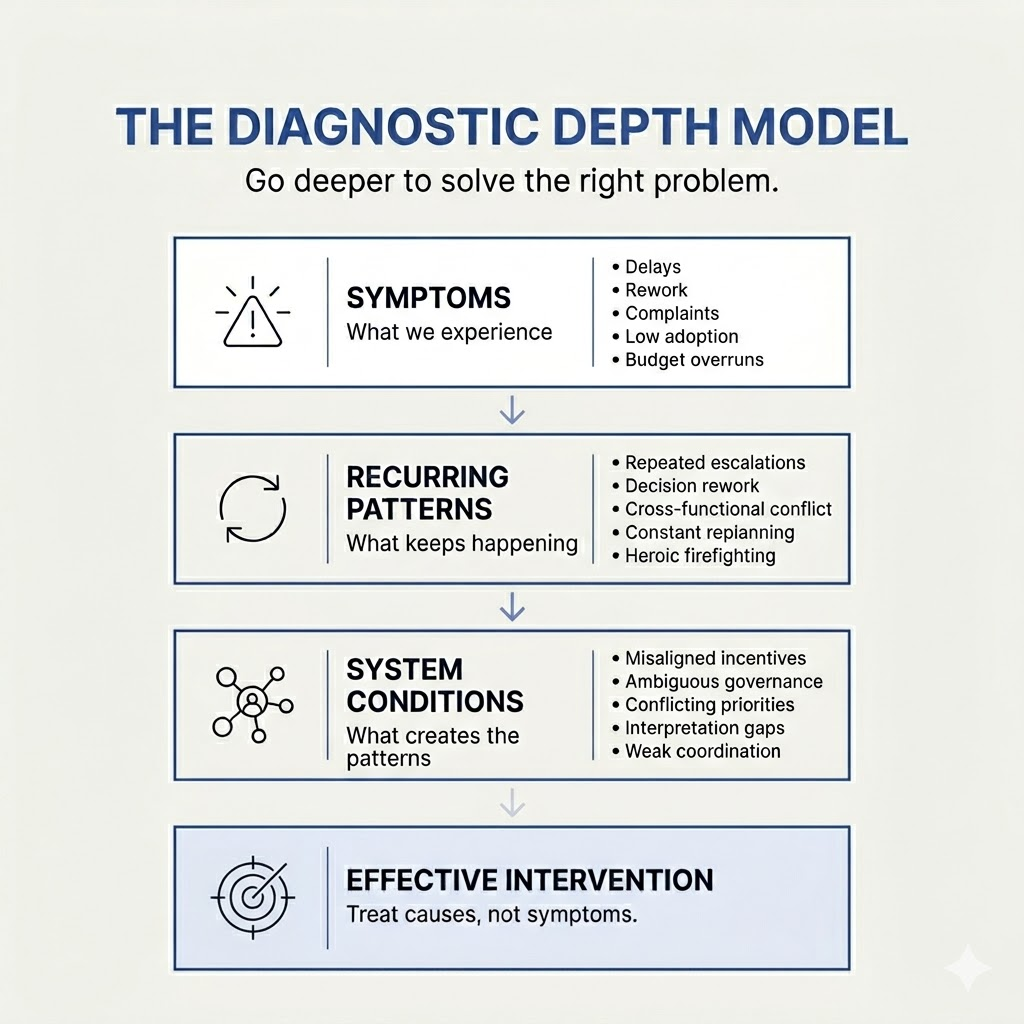
The Three Levels of Transformation Diagnosis
Effective diagnosis typically operates across three levels.
Level 1: Symptoms
Symptoms are what people experience.
Examples include:
- Delays
- Rework
- Escalations
- Low adoption
- Budget overruns
- Customer complaints
Symptoms indicate something is wrong.
They rarely reveal what is wrong.
Level 2: Behaviour Patterns
Patterns examine recurring actions and interactions.
Examples include:
- Departments repeatedly disagreeing
- Teams escalating similar issues
- Decisions continually being revisited
- Projects relying on heroics to succeed
Patterns provide clues about systemic weaknesses.
Level 3: System Conditions
This level investigates the structures creating those patterns.
Examples include:
- Misaligned incentives
- Ambiguous governance
- Fragmented information flows
- Conflicting priorities
- Unclear interpretation of strategy
- Weak coherence mechanisms
System conditions are often the true source of recurring transformation difficulties.
Without understanding this layer, symptoms frequently return.
Why Root Causes Are Often Misidentified
Transformation environments are complex.
Multiple issues can appear simultaneously.
Because symptoms are visible and causes are not, organisations often attribute problems to the most convenient explanation.
Examples include:
"People don't want to change."
"The team lacks accountability."
"Communication isn't working."
"The project manager isn't strong enough."
While these explanations may occasionally be correct, they are frequently incomplete.
The real issue may be structural.
When symptoms are attributed to individuals instead of systems, interventions often focus on training, communication, or performance management while deeper constraints remain untouched.
Diagnostic Clarity Changes the Questions We Ask
Poor diagnosis asks:
- Who is causing the problem?
- Which team is responsible?
- What action should we take?
Strong diagnosis asks:
- What conditions are creating this outcome?
- What patterns keep repeating?
- What assumptions are we making?
- What would explain all observed symptoms simultaneously?
The quality of diagnosis depends largely on the quality of questions.
Better questions produce better explanations.
Better explanations produce better interventions.
Diagnostic Clarity and LUCID
The LUCID methodology was designed around a simple observation:
Many transformation failures are not execution failures.
They are diagnosis failures.
Organisations frequently focus on visible breakdowns while the underlying system remains unchanged.
LUCID helps practitioners investigate transformation challenges through a systems lens.
Instead of asking:
"What problem should we fix?"
It asks:
"What conditions are generating this problem?"
This shift changes the entire nature of intervention.
Rather than repeatedly treating symptoms, practitioners begin addressing the structures that create them.
From Activity to Understanding
Transformation pressure often rewards action.
Diagnostic clarity rewards understanding.
The two are not the same.
Activity can occur without understanding.
Understanding can dramatically improve the effectiveness of activity.
Organisations that develop strong diagnostic capability become better at:
- Identifying root causes
- Prioritising interventions
- Avoiding wasted effort
- Reducing transformation friction
- Improving execution outcomes
They spend less time reacting to symptoms and more time improving the systems that generate results.
Conclusion
Every transformation begins with an interpretation of the problem.
If that interpretation is inaccurate, even excellent execution may fail to create meaningful improvement.
Diagnostic clarity is therefore not a luxury.
It is a prerequisite for effective transformation.
Before asking whether execution is working, leaders should ask a more fundamental question:
Are we solving the right problem?
Because the quality of a transformation is often determined long before implementation begins—at the moment the problem is defined.
Part of the Diagnostic Thinking Series from LUCID Methods.
Explore more frameworks, diagnostic perspectives, and systems-thinking insights through the LUCID Method — developed to help organisations build clarity, coherence, and transformation that holds over time.