

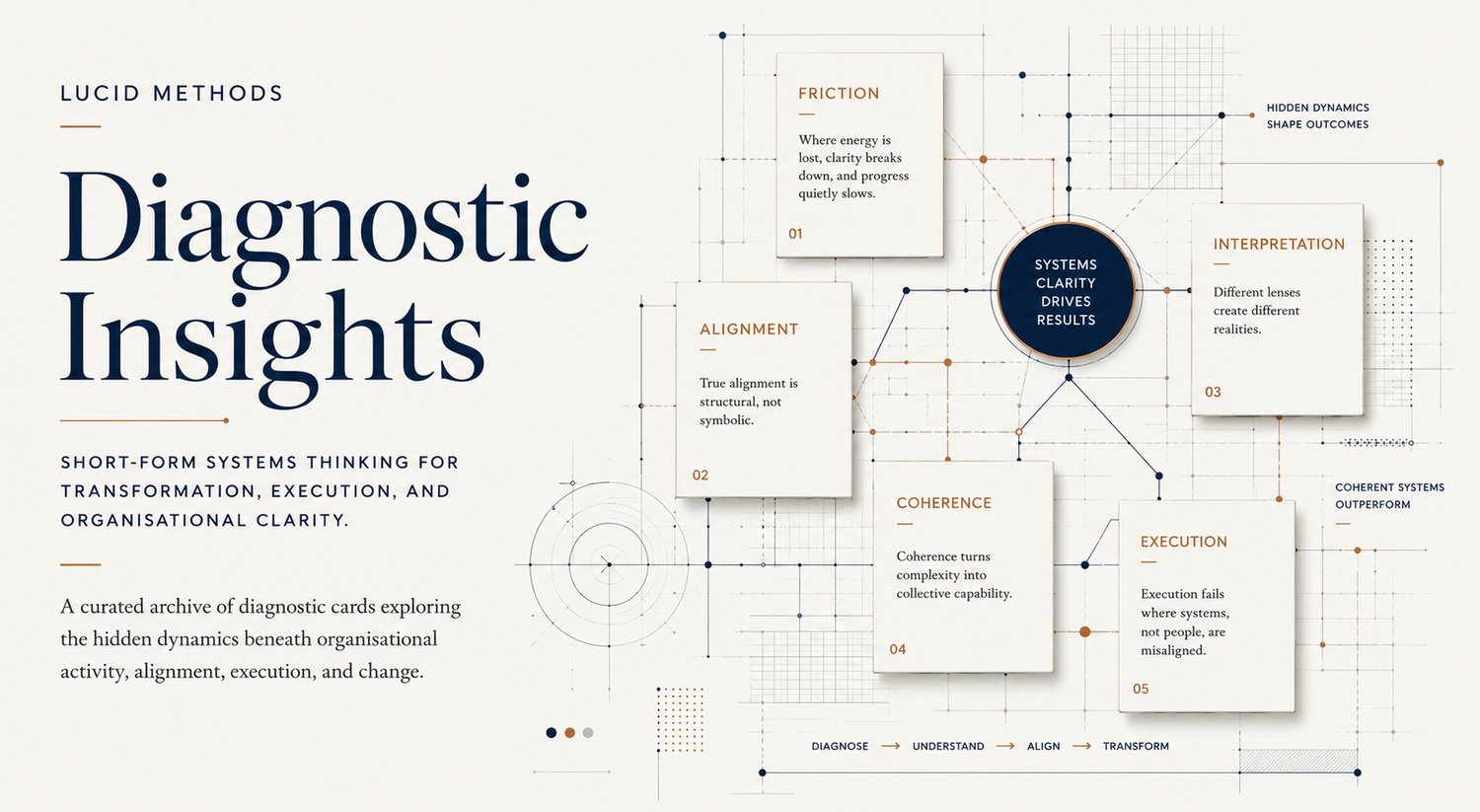
Series 1: Transformation Failure Signals
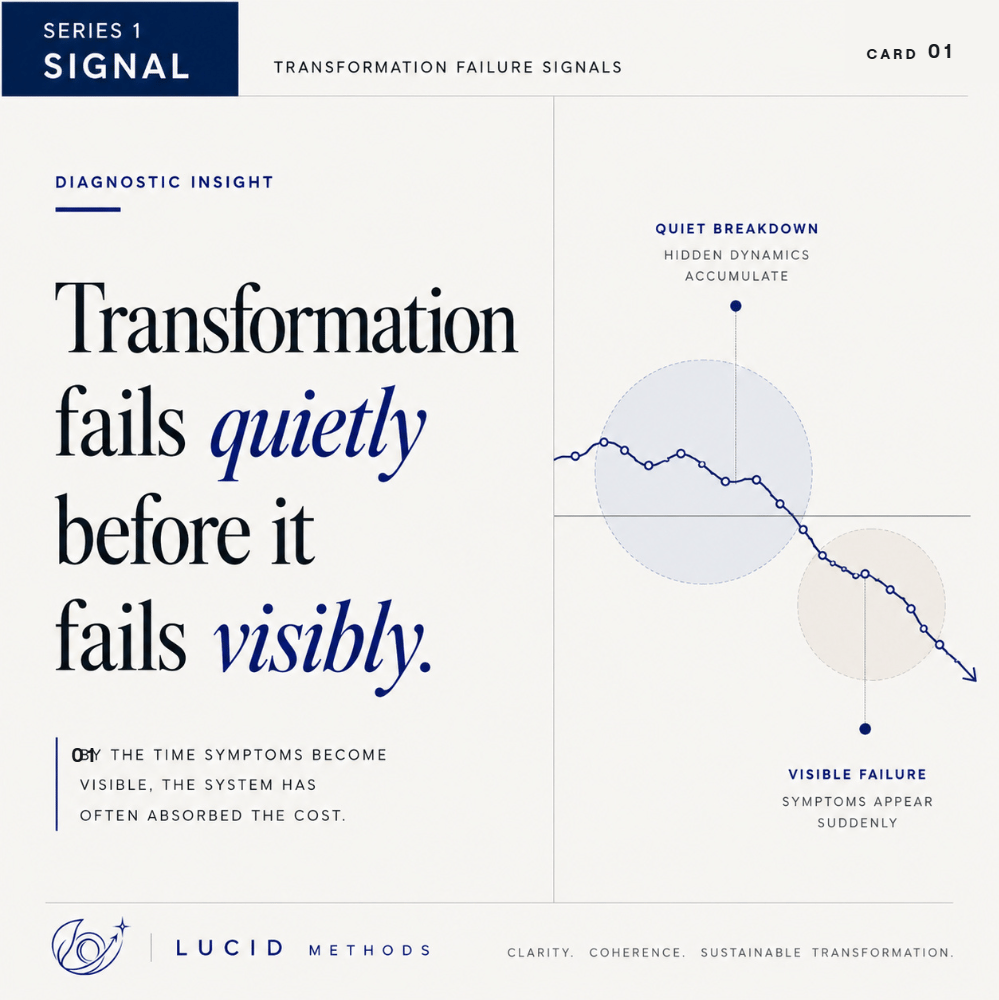
Transformation rarely collapses overnight.
Most systems fail quietly first.
Misalignment accumulates beneath visible activity.
Teams keep moving, meetings continue, dashboards stay green — but coherence slowly erodes underneath the surface.
Interpretation drifts.
Priorities compete.
Ownership blurs.
Feedback weakens.
Execution fragments.
By the time failure becomes visible, the system has often already absorbed months of hidden cost.
Visible failure is usually the symptom.
Quiet breakdown is the real problem.
Sustainable transformation depends on detecting structural friction before momentum turns into decline.
That is why clarity, coherence, and aligned execution matter more than activity alone.
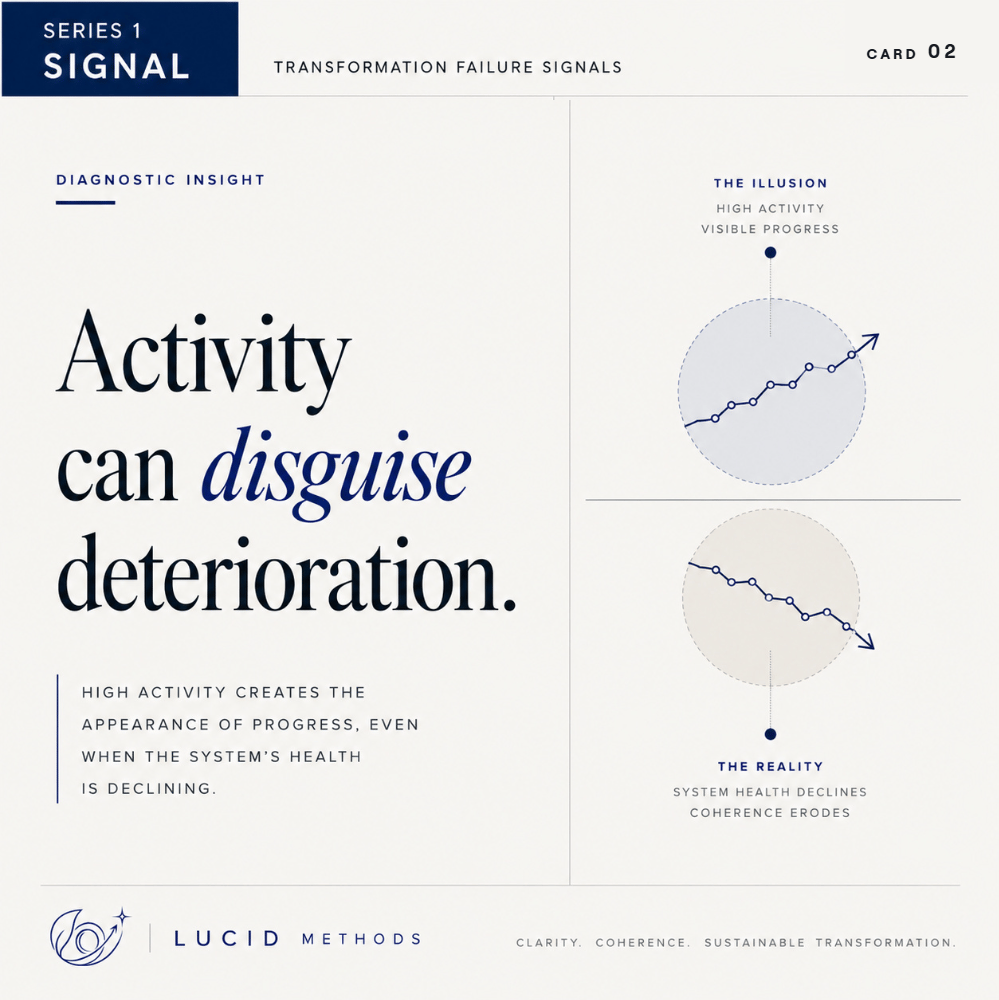
One of the most dangerous moments in transformation is when the organisation appears busy.
Meetings increase.
Updates multiply.
Teams move faster.
Dashboards stay active.
From the surface, it looks like progress.
But activity alone is not evidence of system health.
A system can be highly active while coherence is quietly deteriorating underneath:
• priorities begin competing
• teams interpret goals differently
• coordination weakens
• friction accumulates
• decisions lose alignment
This creates the illusion of progress.
The organisation keeps moving — but not necessarily in the same direction.
Sustainable transformation is not built on motion alone.
It depends on clarity, coherence, and aligned execution across the system.
Because activity can disguise deterioration long before failure becomes visible.
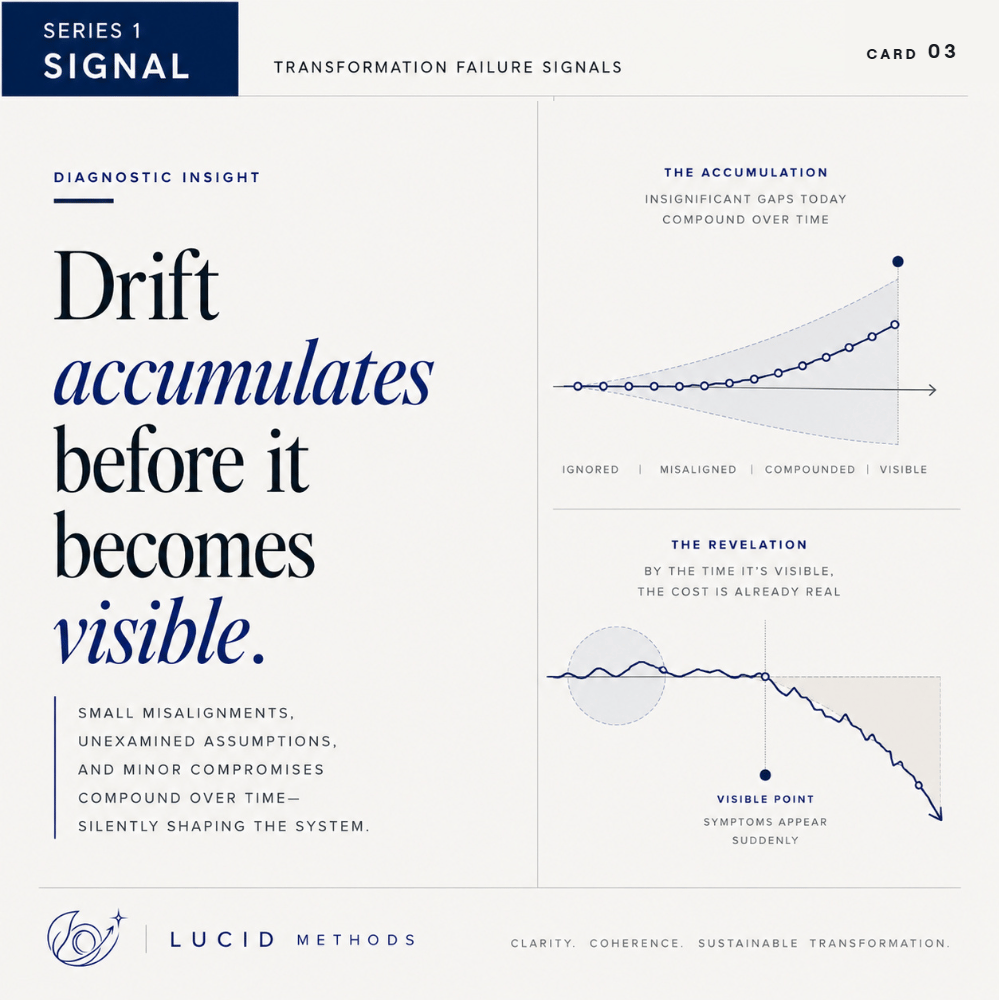
Transformation breakdown rarely begins with a major failure.
It usually begins with small drift.
A minor compromise.
An unclear assumption.
A delayed conversation.
A misaligned interpretation that nobody stops to correct.
Individually, these moments appear insignificant.
But systems remember.
What goes unexamined today compounds tomorrow:
• small gaps widen
• coordination weakens
• clarity erodes
• trust declines
• execution fragments
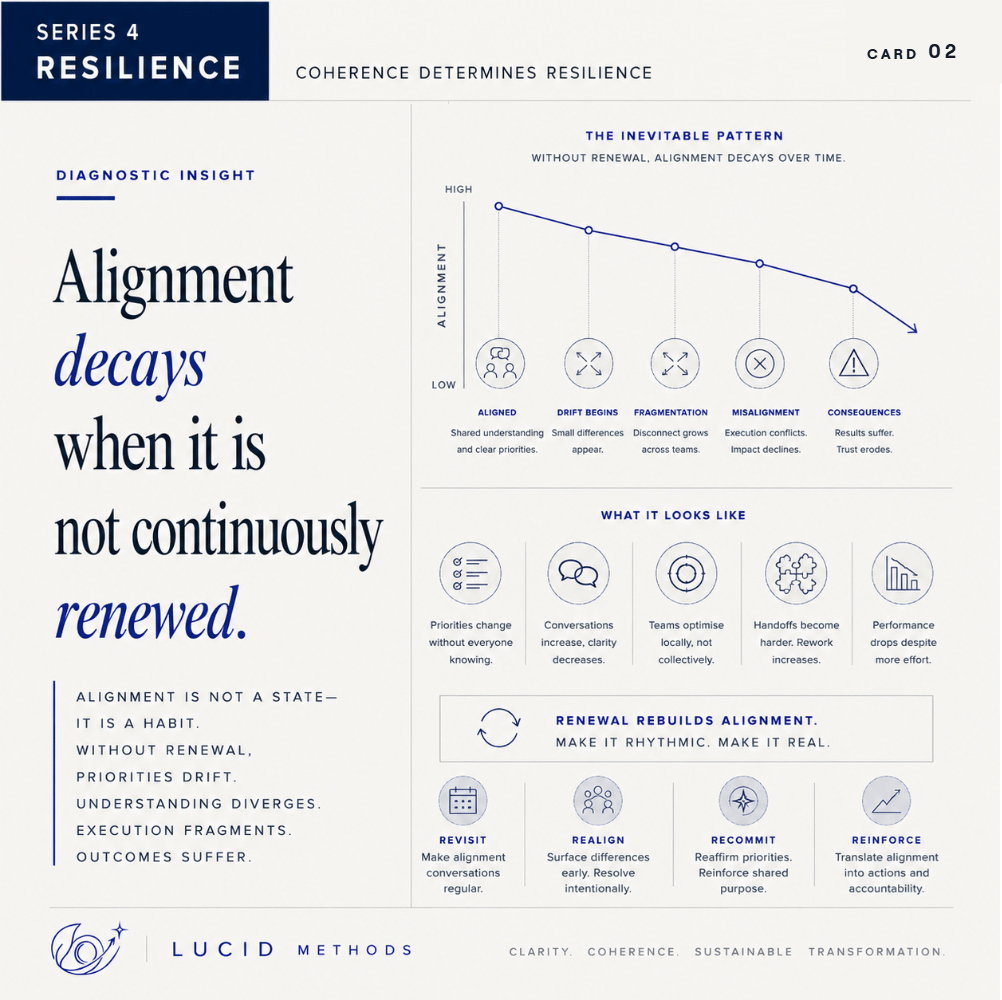
Over time, drift becomes embedded into the operating system itself.
Then one day, the symptoms suddenly become visible — missed outcomes, escalating friction, stalled momentum, declining confidence.
But visible failure is often the revelation, not the beginning.
The cost had already been accumulating quietly beneath the surface.
Healthy transformation systems do not only manage execution.
They continuously correct drift before it compounds.
Series 2: Interpretation & Shared Meaning
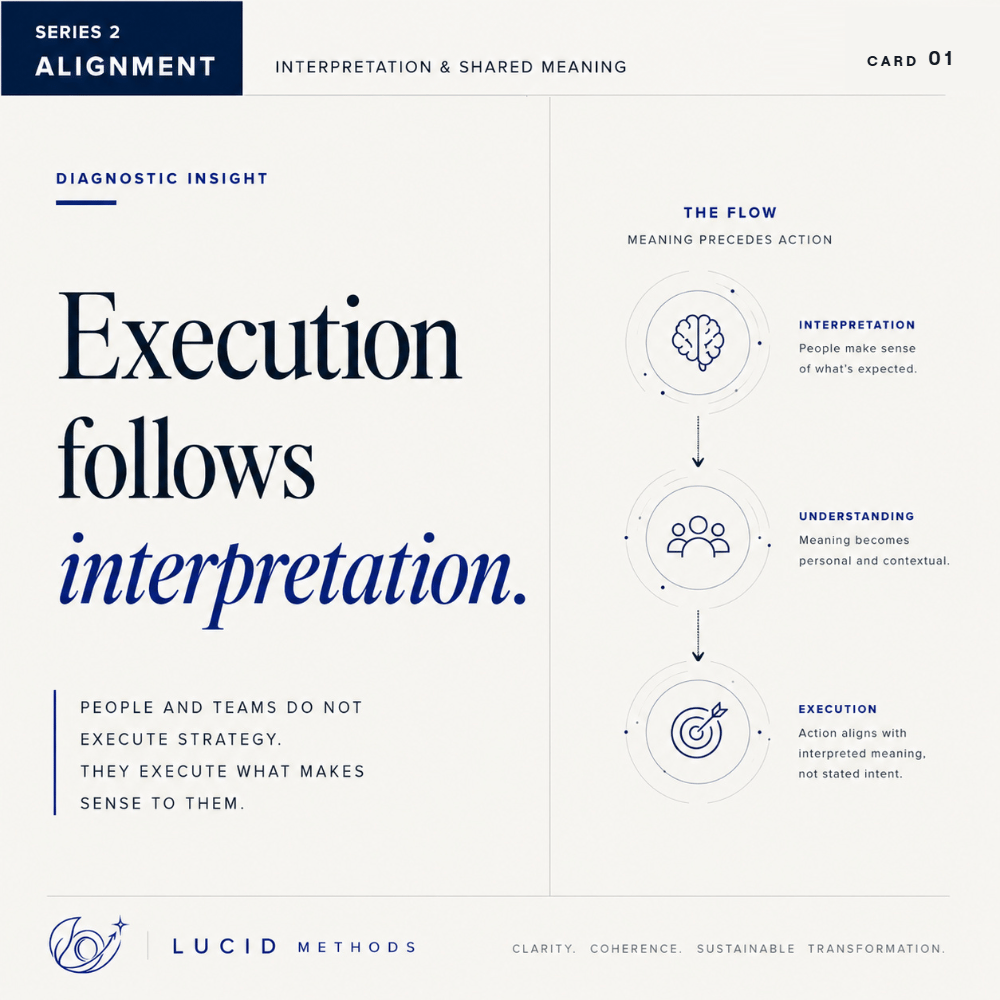
Execution does not begin at action.
It begins much earlier — at interpretation.
Teams rarely execute strategy exactly as stated. They execute what they believe the strategy means within their own context, pressures, incentives, and assumptions. This is why organisations can appear aligned at the surface while fragmentation quietly develops underneath.
The same instruction can produce:
- different priorities
- different decisions
- different definitions of success
- different execution behaviours
Over time, interpretation drift becomes operational friction.
Alignment is therefore not simply about communication clarity. It is about building shared meaning that can hold under pressure, ambiguity, and changing realities.
Because in practice:
People do not execute strategy.
They execute what makes sense to them.
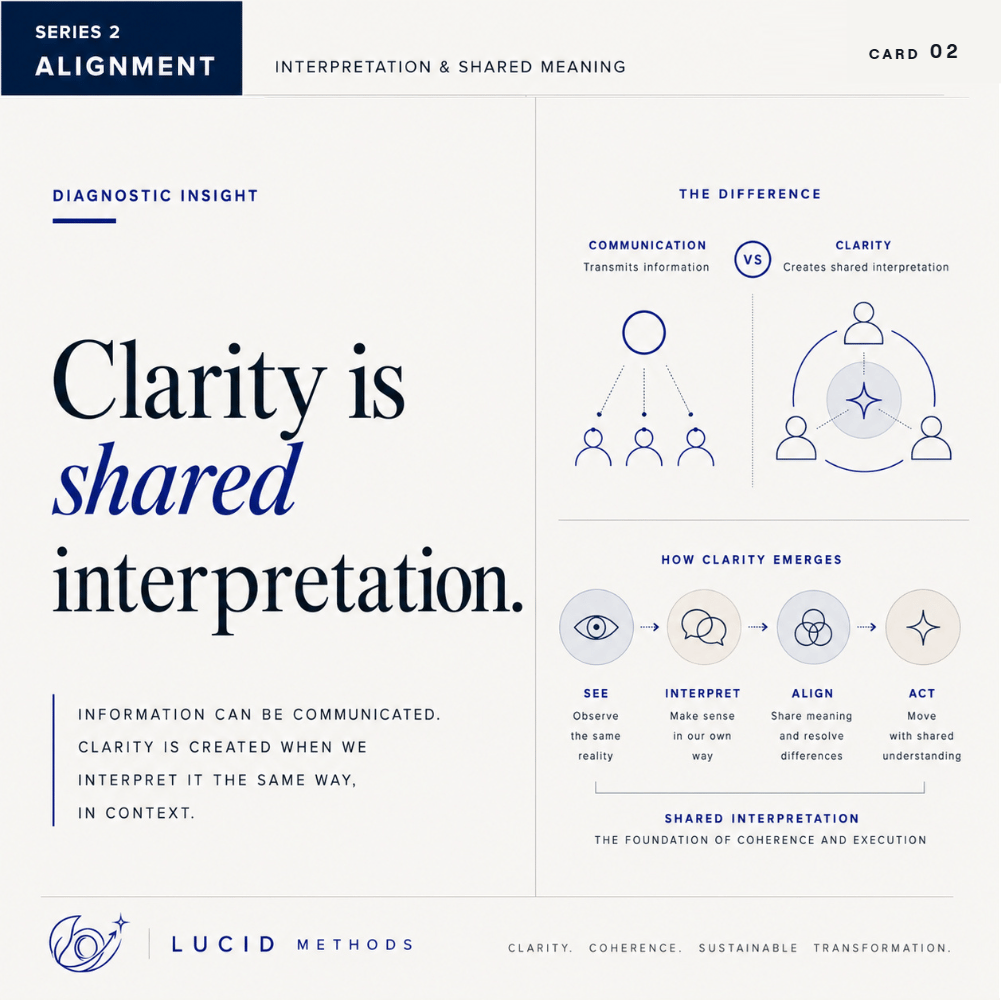
One of the most dangerous moments in transformation is when the organisation appears busy.
• Meetings increase.
• Updates multiply.
• Teams move faster.
• Dashboards stay active.
From the surface, it looks like progress.
But activity alone is not evidence of system health.
A system can be highly active while coherence is quietly deteriorating underneath:
• priorities begin competing
• teams interpret goals differently
• coordination weakens
• friction accumulates
• decisions lose alignment
This creates the illusion of progress.
The organisation keeps moving — but not necessarily in the same direction.
Sustainable transformation is not built on motion alone.
It depends on clarity, coherence, and aligned execution across the system.
Because activity can disguise deterioration long before failure becomes visible.
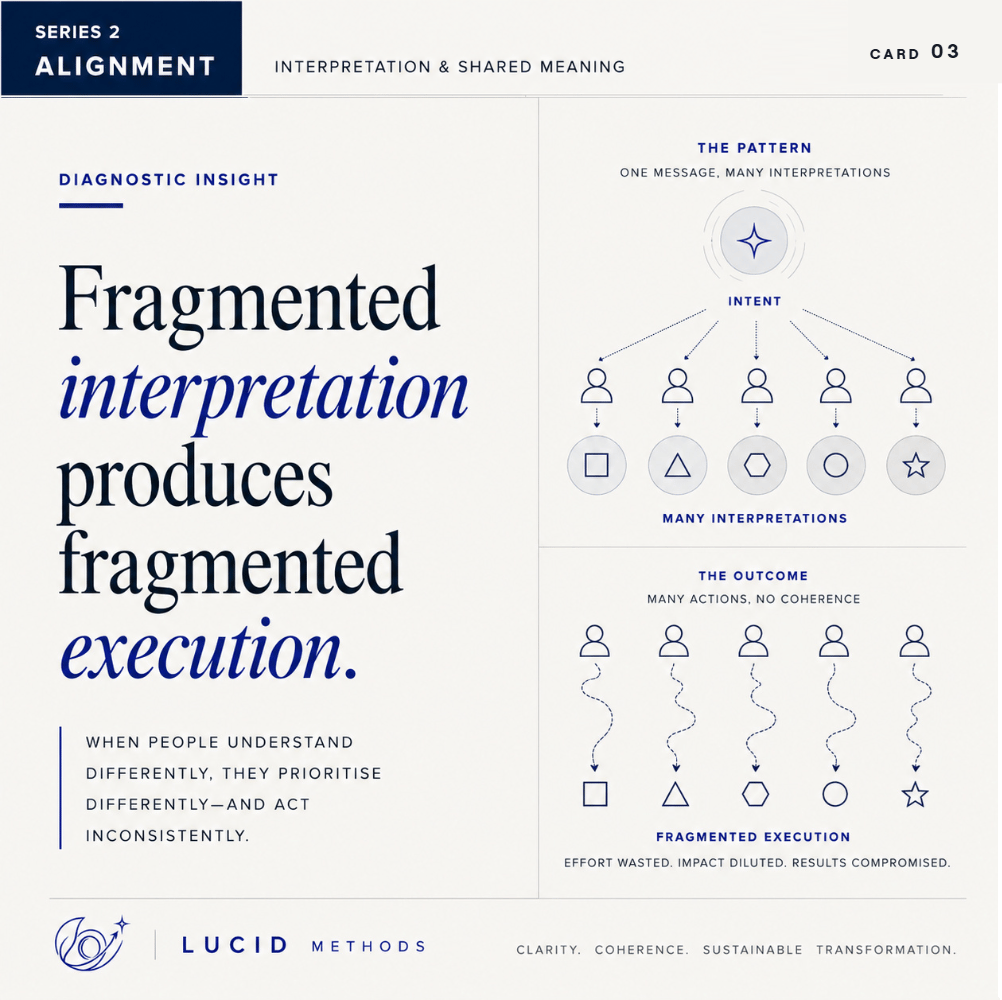
Most execution problems are not execution problems at all.
They are interpretation problems that surfaced later as operational fragmentation.
A single strategy can be communicated across an organisation —
yet each team may still walk away with a different understanding of:
- what matters most
- what success means
- what should be prioritised
- what actions should follow
The result is predictable.
Different interpretations create different decisions.
Different decisions create competing execution behaviours.
And over time, the organisation begins moving in multiple directions at once.
This is why teams can all appear busy, committed, and productive…
while the broader system slowly loses coherence underneath.
Fragmented execution rarely begins with bad intent.
It begins with unaligned meaning.
When shared interpretation weakens:
- priorities compete
- coordination slows
- rework increases
- ownership blurs
- momentum becomes expensive
Execution coherence is therefore not created through activity alone.
It is created through continuously aligning how people understand reality, intent, and outcomes together.
Series 3: Structure Shapes Behaviour
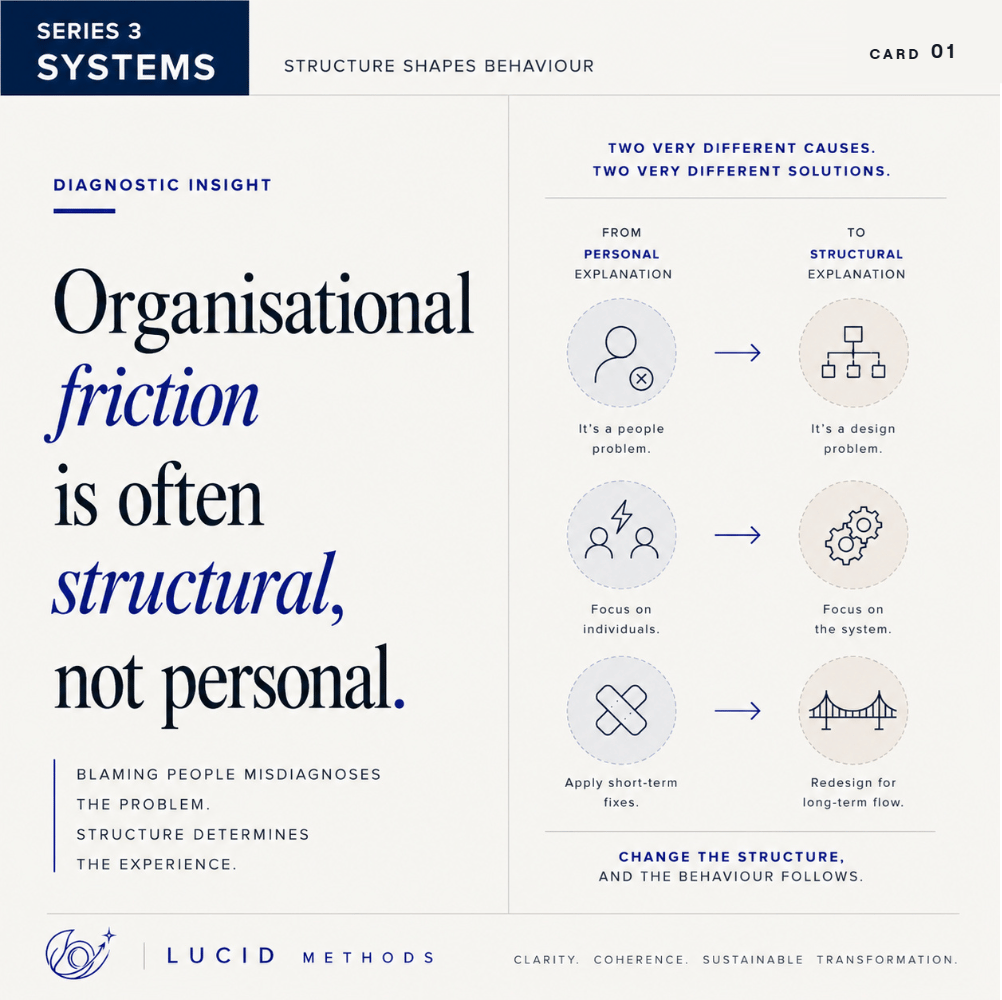
Many organisational problems are diagnosed at the wrong level.
When friction appears, the instinct is often to blame individuals:
- people are resistant
- teams are not collaborating
- communication is weak
- execution discipline is poor
But in many cases, the deeper issue is structural.
Systems shape behaviour.
Structures influence incentives.
Processes reinforce priorities.
Design determines how work actually flows.
When structures are fragmented, even capable people struggle to coordinate coherently.
This is why organisations often experience:
- duplicated effort
- slow decisions
- recurring misalignment
- accountability confusion
- constant firefighting
—not because people are inherently ineffective, but because the system continuously generates friction.
Personal explanations produce personal fixes:
more pressure, more meetings, more reminders, more escalation.
Structural explanations produce structural solutions:
better alignment architecture, clearer ownership, reduced dependency friction, and healthier operational flow.
Sustainable transformation begins when organisations stop asking:
“Who is causing the problem?”
And start asking:
“What in the system is producing this behaviour?”
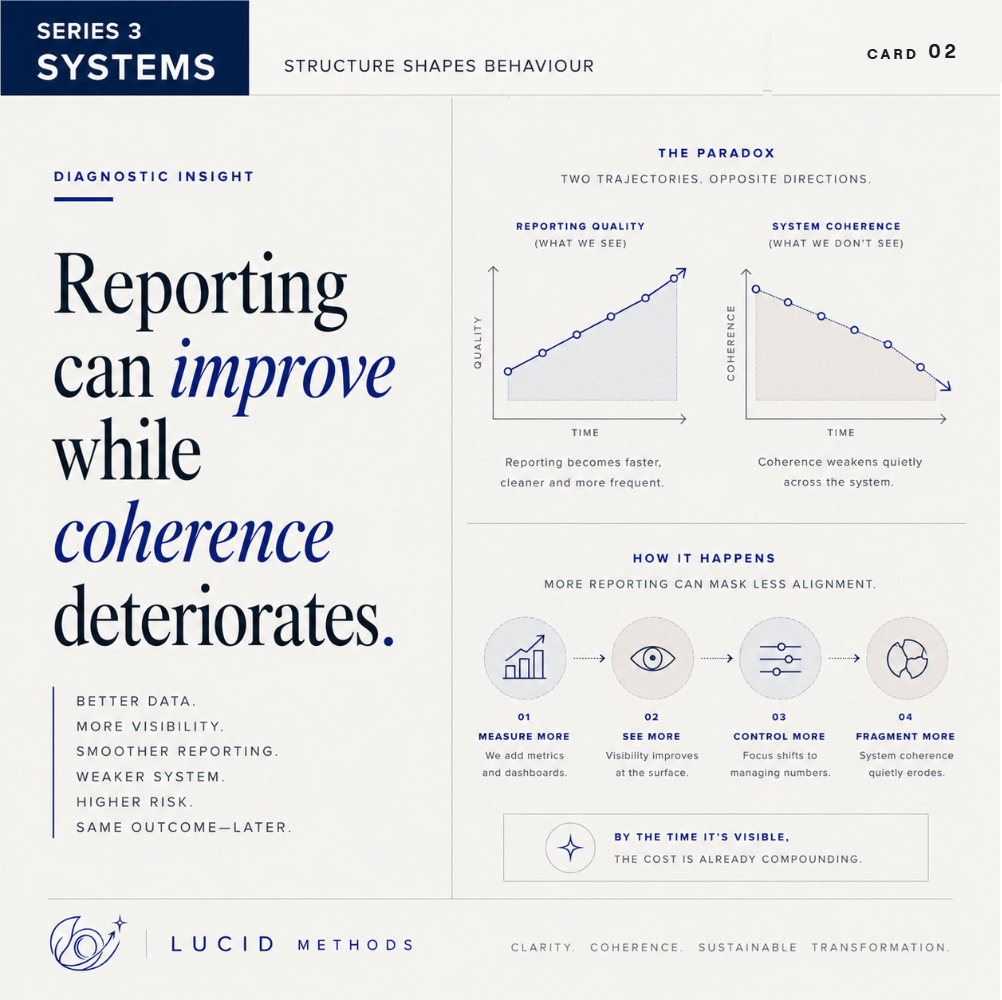
More visibility does not automatically create more coherence.
In many organisations, reporting improves while alignment quietly deteriorates underneath.
Dashboards become cleaner.
Metrics become more detailed.
Updates become more frequent.
Visibility increases across the system.
Yet despite all this activity:
- coordination weakens
- priorities drift
- teams optimise locally
- ownership fragments
- execution slows
Because measurement alone does not create coherence.
Sometimes, increased reporting creates the illusion of control while deeper structural fragmentation continues unnoticed.
The organisation becomes highly visible at the surface —
but poorly aligned underneath.
This is one of the quieter dangers of modern execution systems:
when attention shifts toward managing metrics instead of maintaining shared understanding, operational coherence, and structural alignment.
A system can become:
- more measurable
- more trackable
- more reportable
…while simultaneously becoming less integrated and less resilient.
By the time the breakdown becomes visible in outcomes, the hidden cost has often already compounded across the organisation.
What organisations need is not visibility alone.
They need coherence strong enough to hold beneath visibility.
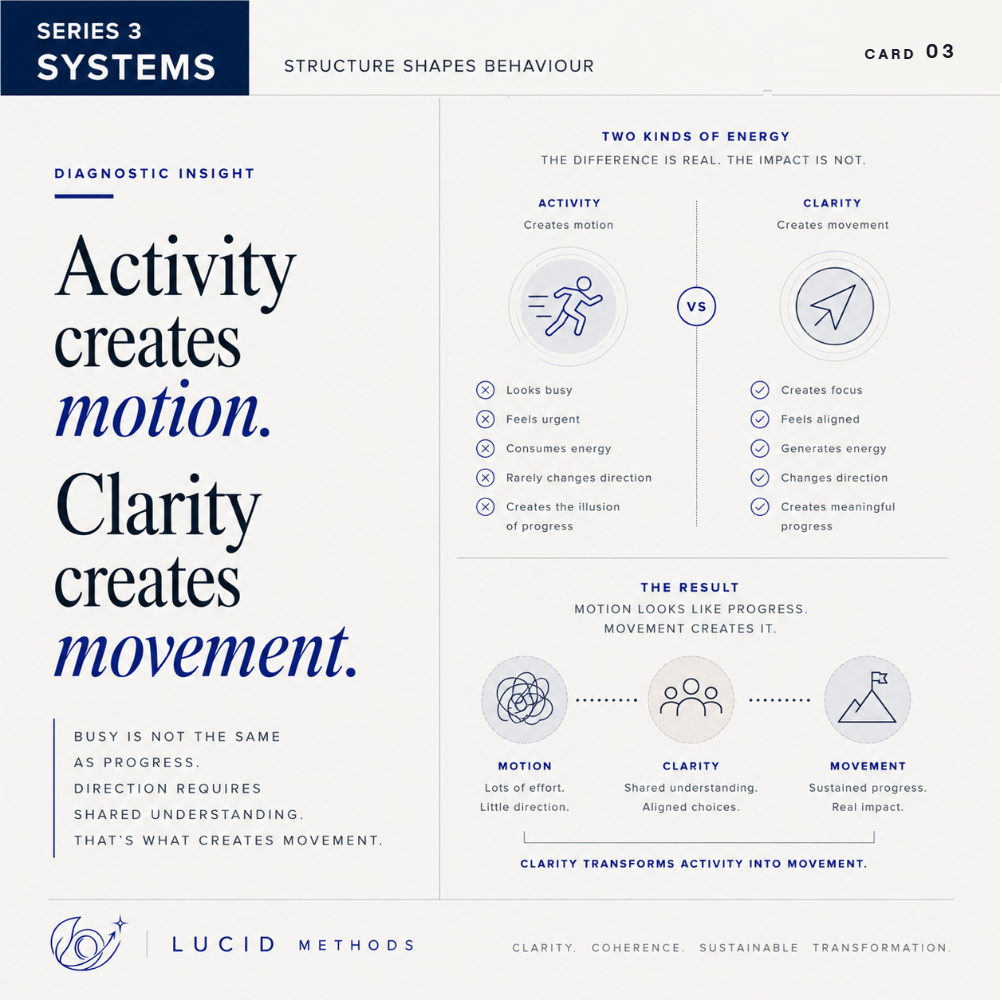
Organisations often confuse movement with motion.
A calendar filled with meetings.
Constant updates.
Fast responses.
Endless activity.
All of it can create the appearance of progress.
But activity alone does not guarantee meaningful movement.
Without clarity:
- teams move in different directions
- priorities compete
- effort becomes fragmented
- urgency replaces focus
- energy gets consumed without sustained impact
Motion feels productive because something is always happening.
Movement is different.
Movement changes direction, creates alignment, and produces compounding progress over time.
The difference is not speed.
It is coherence.
Clarity creates movement because people:
- understand the same priorities
- interpret goals consistently
- make aligned decisions
- coordinate effort meaningfully
This is why some organisations remain exhausted despite working intensely:
they are generating motion without directional coherence.
And this is why clarity matters far beyond communication.
Clarity is what transforms scattered activity into coordinated progress.
Because busy is not the same as effective.
And visible activity is not always evidence of real advancement.
Series 4: Coherence Determines Resilience
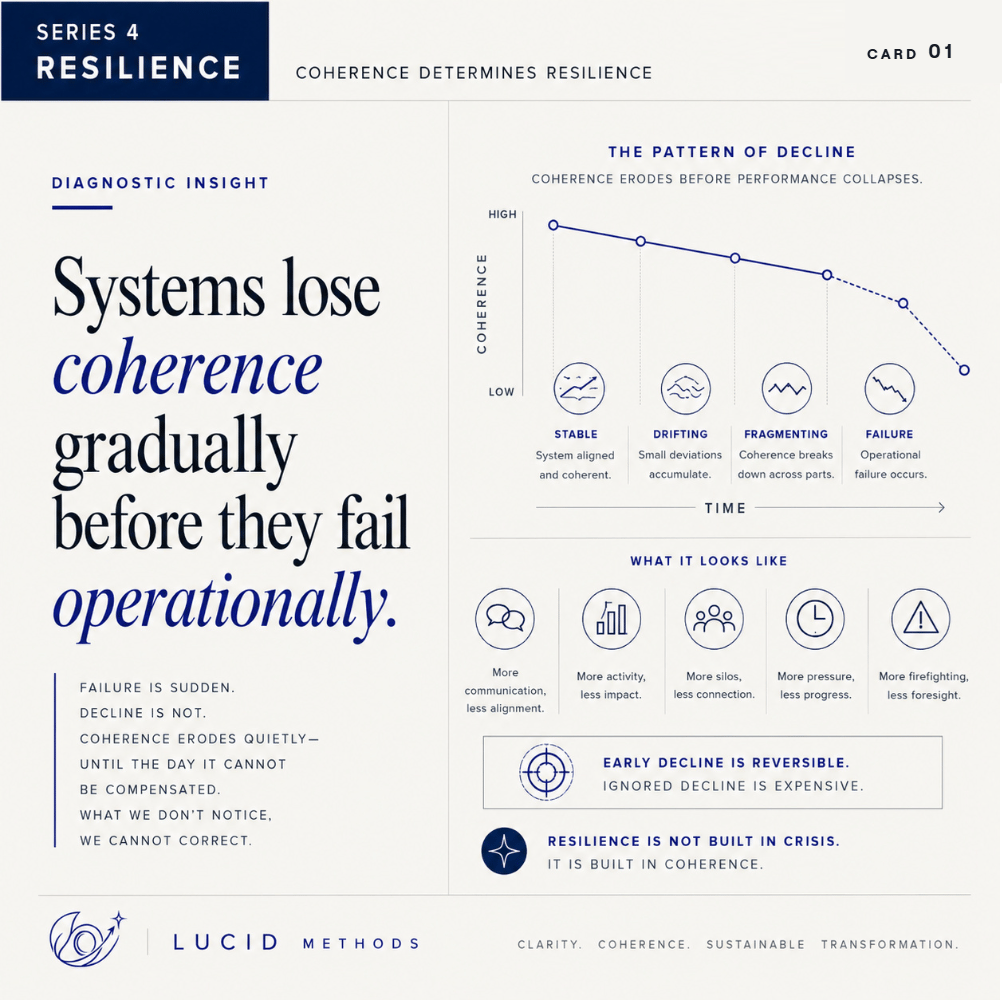
Organisational collapse is rarely sudden.
What appears sudden externally is often the final visible stage of a much longer period of hidden coherence decline.
Systems usually weaken quietly first.
Small misalignments accumulate.
Interpretation drifts.
Coordination becomes harder.
Dependencies strain.
Teams begin compensating manually for structural friction.
At first, the organisation still appears functional.
Performance may even look stable on the surface.
But underneath:
- more communication produces less alignment
- more activity produces less impact
- more urgency produces less clarity
- more firefighting produces less foresight
This is how coherence erosion spreads through systems.
The danger is that organisations often respond only when operational failure becomes visible —
when delays compound, morale drops, execution fragments, or trust weakens.
By then, the hidden cost has usually been compounding for months or years.
Resilient systems are not built only during crisis response.
They are built earlier:
through aligned structures, shared interpretation, healthy coordination, and coherent execution patterns that can absorb pressure without fragmenting.
Because resilience is not simply the ability to survive disruption.
It is the ability to maintain coherence while disruption occurs.
Most organisations focus heavily on visible change.
New initiatives.
New systems.
New metrics.
New milestones.
New reporting structures.
These are the visible signs of transformation.
But lasting transformation is rarely sustained by what people can immediately see.
It is sustained by what exists underneath:
- shared beliefs
- behavioural patterns
- trust dynamics
- structural alignment
- operational systems
- cultural norms
- collective assumptions
This is why many transformation efforts appear successful initially…
yet slowly regress once pressure increases or leadership attention fades.
Visible change can be implemented quickly.
Sustainable change requires deeper reinforcement.
Because beneath every resilient organisation is an invisible layer holding the visible outcomes together.
When the underlying system is weak:
- behaviours revert
- priorities drift
- old habits return
- execution fragments
- momentum fades
But when the foundation beneath is strong:
- alignment stabilises
- behaviours reinforce each other
- change becomes easier to sustain
- resilience strengthens over time
True transformation is therefore not just about changing what people do.
It is about strengthening the conditions that continuously shape what people do.
What holds beneath determines what endures above.
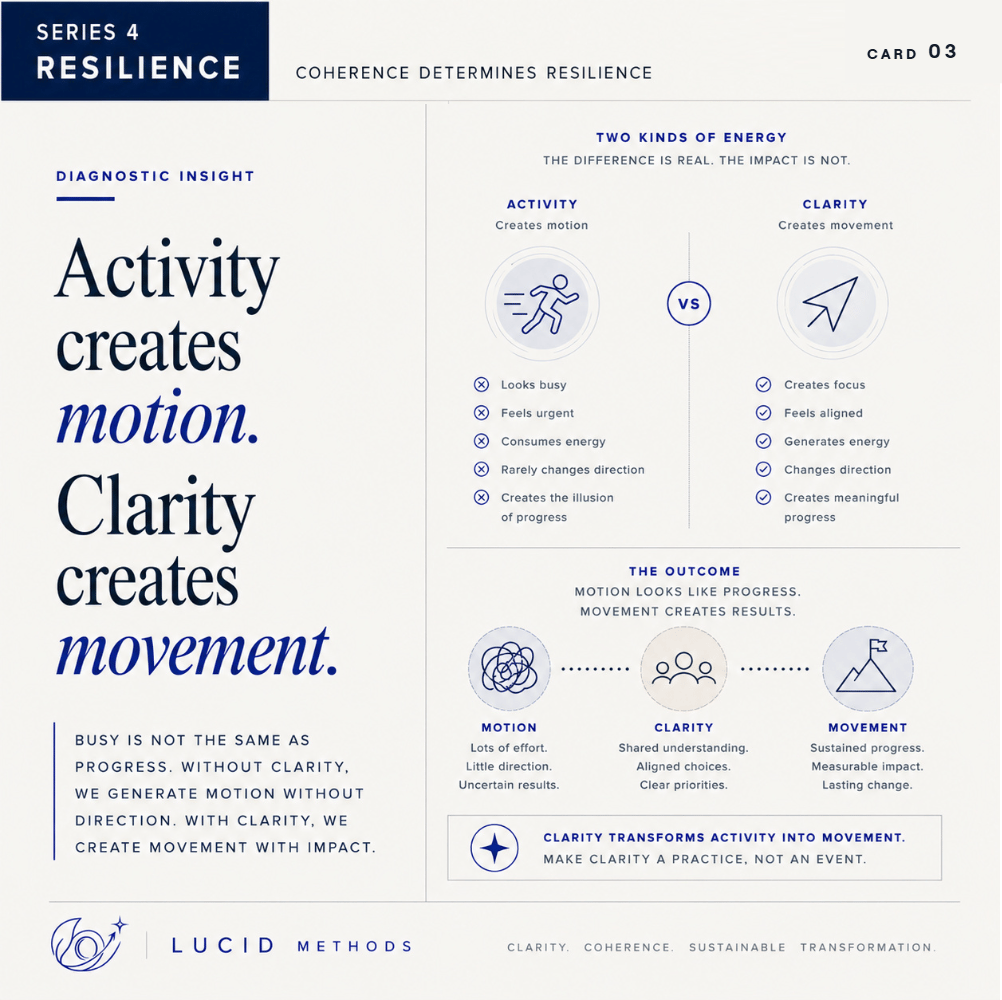
Busy organisations are not always progressing organisations.
Many systems generate enormous amounts of activity:
- more meetings
- more reporting
- more coordination
- more urgency
- more visible effort
Yet despite all the motion, meaningful progress remains slow.
Because activity alone does not create direction.
Without clarity:
- teams move reactively
- priorities compete
- energy becomes fragmented
- effort gets consumed by coordination overhead
- momentum becomes difficult to sustain
This is where organisations become trapped in cycles of motion without movement.
Everything feels urgent.
Everyone feels busy.
But the system struggles to produce lasting impact.
Clarity changes this dynamic.
When shared understanding strengthens:
- priorities become clearer
- decisions align faster
- effort concentrates instead of scattering
- coordination becomes lighter
- progress compounds more sustainably
Movement is not simply faster motion.
It is aligned motion with coherent direction.
This is why resilient systems depend so heavily on clarity.
Not because clarity sounds idealistic —
but because clarity reduces friction, preserves energy, and enables organisations to keep moving coherently under pressure.
Activity may create visible motion.
But clarity is what transforms effort into meaningful movement.
Series 5: Coherence Create Sustainable Change
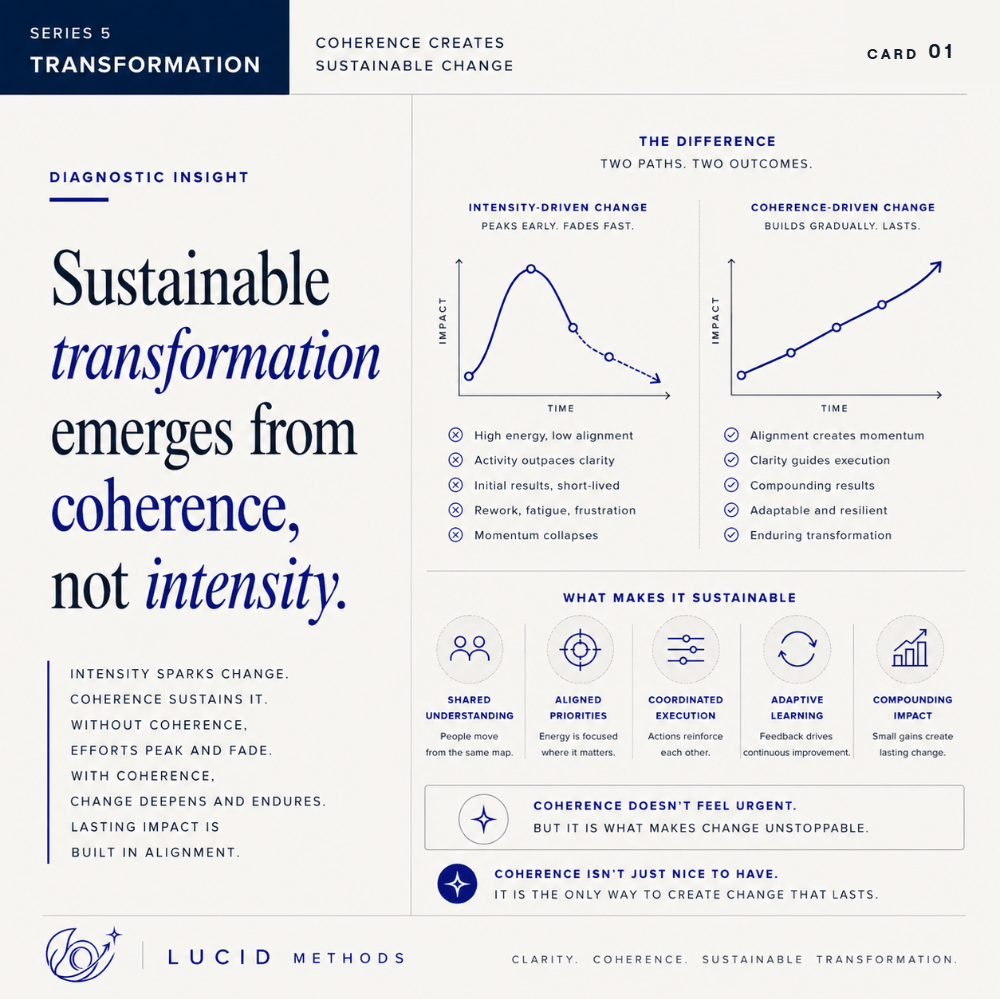
Transformation often fails because organisations confuse intensity with sustainability.
A burst of energy can create visible momentum:
- urgent initiatives
- rapid activity
- aggressive timelines
- constant escalation
- high emotional commitment
At first, it feels like progress.
But when alignment is weak, intensity becomes difficult to sustain.
Teams begin interpreting priorities differently.
Execution fragments.
Rework increases.
Fatigue accumulates.
Momentum slowly collapses under the weight of incoherent effort.
This is why many transformation programmes peak early and fade quickly.
Not because people stopped caring —
but because the system lacked the coherence needed to sustain coordinated movement over time.
Sustainable transformation works differently.
It builds through:
- shared understanding
- aligned priorities
- coordinated execution
- adaptive learning
- compounding improvement
Coherence may appear slower initially because it focuses on structural alignment rather than visible urgency.
But over time, coherence creates resilience, adaptability, and enduring impact.
Intensity can spark change.
Coherence is what allows change to hold.
Because lasting transformation is not built through temporary surges of effort alone.
It is built through systems capable of maintaining aligned movement long after the initial energy fades.
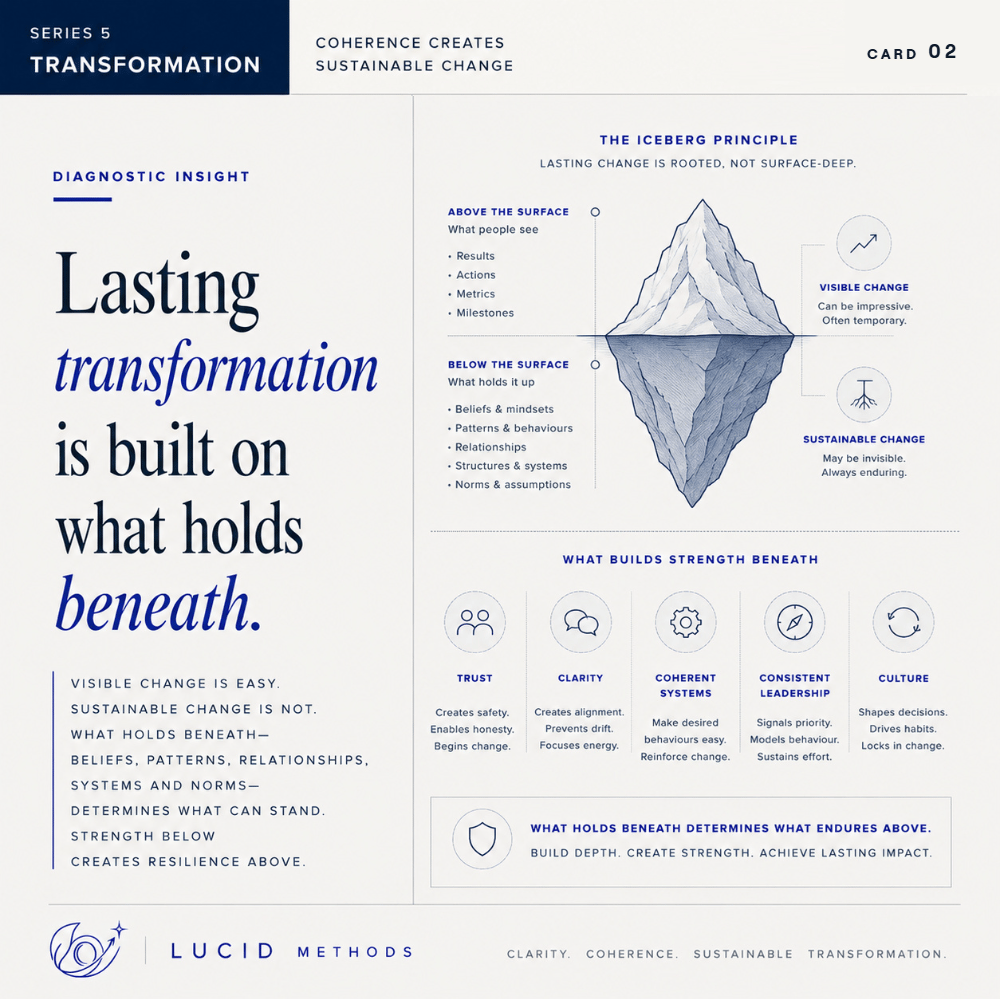
Most organisations focus heavily on visible change.
New initiatives.
New systems.
New metrics.
New milestones.
New reporting structures.
These are the visible signs of transformation.
But lasting transformation is rarely sustained by what people can immediately see.
It is sustained by what exists underneath:
- shared beliefs
- behavioural patterns
- trust dynamics
- structural alignment
- operational systems
- cultural norms
- collective assumptions
This is why many transformation efforts appear successful initially…
yet slowly regress once pressure increases or leadership attention fades.
Visible change can be implemented quickly.
Sustainable change requires deeper reinforcement.
Because beneath every resilient organisation is an invisible layer holding the visible outcomes together.
When the underlying system is weak:
- behaviours revert
- priorities drift
- old habits return
- execution fragments
- momentum fades
But when the foundation beneath is strong:
- alignment stabilises
- behaviours reinforce each other
- change becomes easier to sustain
- resilience strengthens over time
True transformation is therefore not just about changing what people do.
It is about strengthening the conditions that continuously shape what people do.
What holds beneath determines what endures above.
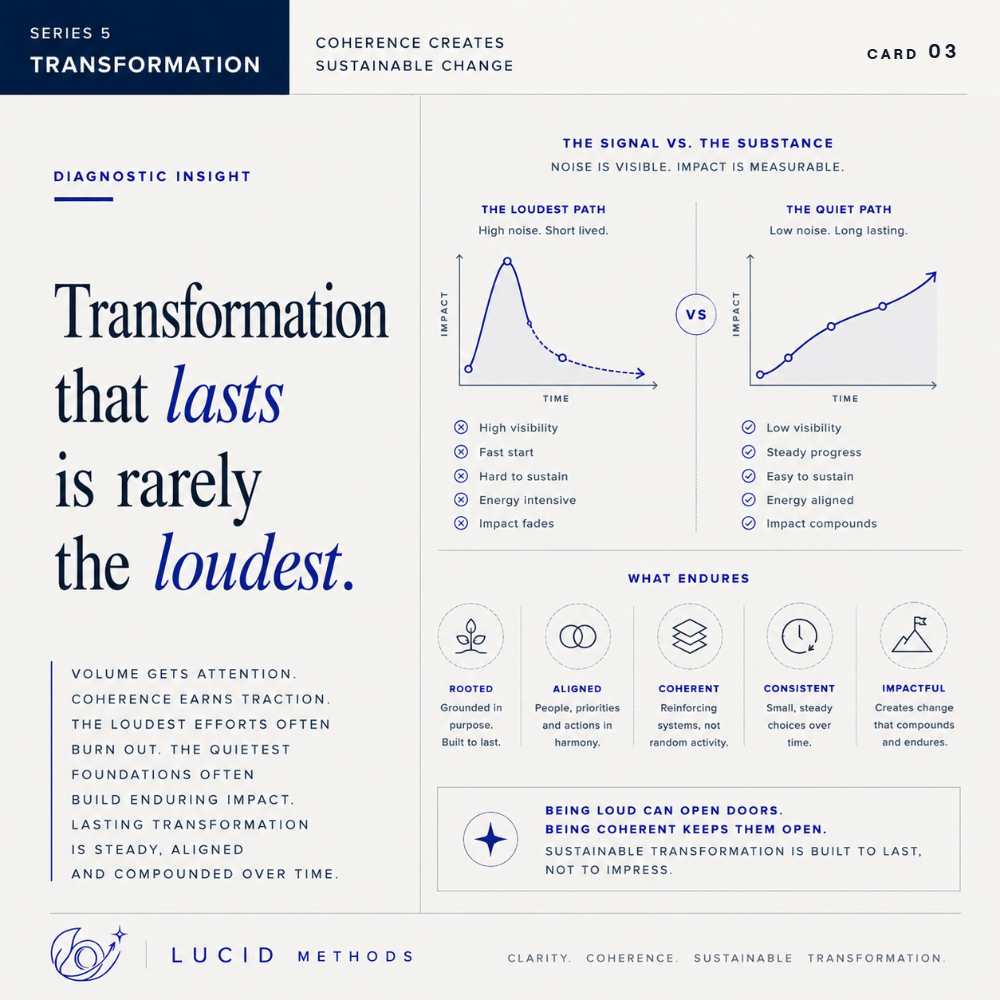
Transformation becomes sustainable when the invisible layers become stable.
Most organisations focus attention on what is easiest to measure:
- delivery milestones
- visible outputs
- project activity
- short-term results
But transformation does not endure because activity was visible.
It endures because the underlying system became stronger.
Lasting change is built beneath the surface:
- shared beliefs
- aligned behaviours
- trust across teams
- coherent structures
- reinforcing systems
- leadership consistency
- cultural stability
These deeper conditions determine whether change survives pressure, fatigue, leadership turnover, and operational complexity over time.
This is why some organisations appear transformed temporarily…
yet slowly return to old patterns once urgency fades.
The visible layer changed.
The underlying system did not.
Sustainable transformation works differently.
It strengthens the foundations that continuously shape behaviour:
- clarity that aligns decisions
- systems that reinforce desired actions
- cultures that support accountability
- leadership that models consistency
- structures that reduce fragmentation
Because resilience above the surface depends on coherence below it.
What people see may create excitement.
What holds underneath determines whether the transformation lasts.
Explore more frameworks, diagnostic perspectives, and systems-thinking insights through the LUCID Method — developed to help organisations build clarity, coherence, and transformation that holds over time.