

Empathy Is a Leadership Diagnostic
Empathy is often described as a leadership quality.
It is associated with listening, understanding and the ability to recognise how another person feels.
These qualities matter.
But empathy has another role in leadership that is less frequently discussed.
Empathy is a diagnostic capability.
It helps leaders understand not only how people feel, but what their experiences may be revealing about the organisation.
A frustrated employee may be pointing to more than a personal difficulty.
A hesitant team may be responding to more than resistance to change.
A silent meeting may indicate more than a lack of ideas.
Each may be a signal of something within the system that is unclear, contradictory or unsafe.
The challenge is learning how to read that signal.
The Organisation Seen from Above
Leaders usually experience the organisation through structured information.
They receive dashboards, reports, project updates, performance measures and employee survey results.
This information creates visibility.
But it does not always create understanding.
Reports tend to show what can be measured.
They are less capable of showing what people must do to keep the system functioning.
A process may appear efficient because employees are quietly correcting errors before they become visible.
A project may appear stable because teams are absorbing additional work without escalating it.
A decision may appear clear because no one openly challenges it, even though different departments have interpreted it differently.
What the organisation leaders see may therefore be different from the organisation employees experience.
Both views contain information.
Neither is sufficient on its own.
The Emotion Is Not the Diagnosis
Empathy does not mean assuming that every feeling accurately explains its own cause.
People interpret events through incomplete information, previous experiences and personal expectations.
A person can feel excluded without having been deliberately excluded.
A team can feel unsupported even when significant support has been provided.
An employee can experience a decision as unfair while being unaware of the wider constraints behind it.
The experience is still real.
The interpretation may still need examination.
This distinction matters.
If leaders dismiss the emotion, they may overlook an important signal.
If they accept the interpretation without question, they may misdiagnose the problem.
Empathy requires neither response.
It does not ask leaders to replace evidence with emotion.
It asks them to treat human experience as part of the evidence.
The emotion indicates where closer examination may be needed.
It is not the conclusion.
It is the beginning of inquiry.
Discuss your brand or product
Talk about who you are and what your brand is all about. You can use this text to share details about a product or announcements that you'd like your customers to see.
Empathy Is Not Agreement
Empathy is sometimes resisted because it is associated with softness.
There is a concern that listening to every perspective will weaken accountability, slow decisions or make difficult changes impossible.
But understanding someone’s experience does not require agreeing with every conclusion drawn from it.
A leader can understand why an employee is anxious and still proceed with the change.
A leader can recognise that a decision has caused disappointment without reversing it.
A leader can acknowledge that a process is difficult while maintaining the standards it is designed to protect.
Empathy does not remove the responsibility to decide.
It improves the quality of the decision by making its human consequences more visible.
This is especially important during transformation.
Some discomfort is unavoidable when roles, identities and established ways of working change.
But not all discomfort comes from change itself.
Some comes from unclear communication.
Some comes from inconsistent leadership behaviour.
Some comes from decisions made without understanding operational reality.
Some comes from asking employees to accept uncertainty while leaders continue to project certainty.
Empathy helps distinguish between the discomfort that accompanies necessary change and the friction created by the way that change is being led.
From Individual Experience to System Pattern
One employee’s experience should not automatically define organisational reality.
But it should not be dismissed simply because it is one experience.
A single account may be an exception.
It may also be the first visible expression of a wider pattern.
The diagnostic task is to move from the individual experience towards the conditions that produced it.
If an employee says that it is unsafe to raise concerns, the issue is not resolved by reassuring the employee that the organisation values openness.
Leaders need to examine what happens when concerns are raised.
How do managers respond to unwelcome information?
Are people thanked for identifying risks, or quietly labelled as difficult?
Do escalation channels protect the person raising the issue?
Are leaders willing to change course when the evidence challenges their preferred direction?
The person’s experience becomes useful when it leads to examination of the system.
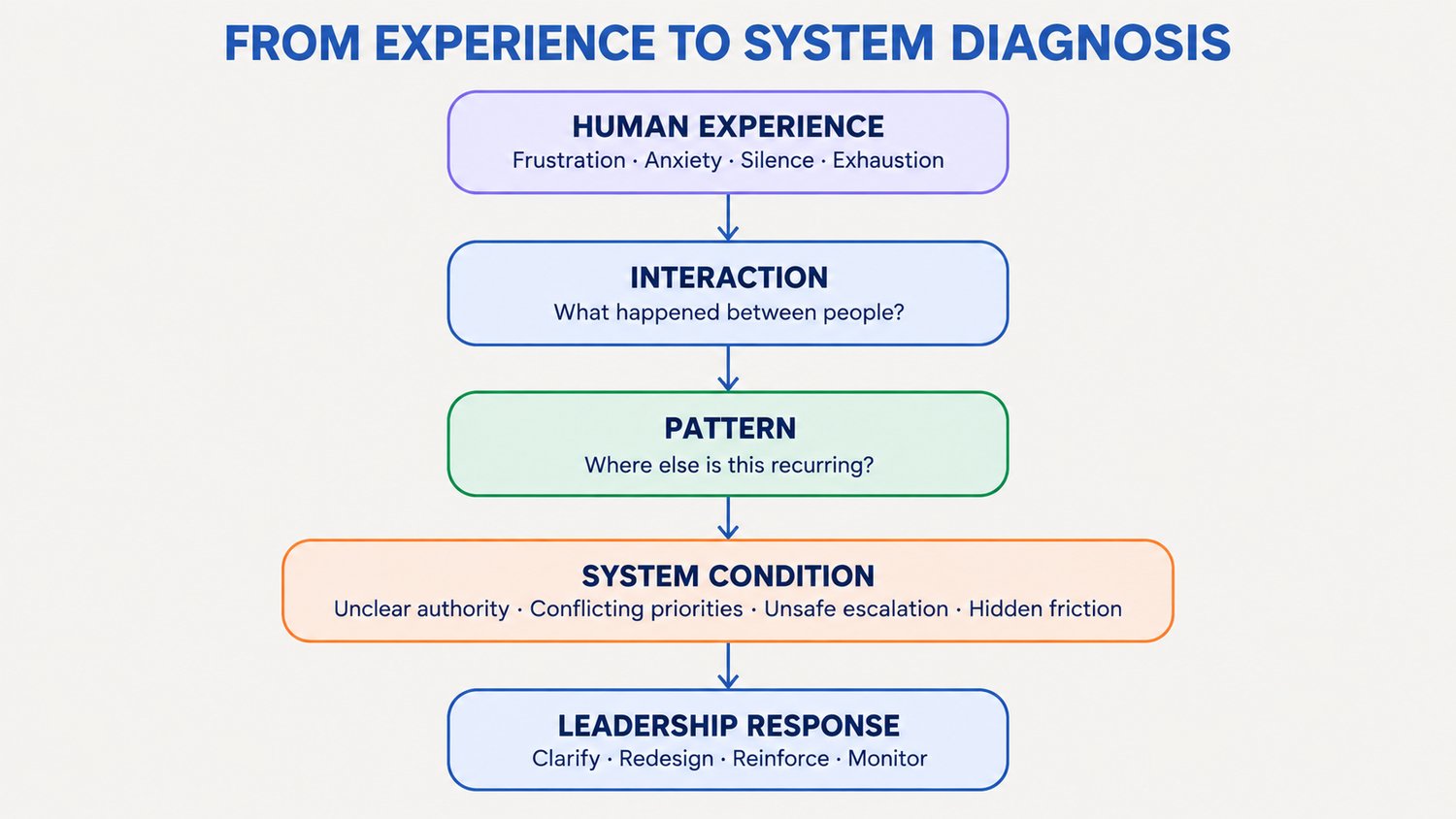
The movement is from experience to interaction, from interaction to pattern, and from pattern to structure.
This is where empathy becomes diagnostic.
What Empathy Can Make Visible
Empathy can reveal organisational conditions that formal measures may not detect early enough.
It can reveal interpretation drift, where people hear the same message but leave with different understandings of what it means.
It can reveal hidden work, where employees perform unrecorded coordination and correction to compensate for weaknesses in the process.
It can reveal transferred friction, where a solution appears efficient at one level because its cost has been pushed elsewhere.
It can reveal contradictory leadership signals, where people are encouraged to speak honestly but rewarded for agreement.
It can reveal identity threats, where employees are not merely learning a new process but confronting a loss of competence, status or professional meaning.
It can also reveal the development of organisational silence.
Silence is rarely created by one dramatic event.
It develops through repeated observation.
People notice which questions are welcomed.
They notice which problems receive attention.
They notice who is protected, who is blamed and what happens to those who make inconvenient realities visible.
Over time, employees learn what the organisation genuinely wants to know.
Empathy helps leaders see the accumulated learning behind that silence.
When Listening Becomes Theatre
Many organisations have mechanisms for listening.
They conduct surveys, organise town halls, create feedback channels and invite employees to speak openly.
These mechanisms can be useful.
But listening is not evidence of empathy
if the organisation has no capacity or intention to respond.
When employees repeatedly describe the same barriers and nothing changes, they do not conclude that leaders have listened.
They conclude that the organisation wants disclosure without obligation.
This creates a particular kind of mistrust.
People have translated their experience into language the organisation requested.
They have spent time explaining the problem.
They may even have exposed themselves to personal risk by doing so.
If there is no visible response, silence becomes a rational adaptation.
Not every concern requires action.
But every serious concern requires closure.
People should know what was heard, what was examined, what will change, what will not change and why.
Without closure, listening becomes performative.
It collects experience without converting it into organisational learning.
A Practical Diagnostic Lens
Empathy becomes a leadership diagnostic when it moves through five questions.
First, what is the person experiencing?
This requires listening carefully enough to understand the situation from the person’s perspective, without immediately correcting or defending.
Second, what conditions may have contributed to that experience?
The cause may lie in a process, an incentive, a dependency, a leadership behaviour or an ambiguity in responsibility.
Third, is this an isolated experience or part of a wider pattern?
Other people may be affected without having reported it.
Some may have adapted.
Others may already have disengaged.
Fourth, what is the organisational cost?
The cost may appear through delay, rework, risk, reduced trust, weaker collaboration or the gradual loss of capability.
Finally, what response is required?
Something may need to be clarified, redesigned, reinforced or consciously left unchanged.
The purpose of this lens is not to turn every conversation into an investigation.
It is to prevent leaders from treating human experience as either irrelevant or conclusive.
Both responses reduce understanding.
Empathy Tests Leadership Coherence
Organisations often describe the culture they intend to create.
They value honesty, accountability, collaboration, initiative and care.
Empathy helps leaders examine whether these values are present in the experience of the system.
If initiative is valued, what happens when someone acts without seeking permission?
If honesty is valued, what happens when the truth threatens a preferred narrative?
If collaboration is valued, are teams given shared priorities, or left to negotiate competing expectations themselves?
If wellbeing is valued, where are people routinely required to absorb the consequences of poor coordination?
If accountability is valued, are authority and consequences distributed consistently?
These are not questions about whether leaders have good intentions.
They are questions about whether those intentions survive contact with the organisation.
The gap between stated intent and lived experience is where leadership incoherence becomes visible.
Empathy helps leaders find that gap.
Empathy at Scale
No leader can personally understand every experience within an organisation.
Nor should leadership depend entirely on the emotional sensitivity of individual leaders.
Empathy at scale must be supported by the system.
There must be credible channels through which experience can travel.
Managers must know how to listen without becoming defensive.
Escalation must be possible without disproportionate personal risk.
Patterns must be identified across individual accounts.
Responses must be visible enough for people to know that speaking has meaning.
The aim is not to make leaders endlessly emotionally available.
It is to ensure that human consequences can enter organisational decision-making without being stripped of meaning, softened for comfort or dismissed as anecdotal.
This is how empathy becomes more than a personal virtue.
It becomes part of the organisation’s capacity to understand itself.
A Question for Leaders
When someone describes a difficult experience, the easiest response is to decide whether the person is right or wrong.
A more useful response is to ask:
What might this experience be revealing about the system that produced it?
That question does not remove the need for evidence.
It does not weaken standards.
It does not prevent difficult decisions.
It creates a fuller understanding of the conditions in which those decisions are made.
Empathy is not the opposite of rigour.
Properly used, it reveals where rigour is most needed.
Part of the Leadership & Culture Series from LUCID Methods.
Explore more frameworks, diagnostic perspectives, and systems-thinking insights through the LUCID Method — developed to help organisations build clarity, coherence, and transformation that holds over time.