


The LUCID Execution Toolkit
20 structured diagnostic and execution tools designed to help organisations identify hidden friction, align interpretation, and sustain transformation beyond initial momentum.
Transformation work often fails long before the failure becomes visible.
Teams continue moving.
Projects continue progressing.
Meetings continue happening.
But beneath visible activity:
- interpretation fragments,
- priorities drift,
- execution loses coherence,
- and sustainment weakens over time.
The LUCID Execution Toolkit was designed to help organisations diagnose and address those hidden fractures before momentum alone carries transformation into failure.
What the Toolkit Helps You Diagnose
The toolkit is designed for transformation environments where:
- teams interpret problems differently,
- execution appears active but produces little movement,
- behavioural adoption weakens over time,
- alignment deteriorates across stakeholders,
- or transformation momentum becomes difficult to sustain.
The tools provide structured diagnostic frameworks for:
- organisational friction,
- execution drift,
- behavioural resistance,
- alignment failure,
- dependency exposure,
- sustainment instability,
- and transformation coherence.
The LUCID Diagnostic Process
The toolkit is structured around five interconnected diagnostic stages designed to help organisations move from fragmented execution toward sustained transformation coherence.
Locate
Identify where friction, instability, or execution drift actually exists beneath visible activity.
Understand
Interpret the systemic conditions, behaviours, incentives, and constraints shaping organisational outcomes.
Clarify
Establish coherent shared interpretation across teams, stakeholders, priorities, and transformation objectives.
Integrate
Align structures, behaviours, decisions, ownership, and operational systems around the intended direction.
Drive
Sustain execution momentum, behavioural consistency, and organisational coherence over time.

The Toolkit Structure
The LUCID Execution Toolkit contains 20 interconnected tools organised across four practical transformation domains.
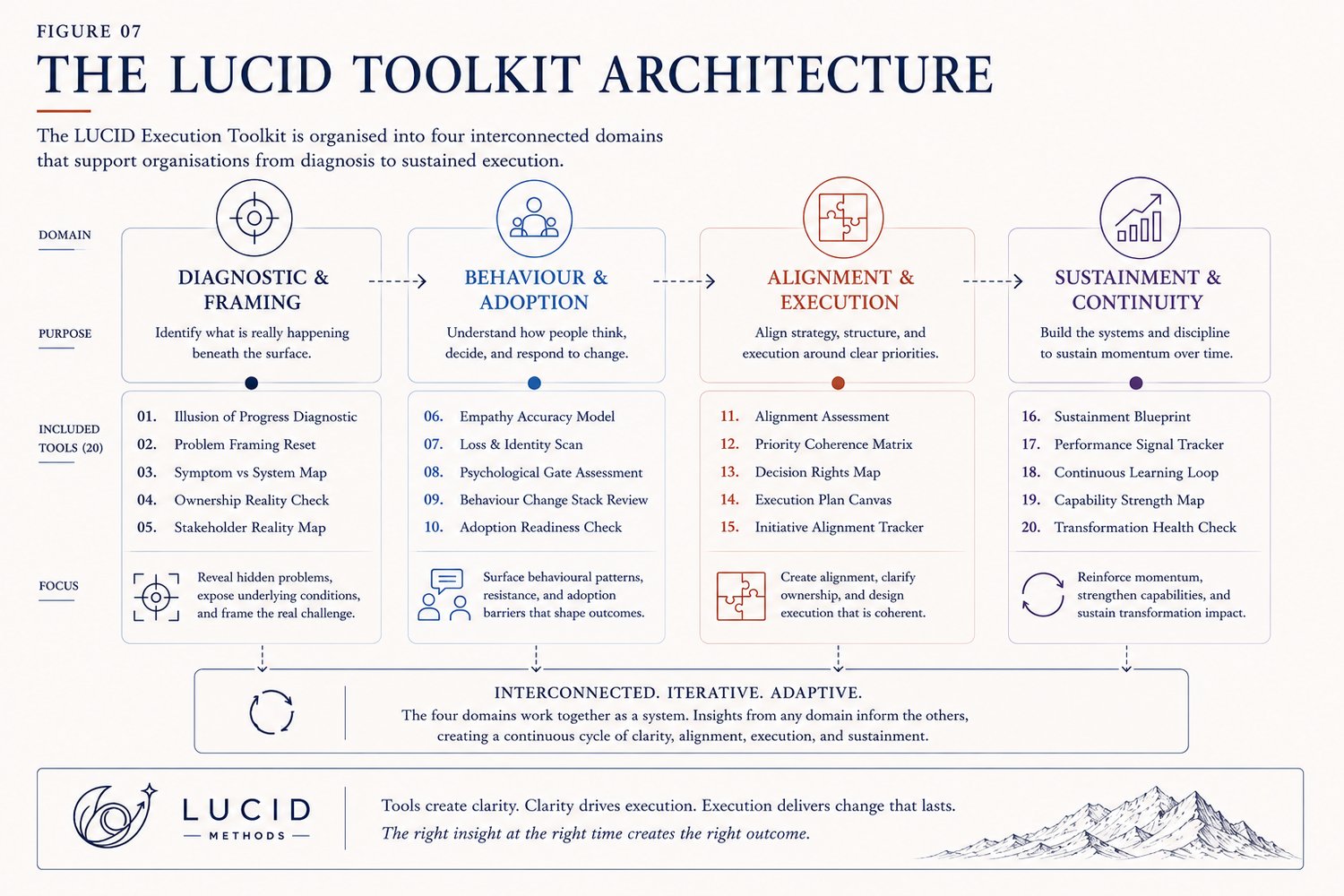
Diagnostic & Framing
Designed to reveal hidden instability beneath visible execution activity.
Included Tools
- Illusion of Progress Diagnostic
- Problem Framing Reset
- Symptom vs System Map
- Ownership Reality Check
- Stakeholder Reality Map
Helps Teams
- identify root causes,
- expose hidden assumptions,
- diagnose fragmentation,
- and clarify what actually requires change.
Behaviour & Adoption
Designed to surface the human and behavioural dynamics that often determine whether transformation sustains or collapses.
Included Tools
- Empathy Accuracy Model
- Loss & Identity Scan
- Psychological Gate Assessment
- Behaviour Change Stack Review
- Adoption Readiness Check
Helps Teams
- identify resistance patterns,
- understand behavioural friction,
- improve adoption readiness,
- and align transformation with real human dynamics.
Alignment & Execution
Designed to strengthen execution coherence across teams, priorities, and operational systems.
Included Tools
- Outcome Definition Canvas
- Clarity Pyramid
- Success Criteria Ladder
- Non-Negotiables Filter
- Alignment Stress Test
- Dependency Exposure Map
- Friction Audit
- Execution Without Friction Playbook
Helps Teams
- align interpretation,
- reduce execution drift,
- improve operational coherence,
- and strengthen transformation delivery.
Sustainment & Continuity
Designed to help organisations sustain transformation after initial momentum declines.
Included Tools
- Sustainment Loop Design
- Attention Decay Safeguard
Helps Teams
- maintain behavioural reinforcement,
- reduce attention decay,
- preserve alignment over time,
- and sustain transformation beyond launch phases.
The 20 Diagnostic Tools
Tool 1 — Illusion of Progress Diagnostic
Exposes activity that creates movement without meaningful advancement.
Tool 2— Problem Framing Reset
Repositions the problem before resources are wasted solving the wrong issue.
Tool 3 — Symptom vs System Map
Separates visible symptoms from the underlying systemic causes driving them.
Tool 4 — Ownership Reality Check
Reveals where accountability is assumed, unclear, or structurally absent.
Tool 5 — Stakeholder Reality Map
Surfaces competing perceptions, priorities, and hidden tensions across stakeholders.
Tool 6 — Empathy Accuracy Model
Tests whether leaders truly understand the people affected by change.
Built for Real Organisational Environments
The toolkit is designed for:
- transformation leaders,
- operations and strategy teams,
- consultants and facilitators,
- change practitioners,
- and organisations navigating complex execution environments.
The tools are structured to support:
- workshops,
- strategic diagnostics,
- alignment conversations,
- execution reviews,
- operational planning,
- and sustainment assessment.
More Than Templates
The LUCID Execution Toolkit is not a collection of disconnected worksheets.
It is a structured diagnostic system designed to help organisations:
- interpret more clearly,
- align more coherently,
- execute with less friction,
- and sustain transformation over time.
Transformation fails quietly before it fails visibly.
The LUCID Execution Toolkit was created to help organisations diagnose those failures before execution absorbs them.