

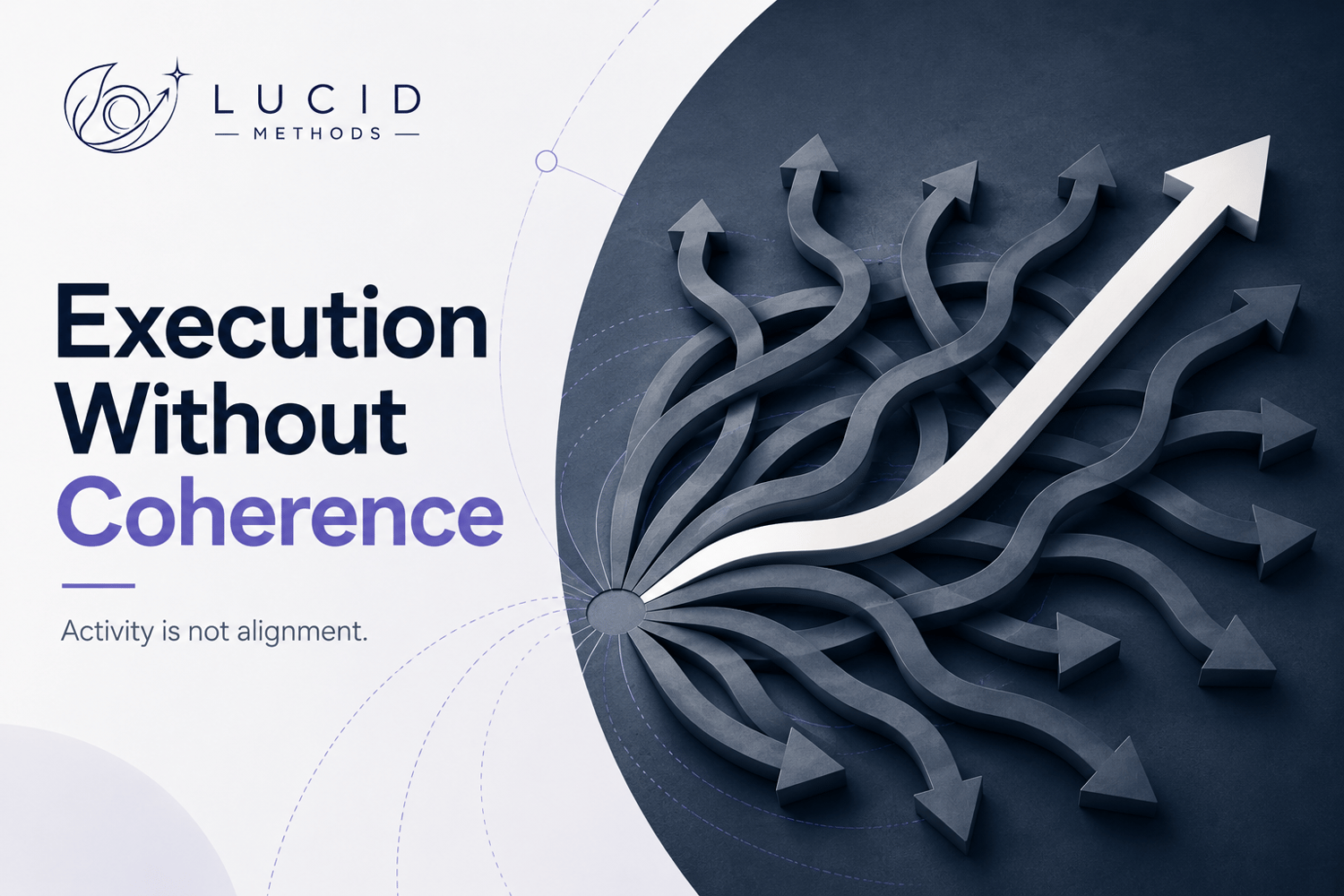
Execution Without Coherence
Execution Without Coherence
Activity Is Not the Same as Alignment
Many transformation initiatives fail despite intense effort.
Teams work long hours.
Projects remain on schedule.
Status reports appear positive.
Milestones are achieved.
Yet months later, leaders discover that the intended outcomes have not materialised.
The organisation has executed extensively.
But it has not moved coherently.
This distinction is often overlooked.
Execution is commonly viewed as the primary challenge in transformation.
As a result, organisations invest heavily in project management, governance structures, delivery teams, reporting mechanisms, and accountability systems.
These capabilities matter.
However, execution alone cannot guarantee progress.
Execution merely determines whether activity occurs.
Coherence determines whether activity accumulates toward a shared outcome.
Without coherence, execution can become highly efficient movement in multiple directions simultaneously.
The result is often frustration.
Not because people failed to act.
But because their actions failed to reinforce one another.
The Hidden Assumption Behind Execution
Many leaders unconsciously assume that if everyone performs their assigned tasks, desired outcomes will emerge.
This assumption appears reasonable.
After all:
- Strategies are defined.
- Objectives are communicated.
- Teams are assigned responsibilities.
- Projects are launched.
Why would execution not produce results?
The answer lies in a hidden assumption:
Everyone must interpret the objective in roughly the same way.
Unfortunately, this condition is rarely examined.
People hear the same words.
Yet construct different meanings.
They receive the same instruction.
Yet develop different priorities.
They pursue the same initiative.
Yet optimise for different outcomes.
Execution then begins.
But coherence never existed.
How Coherence Disappears
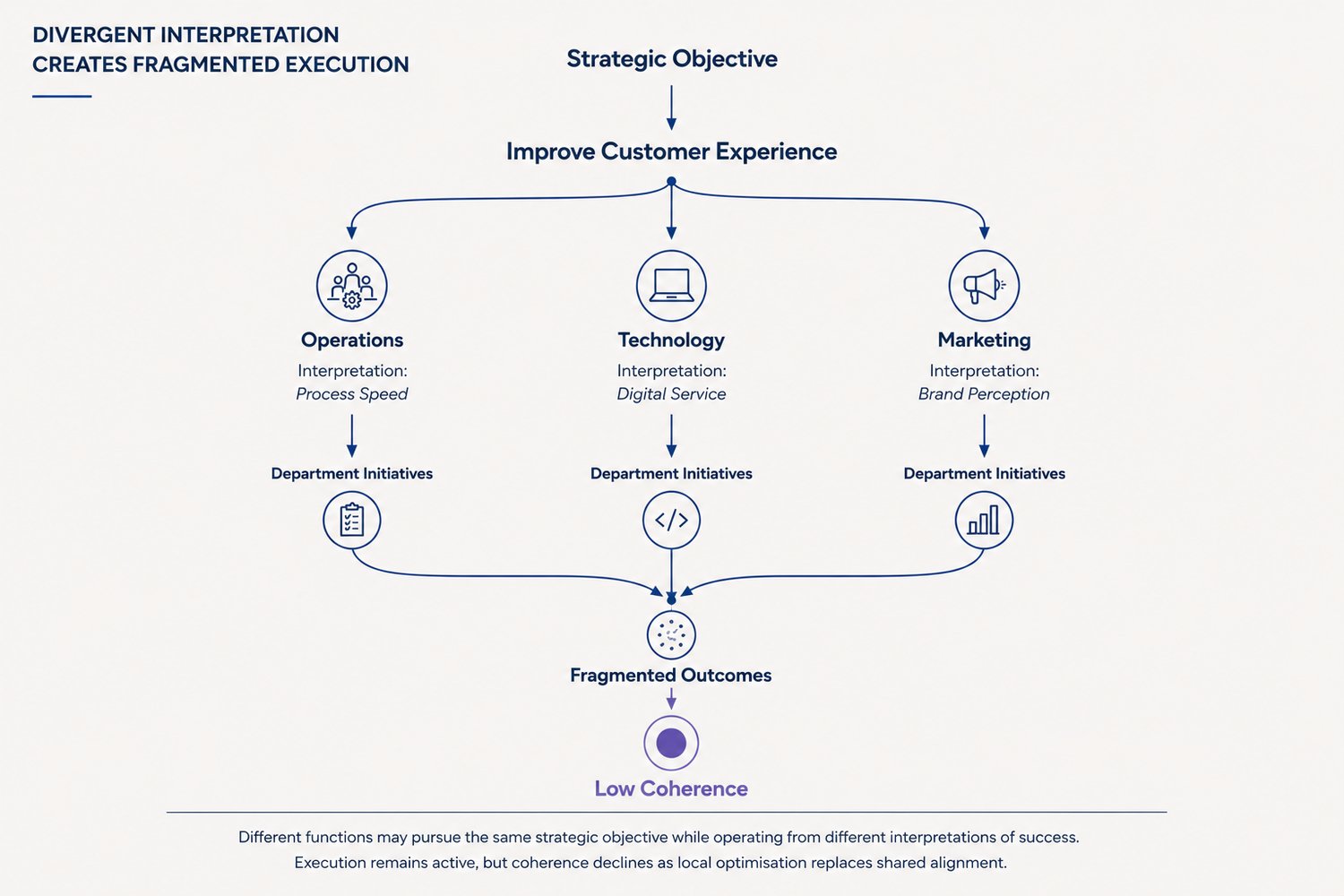
Imagine a leadership team announcing a transformation initiative intended to improve customer experience.
The message appears clear.
Everyone agrees.
Everyone supports the initiative.
Everyone begins working.
However, different functions may interpret the objective differently.
Operations may define customer experience as process speed.
Technology may define it as digital self-service.
Marketing may define it as brand perception.
Finance may define it as cost-efficient service delivery.
Human Resources may define it as staff capability.
None of these interpretations are wrong.
Yet they are not identical.
Each department begins executing according to its own understanding.
Resources are invested.
Projects move forward.
Metrics improve.
Activity increases.
But because efforts are not reinforcing one another, organisational coherence begins to decline.
The organisation becomes busier while becoming less aligned.
When Success Creates Failure
One of the most dangerous aspects of incoherent execution is that individual success can create collective failure.
Each team may achieve its own objectives.
Each department may demonstrate measurable progress.
Each manager may deliver expected outputs.
Yet the overall system may deteriorate.
This occurs because local optimisation does not necessarily create system optimisation.
A department can improve its own performance while unintentionally creating friction elsewhere.
A process can become more efficient while making coordination more difficult.
A policy can solve one problem while generating several new ones.
The organisation appears productive because many individual successes are occurring simultaneously.
Yet the system as a whole becomes increasingly fragmented.
This creates a paradox:
The organisation may be executing effectively while failing strategically.
The Illusion of Progress
Execution without coherence often produces what appears to be progress.
Common indicators include:
- Increasing project activity
- High levels of stakeholder engagement
- Positive milestone reporting
- Expanding transformation portfolios
- Growing numbers of initiatives
These signals create confidence.
Leaders observe movement and assume progress.
However, movement alone is not evidence of advancement.
An organisation can move extensively without moving meaningfully.
Imagine a rowing team.
Every rower is working hard.
Every rower is committed.
Every rower is pulling with full effort.
But if each person rows in a slightly different direction, the boat slows despite enormous exertion.
The issue is not effort.
The issue is coherence.
The same principle applies within organisations.
The Cost of Fragmented Execution
When coherence declines, organisations experience several recurring symptoms.
Duplicate Effort
Different teams unknowingly solve the same problem independently.
Resources are consumed repeatedly.
Knowledge remains fragmented.
Conflicting Decisions
Local priorities generate decisions that undermine one another.
Progress in one area creates obstacles elsewhere.
Escalating Coordination Costs
More meetings become necessary.
More governance is introduced.
More reporting is required.
The organisation spends increasing effort managing complexity created by itself.
Change Fatigue
Employees receive multiple messages that appear inconsistent.
Priorities seem to shift constantly.
Confidence in leadership declines.
Reduced Adaptability
As fragmentation increases, the organisation becomes slower at responding to change.
Every adjustment requires extensive negotiation and coordination.
What initially appears to be an execution challenge is often a coherence challenge.
Why More Governance Often Fails
When leaders detect execution problems, they frequently respond by increasing control.
More reporting.
More meetings.
More approval layers.
More oversight.
These interventions may improve visibility.
But visibility does not automatically create coherence.
In some cases, additional governance actually worsens the problem.
Teams become increasingly focused on compliance rather than alignment.
Energy shifts toward satisfying reporting requirements rather than reinforcing shared outcomes.
The organisation becomes more managed but not necessarily more coherent.
The challenge is not insufficient control.
The challenge is insufficient shared understanding.
The Cost of Fragmented Execution
When coherence declines, organisations experience several recurring symptoms.
Duplicate Effort
Different teams unknowingly solve the same problem independently.
Resources are consumed repeatedly.
Knowledge remains fragmented.
Conflicting Decisions
Local priorities generate decisions that undermine one another.
Progress in one area creates obstacles elsewhere.
Escalating Coordination Costs
More meetings become necessary.
More governance is introduced.
More reporting is required.
The organisation spends increasing effort managing complexity created by itself.
Change Fatigue
Employees receive multiple messages that appear inconsistent.
Priorities seem to shift constantly.
Confidence in leadership declines.
Reduced Adaptability
As fragmentation increases, the organisation becomes slower at responding to change.
Every adjustment requires extensive negotiation and coordination.
What initially appears to be an execution challenge is often a coherence challenge.
Coherence Before Execution
High-performing transformations do not begin with activity.
They begin with alignment.
Before execution scales, coherent organisations invest time ensuring that people share a common understanding of:
- The problem being solved
- The desired outcome
- Success criteria
- Decision priorities
- Key trade-offs
- System dependencies
This may initially feel slower.
In reality, it often accelerates execution dramatically.
Because once coherence exists, decisions become easier.
Coordination becomes simpler.
Adaptation becomes faster.
Execution becomes reinforcing rather than competing.
The organisation spends less effort correcting misunderstandings and more effort creating value.
Diagnosing Execution Without Coherence
Several questions can help reveal whether execution is occurring without coherence:
- Can different teams describe the desired outcome in the same way?
- Do departments optimise for compatible objectives?
- Are local successes producing system-level improvement?
- Do stakeholders interpret priorities consistently?
- Are coordination costs increasing over time?
- Does additional activity consistently produce additional value?
If these questions reveal significant variation, the challenge may not be execution capability.
The challenge may be coherence.
Treating a coherence problem as an execution problem often creates more activity while leaving the underlying condition unchanged.
Coherence Before Execution
Traditional transformation approaches often focus on execution as the primary determinant of success.
LUCID views execution differently.
Execution is not the starting point.
It is the outcome of coherence.
When coherence exists, execution becomes naturally reinforcing.
When coherence is absent, execution becomes fragmented regardless of effort, capability, or commitment.
The question therefore is not:
"Are people executing?"
The more important question is:
"Are people executing toward the same reality?"
Because execution without coherence rarely produces transformation.
It produces motion.
And motion should never be mistaken for progress.
Part of the Alignment & Interpretation Series from LUCID Methods.
Explore more frameworks, diagnostic perspectives, and systems-thinking insights through the LUCID Method — developed to help organisations build clarity, coherence, and transformation that holds over time.