

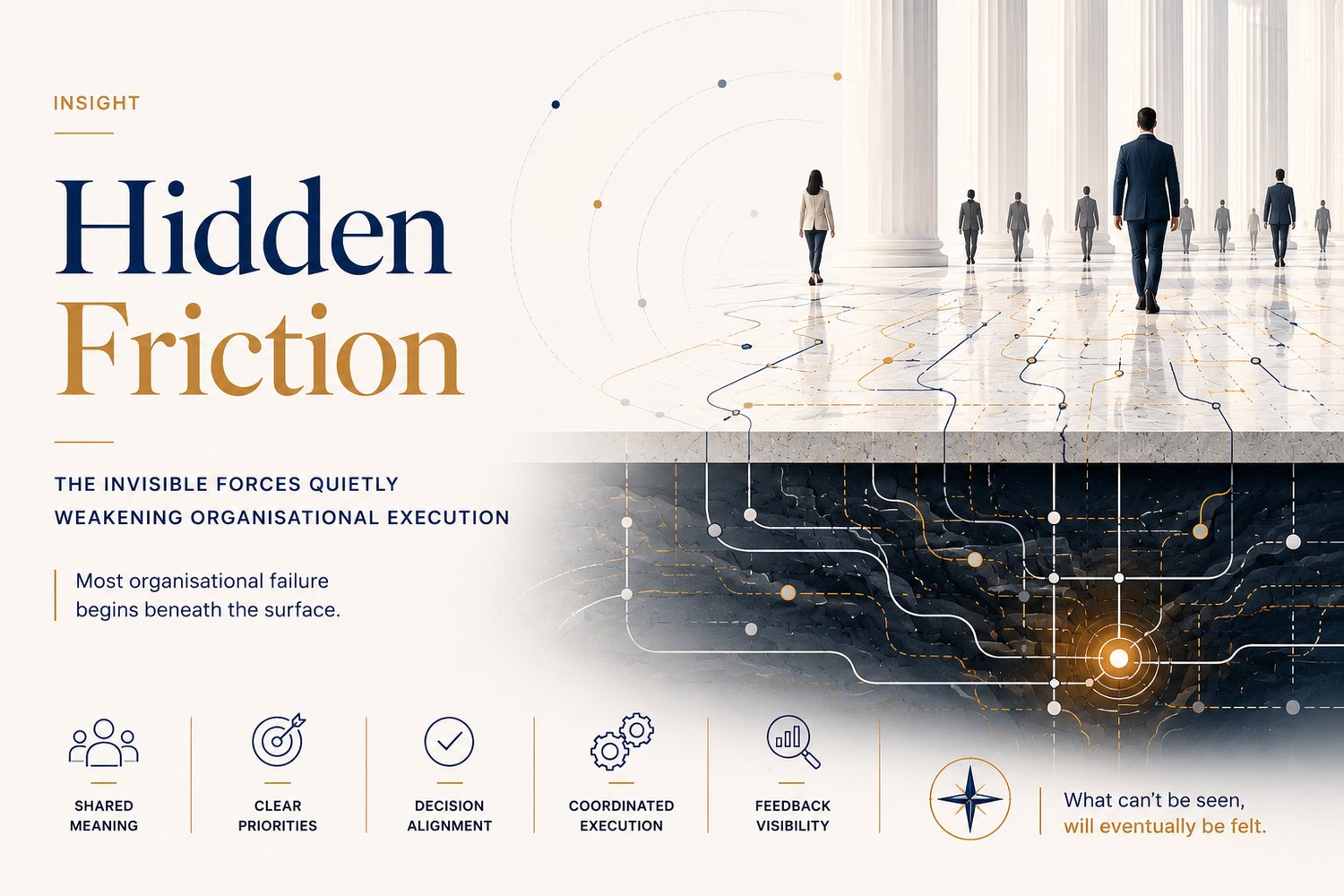
Many transformation frameworks describe change as structured progression:
define vision → align stakeholders → execute roadmap → sustain adoption.
But inside real organisations, execution rarely unfolds that cleanly.
Because organisations are not mechanical systems alone.
They are interpretive systems shaped by ambiguity, incentives, pressure, competing priorities, and evolving meaning.
This is why transformation often feels harder than frameworks suggest.
The difficulty rarely comes from activity alone.
It emerges from the invisible friction created when interpretation fragments and coherence weakens beneath visible movement.
Hidden Friction: The Invisible Forces Quietly Weakening Organisational Execution
Most organisational friction does not begin where leaders first notice it.
It rarely begins in the missed deadline, the delayed project, the tense meeting, or the failed rollout.
Those are usually the symptoms.
The real friction often begins beneath the surface — inside unclear ownership, fragmented interpretation, unstable priorities, competing incentives, and invisible ambiguity that quietly shapes behaviour long before visible failure appears.
This is one of the most dangerous dynamics inside transformation work:
Organisations continue moving while coherence quietly deteriorates underneath.
Meetings continue.
Projects continue.
Reports remain active.
Dashboards stay green.
Yet alignment weakens slowly beneath visible activity.
By the time leaders recognise the problem, the system has often already absorbed months of hidden cost.
Why Hidden Friction Matters
Most organisations are designed to detect visible problems.
They measure timelines.
Track milestones.
Monitor delivery.
Escalate operational failures.
But hidden friction operates below the level most systems are designed to observe.
It influences:
- How teams interpret priorities
- How decisions are made
- How ownership is understood
- How collaboration behaves under pressure
- How meaning changes as information moves across the organisation
The challenge is that hidden friction rarely appears immediately catastrophic.
Instead, it compounds gradually.
Execution becomes slightly slower.
Trust becomes slightly weaker.
Meetings become slightly heavier.
Escalation increases subtly.
Decisions require more coordination.
Alignment becomes harder to maintain.
Over time, these small fractures accumulate into organisational drag.
What leaders eventually experience as “transformation failure” is often the visible outcome of long-standing structural friction that remained unresolved.
Surface Symptoms Rarely Reveal the Real Problem
One of the most common mistakes in transformation work is solving symptoms instead of systems.
Organisations frequently react to visible outcomes while overlooking the structural conditions producing them.
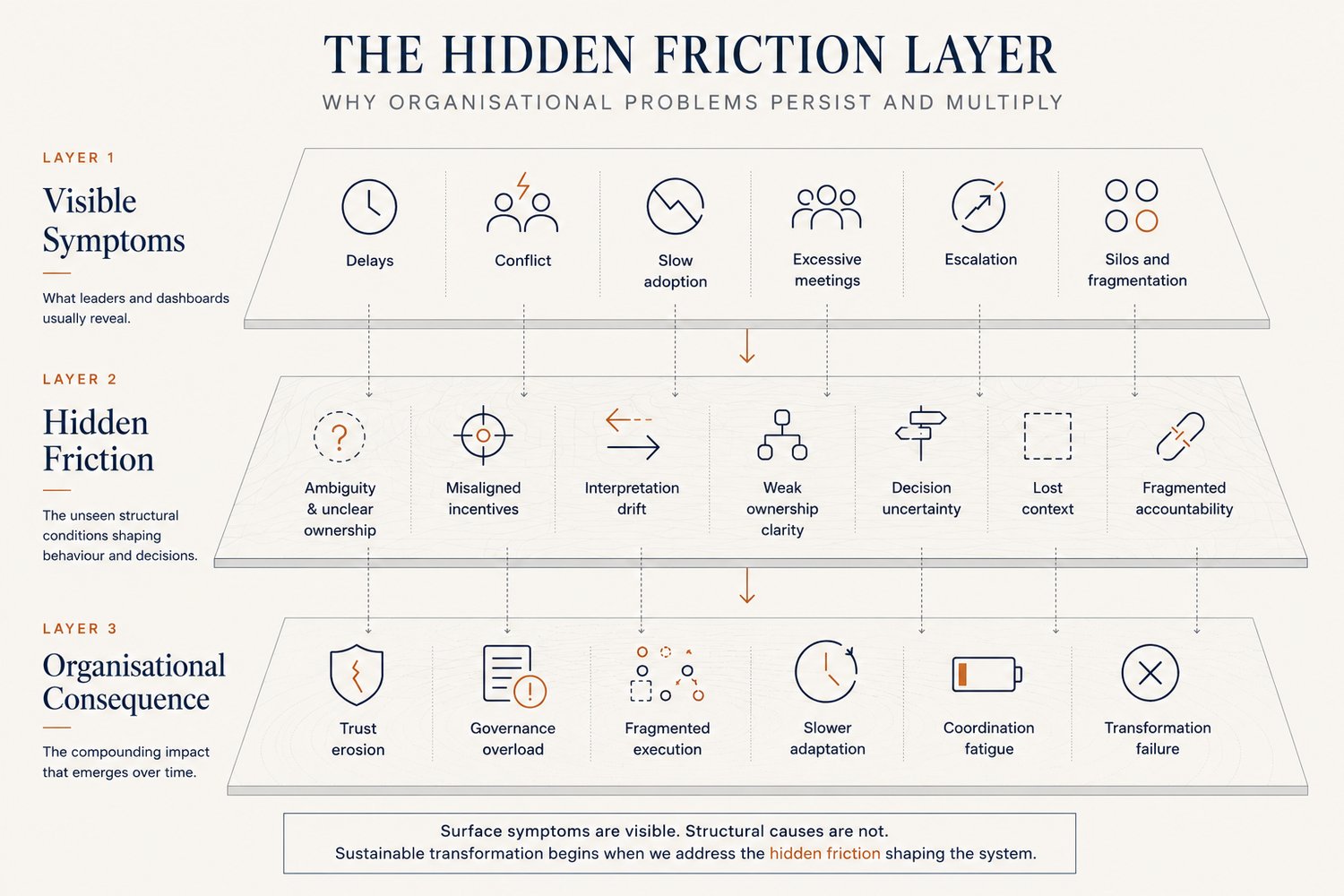
For example:
Visible Symptom --> Hidden Friction
Repeated delays--> Dependency ambiguity
Team conflict--> Unspoken assumptions
Slow adoption--> Unclear meaning
Excessive meetings--> Alignment uncertainty
Escalation overload--> Decision ambiguity
Organisational silos--> Misaligned incentives
Communication breakdown--> Loss of context
Weak culture change--> Inconsistent reinforcement
The visible issue often appears operational.
The underlying issue is usually structural.
This distinction matters because surface-level intervention rarely resolves systemic friction sustainably.
It often only suppresses the symptom temporarily.
Conflict Is Frequently Interpretation Conflict
Many organisations reduce tension to personality clashes.
But organisational conflict often emerges because different groups are operating from different interpretations of reality.
Different teams may hold conflicting assumptions about:
- Priorities
- Risks
- Success definitions
- Customer needs
- Operational constraints
- Strategic intent
When those assumptions remain unspoken, friction intensifies silently.
People defend positions because they are defending meaning.
This is why alignment cannot rely purely on communication volume.
Clarity is not simply the transfer of information.
Clarity is the stabilisation of shared interpretation.
Adoption Fails When Meaning Remains Unclear
Many change initiatives focus heavily on implementation mechanics while underestimating meaning creation.
People are expected to change behaviour because the process has been announced.
But behaviour rarely changes sustainably without interpretive clarity.
Employees need to understand:
- Why the change matters
- Why it matters now
- What problem it solves
- What changes operationally
- What success looks like
- What risks exist if nothing changes
Without that clarity, change feels procedural rather than meaningful.
Compliance may occur temporarily.
Commitment usually does not.
This creates fragmented adoption across the organisation.
Excessive Coordination Often Signals Hidden Uncertainty
One of the most misunderstood organisational patterns is excessive meeting activity.
More communication is often assumed to mean stronger alignment.
In reality, excessive coordination frequently indicates unresolved ambiguity beneath the surface.
When teams lack stable clarity:
- Discussions repeat
- Decisions reopen
- Alignment requires constant maintenance
- Stakeholders seek reassurance repeatedly
- Meetings expand to compensate for uncertainty
The organisation becomes operationally busy but strategically heavy.
Movement continues.
Momentum weakens.
Silos Are Usually Structural, Not Personal
Silos rarely form because people intentionally resist collaboration.
They form because organisational systems unintentionally reward fragmentation.
Departments may operate under different:
- Incentives
- Success metrics
- Budget pressures
- Leadership expectations
- Data structures
- Operational priorities
Even highly capable teams become disconnected when the system itself reinforces separation.
This is why many collaboration initiatives fail.
They attempt behavioural correction without addressing structural reinforcement.
Silos are not simply communication failures.
They are often system design failures.
Complexity Expands When Clarity Weakens
As uncertainty increases, organisations often respond by adding layers:
- More governance
- More approval pathways
- More reporting structures
- More process controls
- More escalation checkpoints
Initially, these mechanisms may appear stabilising.
But over time, unmanaged complexity creates new friction.
Complexity slows interpretation.
Slows decision-making.
Slows accountability.
Slows adaptation.
Eventually, the organisation spends increasing energy navigating the system itself.
Simplicity is not the absence of sophistication.
It is the intentional reduction of unnecessary friction.
Metrics Can Quietly Distort Organisational Behaviour
What organisations measure strongly influences what people optimise for.
When metrics reward activity over impact:
- Teams optimise outputs instead of outcomes
- Reporting becomes performative
- Short-term visibility overrides long-term effectiveness
- Behaviour shifts toward target protection
The organisation appears productive
while slowly disconnecting from meaningful progress.
Visible activity becomes mistaken for transformation.
This creates the illusion of movement without systemic improvement.
Communication Breaks When Context Disappears
Most communication breakdowns are not caused by missing information.
They are caused by missing interpretive context.
As information travels across organisational layers:
- Nuance gets compressed
- Assumptions increase
- Meaning shifts
- Interpretation diverges
Eventually, teams believe they are aligned while operating from fundamentally different understandings.
This is one of the most dangerous forms of hidden friction because the organisation may appear coordinated externally while fragmentation deepens internally.
Culture Follows Reinforcement More Than Messaging
Many organisations attempt to change culture through declarations.
But culture stabilises through reinforcement systems.
People observe:
- What leaders tolerate
- What systems reward
- What behaviours advance careers
- What decisions receive protection
- What priorities consistently survive pressure
If operational systems continue reinforcing old behaviour, cultural messaging alone rarely sustains change.
Culture changes when reinforcement changes.
Not simply when communication changes.
The Real Challenge of Transformation
Transformation is not merely about increasing activity.
It is about sustaining coherence under pressure.
That requires organisations to diagnose friction before visible failure emerges.
The most resilient organisations learn to look beneath surface symptoms and ask deeper questions:
- Where does interpretation differ?
- Where is ownership unstable?
- Which incentives create fragmentation?
- Where is coordination compensating for ambiguity?
- What invisible conditions are shaping behaviour?
- Which friction points are slowly weakening execution?
Because transformation rarely collapses overnight.
Most systems fail quietly first.
The organisations that sustain transformation successfully are usually not the ones moving the fastest.
They are the ones able to maintain clarity, coherence, and aligned interpretation as complexity increases.
That is the real work beneath sustainable execution.
Part of the Transformation Failure Dynamics Series from LUCID Methods.
Explore more frameworks, diagnostic perspectives, and systems-thinking insights through the LUCID Method — developed to help organisations build clarity, coherence, and transformation that holds over time.