

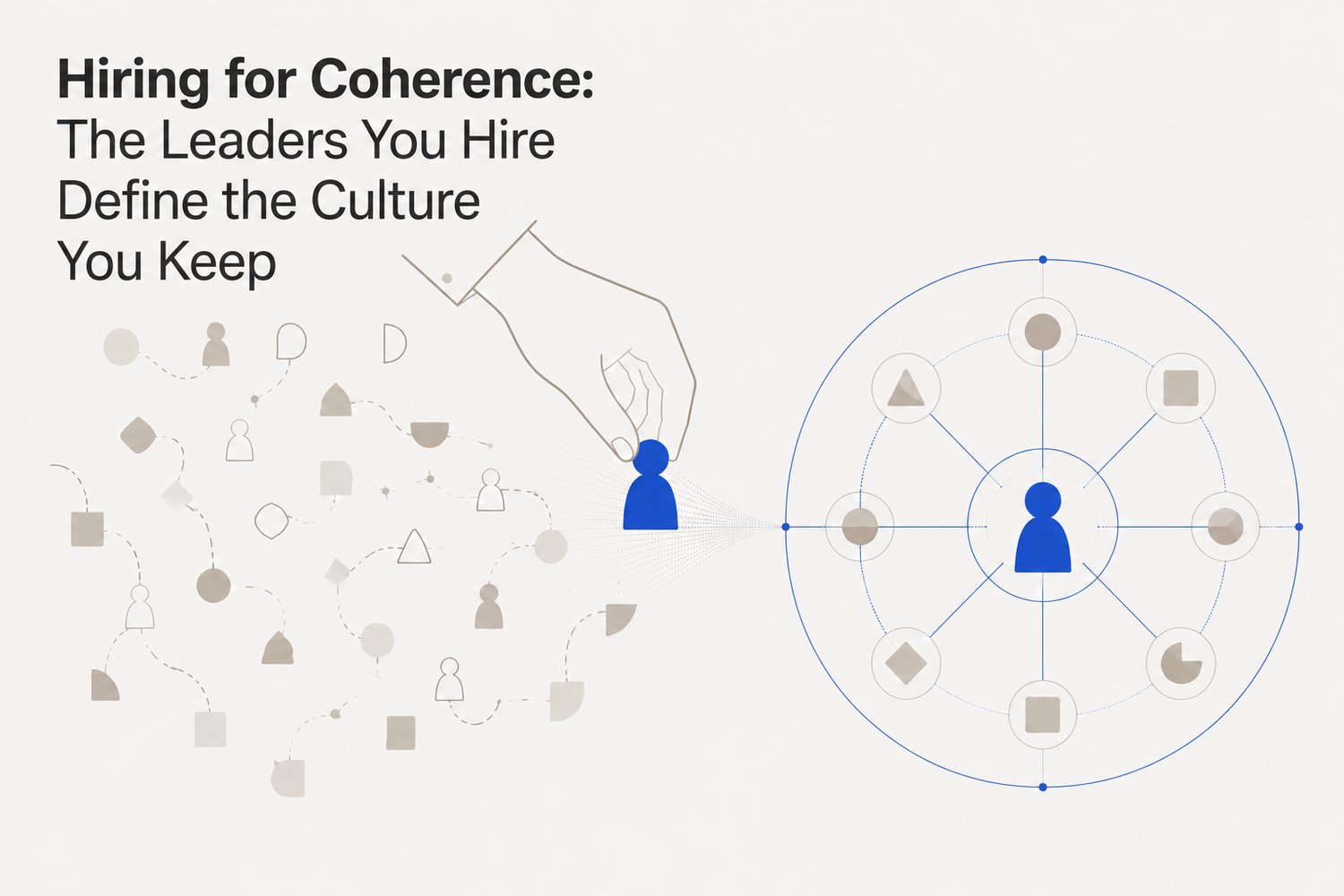
Hiring for Coherence: The Leaders You Hire Define the Culture You Keep
Every leadership appointment is a cultural decision.
Organisations often hire leaders by looking at what they have achieved: growth delivered, costs reduced, teams expanded, crises managed, or transformations completed.
These achievements matter. Leadership requires competence.
But competence alone does not tell us how those results were achieved—or what the organisation had to absorb along the way.
A leader does not bring only experience into an organisation. They also bring beliefs about authority, trust, accountability, conflict, performance, and how people should be treated.
Those beliefs become visible through behaviour.
Behaviour creates signals.
Repeated signals become organisational permission.
And what the organisation repeatedly permits becomes its culture.
This is why the leaders you hire define the culture you keep.
Leadership hiring is culture design
Culture is often treated as something that belongs to Human Resources, internal communications, or employee engagement.
But culture is shaped most powerfully by those who hold authority.
Leaders influence:
- who is heard;
- which questions may be asked;
- how disagreement is received;
- whether mistakes are examined or concealed;
- how accountability is applied;
- which behaviours are rewarded;
- and what the organisation is prepared to overlook.
A leadership appointment therefore changes more than the reporting structure.
It gives authority to a particular way of thinking and behaving.
When a leader interrupts or dismisses people, others learn whose voice matters.
When a leader avoids difficult conversations, others learn that discomfort can override accountability.
When a leader protects a high performer whose behaviour harms the team, others learn that results provide immunity.
When a leader listens, explains decisions, welcomes challenge, and applies standards consistently, others learn that candour and fairness are safe.
Culture does not wait for the new leader to announce their values.
It begins interpreting their behaviour immediately.
The strongest candidate may not be the most coherent choice
Leadership selection frequently favours visible evidence of success.
A candidate may have an impressive record of revenue growth, operational efficiency, rapid expansion, turnaround performance, or delivery under pressure.
But results do not reveal the full system that produced them.
A leader may have delivered exceptional outcomes through fear, dependency, internal competition, information control, or relentless personal intervention.
The results appear on the résumé.
The organisational cost usually does not.
This creates a common hiring error: confusing performance with coherence.
Performance asks:
- Can this person deliver results?
Coherence asks:
- Can this person deliver results in a way that strengthens how this organisation intends to operate?
The distinction matters.
A leader can be individually impressive while being organisationally disruptive.
They may achieve short-term targets while weakening trust, collaboration, decision quality, or the organisation’s ability to function without them.
At first, the appointment may appear successful.
Targets are achieved. Decisions move faster. Problems are resolved.
The cultural consequences often arrive later.
Employees become more guarded. Information stops travelling upwards. Managers learn to anticipate the leader rather than exercise judgment. Teams protect themselves instead of collaborating.
Execution becomes increasingly dependent on one person.
By the time the damage becomes visible, the results that justified the appointment may already have been celebrated.
Values must become observable
Many organisations say they hire for values.
Fewer define what those values look like in practice.
Words such as integrity, empathy, courage, collaboration, and accountability are easy to endorse.
Most leadership candidates know how to speak the language of good leadership.
The real question is not whether a candidate agrees with a value.
It is whether they continue to practise it when doing so becomes inconvenient.
If collaboration matters, examine how the candidate responds when another function disagrees with them.
If accountability matters, ask what they did when a high performer damaged the team.
If psychological safety matters, explore what happened when someone challenged their judgment.
If integrity matters, ask about a decision that carried a personal or professional cost.
If empowerment matters, examine whether they develop decision-making capability in others or retain control around themselves.
Values become meaningful hiring criteria only when they are translated into observable behaviour, difficult decisions, and real trade-offs.
Otherwise, the interview assesses fluency rather than evidence.
Pressure reveals the leadership system
Most candidates can describe how they lead under normal conditions.
Culture, however, is shaped most clearly under pressure.
That is when priorities conflict, information is incomplete, deadlines tighten, and the consequences of failure become personal.
Under pressure, does the leader become more controlling?
Do they narrow the circle of information?
Do they invite challenge but respond defensively when it comes?
Do they blame others, conceal uncertainty, or bypass agreed processes?
Do they maintain standards when the person involved is commercially valuable?
Can they distinguish urgency from panic?
These are not simply questions of personality.
They reveal the leadership system the candidate is likely to create around them.
Instead of asking:
- What is your leadership style?
Ask:
- Tell us about a time when someone more junior challenged your decision. What happened next?
- Describe a situation in which your preferred approach was wrong. How did you recognise it?
- Tell us about a high performer whose behaviour was harming others. What did you do?
- When have you upheld a principle even though it made achieving the immediate target more difficult?
- Describe a failure for which you accepted responsibility when blame could easily have been placed elsewhere.
The quality of an answer lies not only in what happened.
It lies in how the candidate interprets what happened.
Do they demonstrate curiosity, accountability, and awareness of their impact?
Or does every story end by proving that they were right?
Coherence does not mean sameness
Hiring for coherence should not become hiring for similarity.
A coherent leadership team does not require identical personalities, backgrounds, perspectives, or working styles.
In fact, excessive similarity can create blind spots and weaken decision-making.
One leader may be direct while another is reflective.
One may be highly relational while another is strongly analytical.
One may move quickly while another prefers to test assumptions more carefully.
These differences can strengthen the organisation.
Coherence means that leaders can differ without undermining the principles that hold the organisation together.
They may approach problems differently while sharing a common understanding of:
- how authority should be exercised;
- how decisions should be made;
- how disagreement should be handled;
- how people should be treated;
- what accountability requires;
- and which behaviours remain unacceptable regardless of performance.
Diversity expands the organisation’s perspective.
Coherence allows those different perspectives to work together.
Without coherence, difference can become fragmentation.
The organisation is also being assessed
Hiring is not a one-way evaluation.
While the organisation assesses the candidate, the existing system influences which candidates appear attractive.
A culture that values certainty may prefer someone who projects confidence over someone who asks better questions.
A system dependent on heroic intervention may favour a leader who promises decisive rescue.
A leadership team uncomfortable with challenge may reject someone who notices contradictions too quickly.
A culture built around control may describe an empowering leader as insufficiently hands-on.
A system that avoids accountability may describe a consistent leader as inflexible.
The hiring process can therefore reproduce the very culture the organisation claims it wants to change.
Before evaluating candidates, the organisation should examine its own preferences:
- What behaviours are we unconsciously rewarding?
- What discomfort are we trying to avoid?
- Are we hiring for the future we describe—or for the system we already know?
- Do we genuinely want this leader to challenge existing patterns?
- Will we support them when that challenge becomes inconvenient?
Sometimes the recruitment brief calls for transformation while the selection process quietly rewards preservation.
The organisation says it wants change.
But it hires the person who makes the existing system feel safest.
A coherent leader can still fail in an incoherent system
The right appointment cannot compensate indefinitely for the wrong environment.
An organisation may hire a collaborative leader while continuing to reward individual competition.
It may appoint an empowering leader while senior executives repeatedly bypass delegated authority.
It may ask for transparency and then punish the first person who delivers unwelcome information.
It may recruit for long-term capability while evaluating success almost entirely through short-term results.
Under these conditions, the leader faces three choices:
- resist the system;
- adapt to it;
- or leave.
Hiring for coherence must therefore include organisational readiness.
The question is not only whether the candidate aligns with the intended culture.
The organisation must also ask whether its structures will support the behaviour it claims to want.
This requires alignment across performance measures, incentives, decision rights, governance, promotion criteria, leadership expectations, and consequences.
A coherent leader placed inside an incoherent system can become a symbolic appointment rather than a structural change.
The organisation may hire the right person while preserving the conditions that make the right behaviour difficult to sustain.
The cultural cost of a wrong leadership hire
A poor leadership appointment rarely affects only one role or one team.
Leaders influence who is hired, promoted, trusted, protected, and excluded.
They select the next layer of management.
That layer then repeats similar choices further through the organisation.
The effects compound.
One leader who rewards silence creates managers who filter information.
One leader who confuses loyalty with agreement builds a team that cannot challenge weak decisions.
One leader who excuses harmful behaviour for the sake of results teaches the organisation that values are conditional.
One leader who centralises every decision creates dependency that may be mistaken for strong leadership.
Over time, these behaviours become embedded in routines, relationships, expectations, and promotion decisions.
By the time the organisation recognises the damage, the problem may no longer be one leader.
It has become part of the system.
Removing the person does not automatically remove the culture they created.
Hiring for coherence requires better evidence
Leadership hiring should examine more than career achievement and interview performance.
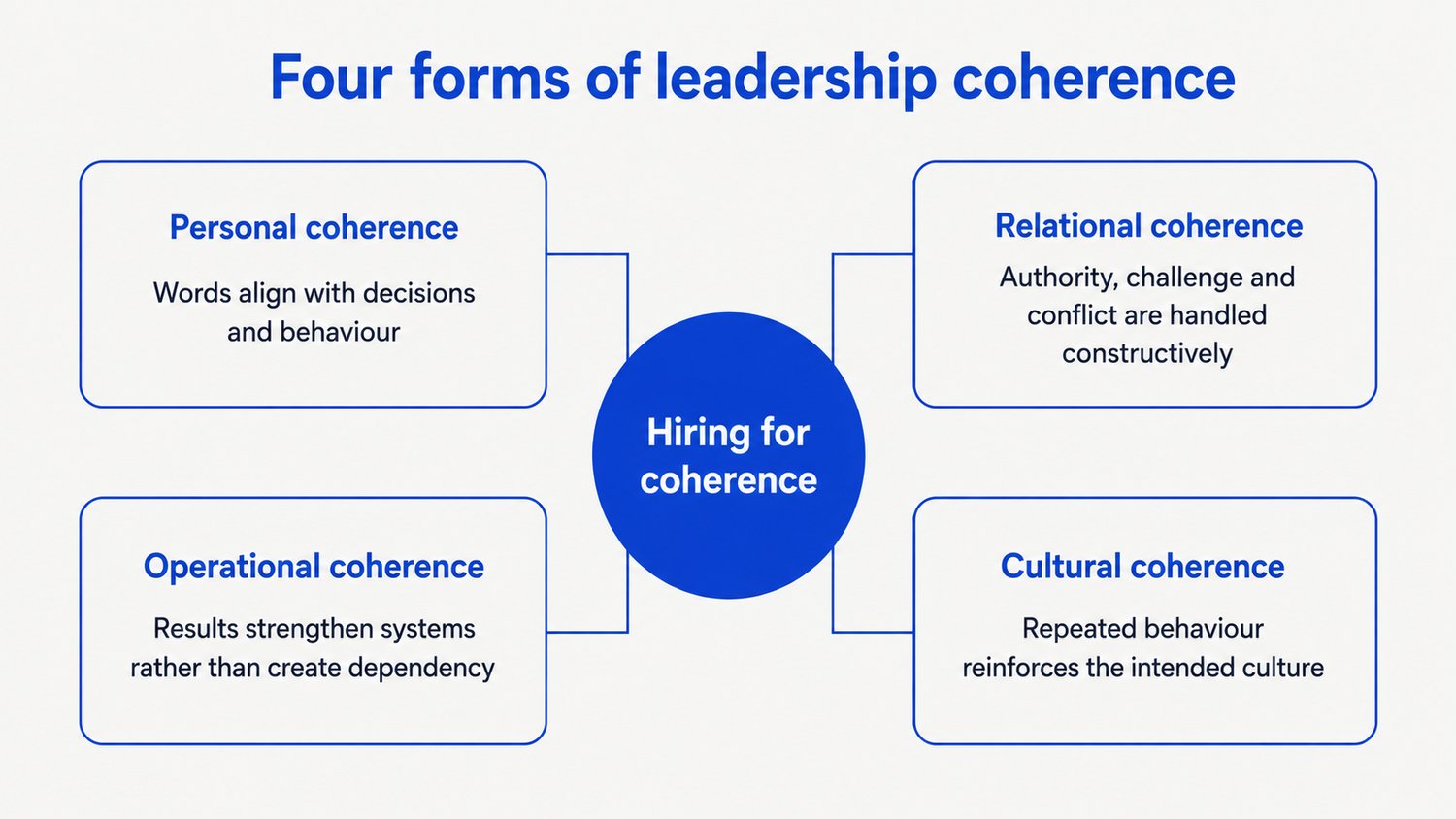
A stronger assessment considers four forms of coherence.
Personal coherence
Are the candidate’s words consistent with their decisions, examples, and treatment of others?
Relational coherence
How do they exercise authority, receive challenge, manage conflict, and respond to vulnerability?
Operational coherence
Do their methods of delivering results strengthen the organisation’s systems and capabilities—or make the organisation more dependent on them?
Cultural coherence
Will their repeated behaviour reinforce the principles the organisation intends to make real?
Evidence should come from more than one polished conversation.
It can include structured behavioural interviews, realistic scenarios, reference conversations, interactions with people at different organisational levels, and closer examination of how previous results were achieved.
The purpose is not to find a flawless leader.
It is to understand the system of leadership that is likely to form around them.
The decision is larger than the role
A leadership vacancy may appear to be an empty position that needs to be filled.
It is more than that.
It is a moment when the organisation decides which behaviours will receive authority, which assumptions will shape decisions, and which signals employees will learn to trust.
A leader’s experience may determine what they are capable of doing.
Their judgment shapes what they choose to do.
Their behaviour teaches others what is permitted.
And what the organisation repeatedly permits becomes the culture it keeps.
Hiring for coherence is therefore not an additional consideration after competence has been assessed.
It is part of determining whether that competence will strengthen the organisation—or slowly work against it.
Every leadership appointment leaves a cultural inheritance.
The question is whether the organisation has examined what it is choosing to inherit.
Part of the Leadership & Culture Series from LUCID Methods.
Explore more frameworks, diagnostic perspectives, and systems-thinking insights through the LUCID Method — developed to help organisations build clarity, coherence, and transformation that holds over time.