

The Core Problem
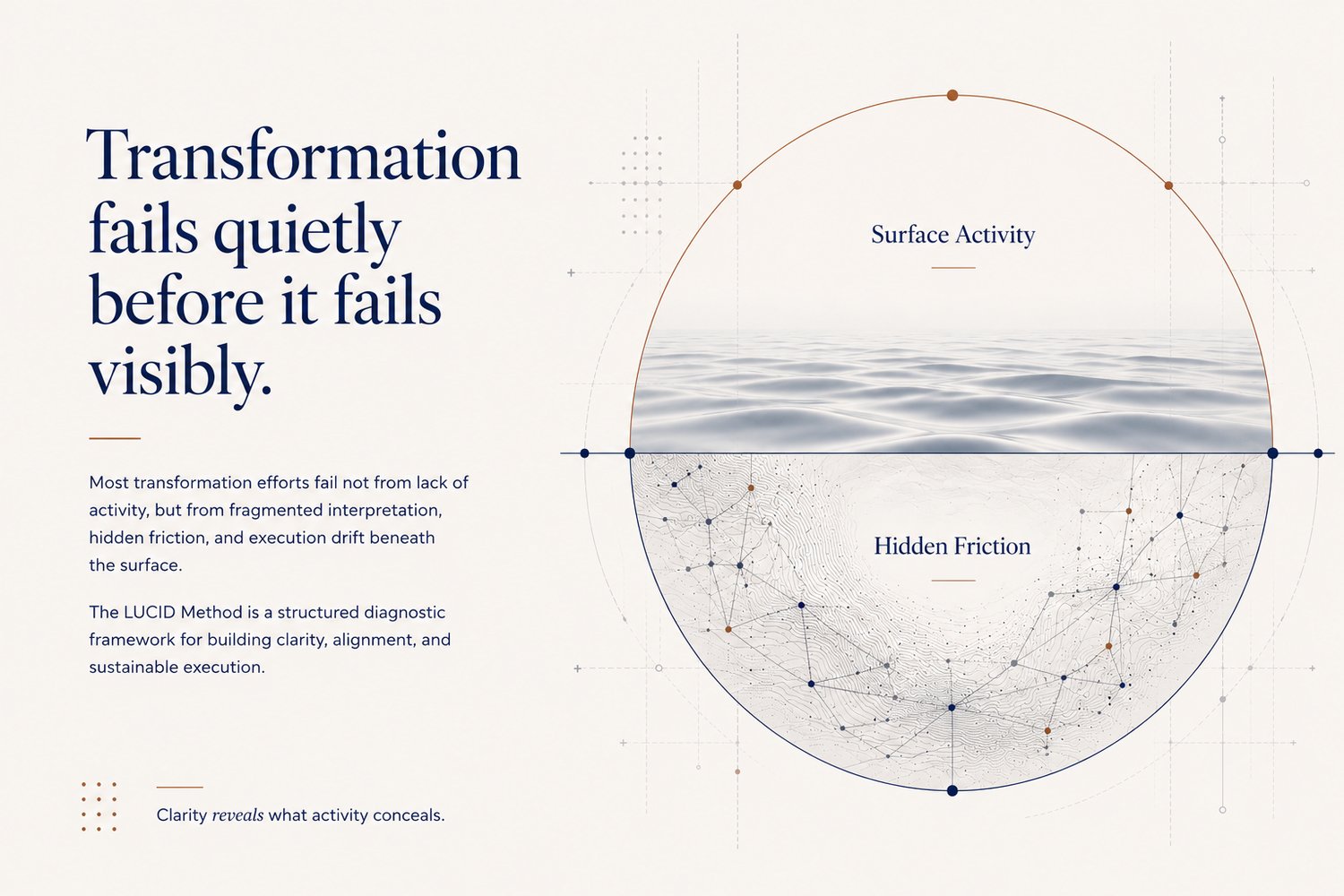
Most transformation efforts do not fail because organisations lack effort, activity, or intent. They fail because teams gradually stop operating from the same understanding of what the transformation actually requires.
Visible progress can conceal hidden fragmentation beneath the surface — competing interpretations, unclear ownership, execution drift, and systemic friction accumulating quietly over time.
As alignment weakens, coordination becomes harder. Decisions diverge. Priorities compete. Momentum fragments. Transformation begins losing coherence long before failure becomes visible.
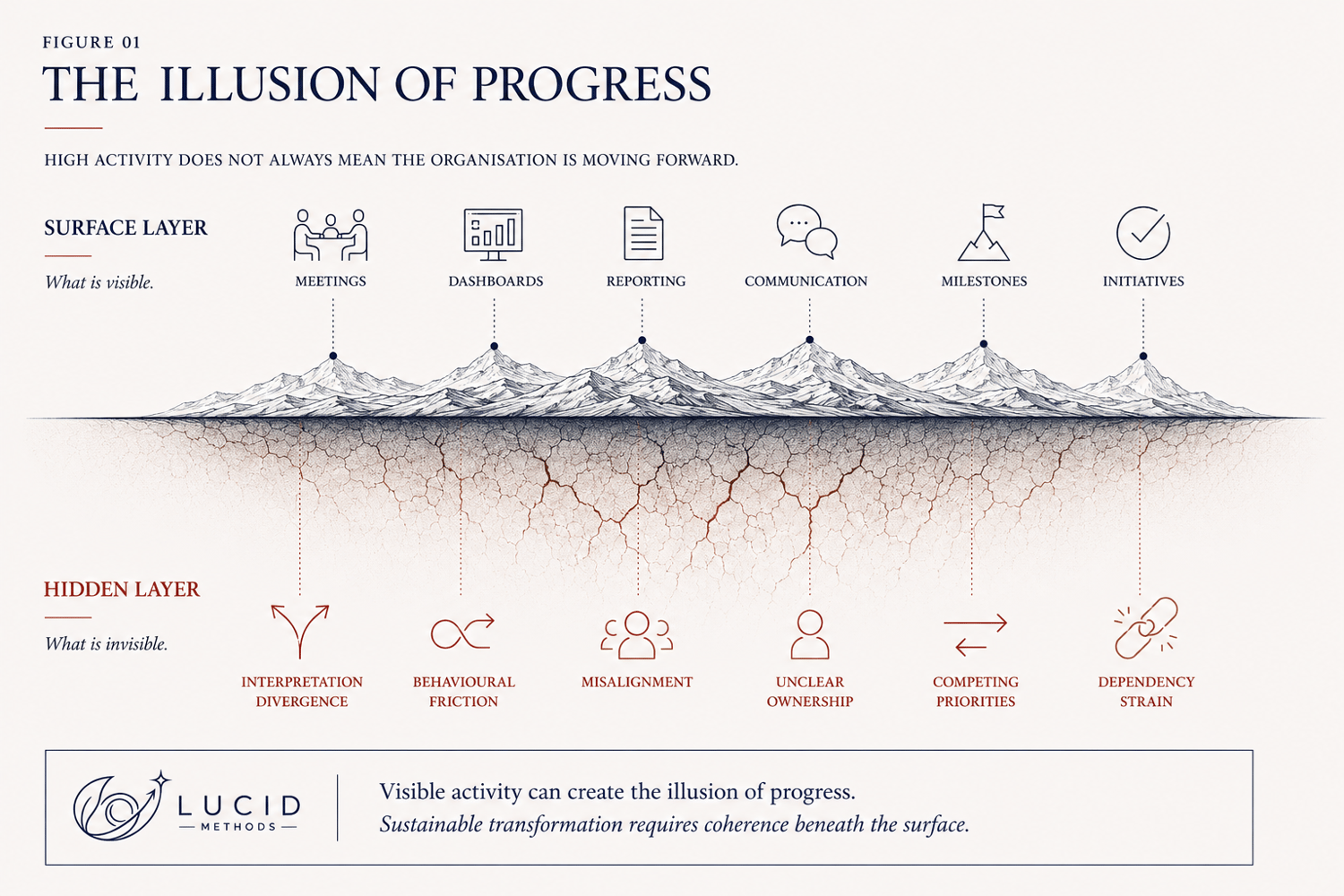
What organisations often see
- Activity increasing
- New initiatives launched
- Milestones progressing
- Reporting intensifying
What is often happening beneath the surface
- Interpretation drift
- Fragmented ownership
- Execution friction
- Coordination breakdown
Sustainable transformation requires more than activity alone. It requires shared interpretation, coherent execution, and alignment beneath the surface.
The LUCID Methods
The LUCID Method was developed to help organisations see beyond surface activity and understand the deeper conditions shaping transformation outcomes.
Rather than focusing only on execution mechanics, the method examines how interpretation, alignment, behaviour, ownership, and systemic friction interact beneath the surface of organisational change — before hidden instability becomes visible failure.
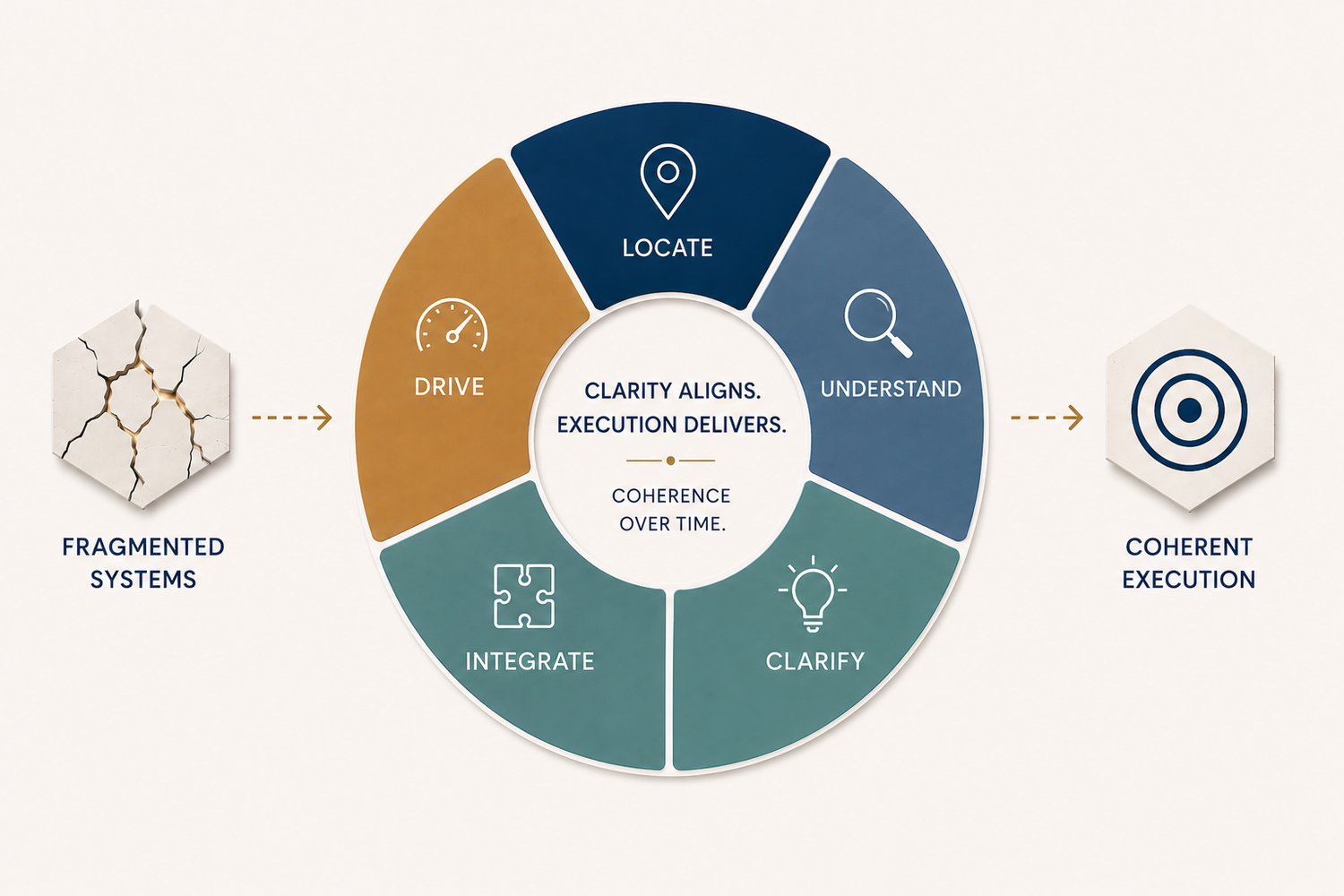
The method is built around five interconnected disciplines:
- Locate — identify where systemic friction, misalignment, and execution drift are forming
- Understand — diagnose the deeper behavioural and structural conditions driving them
- Clarify — establish shared interpretation of what the transformation is truly solving
- Integrate — translate clarity into coordinated and executable behavioural change
- Drive — sustain coherence and execution momentum as complexity increases over time
At its core, the LUCID Method is designed to help organisations maintain clarity when transformation environments become ambiguous, politically fragmented, or operationally complex.
Because sustainable transformation is not created through activity alone.
It is created through shared understanding sustained over time.
The Complete LUCID System
Most transformation failures are diagnostic failures.
The LUCID Method is a strategic diagnostic and transformation framework designed to help organisations identify hidden failure patterns, reduce systemic friction, strengthen execution alignment, and sustain behavioural change over time.
Built for leaders navigating complexity, the system combines structured diagnostics, behavioural execution tools, and practical transformation frameworks designed for real organisational environments.
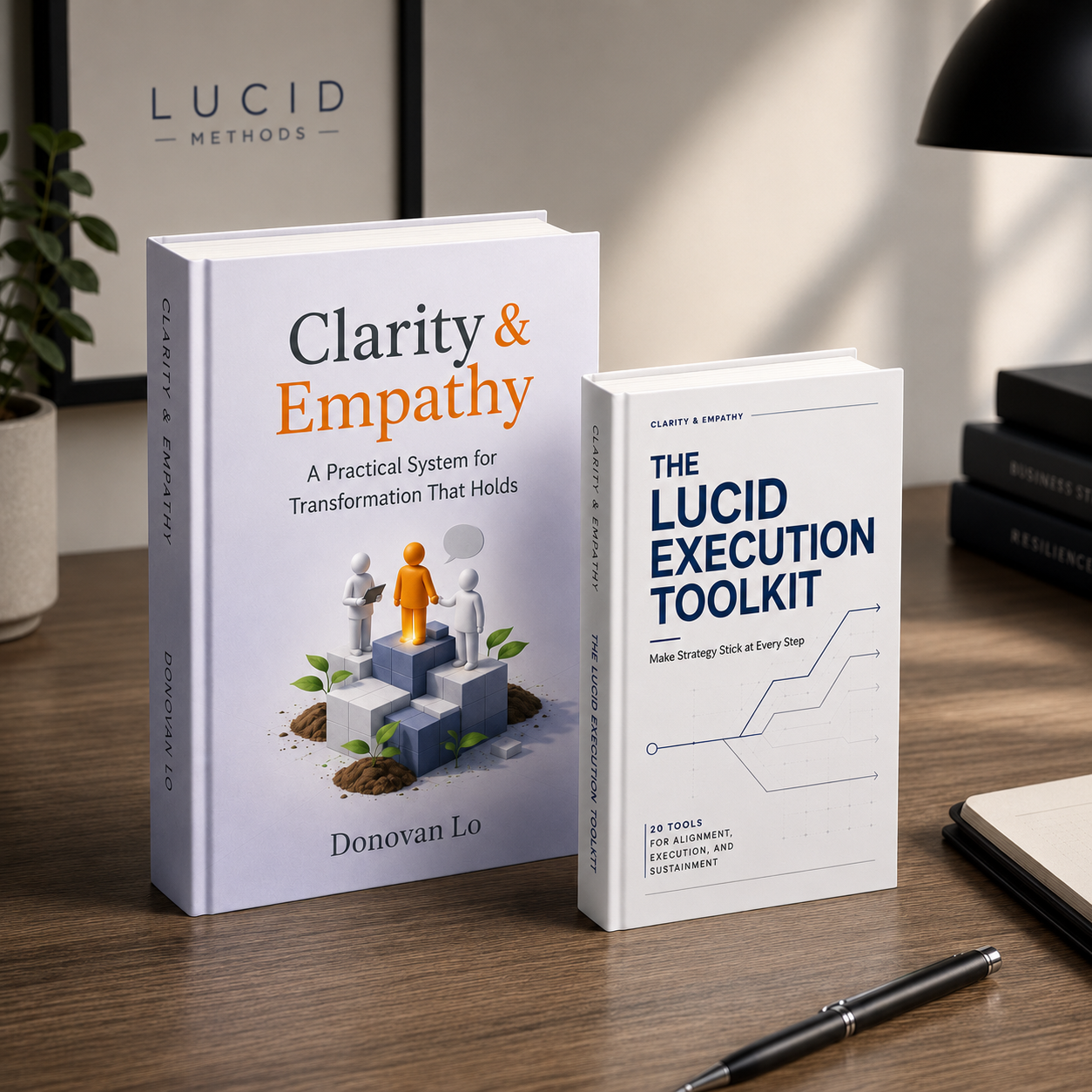
Includes
- Clarity & Empathy
- A practical system for understanding why transformation efforts fragment beneath the surface.
- The LUCID Execution Toolkit
- Twenty structured diagnostic and execution tools for alignment, execution, and sustainment.
Diagnostic Insight
Transformation rarely collapses in a single moment.
Failure usually emerges gradually — through accumulated misalignment, fragmented interpretation, unresolved friction, and execution patterns that quietly diverge over time.
By the time visible failure appears, the underlying conditions have often been forming beneath the surface for months or even years.
The challenge is not simply executing harder.
It is learning to diagnose earlier.
Why LUCID Method Matters
Why Organisations Fail
Activity is not progress.
Most organisations fail quietly before they fail visibly — not from lack of effort, but from diagnostic blindness.
Why Clarity Matters
Clarity is a structural advantage.
Without it, execution fragments, alignment weakens, and transformation collapses under accumulated friction.
Why Systems Thinking
Systems rarely fail all at once.
LUCID Method helps organisations see the hidden structures, behavioural dynamics, and execution patterns shaping outcomes beneath the surface.
Built for organisations
where
- activity outpaces clarity
- alignment erodes across teams
- execution becomes fragmented
- momentum fades after launch
- complexity obscures root causes
The cost of diagnostic blindness compounds over time.
The earlier organisations can see clearly, the more effectively they can align, adapt, and execute.
Stay in the conversation
Receive reflections, book updates, new essays, and occasional resources from Donovan Lo.