

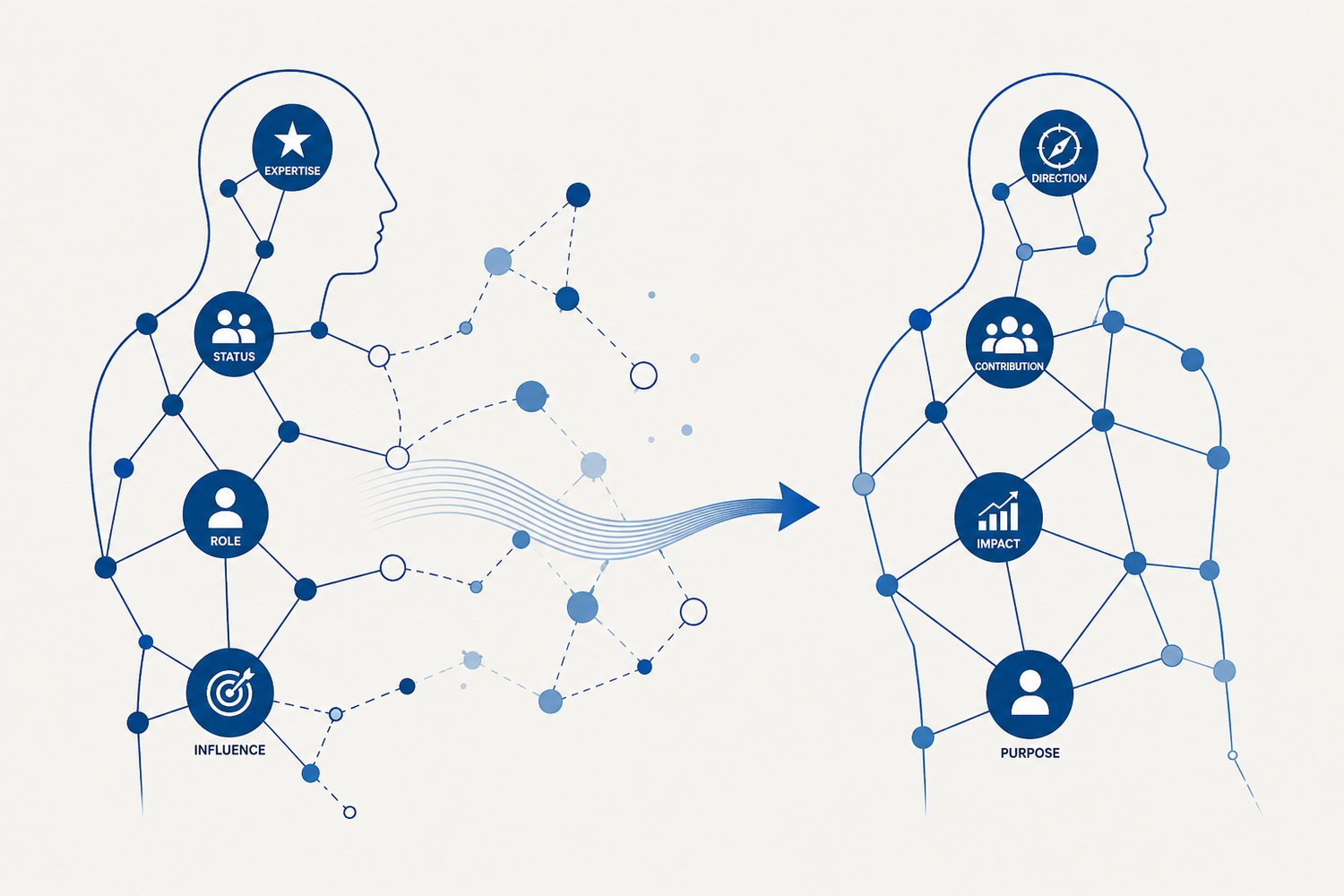
Identity Loss During Change
Change Is Not Just Operational
Many transformation efforts assume resistance is caused by poor communication, lack of training, or insufficient incentives.
Sometimes that is true.
But there is another, less visible source of resistance that leaders often fail to recognise:
People are not protecting a process.
They are protecting an identity.
The deeper the change, the more likely it is that the resistance being observed is not about the change itself, but about what the change threatens to take away.
Transformation is rarely experienced as a purely rational exercise.
For those affected, it can feel personal.
Because every role, responsibility, expertise, and routine contributes to how people understand who they are within the system.
When transformation disrupts that understanding, identity becomes part of the problem space.
The Hidden Question Behind Resistance
Most change initiatives focus on explicit questions:
- What needs to change?
- Why is the change necessary?
- How will the new process work?
Meanwhile, employees are often asking a different question:
Who will I be after this change?
This question is rarely voiced openly.
Instead, it appears as:
- Skepticism
- Delay
- Defensiveness
- Passive resistance
- Endless requests for clarification
- Excessive focus on minor details
These behaviours are often misdiagnosed as lack of commitment.
In reality, they may be signs of identity uncertainty.
The individual is attempting to understand where they fit within a future they cannot yet see.
How Identity Forms Inside Organisations
Professional identity develops over time through repeated experience.
People begin to associate themselves with:
- Their expertise
- Their responsibilities
- Their influence
- Their status
- Their relationships
- Their contribution to outcomes
Eventually, these become part of how they define themselves.
Examples include:
- "I am the expert everyone comes to."
- "I am the person who approves decisions."
- "I am the bridge between departments."
- "I am the problem solver."
- "I know how things really work."
These identities provide stability.
They help individuals navigate uncertainty and establish value within the organisation.
But they also create attachment.
The stronger the attachment, the greater the disruption when transformation alters the underlying conditions that support it.
Why Good Change Can Feel Like Loss
A transformation initiative may objectively improve organisational performance.
Yet employees may still experience it negatively.
This happens because improvement for the organisation does not automatically translate into continuity for the individual.
Consider several common examples:
Process Automation
An employee who built their reputation on manual expertise may feel threatened when automation removes activities they previously mastered.
The organisation sees efficiency.
The employee sees loss of relevance.
Decision Decentralisation
A manager accustomed to controlling approvals may experience empowerment initiatives as a reduction in authority.
The organisation sees agility.
The manager sees loss of influence.
Digital Transformation
Long-established subject matter experts may find themselves displaced by new tools and new capabilities.
The organisation sees modernisation.
The individual sees erosion of expertise.
In each case, the operational change may be beneficial.
But the psychological experience is one of loss.
Identity Loss Creates Interpretation Conflict
Transformation leaders often assume that resistance emerges from disagreement.
In many cases, resistance emerges from interpretation.
The same change is being interpreted differently by different groups.
Leadership interpretation:
"This change will make us more effective."
Employee interpretation:
"This change makes me less valuable."
Both interpretations can exist simultaneously.
Neither side is necessarily irrational.
They are evaluating the same initiative through different lenses.
One lens focuses on organisational outcomes.
The other focuses on personal meaning.
Without recognising this distinction, conversations become increasingly frustrating.
Leaders explain benefits repeatedly.
Employees remain unconvinced.
Not because they fail to understand.
But because the explanation does not address the question they are actually asking.
The Identity Transition Gap
Most transformation programmes focus on two states:
Current State
Who people are today.
Future State
Who the organisation needs them to become.
What is often missing is the transition space between them.
This gap is where uncertainty lives.
People may understand the future vision.
They may even agree with it.
Yet they struggle because they cannot see a path from their current identity to their future identity.
Without that bridge, change feels less like development and more like replacement.
The result is predictable:
- Anxiety increases
- Trust decreases
- Resistance rises
- Alignment weakens
Not because the future is undesirable.
Because the path remains unclear.
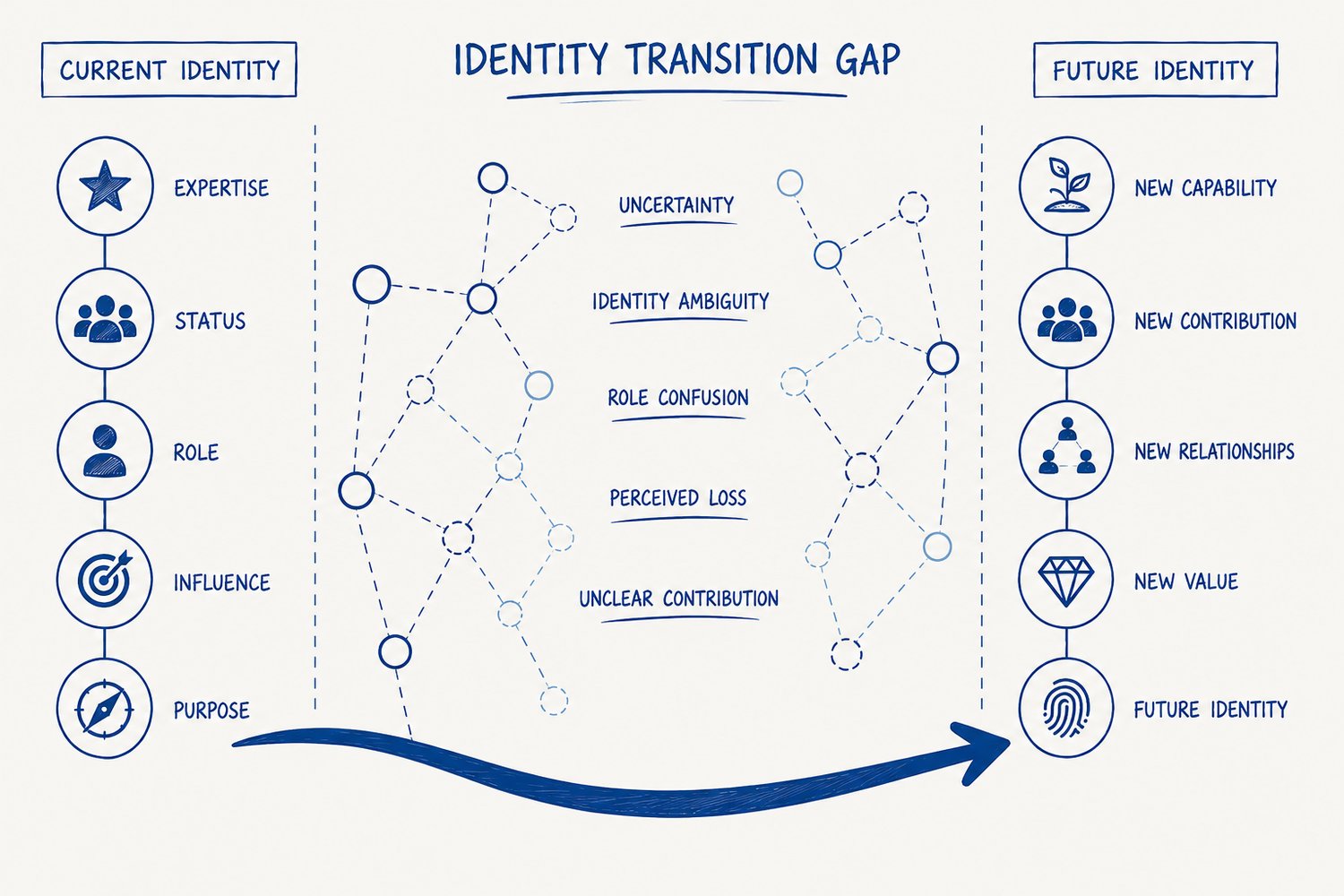
Identity resistance often emerges inside the transition gap between an established identity and an emerging one.
The Most Successful Transformations Preserve Meaning
Successful transformation leaders understand an important principle:
People do not need their old role preserved.
But they often need their sense of value preserved.
This distinction matters.
The goal is not to protect obsolete structures.
The goal is to help people understand how their contribution evolves.
Instead of saying:
"Your role is no longer needed."
Leaders might communicate:
"Your expertise remains important, but it will be applied differently."
Instead of eliminating identity, they facilitate identity evolution.
This creates continuity during disruption.
And continuity creates psychological safety.
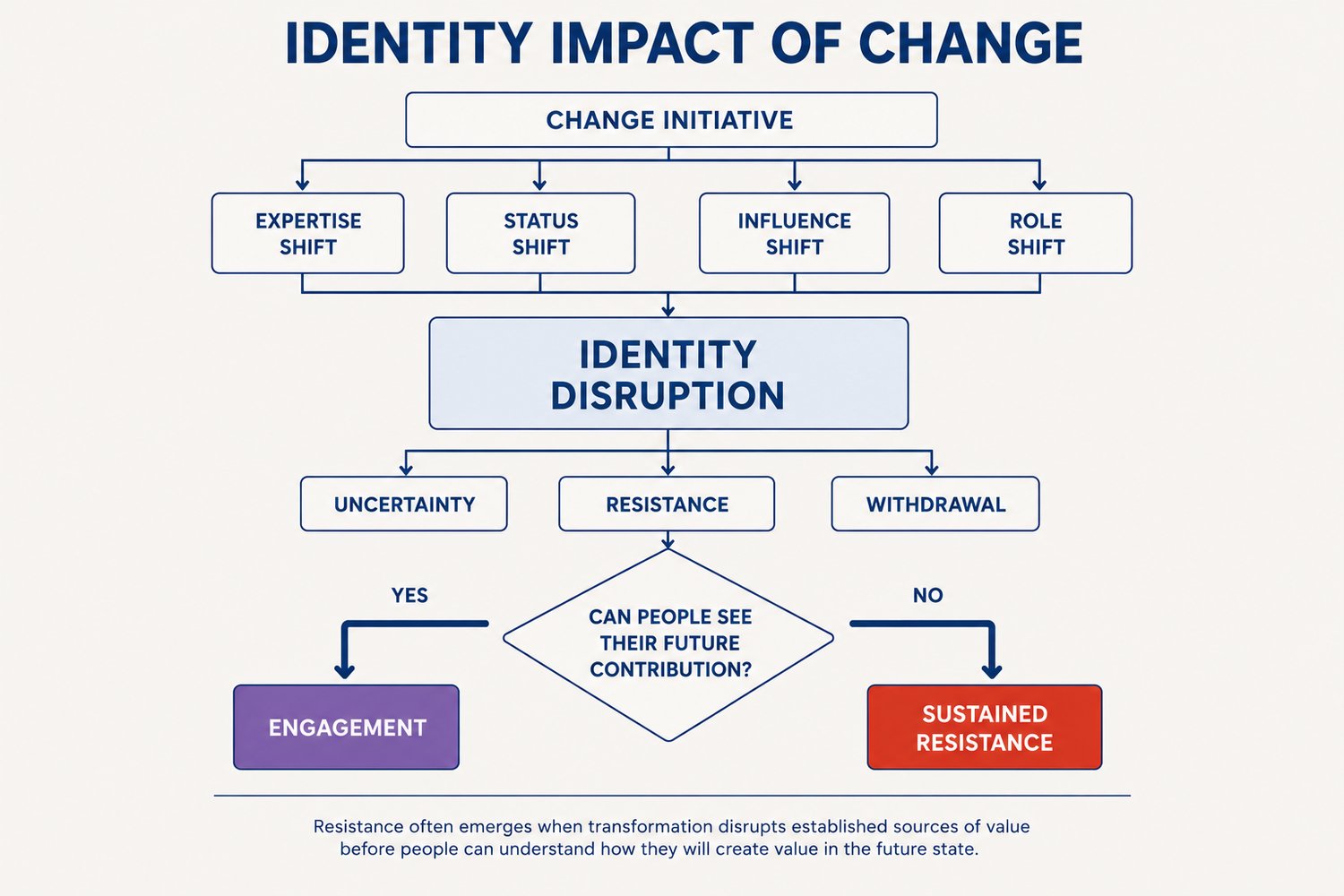
Signs Identity Loss Is Occurring
Transformation teams should pay attention when they observe:
- Strong emotional reactions to seemingly minor changes
- Repeated defence of legacy practices
- Excessive attachment to historical success
- Fear of new technologies despite adequate training
- Loss of engagement among previously high-performing staff
- Persistent nostalgia about previous operating models
These signals often indicate identity disruption rather than capability gaps.
Providing more training may not solve the problem.
Because the challenge is not skill acquisition.
The challenge is identity reconstruction.
Questions Leaders Should Be Asking
Instead of asking:
"Why are they resisting?"
Leaders may benefit from asking:
- What identity is being threatened?
- What source of value is being disrupted?
- What status is being altered?
- What expertise is becoming less visible?
- How can we help people see their future contribution?
These questions often reveal dynamics that traditional change plans overlook.
And once visible, they become easier to address.
Identity Is a Transformation Dependency
In LUCID terms, identity should be viewed as a hidden dependency within transformation.
Many programmes carefully map:
- Processes
- Technology
- Governance
- Stakeholders
- Risks
Yet few map identity dependencies.
This creates blind spots.
A transformation may appear fully aligned on paper while simultaneously creating identity instability among key stakeholder groups.
When that occurs, resistance emerges later and appears unexpected.
In reality, the warning signs existed from the beginning.
They simply remained outside the transformation's field of view.
Final Thought
People rarely resist change because they enjoy inefficiency.
More often, they resist because change threatens an answer to a deeply human question:
"Who am I within this system?"
When transformation removes an existing identity before a new one has formed, uncertainty fills the gap.
That uncertainty often appears as resistance.
The most effective leaders understand that transformation is not merely the redesign of systems.
It is also the redesign of meaning.
And when people can see how they continue to matter in the future state, change becomes significantly easier to embrace.
Part of the Change & Human Systems Series from LUCID Methods.
Explore more frameworks, diagnostic perspectives, and systems-thinking insights through the LUCID Method — developed to help organisations build clarity, coherence, and transformation that holds over time.