

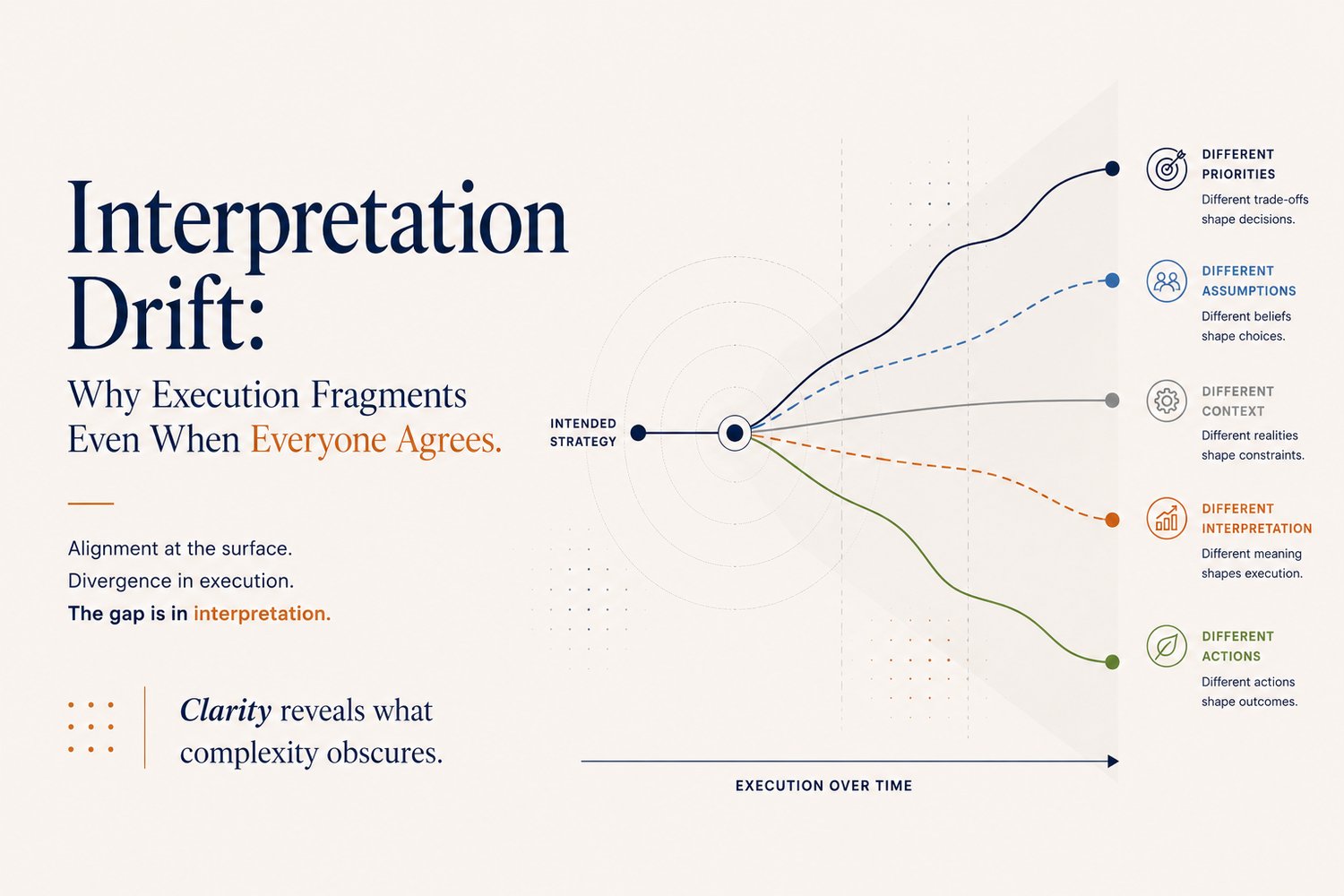
Interpretation Drift: Why Execution Fragments Even When Everyone Agrees
Most organisations do not fail because people refuse to execute.
They fail because people execute different interpretations of the same strategy.
At the beginning of a transformation initiative, alignment often appears strong. Leadership communicates direction. Teams nod in agreement. Plans are documented. Meetings conclude with apparent clarity.
Yet months later, execution begins to fracture.
Priorities conflict.
Decisions slow down.
Teams pull in different directions.
Rework increases.
Momentum fades.
The organisation often interprets this as an execution problem.
But the real issue usually began much earlier.
It began at the level of interpretation.
Agreement Is Not the Same as Shared Understanding
One of the most dangerous assumptions in organisational work is believing that agreement automatically creates alignment.
It does not.
People can agree to the same words while attaching entirely different meanings to them.
A leader may say:
“We need to become more customer-centric.”
Strategy teams may interpret this as market differentiation.
Operations teams may interpret it as service responsiveness.
Finance may interpret it as cost optimisation.
Middle managers may interpret it as reducing complaints quickly.
Everyone believes they are supporting the same objective.
Yet each group is moving according to different assumptions, incentives, pressures, and realities.
The organisation appears aligned at the surface while quietly diverging underneath.
This is interpretation drift.
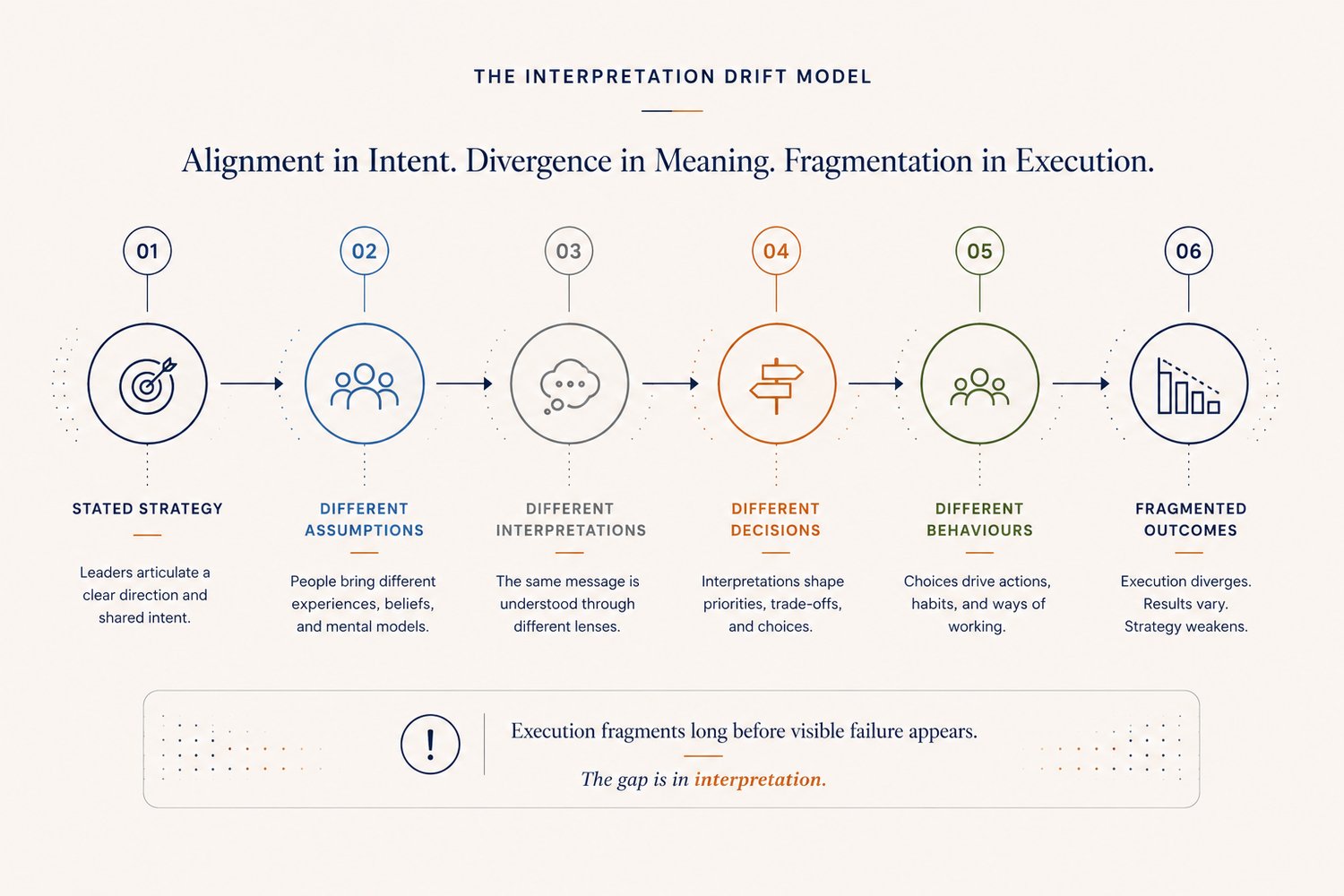
Execution Follows Meaning, Not Messaging
Organisations often focus heavily on communication.
Town halls.
Slides.
Vision statements.
Strategy decks.
Roadmaps.
But communication alone does not create coherence.
People do not execute based only on what leaders say.
They execute based on what they believe the system truly rewards, prioritises, tolerates, and expects.
This distinction matters.
A company may declare innovation as a priority while rewarding short-term operational stability.
It may encourage collaboration while maintaining siloed incentives.
It may promote transformation while punishing experimentation and failure.
In these environments, employees learn quickly which signals are real.
Execution follows interpreted reality.
Not stated intention.
Drift Happens Quietly
Interpretation drift rarely appears dramatic at first.
It begins subtly.
Small differences in assumptions.
Slightly different mental models.
Different contextual pressures across departments.
Local optimisation decisions made independently.
Over time, these small divergences compound.
The further execution progresses, the harder it becomes to detect where alignment was lost.
By the time friction becomes visible, teams are often already operating inside entirely different versions of the same initiative.
This is why many organisations experience:
- Endless alignment meetings
- Repeated course correction
- Conflicting priorities
- Slow decision-making
- Execution fatigue
- Momentum without meaningful progress
The problem is not always capability.
Often, the system has fragmented into multiple operational realities.
Context Changes Faster Than Interpretation
Another reason alignment degrades is that organisational context never stays static.
Markets shift.
Leadership priorities evolve.
Operational pressures emerge.
External conditions change.
What was once a valid interpretation can slowly become outdated.
Yet many organisations continue executing against old assumptions because reinterpretation never occurs explicitly.
Alignment is therefore not a one-time achievement.
It is an ongoing maintenance discipline.
Shared understanding must continuously evolve alongside changing conditions.
Without recalibration, drift becomes inevitable.
Organisational Layers Experience Different Realities
Interpretation drift becomes even more dangerous across organisational layers.
Senior leadership often experiences the organisation through strategic abstraction.
Operational teams experience it through day-to-day constraints.
Middle management operates between both realities, often translating pressure in multiple directions simultaneously.
As initiatives move downward through the organisation, meaning changes.
A strategic transformation initiative may be interpreted by:
- Leadership as market positioning
- Management as delivery coordination
- Frontline teams as survival pressure and workload increase
Everyone may technically support the same initiative while operating from entirely different realities.
This creates hidden fragmentation inside the system.
Not because people are resisting.
Because interpretation was never stabilised across layers.
Coherence Is Maintained, Not Declared
Many organisations treat alignment as
an event.
A workshop.
A strategy offsite.
A leadership announcement.
But coherence cannot be declared once and assumed permanent.
It must be actively maintained.
High-performing organisations tend to do several things differently:
They surface assumptions early.
They revisit interpretation regularly.
They create shared operational language.
They clarify trade-offs continuously.
They recalibrate as context evolves.
Most importantly, they understand that clarity is not merely communication.
Clarity is shared interpretation sustained over time.
Shared Understanding Is a Force Multiplier
When interpretation aligns:
- Decisions accelerate
- Friction decreases
- Trust strengthens
- Rework reduces
- Effort compounds
The organisation moves faster not because people work harder, but because energy is no longer lost through fragmentation.
Execution becomes coherent.
And coherence creates momentum that sustains transformation.
The organisations that adapt best are not necessarily those with the loudest vision or the most aggressive execution.
They are often the ones most capable of maintaining shared understanding as reality changes.
Because in the end, organisations move at the speed of shared interpretation.
Part of the Alignment & Interpretation Series from LUCID Methods.
Explore more frameworks, diagnostic perspectives, and systems-thinking insights through the LUCID Method — developed to help organisations build clarity, coherence, and transformation that holds over time.