

Leadership Silence Is Still a Signal
Leaders communicate through what they say.
They also communicate through what they do not say.
When a concern is raised and receives no response, people notice.
When behaviour contradicts stated values and is left unaddressed, people notice.
When uncertainty grows and leadership offers no acknowledgement, people notice.
Silence does not remove the signal.
It leaves others to interpret it.
Silence is not an empty space
Leaders may remain silent for understandable reasons.
They may not have all the facts.
They may be considering their response.
They may need to protect confidentiality.
They may assume that no response is better than an incomplete one.
But leadership intent does not determine organisational interpretation.
A leader may intend caution.
Employees may interpret avoidance.
A leader may intend neutrality.
Employees may interpret indifference.
A leader may intend to avoid interfering.
Employees may interpret a lack of support.
The silence may have been intended as a pause.
But without explanation, it can easily be experienced as a position.
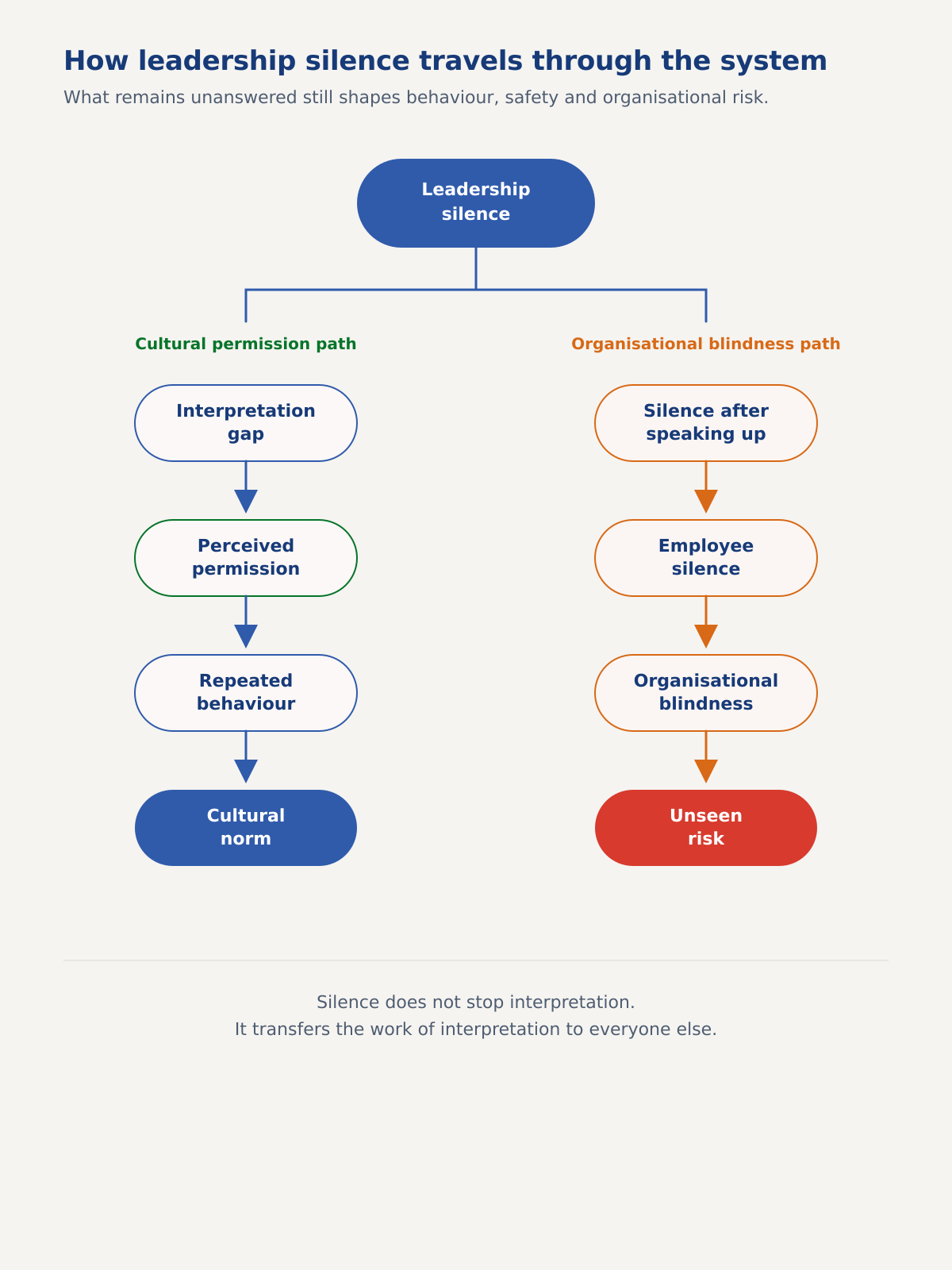
This is the interpretation gap.
What leaders mean and what the organisation understands are not always the same.
People interpret what leadership leaves unexplained
When leaders do not provide meaning, people construct it for themselves.
They look at the surrounding evidence.
They observe who is involved.
They remember how similar situations were handled.
They notice whether the behaviour continues.
They watch whether anyone follows up.
From these observations, they form conclusions:
- Leadership does not know.
- Leadership knows but does not care.
- Leadership agrees with what happened.
- Leadership is unwilling to intervene.
- The issue is not important enough to address.
- Speaking up will not change anything.
These conclusions may be wrong.
But they are not necessarily unreasonable.
People interpret leadership through the information available to them.
When direct communication is absent, indirect evidence becomes more influential.
Silence does not stop interpretation.
It transfers the work of interpretation to everyone else.
Silence can become organisational permission
A policy tells people what should happen.
Leadership response tells them what actually matters.
Consider a manager who repeatedly dismisses concerns raised by the team.
The organisation may have policies on respect, inclusion and psychological safety.
But if senior leaders observe the behaviour and say nothing, employees learn from the silence.
They learn that the behaviour can continue.
The same pattern appears when a high performer ignores agreed processes,
when a senior colleague takes credit for another person’s work,
or when a leader behaves disrespectfully towards someone with less power.
What is left unchallenged begins to define the practical boundary of acceptable behaviour.
This does not mean that every matter must be addressed publicly.
Many issues should be handled privately.
Confidentiality may limit what leaders can disclose.
But confidentiality does not require complete silence.
A leader can acknowledge that a concern has been heard.
They can explain that it is being reviewed.
They can reinforce the standard that still applies, even when the details of an individual case cannot be discussed.
Without that acknowledgement, people are left to judge the organisation by the only visible evidence they have:
The behaviour occurred.
The behaviour continued.
Leadership remained silent.
Silence becomes interpreted as permission.
Permission enables repetition.
Repetition becomes culture.
Silence communicates priority
Leadership attention is limited.
Where leaders direct that attention reveals what the organisation is expected to take seriously.
What leaders ask about receives preparation.
What they review receives focus.
What they challenge receives correction.
What they repeatedly ignore is gradually understood as unimportant.
A leader may say that employee wellbeing matters but remain silent when workloads become unsustainable.
A leader may say that collaboration matters but overlook territorial behaviour among senior managers.
A leader may say that candour is welcome but provide no response when someone raises a difficult concern.
In each case, the stated message remains intact.
But the organisational signal changes.
People do not evaluate values only by reading what the organisation has written.
They evaluate them by observing where leadership attention appears—and where it disappears.
When leadership words and leadership attention point in different directions, people usually trust the pattern of attention.
Silence after speaking up is especially consequential
Psychological safety is often framed as whether employees feel able to speak.
But speaking is only the first part of the system.
The organisation’s response determines what people learn from having spoken.
Was the concern acknowledged?
Did anyone ask for more information?
Was there follow-up?
Did anything change?
Was the person who spoke treated differently afterwards?
An invitation to speak means little when speaking is followed by silence.
Employees may initially continue raising concerns.
But when nothing appears to happen, they begin to adapt.
They soften difficult messages.
They wait until the evidence is undeniable.
They discuss problems privately rather than through formal channels.
Eventually, they stop raising concerns altogether.
The organisation may then appear calm. Meetings may contain fewer disagreements.
Leaders may hear fewer complaints.
But fewer reported concerns do not necessarily mean fewer problems.
They may mean that the organisation has taught people that speaking produces no meaningful response.
Leadership silence creates employee silence.
Employee silence creates organisational blindness.
The absence of warning is then mistaken for the absence of risk.
Silence can protect power without intending to
Silence does not affect everyone equally.
When there is a difference in status, authority or influence, leadership silence often protects the person who already holds more power.
If a junior employee raises a concern about a senior manager and leadership says nothing, the junior employee carries the uncertainty.
They do not know whether they were believed.
They do not know whether the concern was taken seriously.
They do not know whether speaking has placed them at greater risk.
The senior manager, meanwhile, may experience no visible consequence.
Even when leadership is quietly reviewing the matter, the visible pattern can appear unchanged.
This is why silence in situations involving power requires particular care.
The question is not only whether leaders are acting.
It is whether the organisation can see enough to understand that its standards still hold.
Not all silence is avoidance
Leadership does not require an immediate answer to every question.
There are times when silence is thoughtful.
A leader may pause to listen.
They may need to verify information.
They may avoid forming a conclusion before hearing different perspectives.
They may deliberately create space so that their authority does not dominate the discussion.
This kind of silence can strengthen leadership.
But constructive silence has purpose.
It creates space for better understanding and is followed by response.
Avoidant silence leaves uncertainty unattended.
The distinction is not whether the leader speaks immediately.
It is whether people understand what the silence means.
A leader can say:
“I have heard the concern, but I need more information before responding.”
“I cannot discuss the individual details, but the matter is being addressed.”
“I would like to hear other perspectives before offering my own.”
“We do not yet have an answer. We will provide an update by Friday.”
These responses do not create false certainty.
They create orientation.
People may still need to wait.
But they are no longer left to decide
whether leadership has noticed,
whether the matter matters or
whether anything will happen.
The pattern matters more than the moment
A single period of silence may be reasonable.
A repeated pattern of silence becomes organisational evidence.
Employees do not interpret each leadership response in isolation.
They compare it with what has happened before.
If leaders have consistently acknowledged difficult issues, people are more likely to trust that a temporary silence reflects care or due process.
If leaders have repeatedly avoided uncomfortable matters, the same silence will carry a different meaning.
Trust changes the interpretation of silence.
But trust is itself built through earlier patterns of clarity, consistency and follow-through.
This means that leaders cannot rely on their personal intentions to preserve trust.
They must consider the accumulated evidence the organisation is using to interpret them.
The question is not simply:
“Why am I remaining silent?”
It is also:
“What has our previous behaviour taught people this silence means?”
Leadership communication is more than messaging
Organisations often treat leadership communication as the delivery of announcements, decisions and updates.
But leadership signalling is broader.
It includes what leaders acknowledge.
What they question.
What they return to.
What they allow to fade away.
It includes timing, attention, consistency and follow-through.
A well-written message cannot compensate for a pattern of avoidance. Nor does effective communication require leaders to speak constantly.
It requires coherence between the situation, the organisation’s stated principles and the signal created by the leadership response.
When leaders cannot provide a full answer, they can still:
- Acknowledge what has happened or what has been raised.
- Clarify what is known and what remains uncertain.
- Explain what will happen next.
- Reinforce the principle or standard that continues to apply.
- Return with an update when promised.
The final step is essential.
Acknowledgement without follow-through eventually becomes another form of silence.
What is leadership silence teaching?
Leaders are often judged by the decisions they make.
But culture is also shaped by the moments when no visible decision is made.
What goes unanswered?
What remains unnamed?
Which behaviours repeatedly pass without challenge?
Which concerns disappear after being raised?
Where are employees required to interpret leadership intentions without enough evidence?
These are not merely communication gaps.
They are signals about priority, permission and safety.
Leadership silence may be thoughtful. It may be necessary.
It may be temporary.
But it is never free from interpretation.
When leaders say nothing, people still learn something.
They learn what matters.
They learn what is safe to discuss.
They learn what behaviour the organisation will tolerate.
And they adjust accordingly.
Silence is still a signal.
The question is whether it is the signal leadership intends to send.
Part of the Leadership & Culture Series from LUCID Methods.
Explore more frameworks, diagnostic perspectives, and systems-thinking insights through the LUCID Method — developed to help organisations build clarity, coherence, and transformation that holds over time.