

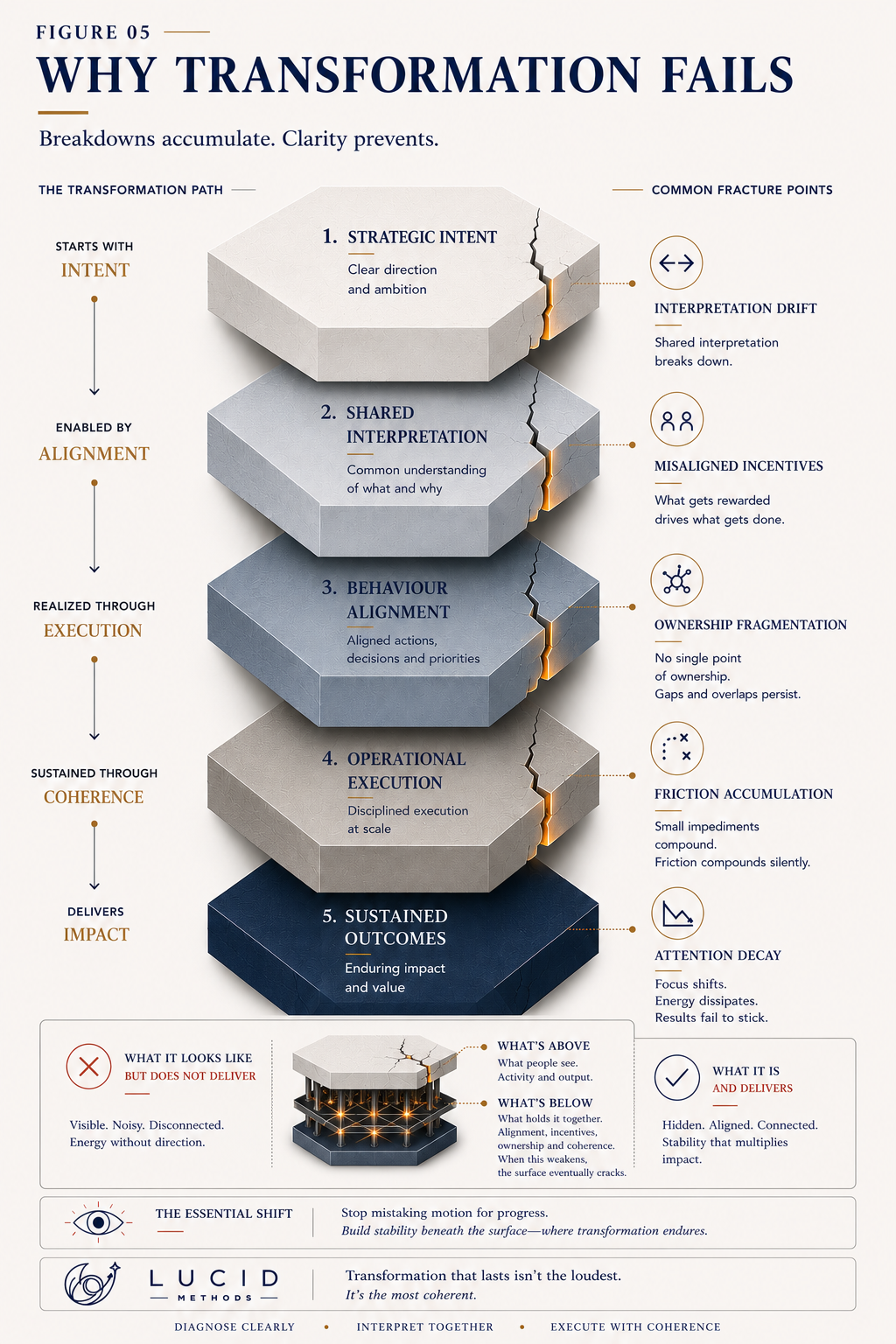
Most transformation efforts do not fail because organisations lack activity or investment. They fail because movement begins before clarity exists.
Teams align around language while interpreting entirely different realities. Visible progress conceals unresolved friction. Execution continues even after coherence has already started to break down.
Over time, organisations become trapped inside systems that appear functional on the surface while quietly drifting away from their original intent.
LUCID Methods was developed as a structured diagnostic framework for making these hidden failures visible before they become embedded into execution.
The framework helps leaders examine how problems are framed, how systems shape behaviour, where friction accumulates, and why transformation efforts gradually lose alignment over time.
Its purpose is to create the conditions where execution becomes sustainable because clarity exists first.
Clarity aligns. Execution delivers.
What LUCID Methods Is
LUCID Methods is a structured diagnostic and execution framework designed to help organisations understand what is actually happening before deciding what to do about it.
It is built on the principle that most transformation failures are not caused by a lack of effort, intelligence, or intent.
They emerge when organisations attempt to solve problems that have not yet been properly understood.
The framework provides a systematic approach for examining how problems are framed, how people interpret change, how systems generate friction, and how execution gradually loses coherence over time.
LUCID Methods approaches transformation as an interconnected system of interpretation, behaviour, structure, and sustained execution.
The methodology combines:
- Diagnostic frameworks
- Behavioural analysis
- Systemic friction mapping
- Execution design principles
- Sustainment structures
- Leadership alignment models
Together, these components provide leaders with a systematic way to diagnose what is breaking down, understand why, and design execution that holds over time.
Because sustainable execution does not begin with action alone.
It begins with clarity.
Key Concepts
Diagnostic Clarity
Understanding the true root causes of transformation failure, not just the symptoms.
Systemic Friction
Identifying hidden resistance and structural barriers that prevent change from sticking.
Execution Architecture
Designing the conditions that enable sustainable transformation and behavioural change.
Operational Clarity
Creating alignment and transparency across teams and organisational systems.
Behavioural Diagnostics
Understanding how people resist change and how to design for sustainable adoption.
Strategic Transformation
Applying systems thinking to transformation strategy and organisational change.
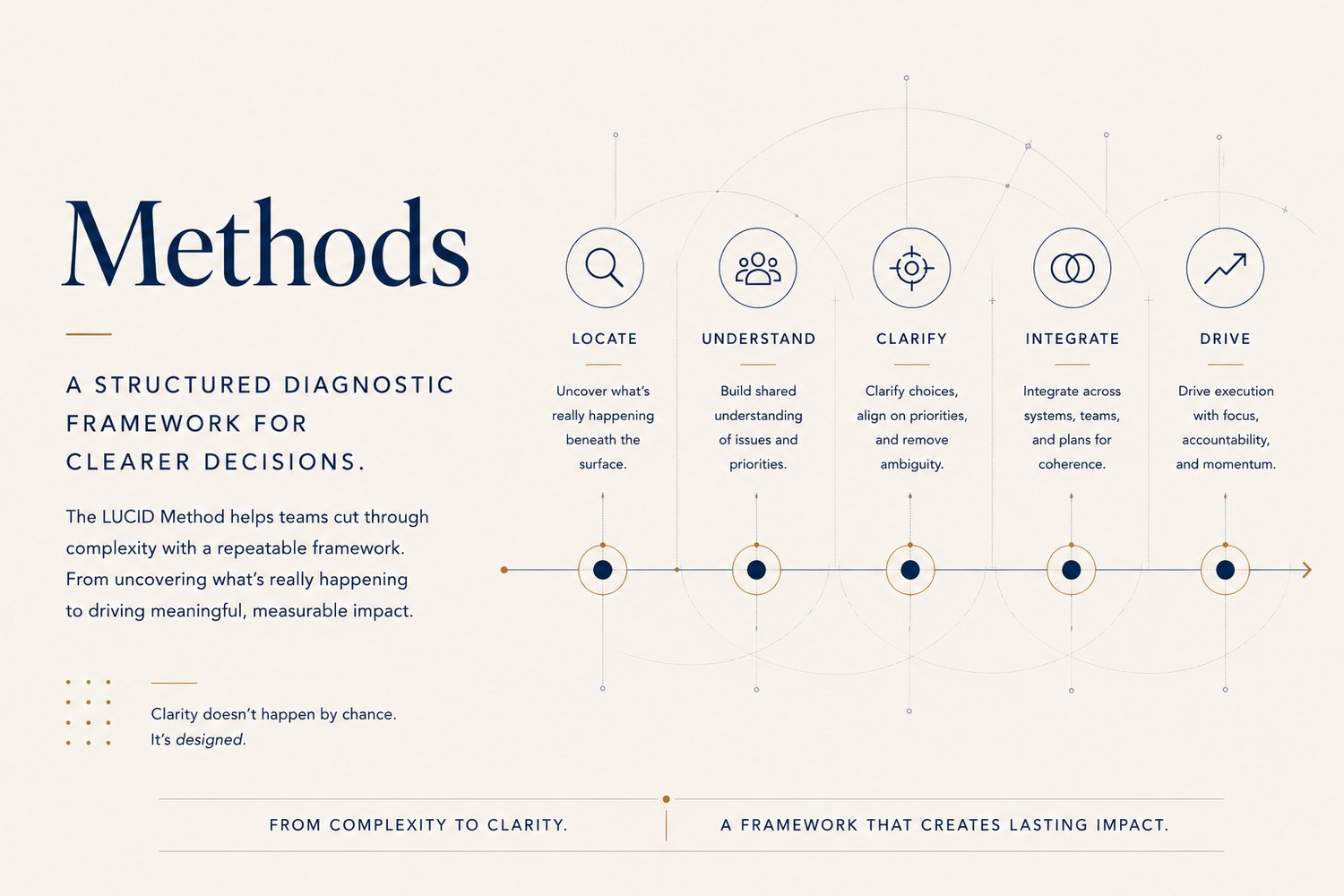
The LUCID Logic
The LUCID framework is built around a simple principle:
Transformation becomes unstable when organisations move into execution before shared interpretation and systemic alignment have been established.
LUCID Methods provides a structured progression for diagnosing that instability and rebuilding execution on clearer foundations.
L — Locate the Real Problem
Diagnose What Is Actually Failing
Most organisations respond to visible symptoms rather than to the underlying system conditions that create them.
The first responsibility of transformation is to identify what is actually failing beneath the surface of operational noise, assumptions, and inherited narratives.
U — Understand Stakeholder Reality
Understand System Behaviour
Problems rarely emerge from a single cause.
They emerge from interconnected behaviours, incentives, constraints, dependencies, perceptions, and competing realities operating across the organisation.
Understanding how different stakeholders experience, interpret, and respond to the system is necessary before attempting to redesign it.
C — Clarify Outcome
Establish Shared Interpretation
Alignment is not achieved simply because people use the same language.
Transformation begins to fragment when teams interpret goals, priorities, risks, trade-offs, and success differently while believing they are aligned.
Clarity requires shared interpretation — not communication alone.
I — Integrate Across Systems
Translate Alignment into Coordinated Execution
Clarity alone does not produce operational coherence.
Transformation weakens when understanding remains disconnected from the realities of execution, workflows, incentives, structures, and decision-making across the organisation.
LUCID Methods helps organisations integrate alignment into the operational systems that shape execution at scale.
D — Drive & Sustain Change
Reinforce Long-Term Organisational Coherence
Execution is not sustained through pressure alone.
It is sustained when systems, leadership behaviour, expectations, incentives, and operational structures continuously reinforce the intended direction over time.
The objective is not simply movement.
It is a coherent movement that holds.
Operationalising the LUCID Method
The LUCID Execution Toolkit translates the framework into 20 structured diagnostic and execution tools designed to help organisations identify hidden friction, strengthen alignment, reduce execution drift, and sustain transformation over time.
The toolkit operationalises the LUCID Method across diagnostic framing, behavioural adoption, execution coherence, and sustainment continuity.
Why It Matters
Modern organisations are surrounded by activity.
Meetings increase.
Initiatives expand.
Roadmaps multiply.
Dashboards become more sophisticated.
Communication becomes more frequent.
Yet many transformation efforts continue to lose momentum, drift away from their original intent, or quietly collapse beneath the surface of visible progress.
The problem is rarely activity alone.
The problem is that organisations often mistake motion for alignment, communication for clarity, activity for progress, and execution speed for execution coherence
When shared interpretation does not exist, teams begin solving different problems while believing they are moving in the same direction.
Over time, friction accumulates silently:
- Misalignment spreads across functions
- Behaviour drifts away from strategic intent
- Ownership becomes fragmented
- Decision quality deteriorates
- Execution becomes increasingly dependent on escalation and pressure
Eventually, organisations become trapped inside systems that continue operating while gradually losing coherence.
LUCID Methods exists to make those hidden breakdowns visible before they become normalised.
Because transformation does not fail only through resistance.
Sometimes it fails through accumulated misunderstanding.
And misunderstanding compounds quietly.
Method Components
LUCID Methods integrates diagnostic frameworks, behavioural analysis, systemic friction mapping, execution design, sustainment structures, and leadership alignment into a single coherent methodology.
Each component exists to help organisations understand not only what is happening, but why it is happening beneath the surface of visible activity.
Diagnostic Frameworks
Structured models for identifying hidden failure patterns, systemic contradictions, and transformation instability before they become embedded into execution.
Behavioural Analysis
Frameworks for understanding how perception, identity, incentives, fear, resistance, and interpretation shape organisational behaviour during change.
Systemic Friction Mapping
Methods for surfacing hidden dependencies, operational friction, communication breakdowns, ownership gaps, and structural misalignment across systems and teams.
Execution Design Principles
Execution structures designed to improve coherence, reduce behavioural drift, strengthen alignment, and sustain movement over time.
Sustainment Structures
Models for reinforcing behavioural consistency, maintaining organisational clarity, and preventing the gradual erosion of transformation coherence over time.
Leadership Alignment Models
Frameworks that help leaders establish shared interpretation, improve strategic coherence, and reduce fragmentation across decision-making environments.
Together, these components form an integrated methodology for diagnosing transformation instability and designing execution systems that remain coherent over time and under pressure.