

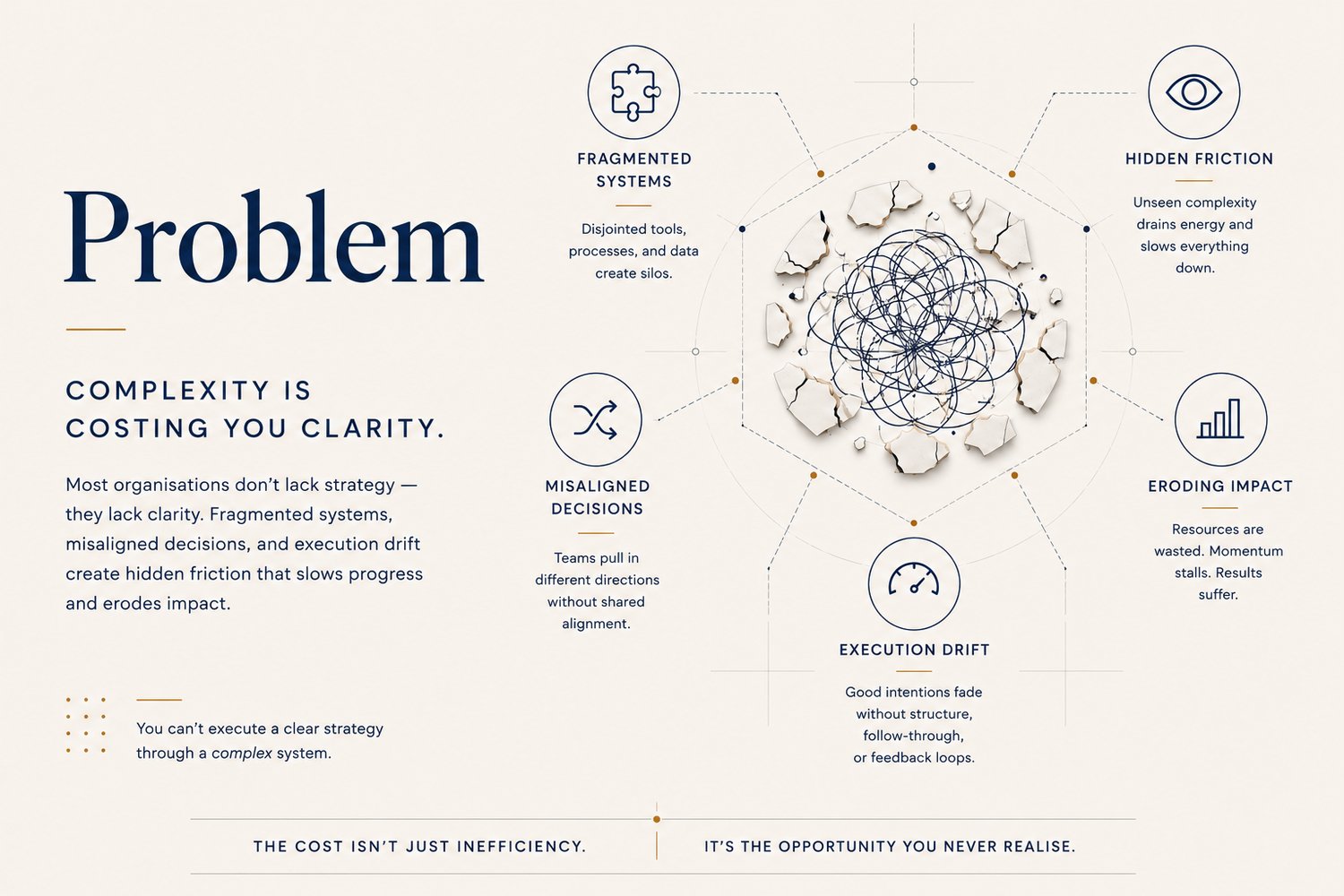
Transformation fails quietly before it fails visibly.
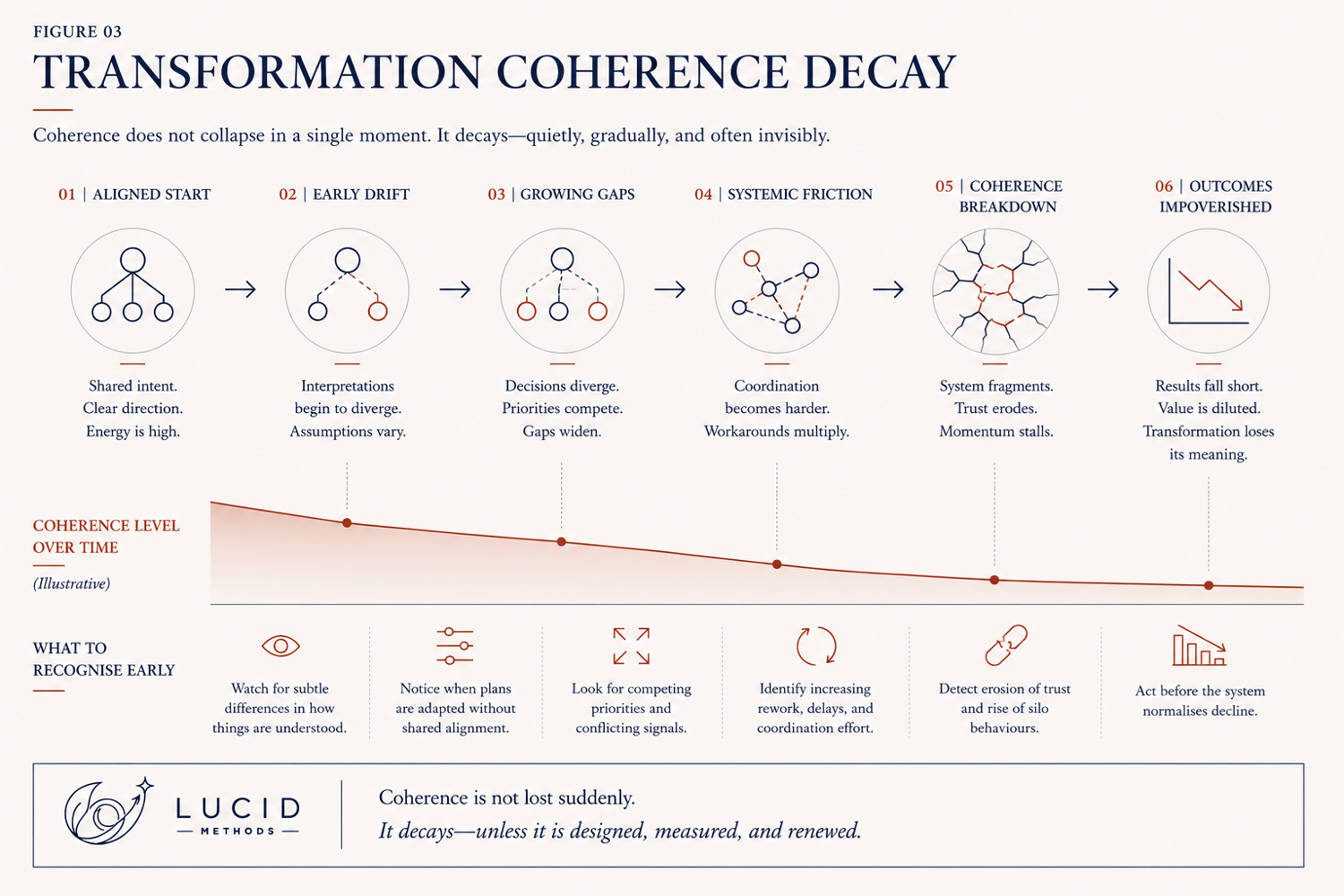
Most transformation efforts do not collapse in a single moment.
They weaken gradually — through fragmented understanding, competing priorities, and the slow erosion of alignment that no one is tracking.
The visible breakdown is usually only the final symptom of deeper conditions that were never properly diagnosed.
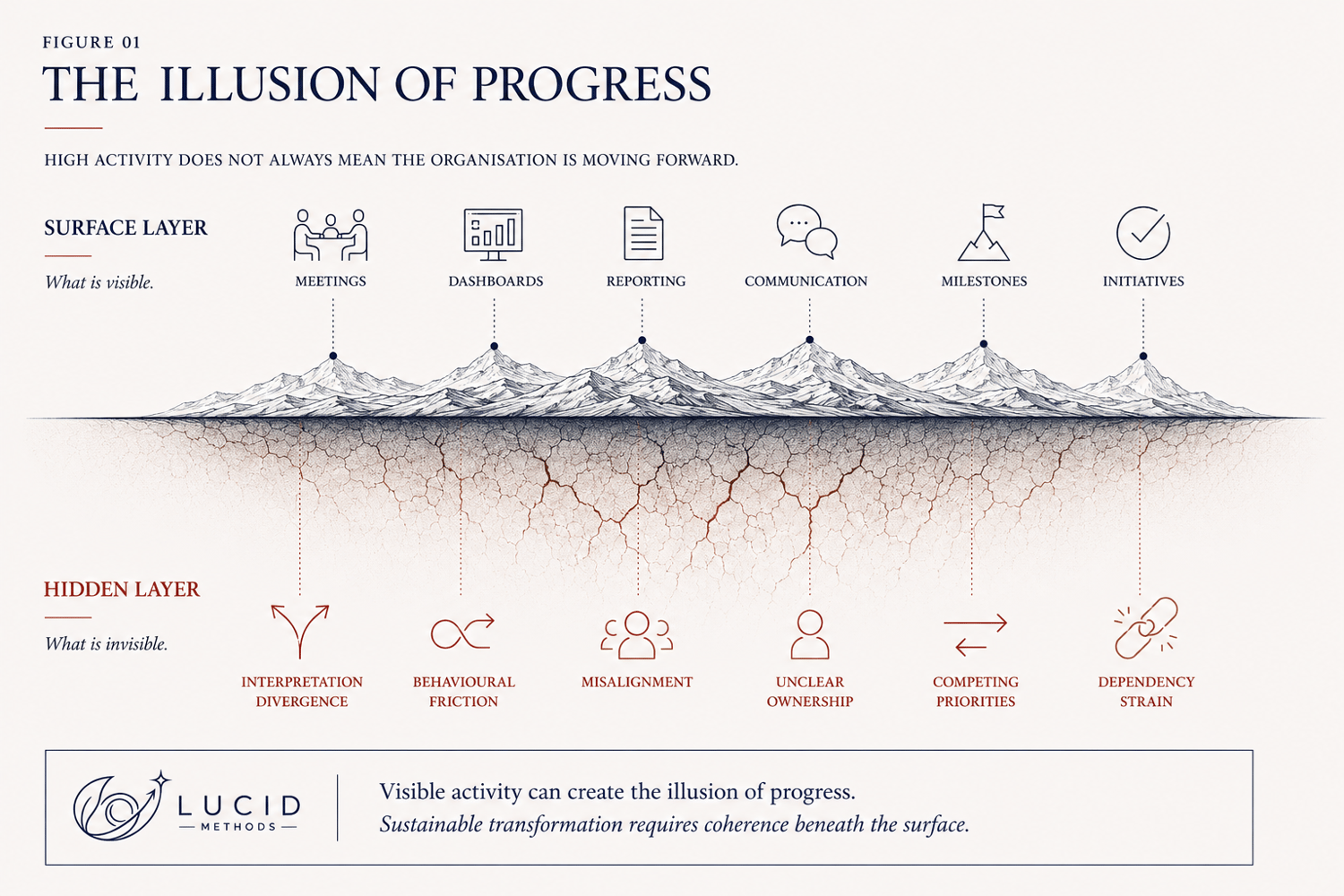
The Illusion of Progress
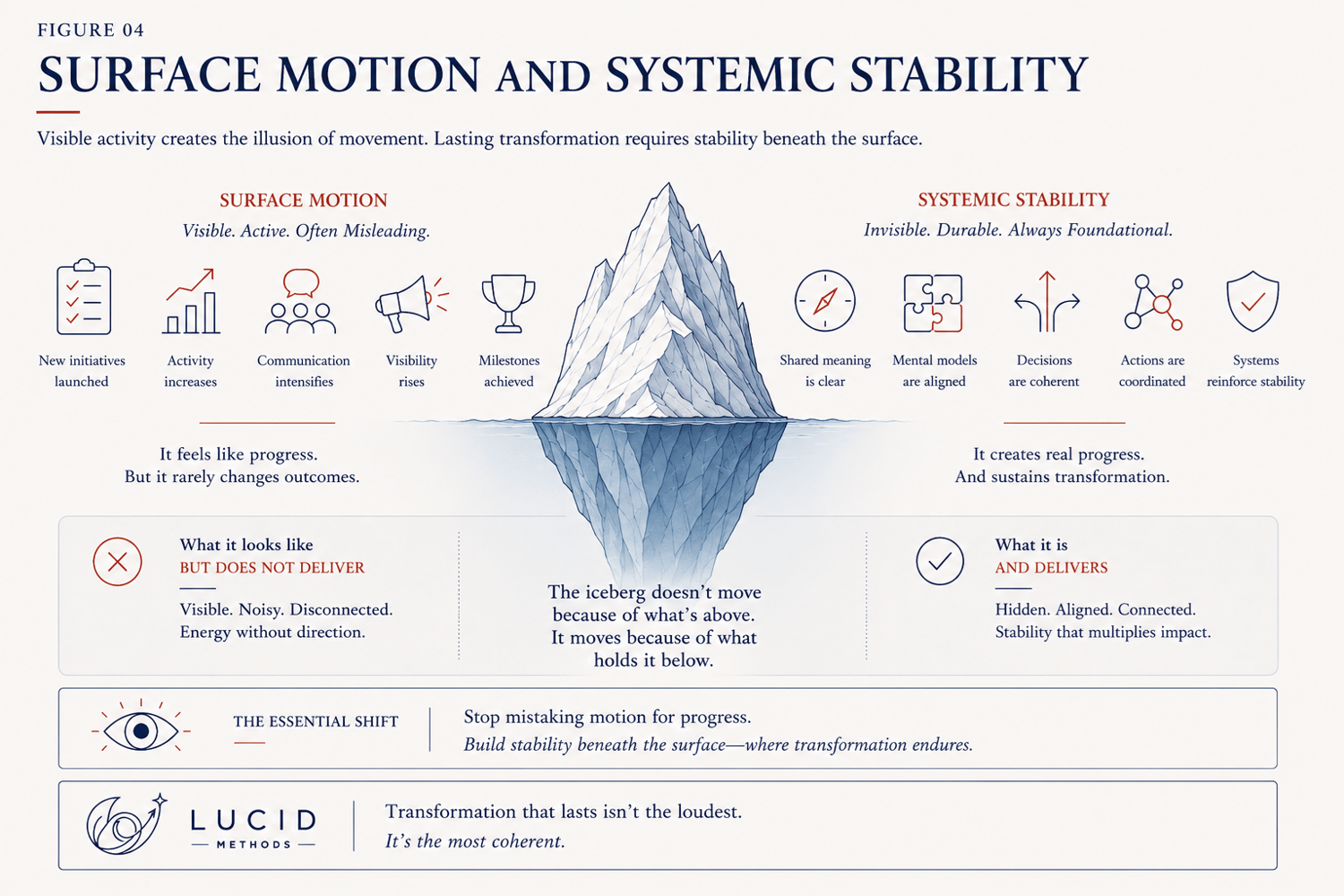
Many transformation efforts appear active long before they become effective.
Meetings continue.
Dashboards are updated.
Milestones are reported.
Communication expands.
Teams remain occupied.
From the surface, the organisation appears to be moving.
Yet movement alone does not mean alignment.
Activity alone does not produce clarity, adoption, or sustained behavioural change.
In many organisations, progress becomes measured through visible motion rather than validated movement.
Reporting improves while interpretation fragments.
Deliverables continue while assumptions quietly diverge beneath the surface.
Execution proceeds, but coherence weakens.
This creates the illusion of progress — a condition where the organisation remains operationally active while the underlying system becomes increasingly misaligned.
By the time friction becomes visible through resistance, confusion, delays, or execution fatigue, the transformation has often already lost coherence.
The visible failure is rarely the beginning of the breakdown.
It is usually the moment the breakdown becomes impossible to ignore — because the conditions generating it were never properly diagnosed.
Why Transformation Efforts Stall
Most transformation failures are not caused by a single decision, department, or individual.
They emerge from systems that gradually lose alignment while still appearing operationally functional.
Priorities begin to compete. Interpretations start to diverge. Ownership becomes fragmented across teams operating with different assumptions, incentives, and definitions of success. What appears aligned at the leadership level often becomes inconsistent at the operational level where execution actually occurs.
As complexity increases, organisations frequently attempt to accelerate execution before establishing shared clarity. More initiatives are launched. More communication is introduced. More processes are layered into the system.
But complexity without coherence does not strengthen execution. It amplifies friction.
Over time, the organisation begins to experience:
decision fatigue,
initiative overload,
behavioural inconsistency,
local optimisation,
dependency strain
Eventually, declining trust in the transformation itself
These conditions rarely emerge all at once. They accumulate gradually beneath ongoing operational activity until the organisation can no longer sustain coordinated movement at scale.
At that point, the problem is no longer isolated to execution.
The system itself has begun to fragment.
The Hidden Layer Most Organisations Miss
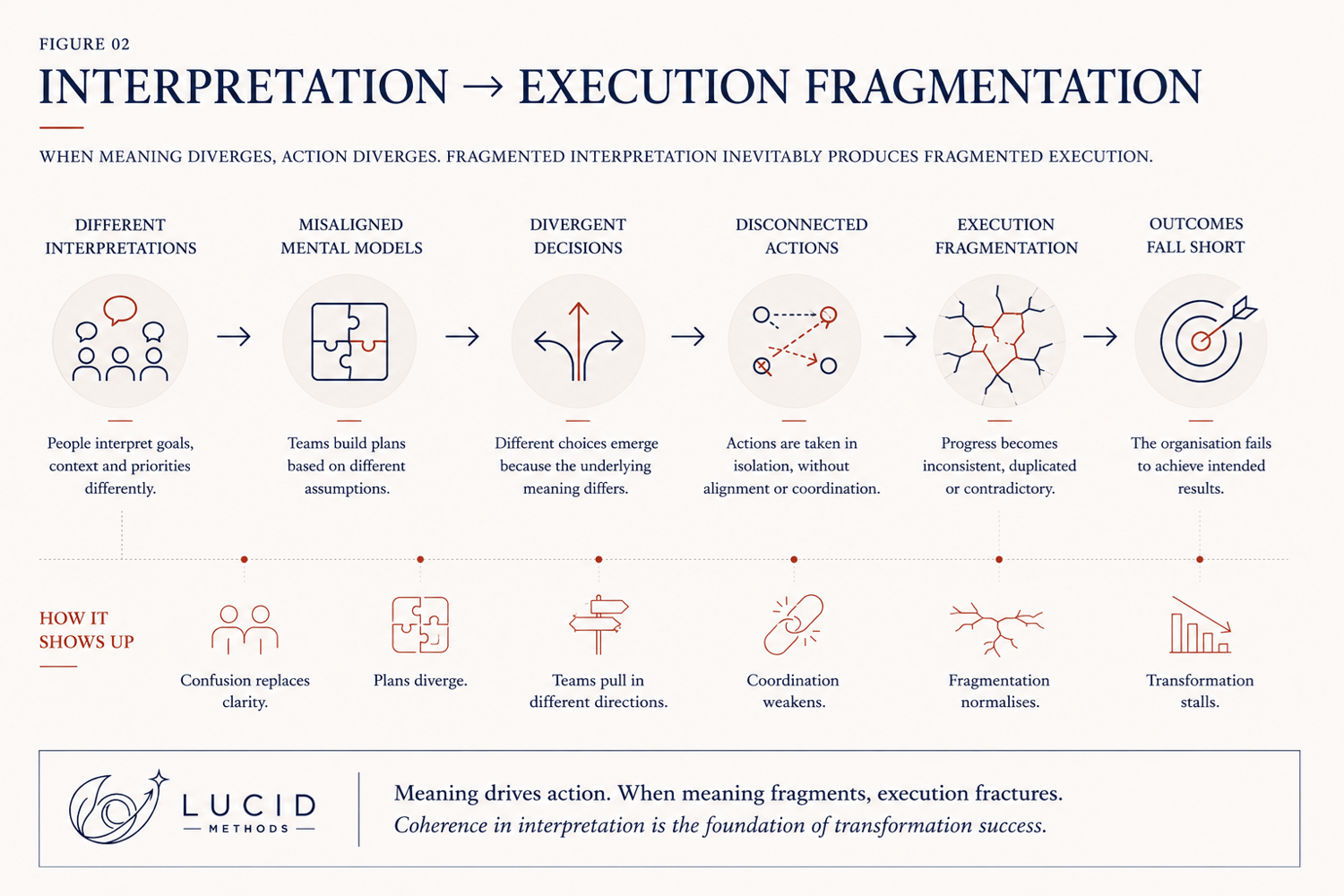
Many organisations attempt to solve execution problems before diagnosing interpretation problems.
They focus on accelerating delivery, improving coordination, increasing accountability, or strengthening communication — while assuming the organisation already shares the same understanding of the problem, the objective, and the required behavioural shift.
Often, it does not.
Different teams may use the same language while operating from entirely different assumptions. Leaders may believe alignment exists because agreement exists at the surface level. But operational coherence cannot be sustained through terminology alone. It depends on shared interpretation.
This creates a hidden layer of fragmentation inside the transformation effort itself.
People continue executing.
Processes continue operating.
Reports continue circulating.
Yet beneath the visible activity, the organisation gradually loses clarity around:
what success actually means,
what must change,
what trade-offs are required,
and how decisions are interpreted across different parts of the system.
As interpretations diverge, execution becomes increasingly inconsistent even while operational activity remains high.
The problem is no longer isolated to language or process.
The organisation has begun to fragment at the level of meaning.
Transformation Does Not Fail at the Strategy Layer Alone
Many transformation efforts appear coherent at the strategic level while becoming increasingly unstable at the operational level.
Leadership alignment does not automatically produce execution alignment.
A strategy may be understood conceptually at the top of the organisation while being interpreted differently across functions, departments, and operational teams responsible for implementing it.
As transformation moves through the organisation, clarity often becomes diluted through layers of translation, assumption, local priorities, and behavioural adaptation.
Teams begin solving for different versions of the same objective.
Decision-making becomes inconsistent.
Dependencies become strained.
Execution slows not because people refuse to act, but because the system no longer shares the same understanding of what movement actually requires.
At this stage, organisations frequently misdiagnose the problem.
The breakdown gets attributed to resistance, capability gaps, communication failure, or poor execution discipline.
But many transformation efforts do not fail because people are unwilling to move.
They fail because the organisation never achieved sufficient coherence for coordinated movement to be sustained at scale.
Without shared interpretation, behavioural alignment, and operational clarity, even well-designed strategies gradually lose integrity as they move through the system.
The failure is rarely located in strategy alone.
It emerges in the space between interpretation and execution.
Shared language does not guarantee shared meaning.
The Cost of Misalignment
Misalignment does not only slow execution.
Over time, it reshapes the behaviour of the organisation itself.
As priorities compete and interpretations diverge, teams begin protecting local stability instead of advancing shared transformation objectives. Decision-making becomes increasingly cautious. Collaboration becomes conditional. Communication expands, yet clarity continues to weaken beneath the surface.
Gradually, the organisation begins to accumulate forms of friction that traditional reporting structures rarely capture:
initiative fatigue,
behavioural inconsistency,
accountability dilution,
operational duplication,
decision paralysis,
and declining confidence in leadership direction.
As unresolved friction compounds over time, transformation efforts begin losing credibility within the organisation itself.
People become less willing to commit fully to new initiatives.
Trust in long-term change weakens.
Execution becomes performative rather than adaptive.
At this stage, the cost is no longer limited to delayed delivery, budget overruns, or incomplete implementation.
The organisation begins to experience structural erosion:
weakened alignment,
fragmented ownership,
reduced organisational trust,
declining adaptability,
and increasing resistance to future transformation efforts.
Misalignment rarely remains isolated to a single initiative. Left unaddressed, it becomes embedded into the operating behaviour of the system itself.
Diagnosing Hidden Transformation Failure
The LUCID Execution Toolkit was developed to help organisations identify the hidden friction, fragmentation, behavioural drift, and execution instability that often remain invisible until transformation momentum begins to collapse.
Built around 20 structured diagnostic and execution tools, the toolkit helps teams move from visible activity toward sustained organisational coherence.
Why the LUCID Method Exists
The LUCID Method was developed to diagnose the underlying conditions that cause transformation efforts to fragment, stall, or lose coherence over time.
Rather than treating transformation failure as an isolated execution problem, the method approaches organisations as interconnected systems shaped by interpretation, behaviour, dependency, incentives, and operational friction.
Many transformation efforts focus primarily on visible activity:
delivery plans,
reporting structures,
governance mechanisms,
communication strategies,
and execution tracking.
These are necessary.
But they are often insufficient to explain why organisations continue experiencing resistance, fragmentation, misalignment, or execution fatigue despite sustained operational effort.
The LUCID Method focuses on the hidden conditions operating beneath visible execution:
clarity gaps,
interpretation divergence,
behavioural friction,
alignment decay,
and fragmentation.
Its purpose is not simply to accelerate movement.
Its purpose is to help organisations understand:
what is actually happening beneath the surface,
why execution friction continues to emerge,
and what conditions are required for coordinated movement to be sustained.
Because sustainable transformation does not emerge from activity alone.
It emerges from shared interpretation, behavioural coherence, and the structural conditions that allow an organisation to move as a system rather than as a collection of parts.