

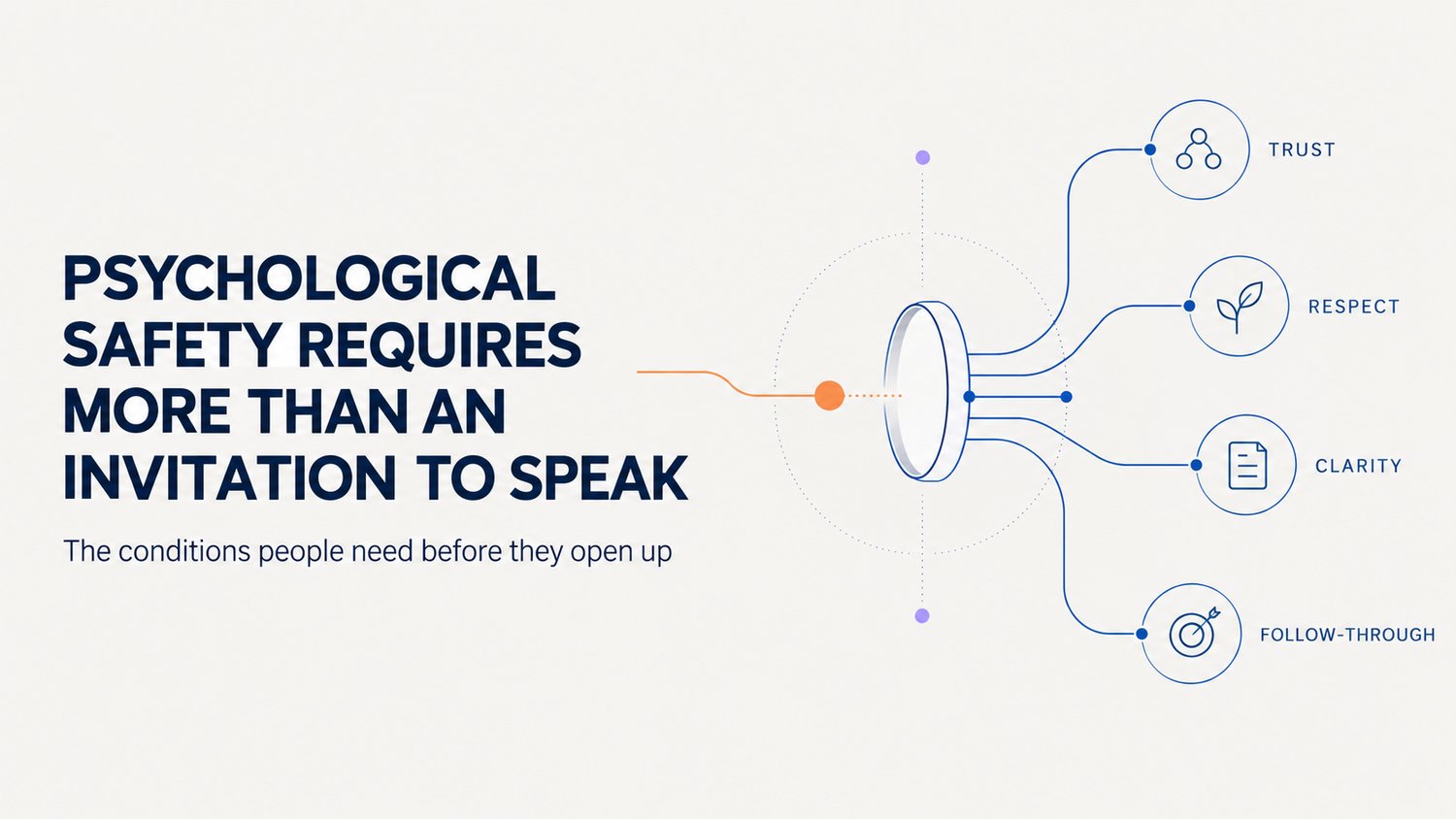
Psychological Safety Requires More Than an Invitation to Speak
The Conditions People Need Before They Open Up
Leaders often say they want people to speak openly.
“My door is always open.”
“Please challenge me.”
“Tell me what you really think.”
The invitation may be sincere.
But sincerity is not the same as safety.
People do not decide whether to speak
based only on what a leader says in that moment.
They decide based on what they believe will happen next.
Will the concern be taken seriously?
Will the leader become defensive?
Will the person be seen differently afterwards?
Will anything change?
Or will speaking simply create more difficulty for the person who spoke?
An invitation provides permission. Psychological safety depends on the conditions surrounding that permission.
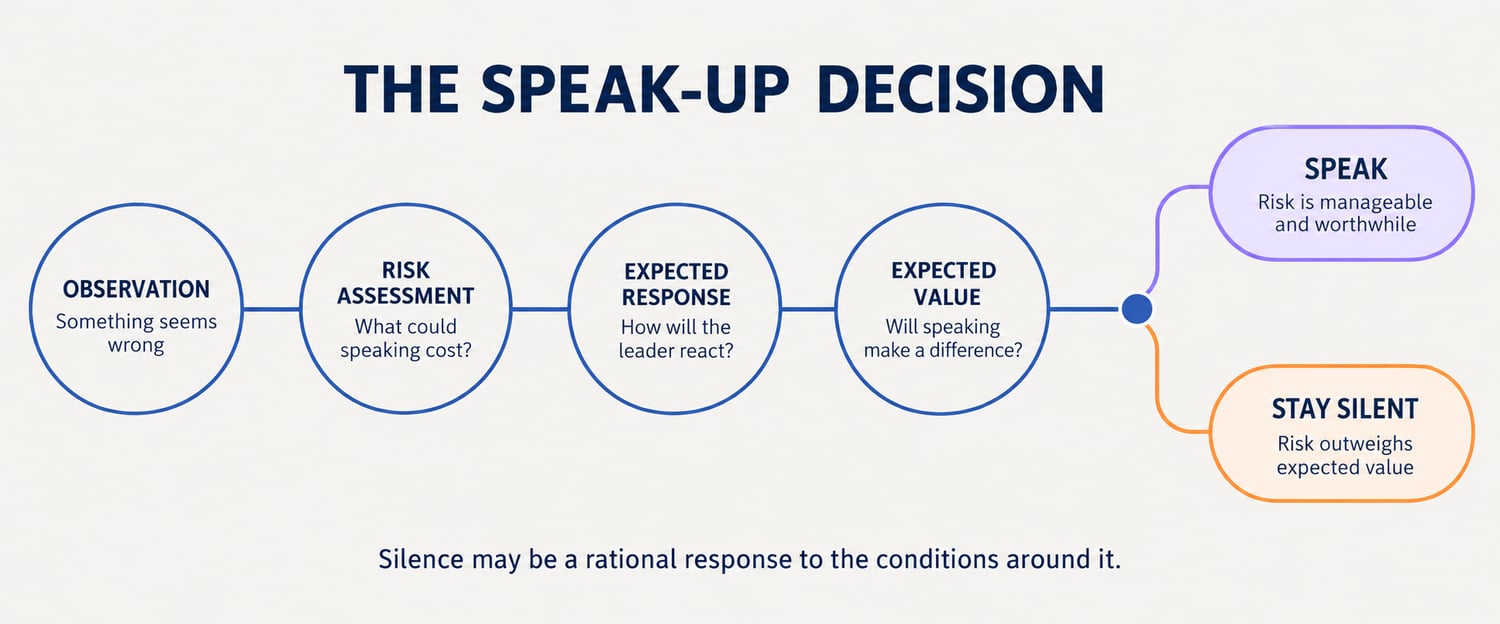
When those conditions are absent, silence is not necessarily agreement. It may be a rational response to risk.
The Invitation Is Only the Visible Part
Psychological safety is often treated as a communication issue: ask for feedback, encourage questions, invite dissent.
These actions matter.
But they address only the visible moment in which someone is asked to speak.
The real decision begins much earlier.
People observe how leaders respond when challenged.
They notice what happens to colleagues who raise inconvenient issues.
They remember whether earlier concerns were examined, dismissed or quietly forgotten.
Over time, these experiences form an unwritten answer to a more important question:
What does speaking honestly cost here?
That cost may be obvious. Someone may be criticised, excluded or labelled difficult.
More often, it is subtle.
The atmosphere changes.
The leader becomes colder.
The person is no longer included in certain conversations.
Their judgement is questioned in ways it was not before.
Nothing needs to be stated explicitly.
People are highly attentive to consequence.
This is why a leader can repeatedly invite openness and still receive carefully edited answers.
The formal message says, “Speak.”
The surrounding system says, “Be careful.”
People respond to the system.
Safety Is Inferred From Patterns
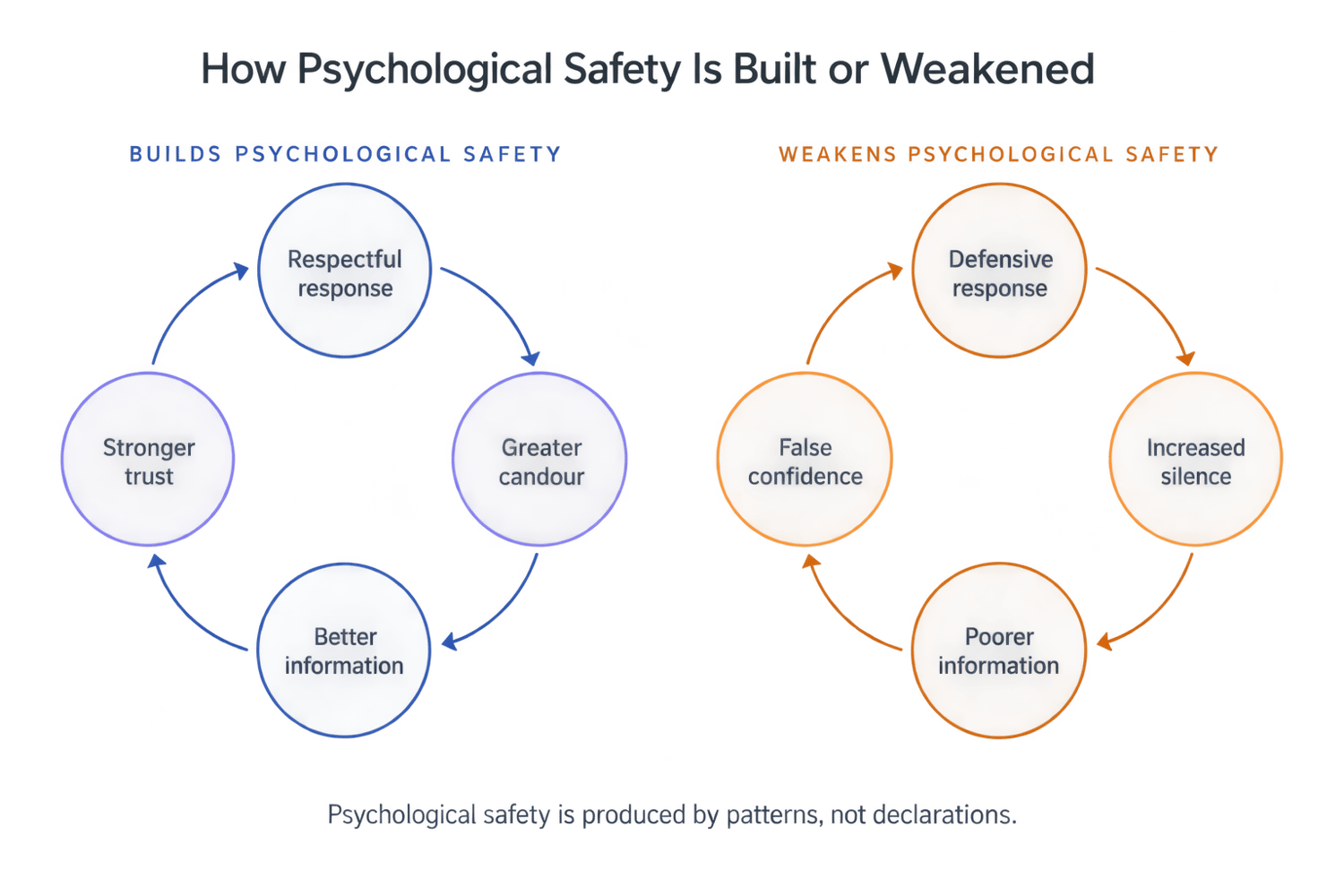
Psychological safety cannot be declared into existence.
It is inferred.
Employees infer it from the consistency between what leaders say, how they react and what happens afterwards.
If a leader asks for challenge but becomes visibly irritated when challenged, people notice the contradiction.
If concerns are welcomed in the meeting but ignored after it, people notice that too.
If honesty is praised in principle but penalised when it creates inconvenience, the organisation teaches people that candour is acceptable only when it is comfortable.
Each response becomes evidence.
A single difficult interaction may not destroy trust.
But repeated inconsistency creates a pattern, and the pattern becomes the operating reality.
This is the part leaders may miss.
They judge safety by their intention.
Employees judge it by their exposure.
Both may believe they are responding to the same environment while experiencing it very differently.
What People Need Before They Open Up
Before someone raises a concern, admits uncertainty or challenges a decision, several conditions need to be credible.
The risk must be manageable
Speaking honestly always carries some interpersonal risk.
The aim is not to remove that risk entirely.
It is to ensure that the person will not be punished, diminished or socially isolated for contributing in good faith.
Disagreement is not the problem.
Retaliation, humiliation and reputational damage are.
Respect must survive disagreement
People need to know that their standing will not depend on whether the leader likes what they say.
Interruptions, sarcasm, eye-rolling, public correction and dismissive language all increase the cost of speaking.
Even when the underlying concern is considered, the way it is received can teach everyone else to remain silent.
Respect does not require agreement.
It requires the issue to be examined without reducing the person who raised it.
The invitation must be clear
“Tell me what you think” sounds open, but it leaves considerable room for interpretation.
Does the leader want support, critique, alternatives or reassurance?
Is the decision still open?
Which part can be challenged?
What will happen to the input?
When the purpose is vague, people must guess the boundary.
Most will choose the least painful path.
Specific questions make the invitation more credible:
- What risk are we underestimating?
- Where is this likely to fail in practice?
- What would make implementation difficult for your team?
- What am I not seeing from where I sit?
Clarity does not guarantee candour.
But it reduces the ambiguity people must navigate before offering it.
The leader must be able to receive the answer
Some leaders invite feedback but are not prepared for what arrives.
They explain too quickly.
Defend their intentions.
Correct the details before understanding the concern.
Turn the exchange into a debate they need to win.
The employee then has two tasks: raise the issue and manage the leader’s reaction to it.
That is not safety.
It is emotional risk transfer.
A leader’s first response matters because it tells the room whether the invitation was real.
Calm curiosity does not mean passive agreement.
It means understanding before judging.
Speaking must have some value
People are less likely to accept risk when they believe nothing will happen.
Not every concern can change the decision.
Not every suggestion should be adopted.
But serious input requires closure.
“We considered this and are proceeding for these reasons” preserves more trust than silence.
Responsiveness tells people that their contribution entered the system, even when it did not determine the outcome.
Without that feedback loop, invitations to speak gradually become ceremonial.
Safety Is Not Evenly Distributed
Leaders sometimes assess psychological safety by looking at the
most vocal people in the room.
But confidence is not proof of safety.
A senior employee may challenge openly because they have status, credibility or a long-standing relationship with the leader.
A junior employee, newcomer, contractor or less-connected colleague may face a very different calculation.
The same behaviour can carry different consequences depending on who performs it.
This means psychological safety should not be measured only by whether someone speaks.
Leaders should also notice who speaks easily, who waits, who softens every point and who never enters the conversation at all.
Absence is also data.
Silence Is a System Response
When a room remains quiet, it is tempting to conclude that everyone agrees.
Sometimes they do.
But silence can also indicate fear, fatigue, uncertainty or learned futility.
People may have raised similar issues before.
They may believe the decision has already been made.
They may be waiting for someone with more protection to speak first.
The more useful question is not simply:
“Why didn’t they say anything?”
It is:
“What have our responses taught them about saying something?”
This shifts the diagnosis from individual courage to organisational conditions.
It also reveals why telling people to “speak up more” often achieves little.
If the underlying conditions remain unchanged, the request merely places responsibility back on the people carrying the risk.
Building Conditions, Not Performing Openness
Psychological safety does not require every conversation to feel comfortable.
Candour can be awkward.
Disagreement can create tension.
Accountability still matters.
The objective is not comfort.
It is confidence that honesty will be handled fairly.
Leaders strengthen that confidence when they:
- ask precise questions instead of issuing broad invitations;
- allow time for reflection rather than rewarding only the fastest voices;
- provide private and written routes for input;
- acknowledge a concern before evaluating it;
- separate the message from the person delivering it;
- explain what will happen next;
- close the loop, including when the answer is no;
- respond consistently when the message is inconvenient;
- admit what they do not know;
- examine whose voices are missing, not only whose are present.
None of these actions proves safety on its own.
Their value lies in repetition.
People need enough consistent evidence to believe that openness is not a temporary mood, a leadership slogan or a carefully managed performance.
The Real Test Comes After Someone Speaks
An open door is easy to offer.
The harder work begins when someone walks through it carrying information the leader would rather not hear.
That moment reveals whether the organisation values candour or merely the appearance of it.
Psychological safety is therefore not created by the invitation itself.
It is created by the structure around the invitation:
the clarity of the request,
the steadiness of the response,
the fairness of the consequences and
the discipline of follow-through.
People open up when experience gives them reason to believe that speaking is both survivable and worthwhile.
Until then, silence may be the most coherent response the system allows.
Part of the Leadership & Culture Series from LUCID Methods.
Explore more frameworks, diagnostic perspectives, and systems-thinking insights through the LUCID Method — developed to help organisations build clarity, coherence, and transformation that holds over time.