

Most Resistance Is Not Opposition
When transformation initiatives encounter resistance, the default explanation is often straightforward:
"People do not want to change."
This explanation is attractive because it is simple.
It creates a clear villain.
It allows leaders to frame the challenge as a behavioural problem that can be solved through communication, training, incentives, or enforcement.
Unfortunately, this explanation is often wrong.
Many transformation efforts fail not because people oppose the intended outcome, but because different groups interpret the transformation differently.
What appears as resistance may actually be competing interpretations of reality.
The issue is not unwillingness.
The issue is incoherence.
Resistance is often interpretation conflict.
The Assumption Behind Resistance
Most change programmes operate under an implicit assumption:
Everyone understands the change in the same way.
Leaders communicate a vision.
Teams receive the message.
Execution begins.
When people fail to act as expected, resistance is assumed.
But this model ignores a fundamental reality of human systems:
People do not respond to what leaders intend.
They respond to what they believe.
And belief is shaped by interpretation.
The Interpretation Layer
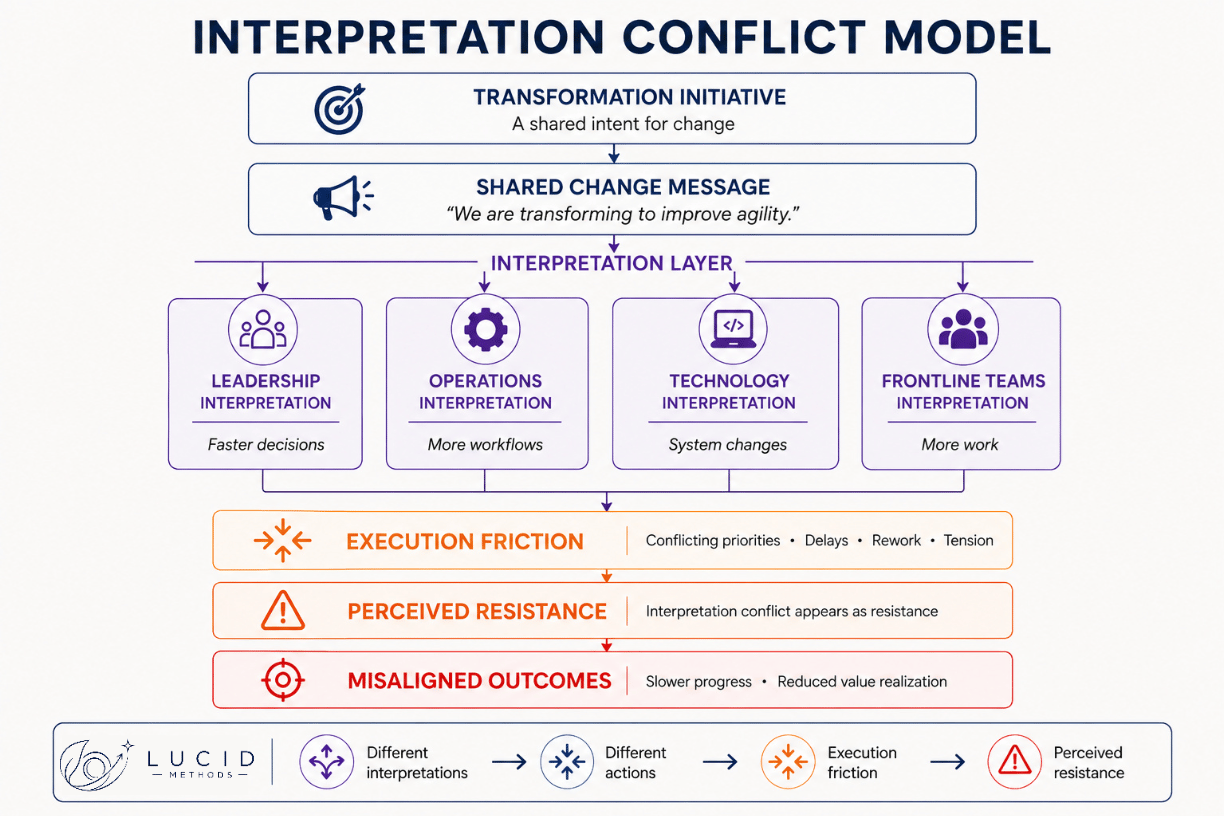
Every transformation message passes through an interpretation layer before action occurs.
The same statement can generate completely different meanings.
Consider a leadership announcement:
"We are restructuring to improve agility."
Leadership may interpret this as:
- Faster decision making
- Better collaboration
- Reduced bureaucracy
Managers may interpret it as:
- New reporting structures
- Increased accountability
- Loss of authority
Employees may interpret it as:
- Possible layoffs
- More work
- Organisational instability
Everyone heard the same message.
Everyone received different meanings.
The conflict emerges long before execution begins.
Why Interpretation Conflict Looks Like Resistance
Interpretation conflict often produces behaviours that resemble resistance:
- Delayed decisions
- Reduced engagement
- Passive compliance
- Increased questioning
- Repeated clarification requests
- Escalating disagreements
- Shadow processes
From leadership's perspective, these behaviours appear obstructive.
However, from the participant's perspective, the behaviour may be entirely rational.
People are acting consistently with their interpretation of the situation.
The apparent resistance is often a symptom.
The underlying issue is divergent understanding.
The Three Sources of Interpretation Conflict
1. Different Definitions of Success
Teams frequently agree on objectives while disagreeing on what success looks like.
For example:
A transformation programme may pursue "customer centricity."
Marketing interprets this as better customer engagement.
Operations interprets it as faster service delivery.
Finance interprets it as lower servicing costs.
Technology interprets it as improved digital experience.
All groups support the objective.
Yet they move in different directions.
Conflict emerges despite alignment around the stated goal.
2. Different Assessments of Risk
People often resist because they perceive risks others do not.
Leadership may focus on strategic opportunity.
Frontline employees may focus on operational disruption.
Technology teams may focus on system stability.
Compliance teams may focus on regulatory exposure.
None of these perspectives are inherently wrong.
They are different interpretations of reality.
When these interpretations remain unresolved, friction emerges.
3. Different Mental Models
Every individual carries assumptions about how organisations work.
These assumptions shape interpretation.
For example:
A leader may believe:
"Greater transparency improves performance."
A manager may believe:
"Greater transparency increases scrutiny."
An employee may believe:
"Greater transparency creates additional reporting work."
The same initiative produces different reactions because people are operating from different mental models.
The Cost of Misdiagnosing Resistance
When interpretation conflict is diagnosed as resistance, organisations typically respond with pressure.
Common responses include:
- More communication
- More training
- Stronger mandates
- Escalation mechanisms
- Accountability measures
These interventions may increase compliance.
But they rarely increase shared understanding.
In some cases, they deepen the problem.
People feel unheard.
Trust decreases.
Psychological safety declines.
Interpretations become more entrenched.
The organisation becomes increasingly aligned on activity while remaining misaligned on meaning.
Interpretation Conflict and Transformation Failure
Many transformation failures follow a predictable pattern:
- Leadership creates a clear strategy.
- Different groups interpret the strategy differently.
- Local actions diverge.
- Friction emerges.
- Leaders perceive resistance.
- Pressure increases.
- Trust decreases.
- Divergence expands.
- Execution slows.
- Transformation underperforms.
At no point was opposition necessarily the primary issue.
The system failed because interpretations drifted apart.
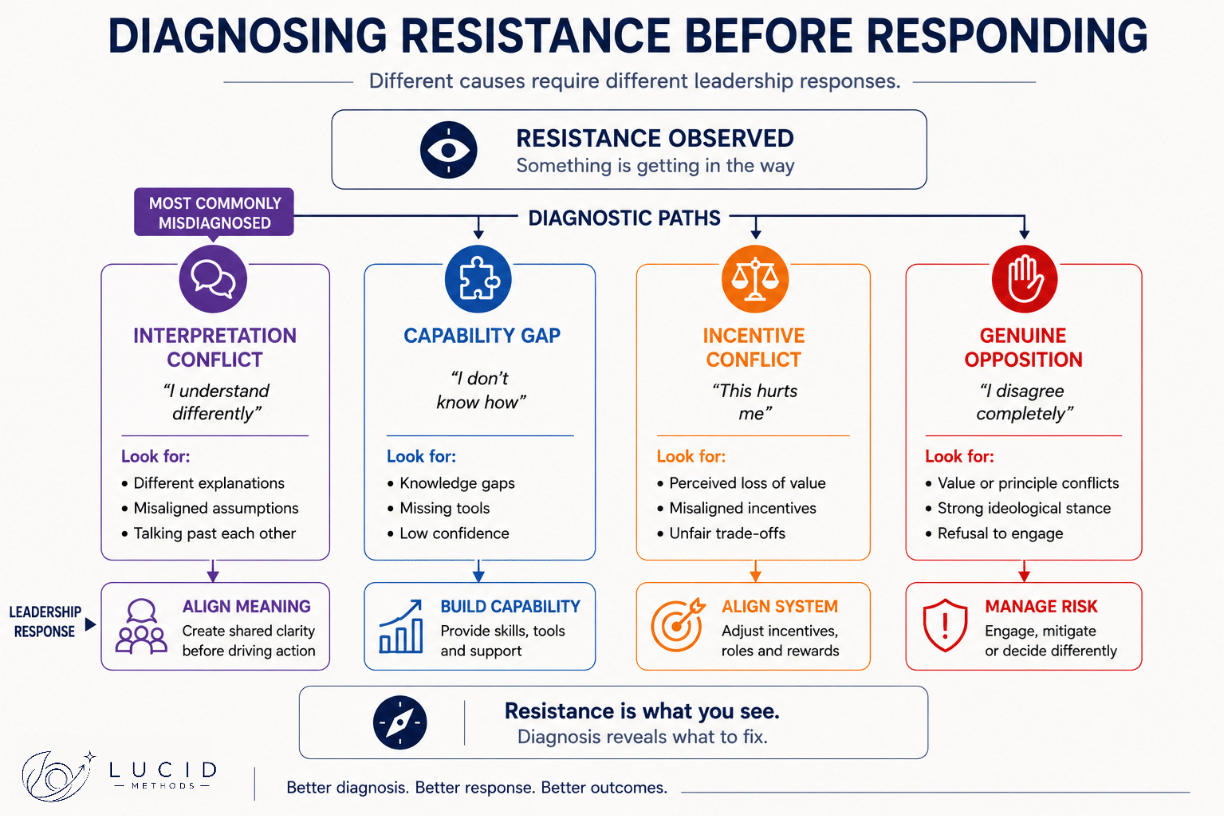
A Better Diagnostic Question
Instead of asking:
"Why are people resisting?"
Ask:
"What are people believing?"
This question shifts the diagnostic lens.
It focuses attention on meaning rather than behaviour.
It explores assumptions rather than compliance.
It investigates interpretation before judging intent.
The answers are often revealing.
Different groups may be pursuing entirely different versions of the same transformation.
Resolving Interpretation Conflict
Interpretation conflict cannot be solved through communication volume alone.
It requires deliberate alignment work.
Effective leaders seek to surface and reconcile interpretations by asking:
- What does this initiative mean to you?
- What concerns does it create?
- What assumptions are you making?
- What outcomes do you believe are intended?
- What risks do you see?
These conversations expose hidden divergence before it becomes execution friction.
The goal is not agreement on every detail.
The goal is sufficient coherence for coordinated action.
Resistance as Diagnostic Data
One of the most useful shifts a leader can make is to stop treating resistance as an obstacle.
Instead, treat it as information.
Resistance often reveals:
- Hidden assumptions
- Unresolved ambiguity
- Competing objectives
- Conflicting incentives
- Divergent interpretations
In this sense, resistance is not necessarily the problem.
It is often evidence that a deeper problem already exists.
The LUCID Perspective
Within the LUCID framework, resistance is frequently an interpretation phenomenon rather than a motivation phenomenon.
People do not execute based on what was said.
They execute based on what they understood.
When interpretations diverge, coherence deteriorates.
As coherence deteriorates, friction increases.
As friction increases, organisations begin to label symptoms as resistance.
The most effective transformations therefore spend less time fighting resistance and more time diagnosing interpretation.
Because what appears to be opposition is often something much simpler:
People are responding to different realities.
And until those realities are aligned, execution will remain fragmented regardless of how committed people appear to be.
Part of the Change & Human Systems Series from LUCID Methods.
Explore more frameworks, diagnostic perspectives, and systems-thinking insights through the LUCID Method — developed to help organisations build clarity, coherence, and transformation that holds over time.