

When Alignment Exists but Understanding Does Not
Organisations often invest significant effort in achieving alignment.
Leaders communicate strategy.
Objectives are documented.
Roadmaps are distributed.
Town halls are conducted.
Meetings are held to clarify priorities.
Yet despite these efforts, execution frequently produces inconsistent outcomes.
Different teams make different decisions.
Projects move in conflicting directions.
Stakeholders believe they are supporting the same initiative while pursuing fundamentally different objectives.
The problem is not always alignment.
The problem is often interpretation.
Teams can hear the same message and leave with entirely different understandings of what that message means.
This condition is known as shared interpretation failure.
It occurs when people believe they are aligned because they have received the same information, while in reality they have constructed different meanings from it.
The result is execution divergence hidden beneath the appearance of agreement.
Information Does Not Create Shared Understanding
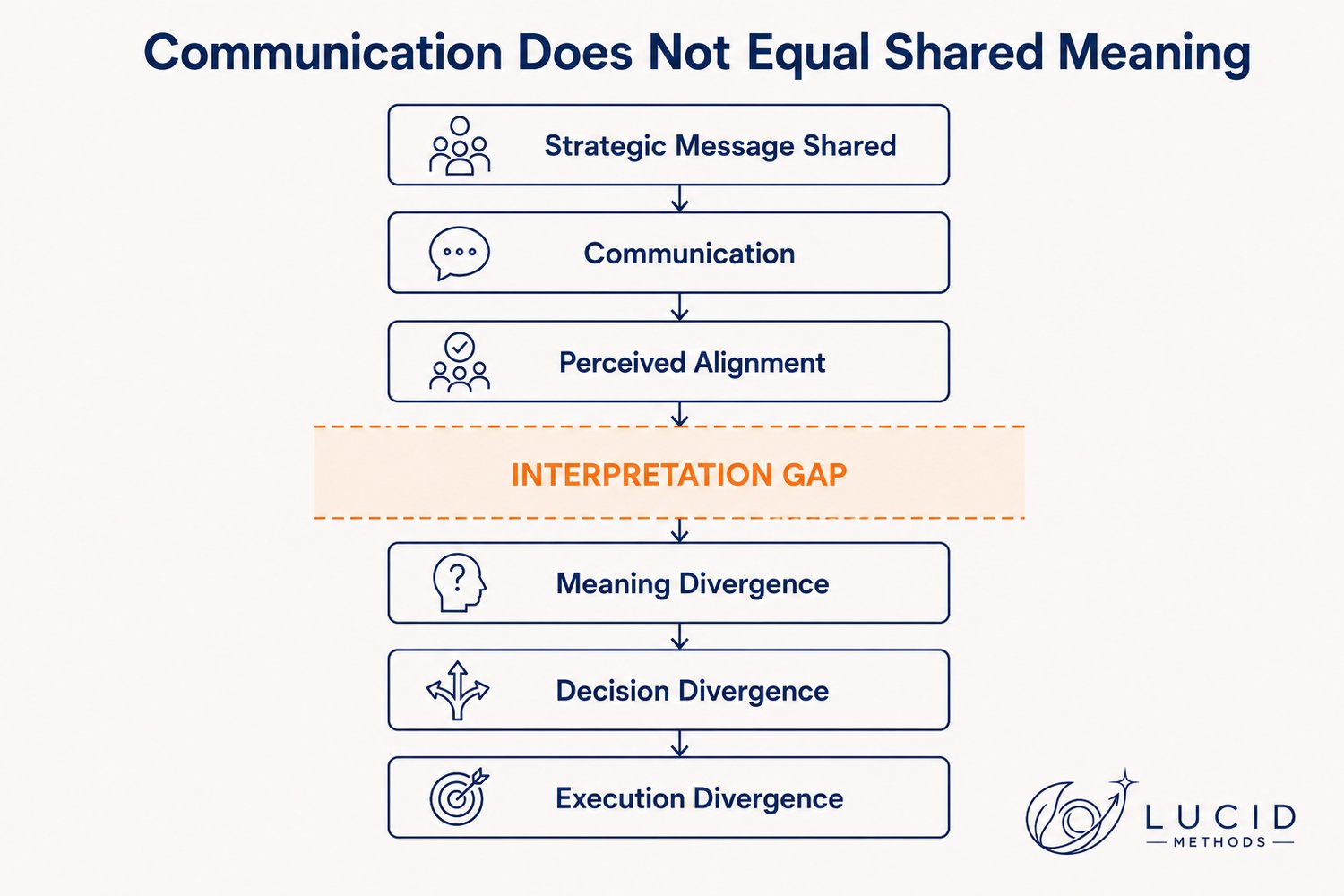
Many organisations assume communication works as a transfer process.
A leader communicates an idea.
The audience receives it.
Understanding is assumed.
Unfortunately, human communication rarely works this way.
People do not receive meaning.
They construct meaning.
Every individual interprets information through their own:
- Experiences
- Incentives
- Professional backgrounds
- Assumptions
- Organisational realities
The same message enters different minds but emerges as different interpretations.
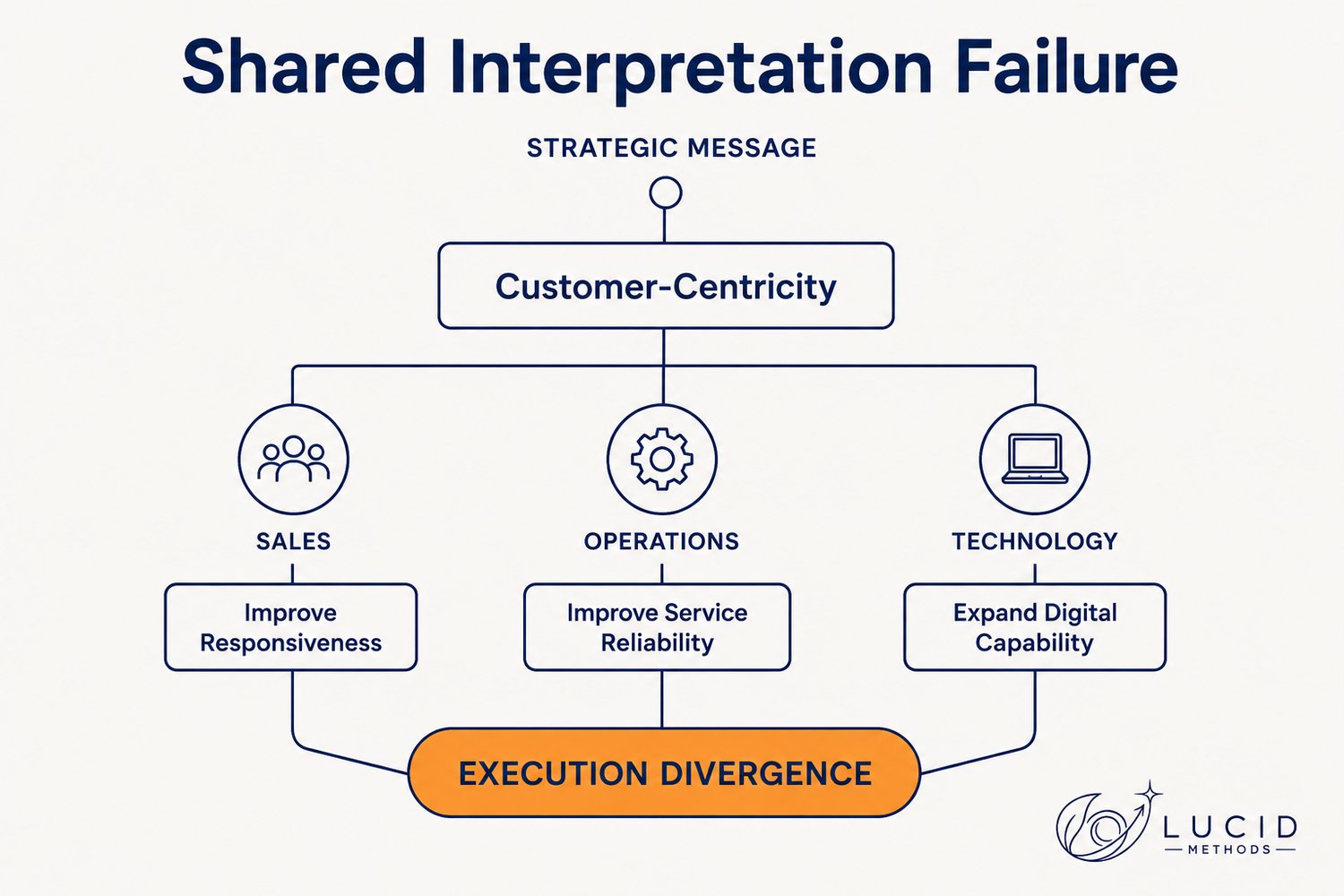
For example, a leadership team announces:
"We need to become more customer-centric."
The sales team may interpret this as improving responsiveness.
The operations team may interpret this as improving service levels.
The technology team may interpret this as building new digital channels.
The finance team may interpret this as reducing customer acquisition costs.
All teams support the same statement.
None necessarily share the same understanding.
The organisation appears aligned while execution begins drifting apart.
The Illusion of Shared Meaning
Shared interpretation failure is dangerous because it often remains invisible during planning.
Meetings conclude successfully.
Participants nod in agreement.
No objections are raised.
Leadership assumes alignment has been achieved.
Yet agreement during discussion does not guarantee agreement in interpretation.
The question:
"Do you understand?"
typically produces a positive response.
The more useful question is:
"What does this mean for your decisions?"
Only when people explain their interpretation does divergence become visible.
Many transformation failures emerge not because teams resisted change but because teams interpreted the intended change differently.
The organisation was aligned at the level of language but fragmented at the level of meaning.
Why Shared Interpretation Failure Occurs
Several organisational conditions increase the likelihood of interpretation divergence.
Ambiguous Language
Words such as:
- Innovation
- Agility
- Customer-centricity
- Transformation
- Ownership
- Accountability
often sound precise but contain multiple possible meanings.
Because these terms are familiar, organisations rarely stop to define them.
Each individual fills the gaps with their own assumptions.
The broader the language, the greater the potential variation in interpretation.
Functional Perspectives
Different departments view reality through different lenses.
Operations focuses on stability.
Sales focuses on growth.
Finance focuses on efficiency.
Technology focuses on capability.
Human Resources focuses on people.
When strategic messages enter these environments, they are naturally translated into locally meaningful interpretations.
This is not incompetence.
It is normal organisational behaviour.
Without active efforts to create shared meaning, divergence becomes inevitable.
Incentive Structures
People tend to interpret messages in ways that support existing objectives.
If success metrics remain unchanged, teams often reinterpret new priorities to fit old measures.
A strategy may change.
Interpretation may not.
As a result, the organisation appears to adopt new directions while continuing old behaviours.
Assumption Gaps
Many leaders possess contextual information unavailable to the wider organisation.
Because leaders understand the reasoning behind decisions, they unconsciously assume others do as well.
The audience receives conclusions without receiving the underlying logic.
People then fill the missing context themselves.
Interpretation becomes fragmented.
How Shared Interpretation Failure Appears
The symptoms often resemble other organisational problems.
Leaders may observe:
- Conflicting project priorities
- Inconsistent decision-making
- Repeated clarification meetings
- Slow execution
- Stakeholder frustration
- Unexpected resistance
- Misaligned outcomes
These symptoms frequently trigger interventions such as:
- More communication
- More meetings
- More documentation
- More reporting
Yet additional information rarely solves interpretation problems.
The issue is not information volume.
The issue is meaning coherence.
Shared Interpretation Failure and Coherence
Within the LUCID framework, coherence depends upon more than alignment.
Alignment ensures people move toward a common objective.
Coherence ensures they understand that objective in compatible ways.
Without coherence:
- Teams optimise different outcomes.
- Decisions become locally rational but globally inconsistent.
- Dependencies become fragile.
- Execution fragments.
Coherence is therefore not created by communication alone.
It is created by shared interpretation.
Only when meaning is sufficiently aligned can coordinated execution emerge.
Diagnosing Shared Interpretation Failure
A useful diagnostic exercise is remarkably simple.
Ask different stakeholders the same questions:
- What problem are we trying to solve?
- Why does this initiative exist?
- What does success look like?
- What decisions should change because of this strategy?
- What behaviours should stop?
If responses vary significantly, interpretation divergence is likely present.
Importantly, stakeholders do not need identical answers.
Perfect uniformity is unnecessary.
What matters is whether interpretations remain sufficiently compatible to support coordinated action.
The objective is coherence, not sameness.
Building Shared Meaning
Reducing interpretation failure requires moving beyond information delivery.
Leaders must actively test understanding.
Effective practices include:
Make Meaning Explicit
Define critical terms.
Do not assume shared understanding exists.
Clarify what important concepts mean within the context of the organisation.
Translate Strategy into Decisions
People understand priorities more clearly when they can see how decisions should change.
Abstract intentions become concrete when linked to behaviour.
Surface Interpretations Early
Invite stakeholders to explain their understanding.
Differences revealed early are easier to reconcile than conflicts discovered during execution.
Create Feedback Loops
Communication should not be treated as a one-way activity.
Leaders need mechanisms to continuously validate understanding across the system.
The Hidden Cost of Interpretation Failure
Many organisational leaders focus heavily on communication.
Far fewer focus on interpretation.
Yet communication quality does not determine execution quality.
Shared understanding does.
An organisation can communicate extensively and still remain fragmented.
It can distribute identical information while generating incompatible actions.
It can achieve apparent alignment while losing execution coherence.
When this occurs, the organisation often concludes that execution has failed.
In reality, execution may simply be revealing an earlier failure of interpretation.
Because teams cannot execute the same strategy if they never understood it in the same way.
Closing Reflection
Organisations often assume alignment is achieved when everyone hears the same message.
But hearing the same message is not the same as understanding it.
Information can be shared.
Meaning cannot.
Meaning must be constructed collectively.
This is why effective transformation depends not merely on communication, but on shared interpretation.
The organisations that execute most effectively are not necessarily those that communicate the most.
They are those that create enough shared meaning for coherent action to emerge.
Part of the Alignment & Interpretation Series from LUCID Methods.
Explore more frameworks, diagnostic perspectives, and systems-thinking insights through the LUCID Method — developed to help organisations build clarity, coherence, and transformation that holds over time.