

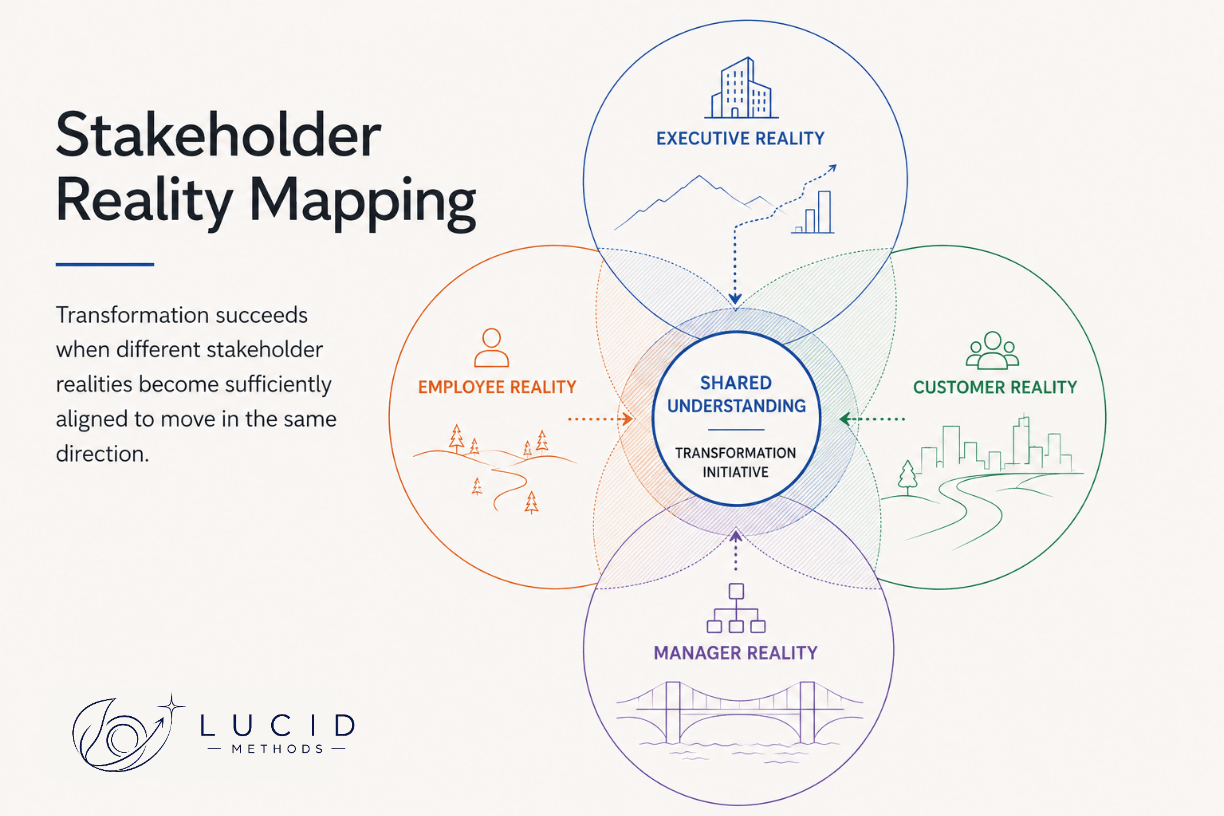
Stakeholder Reality Mapping
The Transformation That Made Sense—But Failed Anyway
A leadership team announces a transformation initiative.
The strategy is sound.
The business case is clear.
The implementation plan is detailed.
Yet progress stalls.
Operations says the plan is unrealistic.
Managers complain about resource constraints.
Employees worry about job security.
Customers experience unexpected disruptions.
The leadership team becomes frustrated.
“We explained the rationale.”
“We communicated the vision.”
“Why are people resisting?”
The answer is often simpler than leaders expect:
Different stakeholders are not reacting to the same reality.
They are reacting to different versions of reality.
Transformation does not occur inside a single shared environment. It occurs across multiple stakeholder realities that coexist at the same time.
Understanding these realities is often the difference between adoption and resistance.
The Illusion of Shared Reality
Most transformation plans are created from a leadership perspective.
Executives review market conditions.
They analyse performance metrics.
They define strategic objectives.
From their viewpoint, the change is obvious and necessary.
However, what appears obvious at one level of the organisation may be invisible at another.
The executive sees declining market share.
The manager sees increasing workload.
The frontline employee sees a new system.
The customer sees a service disruption.
Each perspective is valid.
Each perspective is incomplete.
The challenge is not that stakeholders disagree.
The challenge is that stakeholders are responding to different realities.
Every Stakeholder Lives Inside a Different Context
Reality is shaped by context.
People interpret change through their experiences, incentives, responsibilities, risks, and priorities.
A transformation programme may represent:
- Opportunity to one stakeholder
- Risk to another
- Extra work to a third
- Irrelevance to a fourth
The same initiative generates different meanings because it intersects with different realities.
When leaders assume everyone sees what they see, alignment begins to deteriorate.
What Is Stakeholder Reality Mapping?
Stakeholder Reality Mapping is the practice of identifying and understanding how different stakeholder groups perceive the same transformation.
Rather than asking:
"What do stakeholders think?"
It asks:
"What reality are stakeholders operating within?"
The objective is not agreement.
The objective is understanding.
When leaders understand stakeholder realities, they can anticipate friction before it appears.
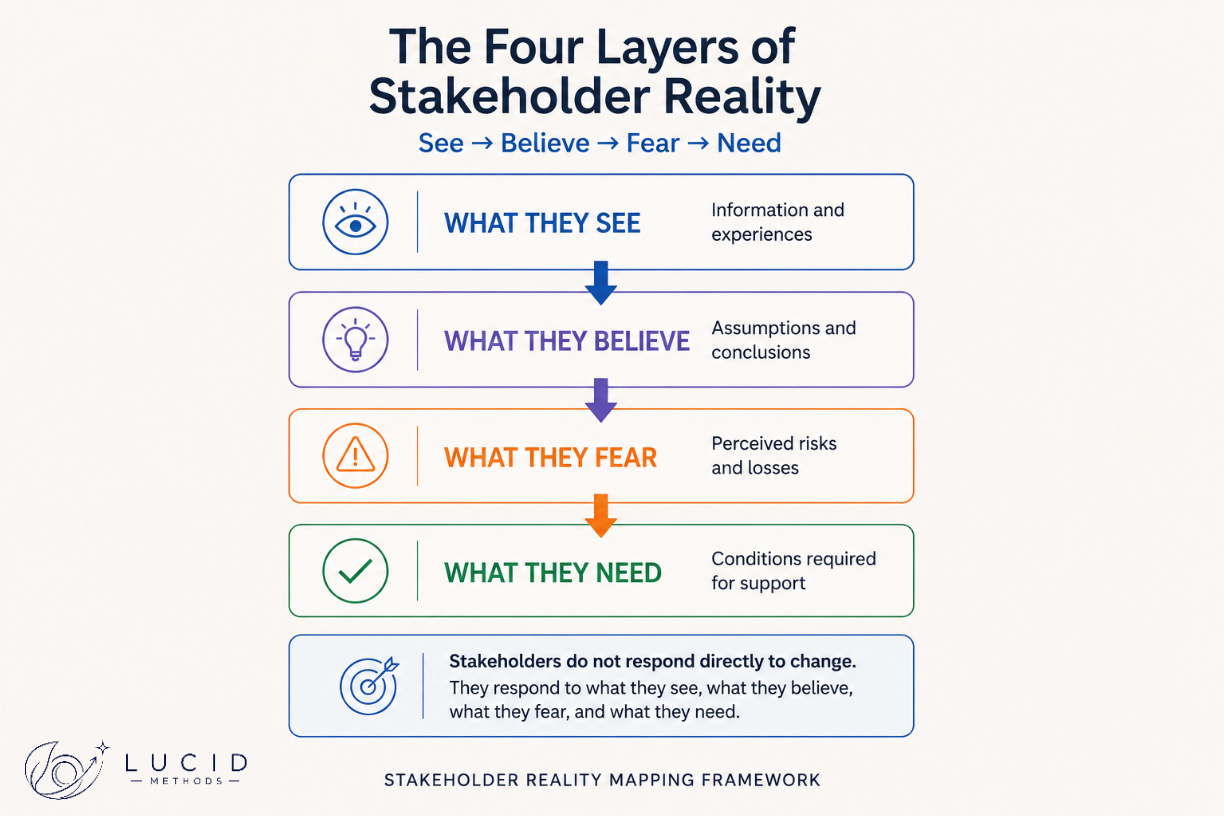
Four Layers of Stakeholder Reality
Layer 1: What They See
The observable environment.
What information is visible to them?
What experiences shape their perception?
What signals are they receiving?
Different visibility creates different conclusions.
Layer 2: What They Believe
The interpretation of what they see.
What assumptions are they making?
What stories are they telling themselves?
What previous experiences influence their expectations?
This is where interpretation drift often begins.
Layer 3: What They Fear
The perceived risk.
What could they lose?
Status?
Control?
Expertise?
Job security?
Relationships?
People rarely resist change itself.
They often resist perceived loss.
Layer 4: What They Need
The conditions required for support.
Clarity?
Training?
Resources?
Authority?
Evidence?
Trust?
Without understanding stakeholder needs, transformation efforts frequently target symptoms instead of causes.o see.
Why Traditional Stakeholder Analysis Falls Short
Traditional stakeholder analysis often categorises stakeholders according to:
- Influence
- Power
- Interest
While useful, these dimensions do not explain behaviour.
Two stakeholders with identical influence levels can react completely differently.
The difference lies in their reality.
Stakeholder Reality Mapping goes beyond classification.
It seeks understanding.
It asks:
- What are they experiencing?
- What are they optimising for?
- What risks do they perceive?
- What assumptions are shaping their response?
These questions reveal the forces behind behaviour.
Resistance Is Often Reality Misalignment
A common leadership mistake is treating resistance as opposition.
Many forms of resistance are actually signals.
Signals that stakeholder realities have not been understood.
Consider a system implementation.
Leadership believes:
"This system improves efficiency."
Employees believe:
"This system will monitor and replace us."
Both groups are reacting rationally within their own reality.
The conflict is not caused by the system.
The conflict is caused by reality misalignment.
Until that gap is addressed, communication alone rarely solves the problem.
Mapping Reality Before Problems Appear
The most effective transformation leaders perform stakeholder reality mapping before major execution begins.
They identify:
- Who is affected
- What each group sees
- What each group fears
- What each group values
- What success means from their perspective
This creates an early warning system for potential friction.
Instead of discovering resistance during implementation, leaders can anticipate it during design.
From Communication to Understanding
Many organisations respond to resistance with more communication.
More town halls.
More emails.
More presentations.
Yet communication only works when it addresses the reality of the audience.
If leaders communicate answers to questions stakeholders are not asking, understanding does not improve.
Volume does not create alignment.
Relevance does.
Stakeholder Reality Mapping shifts the focus from broadcasting messages to understanding perspectives.
The Strategic Advantage
Organisations often invest heavily in planning transformation.
Fewer invest equally in understanding the realities of the people expected to execute it.
This creates a predictable gap.
The strategy may be coherent.
The execution architecture may be sound.
But stakeholders operate according to their perceived reality, not leadership's intended reality.
The organisations that navigate change successfully recognise this truth.
They do not assume shared understanding.
They actively map it.
Because transformation does not happen when everyone receives the same message.
Transformation happens when different realities become sufficiently aligned to move in the same direction.
That alignment begins with understanding the realities that already exist.
Part of the Change & Human Systems Series from LUCID Methods.
Explore more frameworks, diagnostic perspectives, and systems-thinking insights through the LUCID Method — developed to help organisations build clarity, coherence, and transformation that holds over time.