

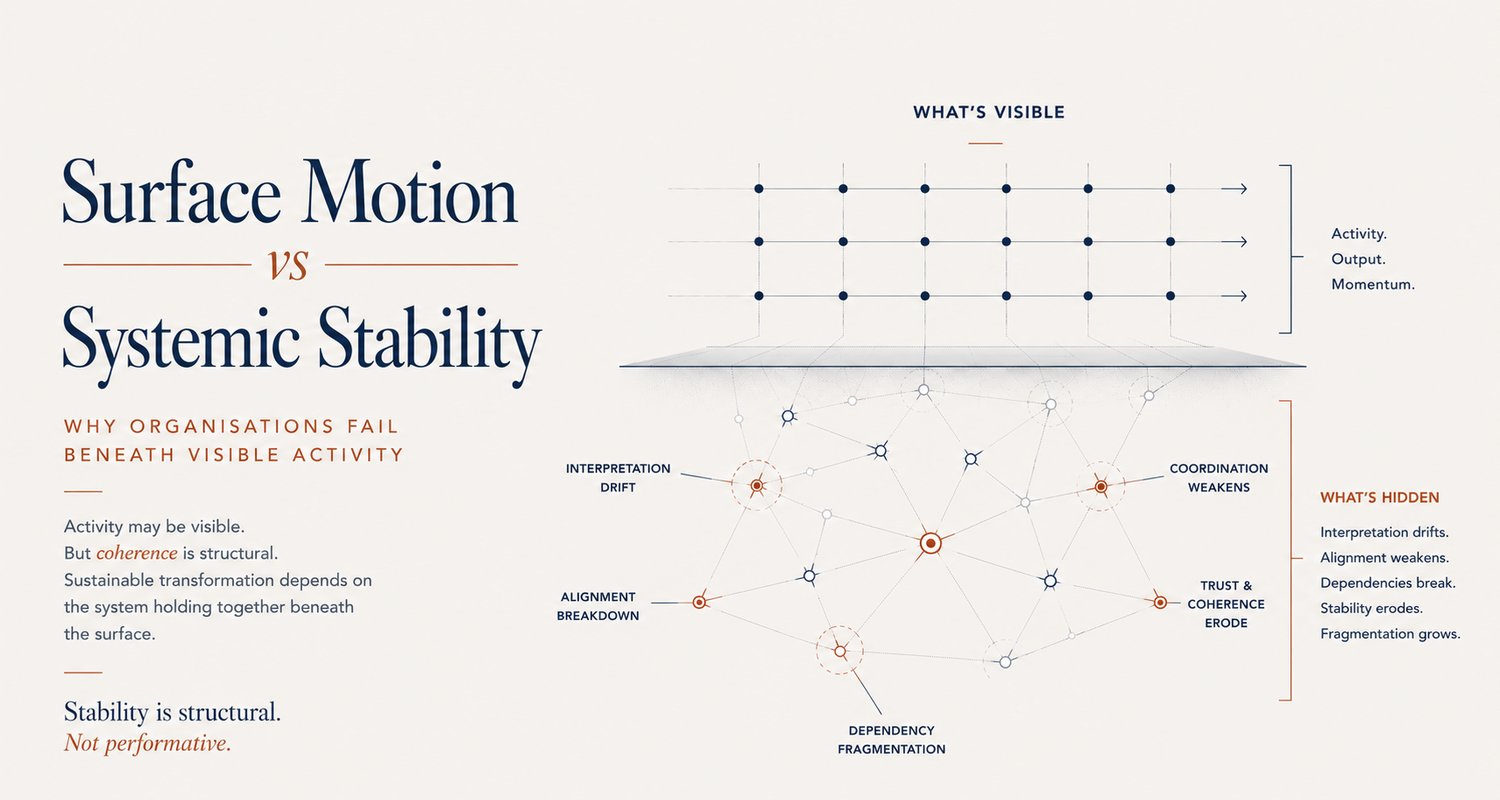
Surface Motion vs Systemic Stability
Organisations often judge stability by what is most visible.
Projects are moving.
Meetings continue.
Teams remain busy.
Targets are still being reported.
Dashboards remain active.
Deadlines continue getting met.
From the surface, the organisation appears stable.
Yet beneath that visible activity, coherence may already be weakening quietly.
Interpretation begins drifting.
Dependencies become fragile.
Ownership blurs.
Coordination weakens.
Priorities slowly separate instead of reinforce one another.
The organisation continues moving — but the system underneath is no longer holding together in the same way.
This is one of the most dangerous dynamics inside transformation work:
Visible motion can create the illusion of systemic stability.
And because activity remains visible, deterioration often goes unnoticed until recovery becomes significantly more difficult.
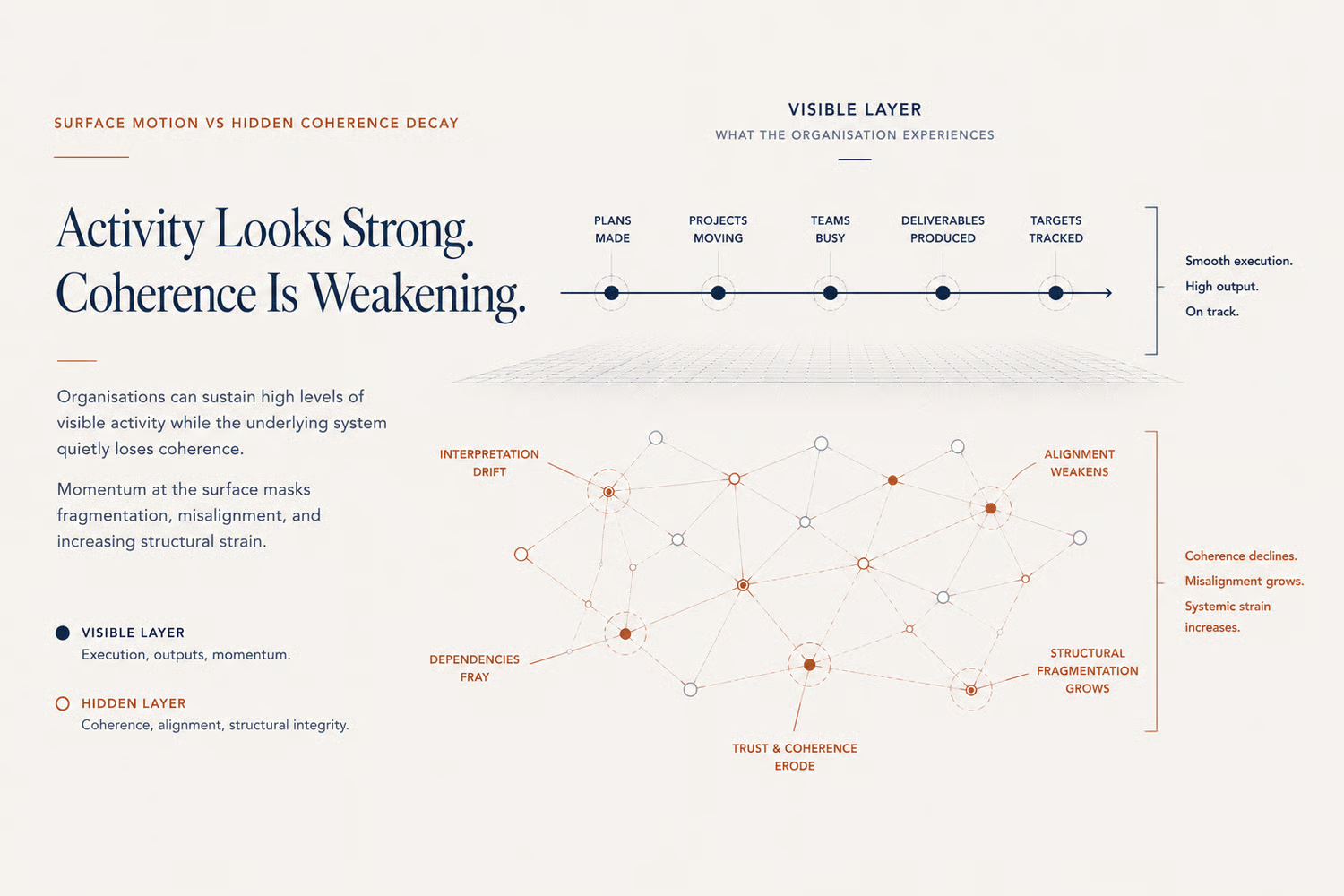
Activity Is Not the Same as Stability
Many organisations unconsciously treat movement as evidence of health.
If work is progressing, leaders assume alignment exists.
If teams remain active, leaders assume the system is functioning.
If momentum continues, leaders assume transformation remains stable.
But systems do not fail only when activity stops.
They often fail while activity continues.
This is because execution alone does not reveal whether:
- interpretation remains aligned
- dependencies still reinforce each other
- coordination remains coherent
- decision-making remains stable under pressure
- priorities continue supporting shared outcomes
An organisation can appear highly active while gradually fragmenting underneath.
In fact, visible activity can sometimes delay recognition of instability.
The busier the organisation becomes, the easier it is for structural deterioration to hide behind operational momentum.
The Difference Between Surface Motion and Systemic Stability
Surface motion is visible.
It includes:
- meetings
- reporting
- delivery activity
- project updates
- implementation movement
- operational responsiveness
These are important signals — but they are incomplete signals.
Systemic stability operates underneath visible execution.
It reflects whether the organisation still maintains:
- shared interpretation
- aligned priorities
- stable dependencies
- coordinated decision-making
- reinforcing behaviour across teams
- resilience under pressure
Surface motion measures whether activity exists.
Systemic stability measures whether the system can continue holding together as complexity, pressure, and uncertainty increase.
The distinction matters because organisations rarely collapse from inactivity alone.
They collapse when coherence deteriorates beneath continued movement.
Why Instability Often Remains Invisible
Structural instability is difficult to detect because organisations naturally optimise for visible indicators.
Leaders monitor:
- delivery timelines
- milestones
- budget performance
- reporting cadence
- operational throughput
These indicators are necessary.
But they do not always expose:
- interpretation drift
- silent disagreement
- dependency breakdown
- conflicting assumptions
- coordination fatigue
- weakening organisational trust
By the time instability becomes visible operationally, the system has often already absorbed months of hidden strain.
This is why transformation failure frequently feels “sudden” to leadership teams.
In reality, the deterioration was usually gradual.
The visible failure was simply the moment hidden instability became impossible to contain.
Coherence Erodes Before Performance Collapses
One of the most misunderstood aspects of transformation is that performance can remain stable for some time even while coherence deteriorates underneath.
This creates a dangerous psychological effect.
Because visible outcomes still appear acceptable, organisations assume:
- alignment still exists
- interpretation remains shared
- execution remains healthy
- teams are still operating cohesively
But internally, the system may already be separating into competing operational realities.
Different teams begin interpreting priorities differently.
Local optimisation starts replacing organisational coherence.
Decision-making becomes inconsistent.
Dependencies weaken silently.
Trust in coordination slowly erodes.
The organisation still appears unified externally while internally becoming increasingly fragmented.
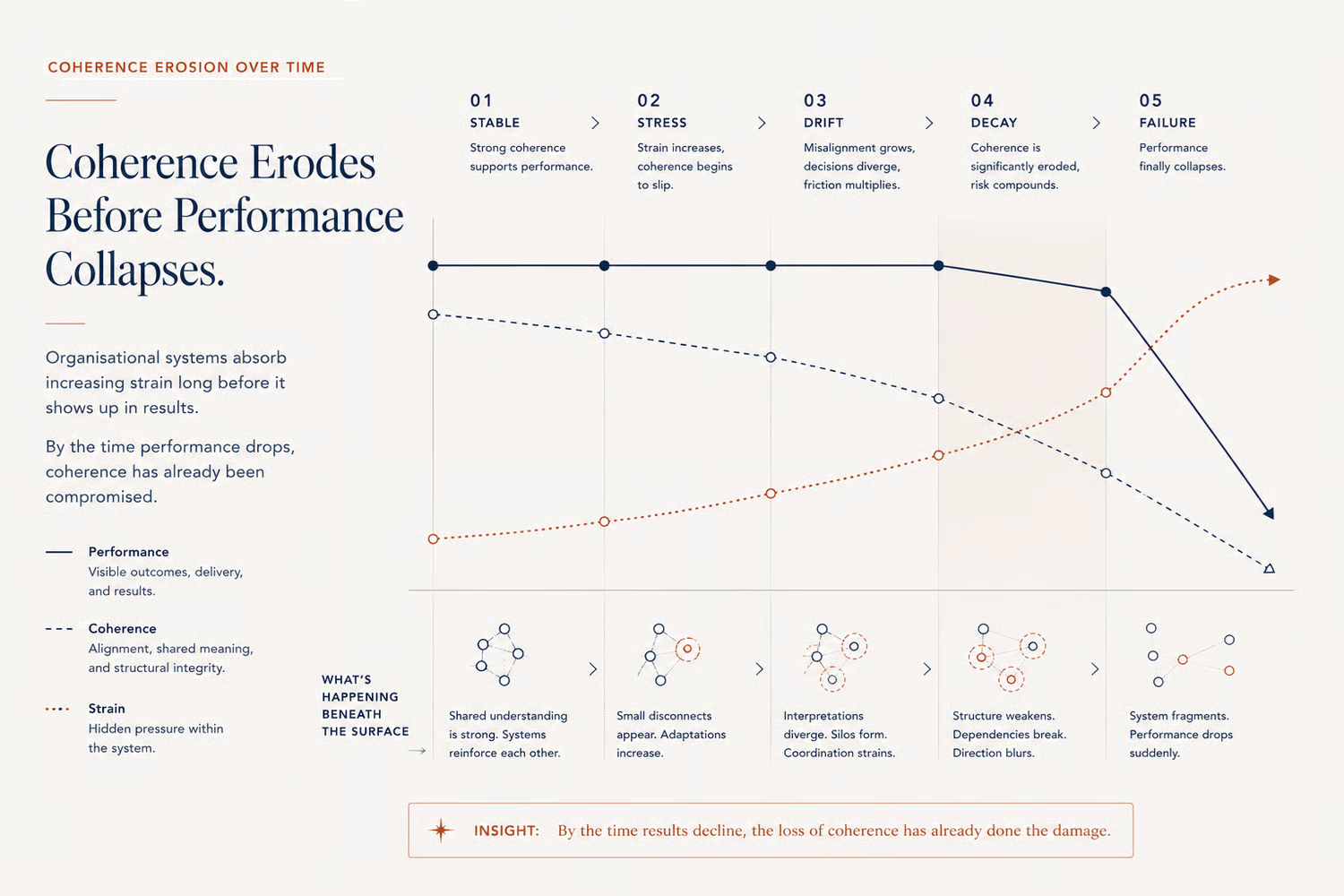
This is why many transformation efforts appear stable right until the moment they suddenly become fragile.
The breakdown did not begin at collapse.
It began during the period when everything still looked manageable.
Stability Is Structural
True organisational stability is not created through optimism, communication volume, or operational intensity alone.
It is structural.
It depends on whether the organisation can maintain coherent execution across complexity, ambiguity, and pressure.
That requires more than activity.
It requires:
- shared interpretation
- aligned incentives
- dependency clarity
- stable coordination pathways
- reinforced behavioural alignment
- resilience inside execution systems
Strong organisations are not merely active.
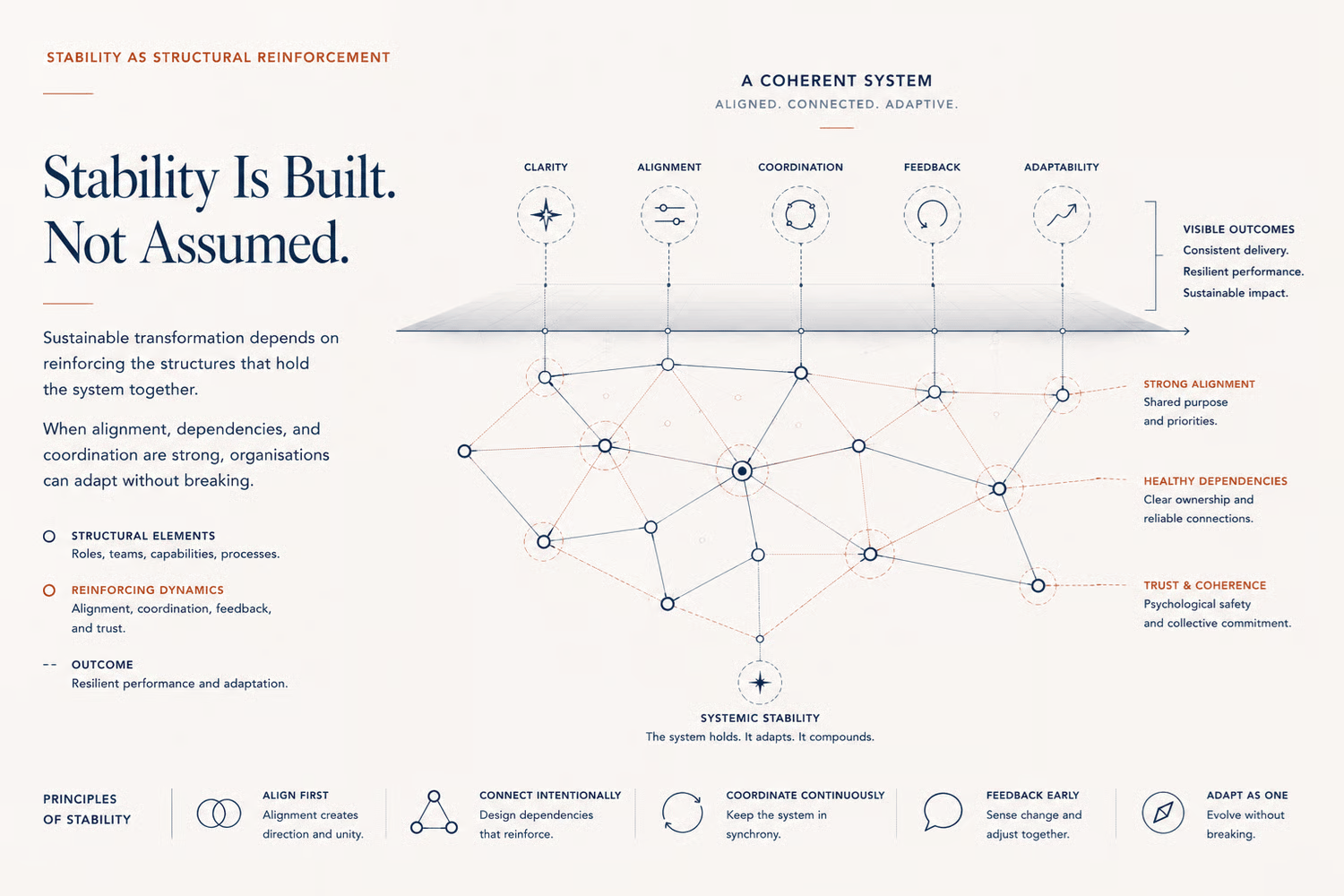
They are structurally coherent.
Their systems continue holding together even as conditions shift.
Their teams interpret priorities consistently.
Their execution pathways reinforce rather than compete.
Their coordination mechanisms remain stable under pressure.
This is what allows transformation to sustain momentum without quietly fragmenting underneath.
Sustainable Transformation Depends on More Than Motion
Many transformation efforts focus heavily on generating movement:
- launching initiatives
- accelerating delivery
- increasing responsiveness
- driving visible momentum
But momentum alone cannot sustain change.
Without systemic stability, acceleration often increases fragmentation instead of reducing it.
The faster an unstable system moves, the faster hidden incoherence compounds.
This is why sustainable transformation requires more than execution capability.
It requires the ability to continuously maintain:
- coherence
- interpretation alignment
- structural resilience
- organisational stability beneath visible activity
Because movement alone does not guarantee transformation is holding together.
Only coherence does.
Closing Reflection
Most organisations do not fail because people stop working.
They fail because coherence quietly deteriorates beneath continued activity.
The visible system keeps moving.
The hidden system slowly separates.
And by the time instability becomes operationally visible, recovery is often significantly harder, slower, and more expensive.
Sustainable transformation depends not only on whether organisations can move.
But whether the system still holds together while moving.
Because stability is not performative.
It is structural.
Part of the Transformation Failure Dynamics Series from LUCID Methods.
Explore more frameworks, diagnostic perspectives, and systems-thinking insights through the LUCID Method — developed to help organisations build clarity, coherence, and transformation that holds over time.