

Why Organisations Keep Solving the Same Problems
Many organisational problems appear obvious.
A project misses its deadline.
Stakeholders resist change.
Teams fail to collaborate.
Adoption rates remain low.
Customer complaints increase.
The symptoms are visible, measurable, and difficult to ignore.
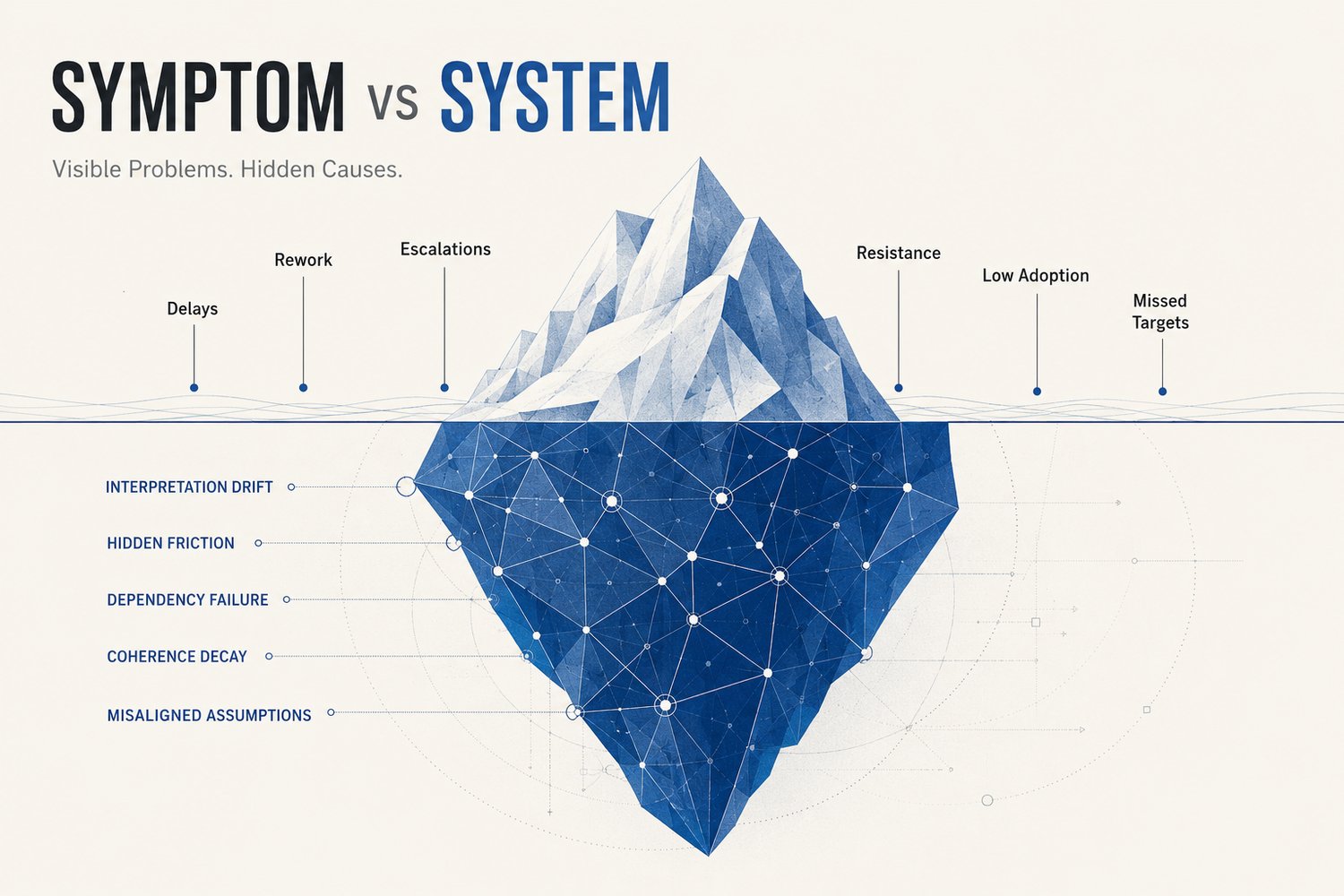
The challenge is that visible problems are often not the actual problem.
What leaders experience as a problem is frequently the outward expression of a deeper system dynamic operating beneath the surface.
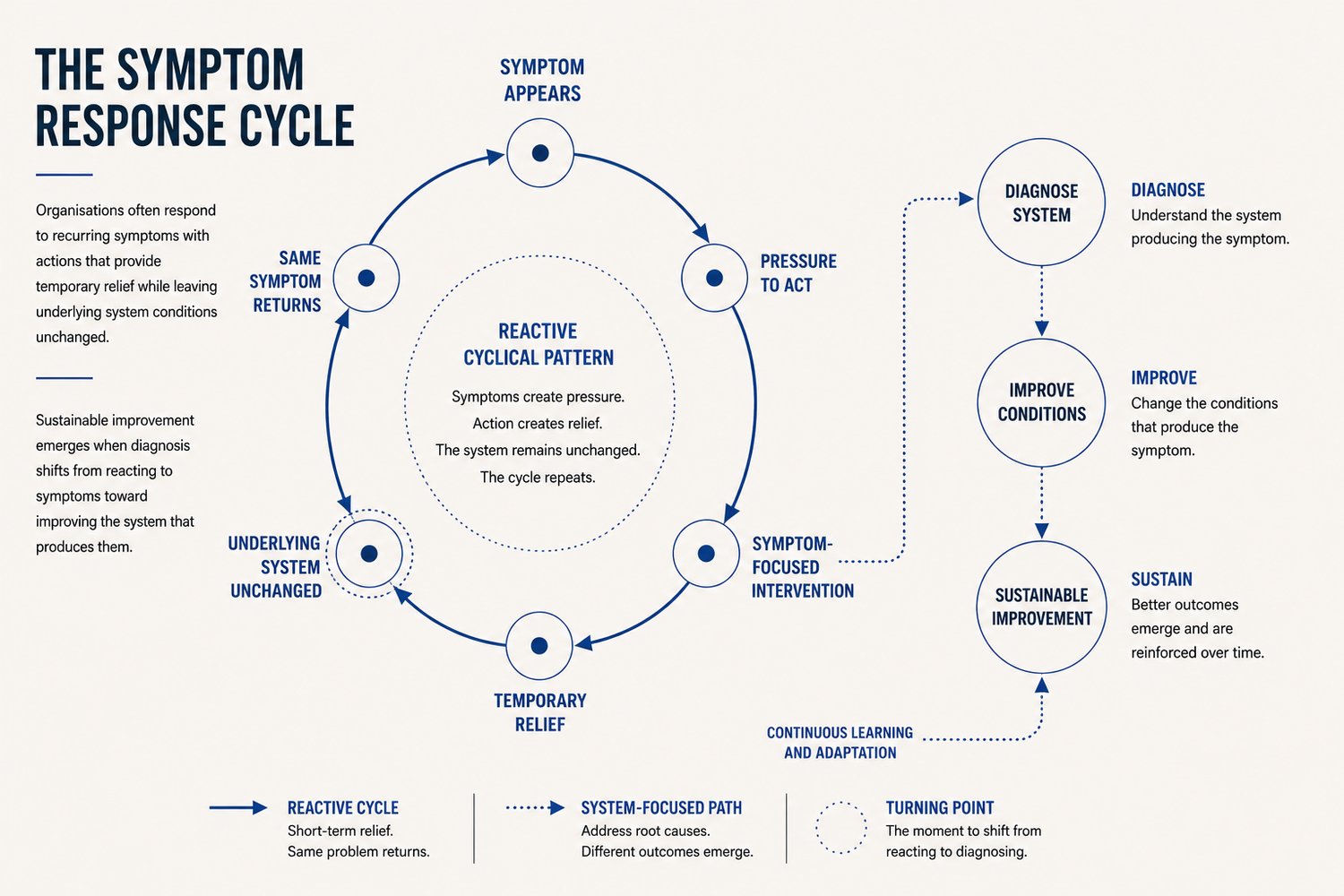
When attention focuses exclusively on symptoms, organisations may create activity without creating improvement.
The result is a cycle of recurring issues that seem to return no matter how many corrective actions are taken.
The question is not whether the symptom is real.
The question is whether the symptom is the cause.
The Attraction of Symptoms
Symptoms naturally attract attention because they are visible.
A delayed project appears on a dashboard.
A missed target appears in a report.
An unhappy stakeholder appears in a meeting.
These signals create urgency and demand action.
Systems, by contrast, are rarely visible.
Interpretations, assumptions, dependencies, behavioural patterns, and decision structures do not appear on status reports. They operate quietly in the background, influencing outcomes long before problems become visible.
Because symptoms are easier to observe than systems, organisations often invest more effort into responding to the symptom than understanding the conditions that created it.
This creates a dangerous illusion of progress.
Action is taking place.
The underlying problem remains.
When the Symptom Becomes the Target
Consider a transformation programme that repeatedly misses milestones.
The visible symptom is delay.
A typical response might include:
More reporting
Additional governance meetings
Escalations to leadership
Increased pressure on delivery teams
These actions appear reasonable.
Yet after several months, the delays continue.
Why?
Because delay may not be the actual problem.
The delay may be a symptom of conflicting interpretations between teams.
It may be caused by hidden dependencies that were never surfaced.
It may result from unclear ownership, fragmented decision-making, or inconsistent understanding of priorities.
In each case, the symptom is identical.
The system generating the symptom is different.
When leaders focus on the symptom alone, they risk treating effects while leaving causes untouched.
Symptoms Are Signals
A useful diagnostic mindset is to view symptoms as signals rather than problems.
A fever is not a disease.
It is evidence that something else is happening within the body.
Likewise, organisational symptoms provide information about the state of the system.
Resistance may indicate conflicting interpretations.
Rework may indicate misaligned assumptions.
Escalations may indicate unresolved dependencies.
Poor adoption may indicate a lack of shared meaning.
The symptom itself rarely explains why it exists.
It merely points toward a deeper investigation.
The objective is not to eliminate the signal.
The objective is to understand what the signal is revealing.
Why Organisations Get Stuck
Many organisations become trapped in symptom-focused thinking because symptoms create immediate pressure.
Leaders are expected to act quickly.
Teams are expected to produce visible responses.
Stakeholders expect reassurance that something is being done.
As a result, organisations often optimise for speed of response rather than quality of diagnosis.
The visible problem receives attention.
The invisible system remains unchanged.
This creates a familiar pattern:
The issue appears.
The organisation responds.
The issue temporarily improves.
The issue returns.
The organisation responds again.
Over time, teams become frustrated because significant effort is being invested without achieving lasting improvement.
The problem is not a lack of effort.
The problem is diagnostic accuracy.
The LUCID Perspective
LUCID is built on the belief that organisational performance is shaped by system conditions rather than isolated events.
The framework encourages practitioners to look beyond visible symptoms and explore the structures producing them.
Instead of asking:
Who caused this?
Which team failed?
What process broke?
LUCID encourages questions such as:
What assumptions differ across stakeholders?
Where are interpretations diverging?
What dependencies remain hidden?
Where is coherence weakening?
What conditions are producing this outcome repeatedly?
These questions shift attention away from blame and toward understanding.
The objective is not simply to solve today's problem.
The objective is to understand why the system keeps producing it.
From Reactive Fixes to Systemic Improvement
A symptom-focused organisation becomes reactive.
A system-focused organisation becomes diagnostic.
The difference is significant.
Symptom Thinking
- What happened?
- Who is responsible?
- Fix the issue
- Respond to events.
- Short-term relief.
vs
System Thinking
- What produced this outcome?
- What conditions created this?
- Improve the system.
- Understand patterns.
- Long-term resilience.
System thinking does not ignore symptoms.
It uses them as entry points for investigation.
Every symptom becomes a clue.
Every recurring problem becomes evidence of an underlying dynamic that deserves attention.
Looking Beneath the Surface
Many transformation efforts fail because organisations become trapped at the level of symptoms.
They increase governance when meaning is unclear.
They increase communication when interpretation differs.
They increase activity when coherence is weak.
The visible problem receives attention while the system producing it remains unchanged.
Sustainable improvement begins when diagnosis moves below the surface.
The most important question is often not:
"What should we do?"
It is:
"What system is producing what we are experiencing?"
When organisations learn to answer that question, recurring problems become opportunities for deeper understanding rather than endless cycles of correction.
Symptoms may demand attention.
But systems determine outcomes.
Part of the Diagnostic Thinking Series from LUCID Methods.
Explore more frameworks, diagnostic perspectives, and systems-thinking insights through the LUCID Method — developed to help organisations build clarity, coherence, and transformation that holds over time.