

Sustainable transformation is not created through activity alone.
It emerges when meaning, priorities, decisions, execution, and feedback remain structurally aligned over time.
Many organisations focus heavily on momentum, delivery, and visible execution.
But long-term stability depends on something deeper: coherence.
Without coherence, systems gradually fragment beneath the surface.
Priorities compete.
Interpretation diverges.
Coordination weakens.
Friction accumulates.
Execution becomes increasingly difficult to sustain.
Healthy systems are not held together by effort alone.
They are intentionally designed to remain aligned under pressure.
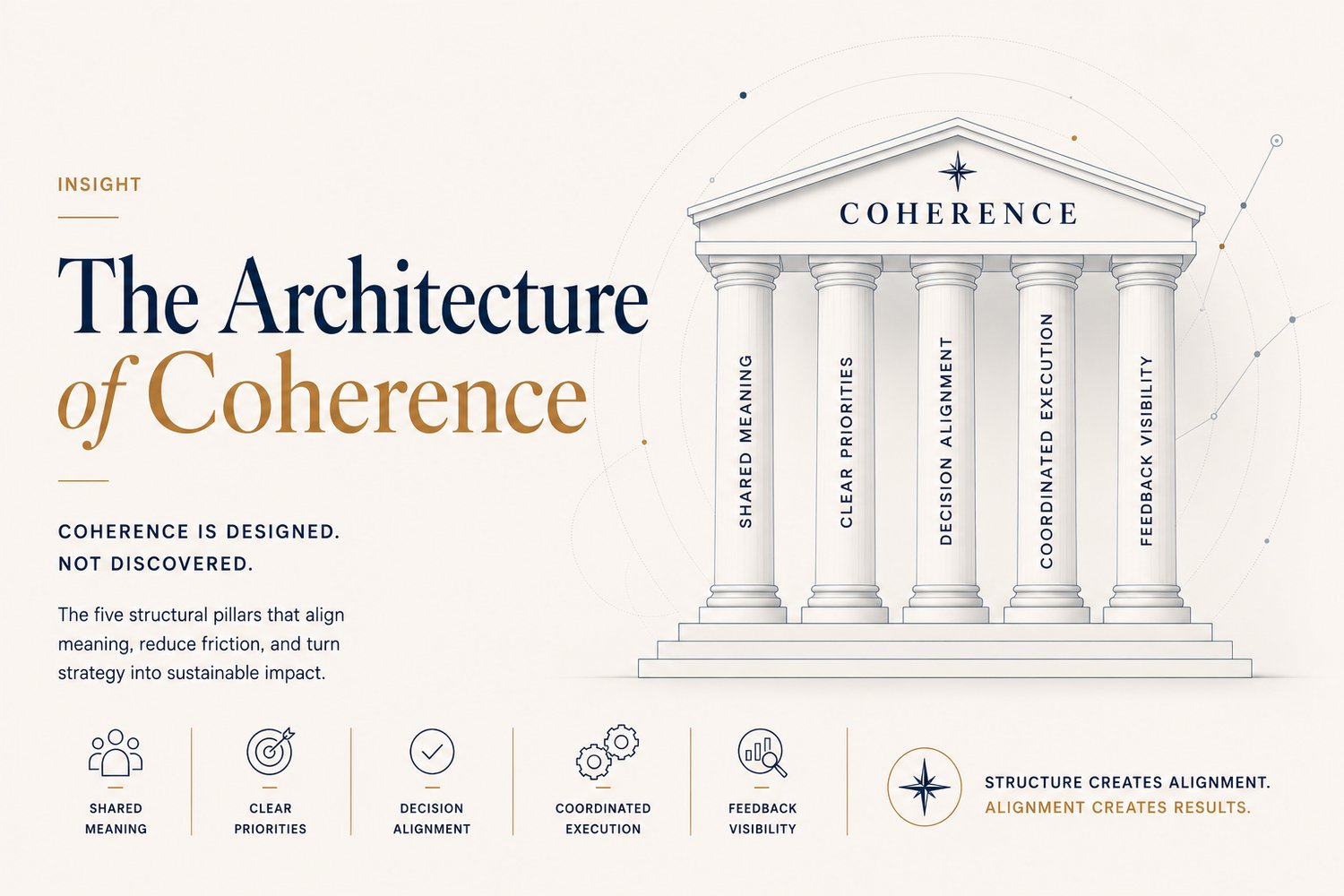
Coherence is not accidental. It is designed.
The Architecture of Coherence
Modern organisations are surrounded by movement.
Projects advance.
Meetings multiply.
Dashboards improve.
Teams remain busy.
Momentum appears visible.
From the surface, the system looks alive.
But movement alone does not create stability.
Many transformation efforts fail not because organisations stop moving, but because the system beneath execution gradually loses coherence. Priorities begin to compete. Interpretation diverges across teams. Coordination weakens quietly beneath visible activity. Decision quality deteriorates slowly over time. Friction accumulates long before failure becomes obvious.
Healthy systems are not sustained through momentum alone.
They are sustained through coherence.
Coherence Is Not Accidental
One of the most dangerous assumptions in organisational transformation is the belief that alignment will emerge naturally if enough activity exists.
It rarely does.
Coherence is not discovered under pressure. It is intentionally designed into the system itself.
Strong systems are built around reinforcing structures that continuously align:.
- meaning
- priorities
- decisions
- execution
- feedback
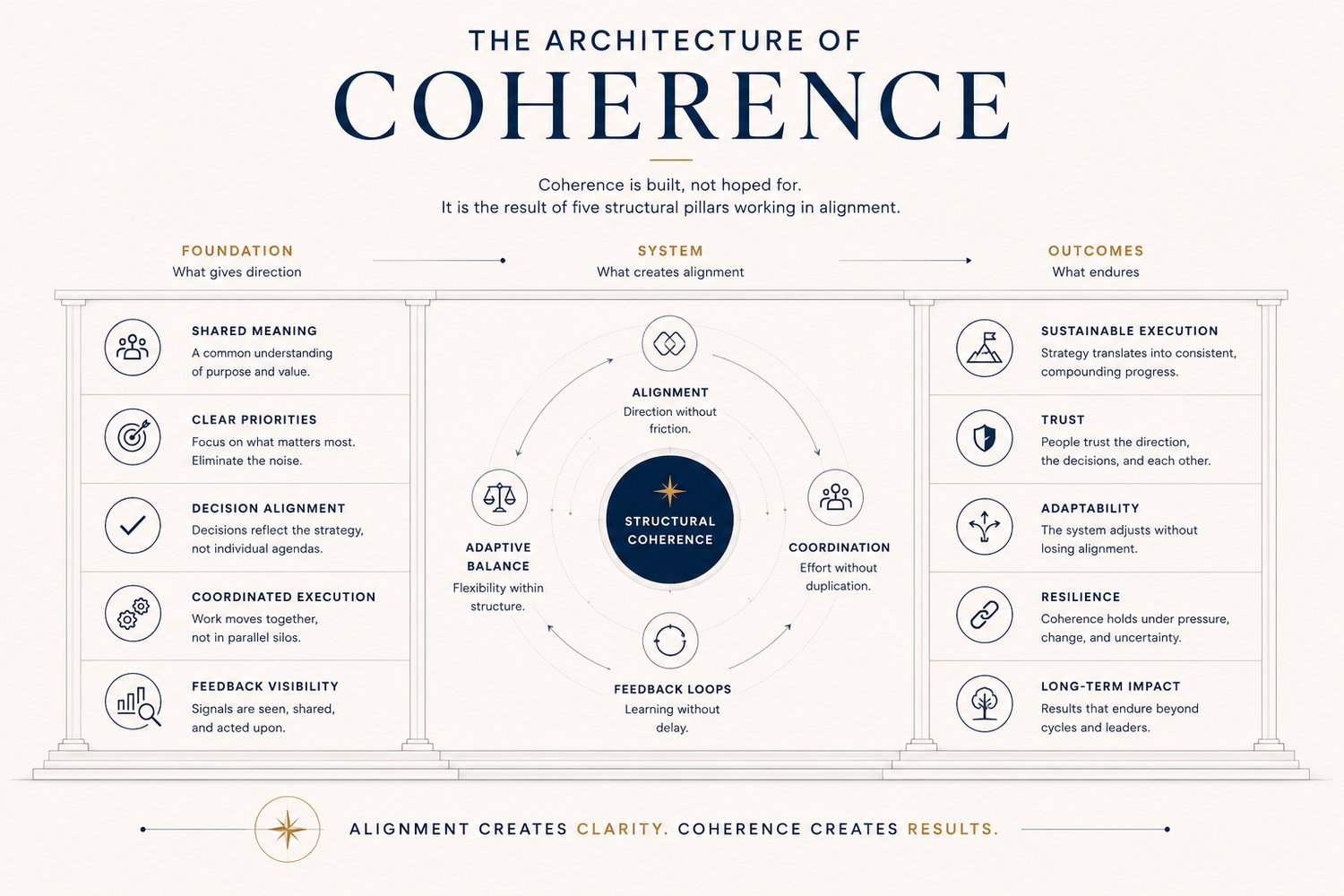
When these structures remain connected, organisations become more resilient, coordinated, and adaptive over time.
When they weaken, even highly capable teams begin drifting apart while appearing productive on the surface.
This is why organisations can remain operationally busy while becoming strategically fragmented.
Clarity Reduces Friction Before Execution Begins
Most execution problems do not begin during execution.
They begin much earlier — during interpretation.
Ambiguity creates hesitation.
Hesitation creates delay.
Delay creates friction.
When priorities are unclear, ownership overlaps, decision boundaries are vague, and success criteria remain undefined, teams compensate by increasing communication volume, meetings, escalation layers, and operational effort.
The system becomes heavier simply to maintain movement.
Clarity changes this.
Clear priorities reduce distraction.
Defined roles reduce duplication.
Shared understanding reduces coordination cost.
Visible measures enable earlier adjustment.
Execution becomes smoother not because people work harder, but because friction is removed before momentum is tested.
Healthy Systems Align Meaning Before Action
Many organisations attempt to align action without first aligning interpretation.
This creates one of the most expensive forms of organisational waste: misdirected effort.
Teams may appear aligned operationally while holding fundamentally different assumptions about:
- the purpose of the work
- the meaning of success
- the nature of the problem
- the priority of trade-offs
- the boundaries of ownership
Under these conditions, activity increases but impact does not.
Alignment is not a meeting.
It is a system capability.
Healthy systems intentionally create shared meaning through:
- common language
- visible priorities
- role clarity
- boundary alignment
- coordinated interpretation
When meaning becomes aligned across the organisation, execution becomes amplified rather than fragmented.
Shared Understanding Is an Operational Asset
Organisations often assume that access to information automatically creates alignment.
It does not.
Teams rarely fail because information is unavailable. More often, they fail because information is interpreted differently across the system.
Shared understanding reduces:
- rework
- coordination friction
- duplicated effort
- conflict escalation
- execution delay
It improves:
- decision quality
- operational trust
- execution speed
- adaptability
- reliability
This is why communication alone is insufficient.
Clarity communicated is not always understanding shared.
Healthy systems continuously validate interpretation, not merely distribute information.
Alignment Turns Strategy Into Momentum
Strategy without alignment creates confusion.
Alignment without execution creates drift.
Many organisations possess strong strategic intent but weak execution coherence. Teams understand fragments of the direction but lack connected priorities, coordinated sequencing, or aligned decision logic.
As a result:
- effort disperses
- momentum stalls
- initiatives compete internally
- operational fatigue increases
Aligned systems behave differently.
They focus attention on the few priorities that matter most.
Resources reinforce direction.
Teams coordinate across dependencies.
Execution compounds instead of colliding.
Momentum is not created by urgency alone.
It is created when aligned execution repeatedly reinforces strategic direction over time.
Feedback Maintains Coherence
Systems rarely drift because change occurs.
They drift because feedback becomes delayed, distorted, ignored, or disconnected from action.
Healthy systems maintain coherence through continuous feedback loops:
- Observe signals
- Interpret meaning
- Decide adjustments
- Act with discipline
- Learn continuously
Feedback is not criticism.
It is structural clarity.
Without feedback:
- problems surface late
- pressure accumulates invisibly
- adaptation slows
- resilience weakens
With strong feedback systems:
- learning compounds
- alignment strengthens
- decisions improve faster
- adaptation becomes continuous
Coherence is maintained through visibility.
Scalable Systems Are Designed, Not Improvised
Growth exposes weak systems.
Many organisations scale output faster than they scale coherence.
As complexity increases:
- communication overhead expands
- coordination cost rises
- decision latency grows
- dependency risk multiplies
Without structural coherence, scale amplifies chaos instead of capability.
Scalable systems are intentionally designed around:
- repeatable processes
- modular structures
- distributed ownership
- adaptive capacity
- reinforcing standards
The goal is not simply bigger systems.
The goal is systems capable of sustaining complexity without collapsing under it.
Growth without coherence creates fragility.
Coherence Creates Clarity
When organisations lose coherence, decision-making becomes increasingly difficult.
Meetings increase.
Analysis expands.
Escalation grows.
Confidence declines.
Leaders often interpret this as a lack of information.
But frequently, the deeper issue is fragmented coherence.
When priorities, interpretation, feedback, and execution become aligned:
- noise decreases
- patterns become visible
- decisions accelerate
- confidence improves
Clarity is not the removal of complexity.
It is the reduction of contradiction.
Coherence creates the conditions where the next right decision becomes visible.
Sustainable Impact Requires Structural Coherence
Sustainable transformation is not maintained through intensity alone.
It is maintained through systems capable of:
- learning
- adapting
- reinforcing alignment
- preserving meaning
- coordinating execution over time
This is the deeper architecture beneath resilient organisations.
Coherence turns:
- effort into momentum
- momentum into stability
- stability into resilience
- resilience into long-term impact
The strongest systems are not those that move fastest under pressure.
They are the systems that remain structurally coherent while adapting to change.
Because in the long run, sustainable transformation depends less on isolated initiatives and more on whether the organisation itself has been designed to hold together over time.
Part of the Execution Architecture Series from LUCID Methods.
Explore more frameworks, diagnostic perspectives, and systems-thinking insights through the LUCID Method — developed to help organisations build clarity, coherence, and transformation that holds over time.