

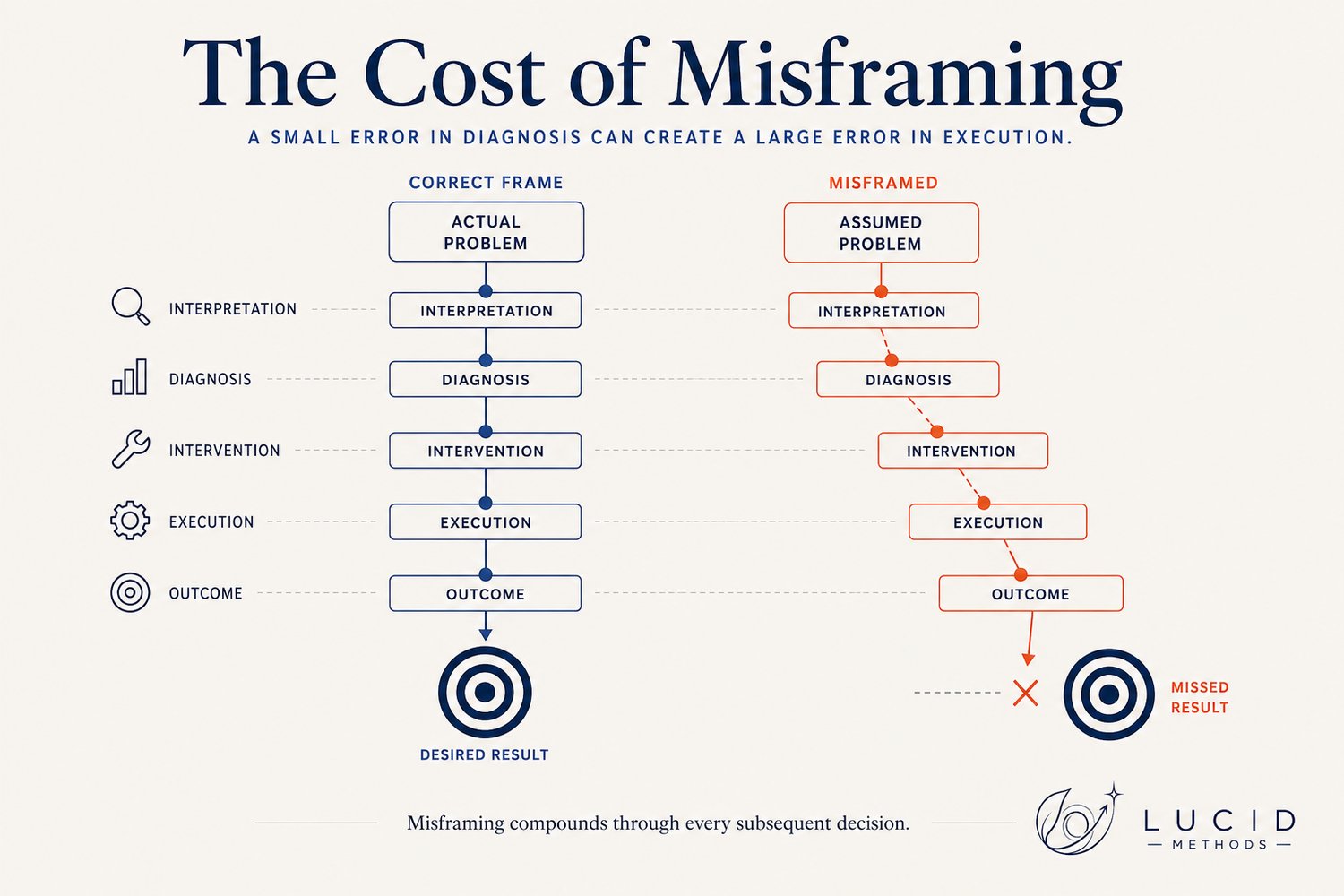
The Cost of Misframing
Many transformation efforts fail long before execution begins.
Not because people resist change.
Not because the strategy is flawed.
Not because resources are insufficient.
They fail because the organisation is solving the wrong problem.
The failure is often invisible at first.
Teams work hard.
Projects move forward.
Workshops are conducted.
Plans are approved.
Activity increases.
Yet outcomes remain disappointing.
The reason is simple:
A well-executed solution cannot compensate for a poorly framed problem.
Misframing creates an invisible distortion that affects every decision that follows.
The greater the effort invested, the more expensive the mistake becomes.
Every Solution Begins With A Frame
Before an organisation decides what to do, it decides what it believes is happening.
This interpretation becomes the frame.
The frame determines:
- What data receives attention
- Which stakeholders are consulted
- What risks are considered important
- Which solutions appear reasonable
- How success is measured
Once established, the frame acts as a lens through which everything else is interpreted.
If the frame is accurate, decisions become progressively more effective.
If the frame is inaccurate, the organisation can become increasingly efficient at moving in the wrong direction.
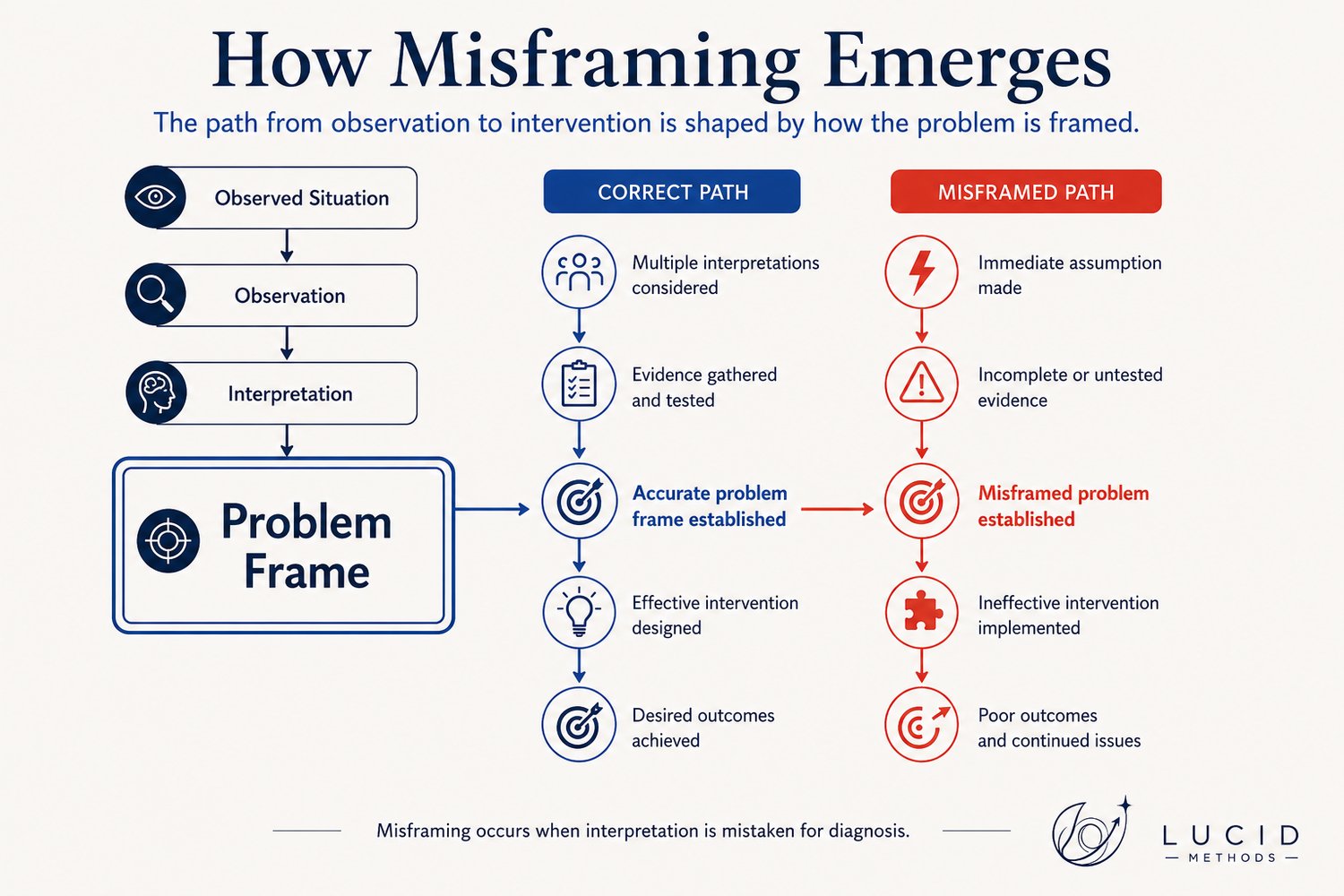
The Hidden Danger Of Early Conclusions
Transformation environments often create pressure for immediate action.
Leaders want answers.
Stakeholders demand progress.
Teams feel compelled to demonstrate momentum.
Under these conditions, organisations frequently confuse observations with explanations.
For example:
Observation:
Customer complaints are increasing.
Assumed explanation:
Customer service quality is declining.
Resulting solution:
Provide customer service training.
Months later, complaints continue to rise.
Further investigation reveals:
- Product quality issues
- Billing errors
- Policy confusion
- Misaligned incentives
The original intervention was not ineffective.
It was simply addressing a problem that did not exist.
The cost was not only wasted effort.
The cost was time lost pursuing the wrong direction.
Misframing Creates Cascading Consequences
A framing error rarely remains isolated.
Once embedded into planning and execution, it begins influencing multiple layers of the organisation.
Resource Misallocation
People, budgets, and attention are directed toward symptoms rather than causes.
Resources become consumed by activities that cannot produce meaningful improvement.
Strategic Drift
Teams begin optimising around incorrect assumptions.
Projects become increasingly disconnected from the actual conditions generating the problem.
Stakeholder Frustration
Employees notice that interventions fail to resolve underlying issues.
Confidence in leadership begins to erode.
Repeated initiatives create change fatigue.
Diagnostic Blindness
The longer an organisation operates within an incorrect frame, the harder it becomes to recognise alternative explanations.
Evidence that contradicts the chosen narrative is often dismissed or overlooked.
The organisation becomes trapped within its own interpretation.
Why Misframing Is So Common
Misframing is not usually caused by incompetence.
It emerges from natural human tendencies.
We Prefer Certainty
An imperfect explanation often feels more comfortable than uncertainty.
People frequently choose a plausible answer before sufficient understanding exists.
We Focus On Visible Symptoms
Symptoms are easier to observe than underlying system conditions.
Delays, complaints, missed targets, and conflicts are visible.
Structural causes are often hidden.
We Interpret Through Existing Beliefs
Previous experiences influence how leaders understand current situations.
Success patterns from one environment are often applied to problems that require different explanations.
We Reward Speed More Than Understanding
Many organisations celebrate rapid action.
Few reward careful diagnosis.
As a result, teams often move into solution mode before understanding the problem space.
The Difference Between A Problem And A Symptom
One of the most common framing mistakes is treating symptoms as problems.
Consider a transformation where adoption rates remain low.
Low adoption is not necessarily the problem.
It may be a consequence of:
- Poor communication
- Conflicting incentives
- Leadership inconsistency
- Workflow disruption
- Capability gaps
- Trust issues
When adoption becomes the problem statement, the organisation may focus on training or awareness campaigns.
When the underlying conditions become the focus, very different interventions emerge.
Symptoms describe what is happening.
Problems explain why it is happening.
Confusing the two leads organisations into endless cycles of correction without improvement.
Better Questions Produce Better Frames
Diagnostic clarity often begins with changing the questions being asked.
Instead of asking:
"How do we fix this?"
Ask:
"What conditions are producing this?"
Instead of asking:
"Who is causing the problem?"
Ask:
"What system is enabling the problem?"
Instead of asking:
"What solution should we implement?"
Ask:
"What are we assuming to be true?"
The quality of the frame depends heavily on the quality of the questions used to construct it.
Misframing Is An Execution Problem
Many organisations treat framing as a strategic activity.
In reality, it is also an execution issue.
Execution follows interpretation.
When interpretation is flawed:
- Plans become flawed
- Priorities become flawed
- Measurements become flawed
- Decisions become flawed
Execution failure is often diagnostic failure appearing later in the process.
What appears to be poor
implementation may actually be the delayed consequence of an inaccurate problem definition.
Diagnostic Clarity Before Action
The purpose of diagnosis is not to delay action.
It is to ensure action is directed toward the right problem.
Effective organisations do not rush to solutions.
They invest effort understanding:
- What is occurring
- Why it is occurring
- Which conditions sustain it
- What evidence supports their interpretation
- Which assumptions remain uncertain
This discipline creates clarity.
Clarity creates alignment.
Alignment creates effective execution.
Final Reflection
Transformation success depends less on how quickly organisations act and more on whether they are acting on an accurate understanding of reality.
A flawed solution can be corrected.
A delayed decision can be recovered.
A misframed problem quietly contaminates every decision that follows.
The greatest cost of misframing is not wasted effort.
It is the opportunity lost while solving a problem that never existed.
In transformation, the quality of the outcome is often determined long before execution begins.
It is determined by how accurately the problem was framed.
Part of the Diagnostic Thinking Series from LUCID Methods.
Explore more frameworks, diagnostic perspectives, and systems-thinking insights through the LUCID Method — developed to help organisations build clarity, coherence, and transformation that holds over time.