

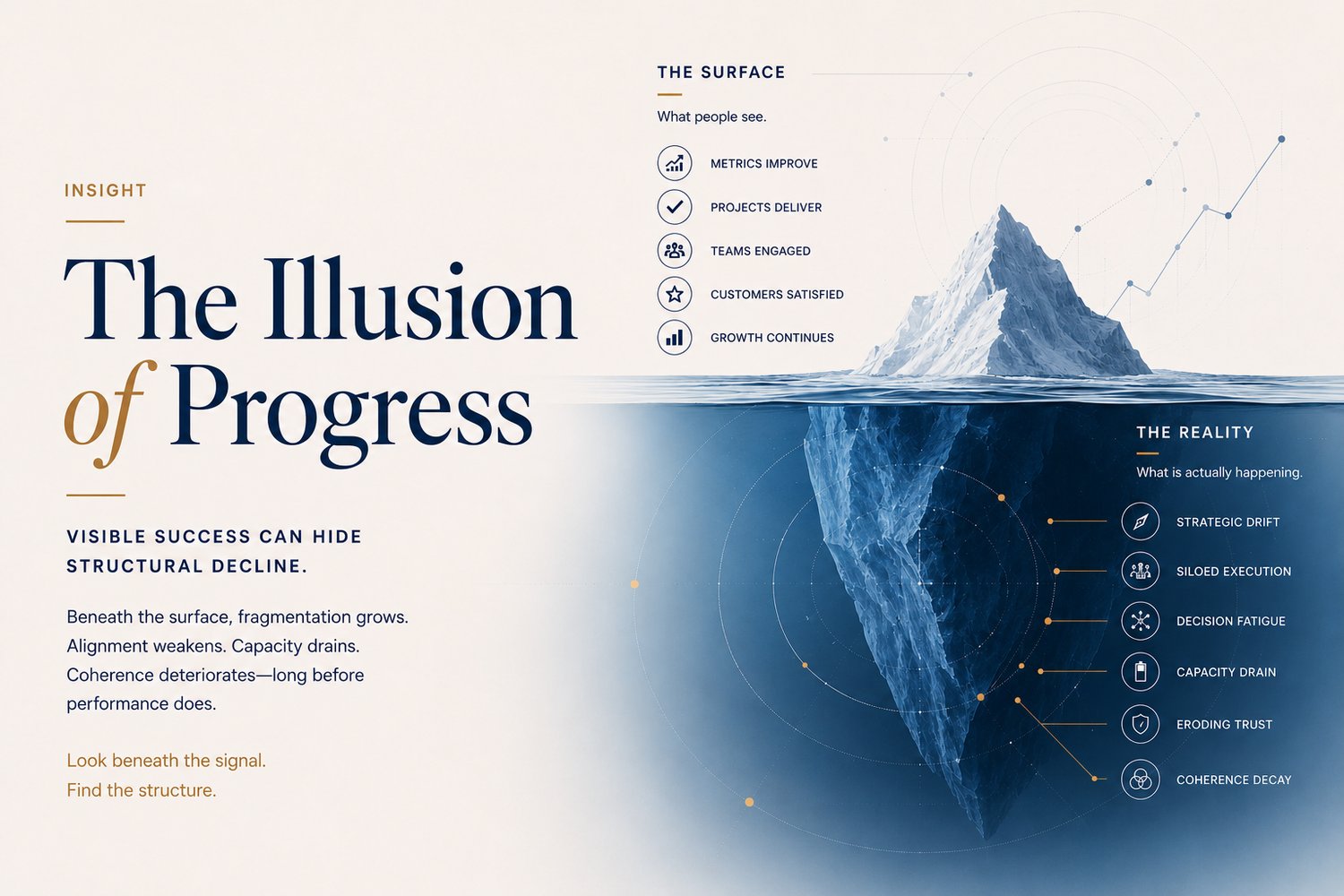
Many transformation efforts do not fail immediately.
In many organisations, performance indicators remain healthy long after deeper structural conditions have begun to weaken. Delivery continues. Teams remain active. Reporting remains positive. Momentum appears sustained.
From the surface, the system still looks functional.
But beneath visible activity, coherence may already be deteriorating.
Alignment weakens quietly.
Coordination friction accumulates.
Capacity drains invisibly.
Strategic interpretation begins to fragment beneath execution.
The most dangerous organisational failures are often not sudden collapses.
They are slow structural deteriorations hidden beneath visible progress.
The Illusion of Progress
Modern organisations are surrounded by indicators of movement.
Dashboards improve.
Projects advance.
Meetings multiply.
Reports show positive signals.
Teams remain busy.
Momentum appears strong.
From the surface, everything can appear healthy.
But systems rarely fail only at the point where visible performance declines. More often, deterioration begins quietly beneath the surface — through weakening coherence, fragmented priorities, growing friction, exhausted capacity, and gradual alignment decay long before outcomes visibly collapse.
This is the illusion of progress.
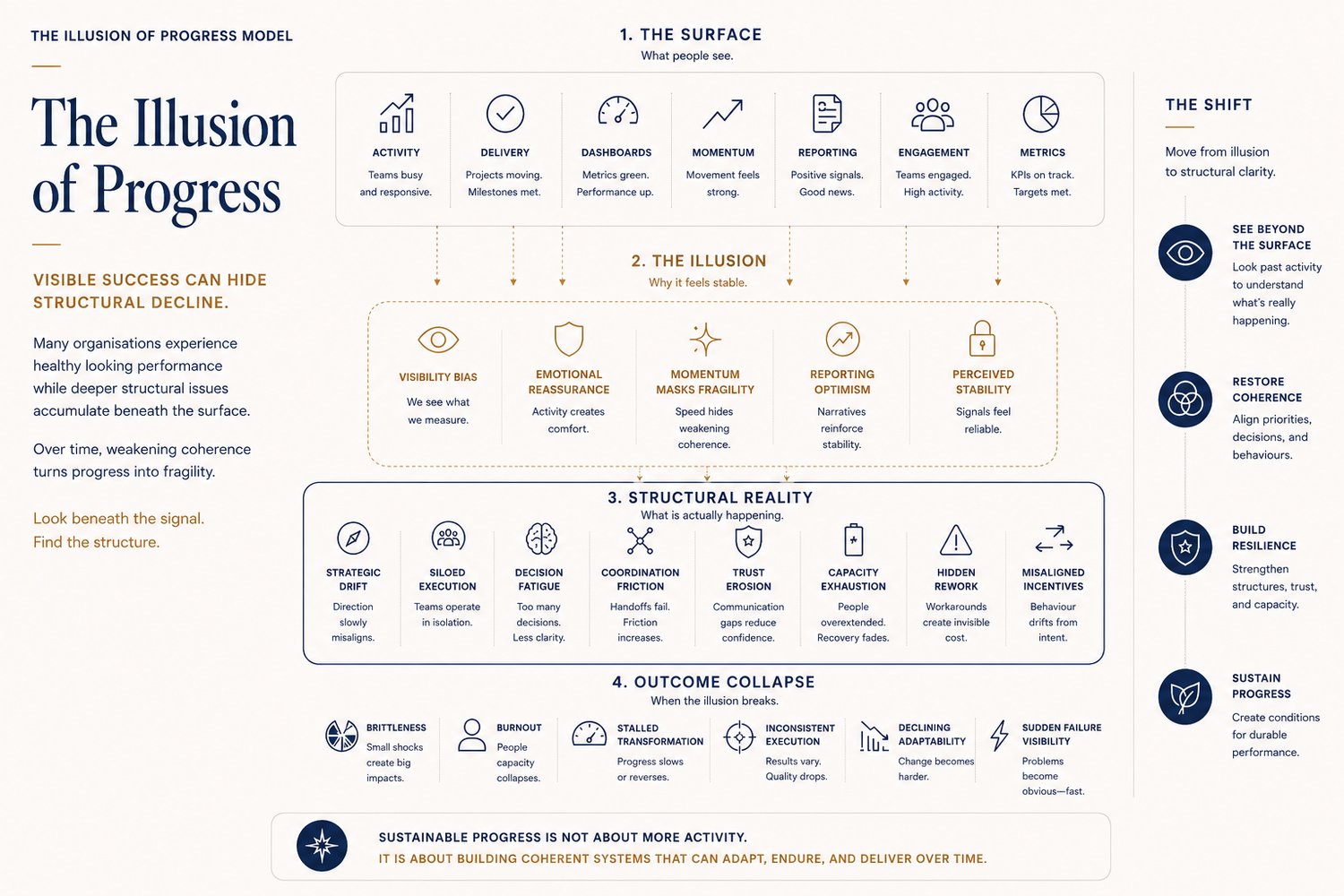
When Activity Is Mistaken for Stability
When Activity Is Mistaken for Stability
High activity often creates emotional reassurance.
Busy calendars, constant communication, accelerating delivery cycles, and increasing output create the feeling that the organisation is functioning well. Motion becomes psychologically persuasive. Visibility becomes interpreted as resilience.
But activity alone does not guarantee structural health.
Systems can move quickly while becoming increasingly fragmented internally. Teams can remain productive while coordination weakens. Delivery can continue while trust erodes. Metrics can improve while coherence deteriorates beneath execution.
The danger is not simply inefficiency.
The danger is delayed recognition.
Because when systems are highly active, structural weakening often becomes harder to detect.
The Hidden Cost of Fragmentation
Many organisational problems are not immediately visible through conventional reporting structures.
What leadership often sees:
- delivery progress
- operational movement
- healthy dashboards
- visible effort
- positive reporting indicators
What the system may actually be experiencing:
- strategic drift
- siloed execution
- decision fatigue
- coordination friction
- weakening trust
- capacity exhaustion
- hidden rework
- misaligned incentives
The system continues to move, but coherence begins to weaken.
And once coherence weakens, complexity compounds faster than performance indicators can reveal.
Why Metrics Alone Cannot Protect a System
Most organisations measure what is easiest to count.
Volume.
Speed.
Output.
Activity.
Compliance.
Short-term delivery.
But what sustains transformation over time is often less visible:
- alignment
- trust
- shared interpretation
- decision clarity
- coordination quality
- structural resilience
- adaptive capacity
These conditions are harder to quantify, yet they shape whether execution remains coherent under pressure.
Measurement systems do not merely observe organisations.
They shape behaviour.
What gets rewarded becomes reinforced.
What gets measured becomes protected.
What remains invisible becomes neglected.
Over time, systems begin optimising for what is visible rather than what is structurally necessary.
Momentum Is Not the Same as Health
Momentum can temporarily conceal structural exhaustion.
Many organisations sustain output through:
- overextension
- hidden dependency strain
- excessive coordination overhead
- psychological depletion
- fragmented decision-making
- accumulated operational debt
Performance continues.
Until recovery capacity disappears.
The problem is not that organisations move too quickly.
The problem is that movement without coherence eventually converts progress into fragility.
Sustainable systems require more than momentum.
They require renewal, alignment, and internal coherence strong enough to absorb pressure without fragmentation.
Sustainable Progress Requires Internal Alignment
Transformation is often approached as a delivery challenge.
But many transformation failures are fundamentally coherence failures.
Not failures of effort.
Not failures of activity.
Not failures of intention.
Failures of alignment.
Systems rarely collapse because people stop working.
They weaken because different parts of the organisation begin moving according to different interpretations of reality, priorities, incentives, and success.
Visible activity can continue for a surprisingly long time under these conditions.
Until the accumulated strain eventually becomes impossible to absorb.
Beyond the Illusion
The goal is not to eliminate metrics, momentum, or operational movement.
The goal is to see beyond them.
Healthy systems require more than visible performance indicators.
They require:
- coherent structures
- aligned priorities
- intentional measurement
- sustainable capacity
- decision clarity
- resilient coordination
- reinforcement systems aligned to long-term outcomes
Because sustainable transformation does not emerge from motion alone.
It emerges from systems capable of remaining coherent while they evolve.
Part of the Transformation Failure Dynamics Series from LUCID Methods.
Explore more frameworks, diagnostic perspectives, and systems-thinking insights through the LUCID Method — developed to help organisations build clarity, coherence, and transformation that holds over time.