

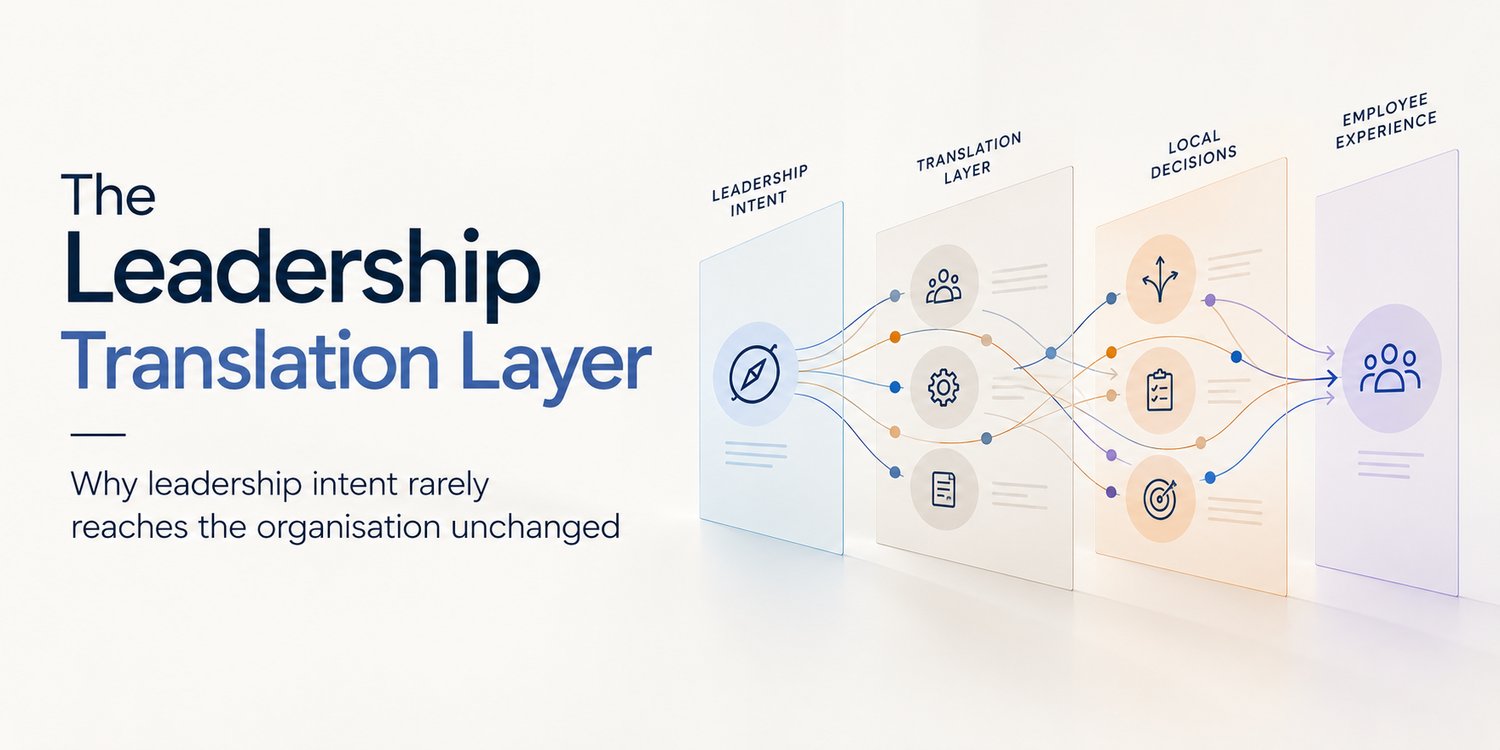
The Leadership Translation Layer
Why leadership intent rarely reaches the organisation unchanged
Senior leaders often believe they have communicated clearly.
The strategy has been presented.
The priorities have been announced.
The values have been articulated.
The expectations have been stated.
Yet several layers down the organisation, people may be acting on something quite different.
Not because they ignored the message.
Because between what leadership intends and what employees experience sits a largely invisible organisational mechanism:
the leadership translation layer.
This layer consists of the managers, systems, decisions, incentives, processes, and everyday interactions through which leadership intent acquires practical meaning.
It is where strategy becomes priorities.
Where values become behavioural expectations.
Where broad direction becomes local decisions.
And where leadership language is either reinforced, reinterpreted, diluted—or contradicted.
Understanding this layer matters because organisations do not operate on leadership intent alone.
They operate on translated intent.
Leadership Intent Does Not Travel Directly
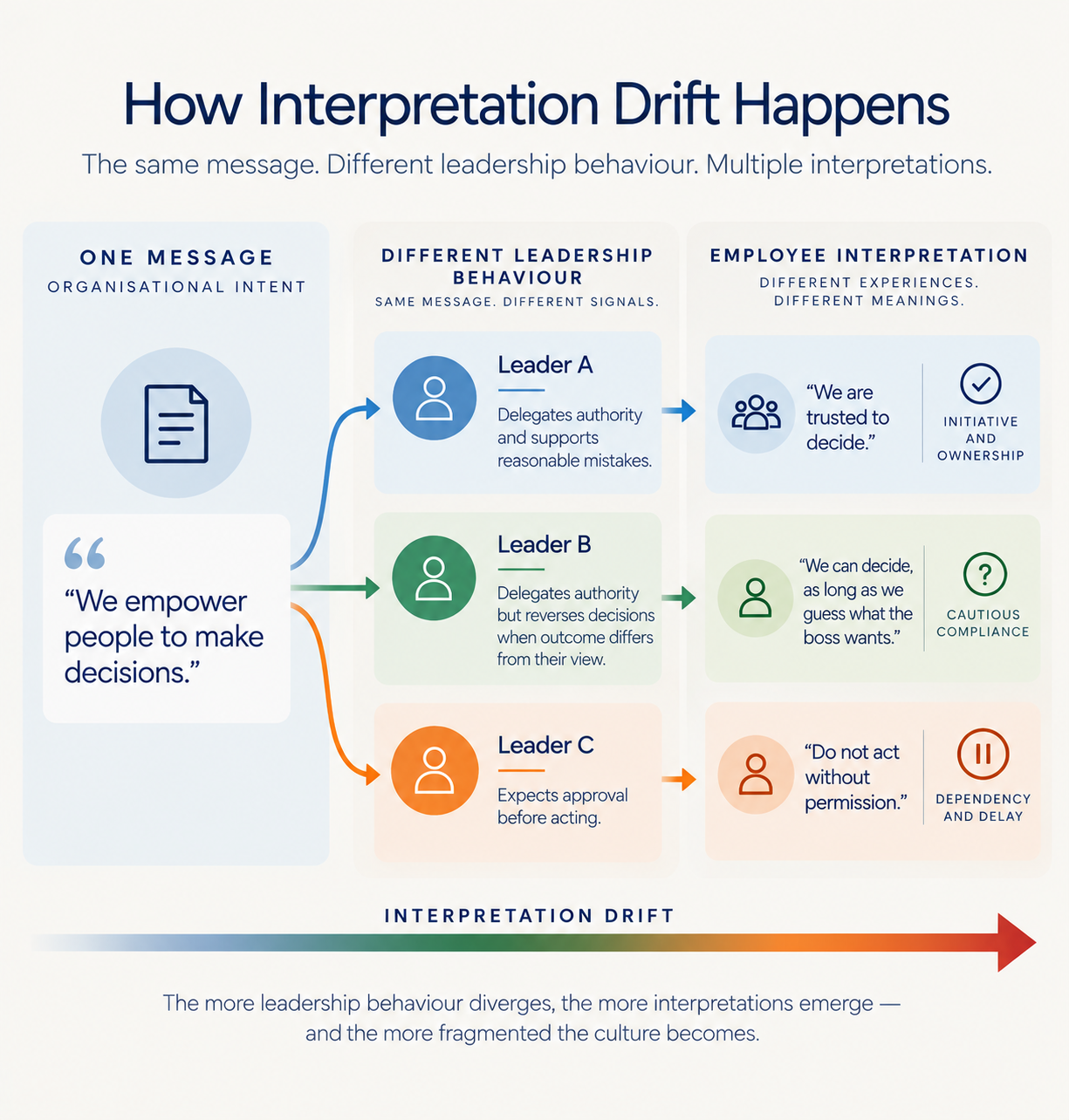
Consider a leadership team that says:
“We want people to take greater ownership.”
At the executive level, the intention may be clear.
But what does ownership mean operationally?
One manager may interpret it as:
Make decisions without waiting for approval.
Another may interpret it as:
Take responsibility, but check with me before changing anything.
Another may interpret it as:
Deliver the result regardless of the obstacles.
And another:
If something goes wrong, you are accountable for it.
The same leadership message has now produced four different working realities.
Nothing necessarily went wrong during communication.
The problem occurred during translation.
Broad organisational language inevitably encounters local context.
Someone must decide what the message means for budgets, deadlines, approvals, priorities, performance expectations, risk and everyday behaviour.
That interpretation becomes the organisation employees actually experience.
Every Organisation Has a Translation Layer
The leadership translation layer is not a formal department.
It exists wherever organisational intent must be converted into action.
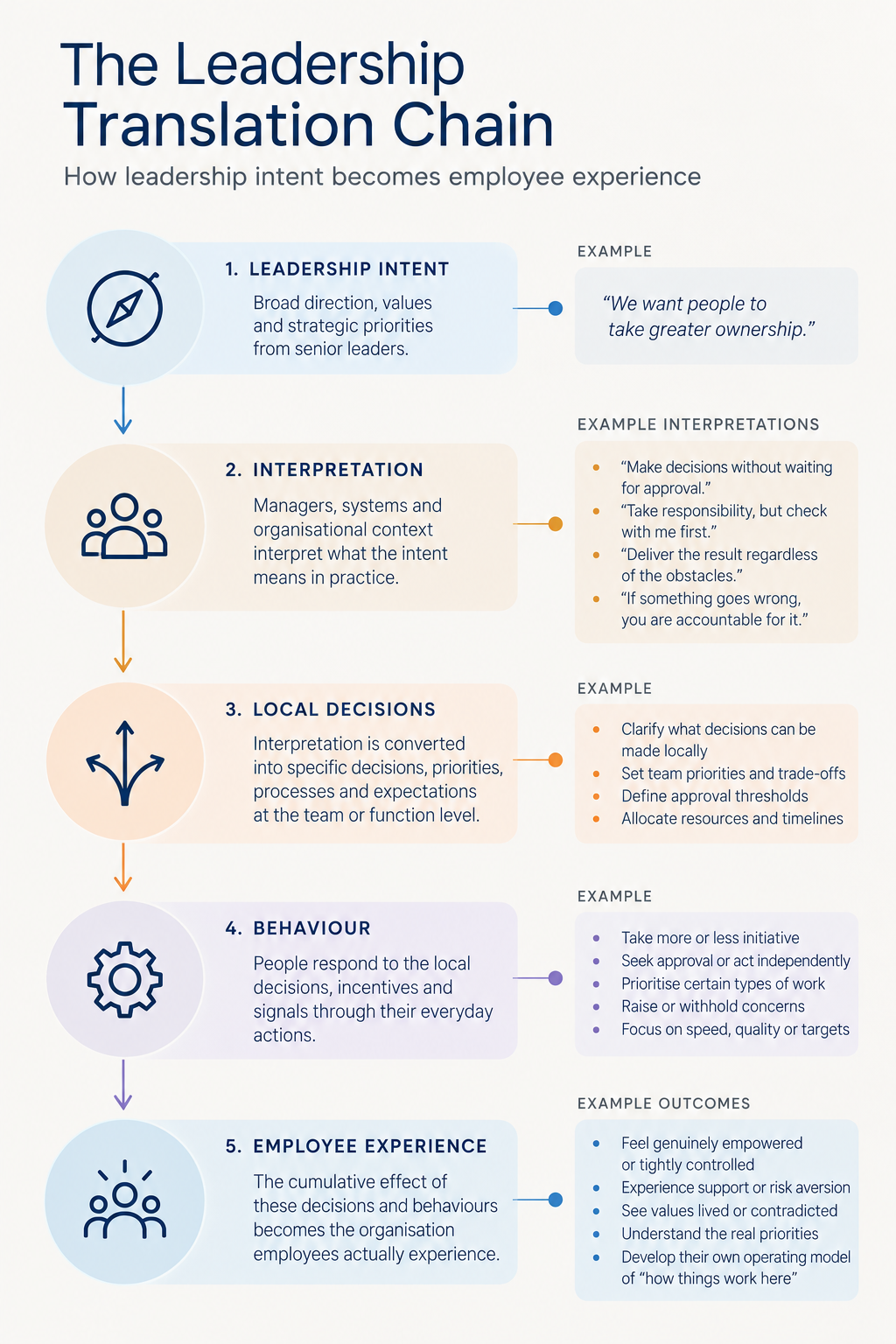
A simple way to think about it is:
Leadership Intent
→ Interpretation
→ Local Decisions
→ Behaviour
→ Employee Experience
Leadership may define the first element.
But the organisation lives largely in the remaining four.
This is why a beautifully articulated strategy can produce fragmented execution.
It is why carefully written values can coexist with behaviours that contradict them.
And it is why employees sometimes appear to misunderstand leadership when they may actually be responding rationally to the version of leadership they encounter locally.
The translation layer determines what abstract leadership language means here, today, in this situation.
Middle Managers Are Often the Human Translation Layer
Middle managers occupy one of the most difficult positions in an organisation.
They receive broad direction from above while managing operational realities below.
Leadership says:
Move faster.
The manager must decide what can be skipped, simplified or prioritised.
Leadership says:
Empower the team.
The manager must decide which decisions employees can actually make.
Leadership says:
Customer first.
The manager must decide what happens when customer needs conflict with cost targets.
Leadership says:
Speak up.
The manager determines what happens when someone actually does.
This is why middle managers should not be treated merely as communication channels.
They are interpreters of organisational intent.
And interpretation involves judgement.
When that judgement is unsupported, inconsistent or constrained by conflicting systems, translation becomes unstable.
Translation Happens Through Systems Too
Managers are only part of the translation layer.
Organisations also translate leadership intent through their systems.
Suppose leadership says:
“Quality matters more than speed.”
But performance dashboards primarily measure turnaround time.
Bonuses reward volume.
Managers are questioned when targets are missed.
Projects are celebrated for finishing early.
Employees quickly learn what the organisation actually means.
The formal message says:
Quality matters.
The organisational system translates it into:
Quality matters—as long as it does not slow us down.
That translation may never appear in a policy document.
It does not need to.
People infer priorities from consequences.
This is why organisational systems often communicate more powerfully than leadership speeches.
The Translation Layer Is Where Culture Becomes Real
Culture is often discussed as though it flows directly from senior leadership.
Leadership certainly shapes culture.
But culture becomes tangible through repeated local interpretation.
Employees encounter culture through questions such as:
What happens when I make a mistake?
What happens when I disagree with my manager?
Which deadlines are genuinely negotiable?
Who gets promoted?
What behaviour gets overlooked?
When two priorities conflict, which one wins?
Can I challenge a decision without damaging my reputation?
The answers rarely come from the values statement.
They come from experience.
Every decision provides another piece of evidence about how the organisation works.
Over time, employees construct their own operating model:
“This is what they really mean.”
That operating model may be more influential than anything leadership formally communicates.
When Translation Layers Become Distorted
Translation problems rarely begin with deliberate sabotage.
More often, they emerge from ambiguity.
Senior leaders communicate direction at a level appropriate for enterprise leadership:
Be agile.
Take ownership.
Collaborate more.
Be customer-centric.
Challenge constructively.
These statements may express legitimate strategic intentions.
But they leave considerable room for interpretation.
Managers then fill the gaps using their own assumptions, incentives, experience, pressures and leadership styles.
The result can be translation variance.
One department becomes highly autonomous.
Another becomes tightly controlled.
One manager welcomes challenge.
Another interprets challenge as resistance.
One team experiments.
Another avoids risk.
Eventually employees working under the same corporate values may experience substantially different organisations.
The problem is no longer simply communication.
It is interpretive fragmentation.
Translation Debt Accumulates
Poor translation can also accumulate over time.
A vague instruction is interpreted locally.
That interpretation becomes a working practice.
The practice becomes normal.
New employees learn it from existing employees.
Managers inherit it from previous managers.
Eventually nobody remembers why the practice exists.
The organisation has accumulated translation debt: layers of assumptions, workarounds and local interpretations that increasingly separate current behaviour from original intent.
This helps explain a familiar organisational puzzle.
Leadership asks:
“Why are people doing this?”
Employees answer:
“Because that is how things work here.”
Both may be correct.
Leadership is looking at intent.
Employees are looking at accumulated reality.
The Dangerous Assumption: “We Communicated It”
Organisations frequently treat communication as evidence of understanding.
The town hall happened.
The email was sent.
The slide deck was distributed.
Managers were briefed.
Therefore, the organisation has been informed.
But transmission is not translation.
A message can reach every employee and still produce different interpretations.
The more abstract the message, the greater the interpretive space.
The greater the interpretive space, the more important the translation layer becomes.
Leadership communication therefore should not end with:
“Have we told people?”
A better question is:
“What will people reasonably conclude from what we have told them—and from what they see us doing?”
That is a much harder question.
It is also a much more useful one.
Strong Translation Requires Decision Clarity
One way to strengthen the translation layer is to move beyond slogans and clarify decision implications.
If leadership says:
“We want greater empowerment,”
employees and managers need to understand:
What decisions can now be made locally?
Which decisions still require approval?
What level of risk is acceptable?
What happens when someone makes a reasonable decision that produces a poor outcome?
Without this clarity, empowerment remains conceptual.
Similarly, if leadership says:
“Psychological safety matters,”
the organisation must translate that into observable behaviour.
How should managers respond when challenged?
How are dissenting views handled?
What happens when bad news is raised?
Can employees question unrealistic timelines?
Values become useful when people can recognise what those values look like in decisions.
Managers Need Translation Capability, Not Just Communication Skills
Organisations invest heavily in teaching managers how to communicate.
Presentation skills.
Coaching conversations.
Feedback techniques.
Stakeholder communication.
These are valuable.
But managers also need the ability to translate organisational intent coherently.
That requires different questions:
What is leadership actually trying to achieve?
What trade-offs are implied?
What behaviour should change?
What should remain unchanged?
Where do I have discretion?
Where do I need clarification?
What contradictions will my team notice?
What might employees reasonably infer from this decision?
These questions turn managers from message distributors into organisational interpreters.
That is a more demanding role.
It is also closer to what effective management actually requires.
Leaders Must Inspect the Translation, Not Just the Message
Senior leaders cannot assume that because their intention was clear to them, its organisational meaning is equally clear elsewhere.
They need feedback loops.
Not simply:
“Did managers communicate the strategy?”
But:
“How are managers explaining it?”
“What decisions are they making because of it?”
“What trade-offs do they believe we expect?”
“What are employees hearing?”
“Where are different parts of the organisation interpreting the same message differently?”
These questions reveal the state of the translation layer.
And sometimes the answers will be uncomfortable.
They may expose contradictions between what leaders intended and what organisational systems reward.
They may reveal that managers are improvising because leadership has left important questions unresolved.
They may show that employees are not resisting the strategy at all.
They are responding logically to the version of the strategy that reached them.
Translation Is a Two-Way Process
There is another dimension that is easily overlooked.
The translation layer does not only move information downward.
It also translates reality upward.
Employees experience operational problems, customer frustrations, process failures and unintended consequences.
Managers decide what gets escalated, how it is framed and how much context accompanies it.
By the time information reaches senior leadership, reality has also been translated.
Sometimes carefully.
Sometimes selectively.
Sometimes optimistically.
Sometimes not at all.
A healthy leadership translation layer therefore performs two functions:
Intent travels downward with clarity.
Reality travels upward with fidelity.
If either direction becomes distorted,
leadership loses coherence.
When downward translation fails, employees do not understand what leadership intends.
When upward translation fails, leaders do not understand what the organisation is experiencing.
Both create decision risk.
The Goal Is Not Perfect Uniformity
Translation does not mean every manager must behave identically.
Different teams operate in different contexts.
Local judgement matters.
A customer service team, finance department and product development team may need to apply the same organisational principle differently.
The objective is not identical behaviour.
It is coherent interpretation.
Local decisions can differ while remaining anchored to the same underlying intent.
That is the distinction between alignment and standardisation.
Strong organisations allow contextual flexibility without allowing fundamental meaning to drift.
Leadership Lives in the Translation
Leadership intent matters.
But intent alone does not create organisational reality.
Between the executive meeting and the employee experience sits a complex translation layer made up of managers, systems, incentives, decisions and repeated behaviour.
That layer determines whether:
strategy becomes coordinated action,
values become credible expectations,
empowerment becomes genuine discretion, psychological safety becomes lived experience, and leadership promises become organisational reality.
So when behaviour across an organisation appears inconsistent with leadership intent, the first question should not always be:
“Why aren't people following the message?”
Sometimes the more revealing question is:
“What did the organisation translate the message into?”
Because leadership is not experienced exactly as it is intended.
It is experienced as it is translated.
And the quality of that translation may determine whether clarity becomes capability—or confusion becomes culture.
Part of the Leadership & Culture Series from LUCID Methods.
Explore more frameworks, diagnostic perspectives, and systems-thinking insights through the LUCID Method — developed to help organisations build clarity, coherence, and transformation that holds over time.