

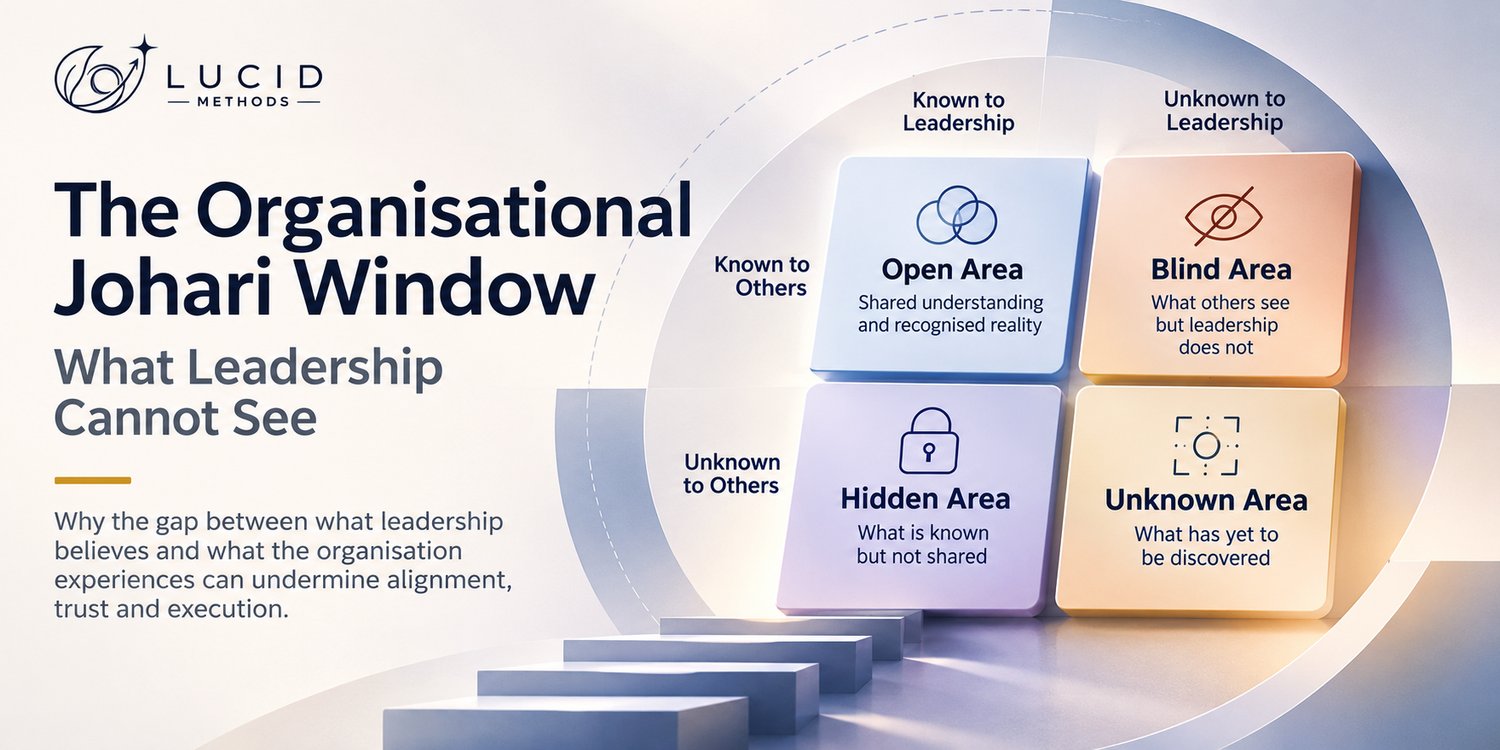
The Organisational Johari Window: What Leadership Cannot See
Why the gap between what leadership believes and what the organisation experiences can undermine alignment, trust, and execution.
When an Organisation Does Not Know Itself
An organisation may believe it has an open culture.
Employees may experience something different.
Leadership may believe decisions are decentralised,
while managers continue seeking informal approval before taking action.
Departments may report strong performance against their respective KPIs, yet the organisation continues to struggle with delays, competing priorities, and poor coordination.
These contradictions do not necessarily indicate dishonesty or incompetence.
They may reveal something more fundamental.
The organisation does not share a common understanding of itself.
What leadership believes, what employees experience, and what customers observe may represent different interpretations of the same organisation.
The information may already exist.
The problem is that it remains distributed across people, departments, and management levels without becoming shared understanding.
The Johari Window, originally developed to explore interpersonal awareness, offers a useful lens for examining these differences.
When adapted to an organisational context, it can help reveal
what is collectively understood,
what leadership fails to recognise,
what remains concealed, and what the organisation has yet to discover.
The deeper question is not simply what an organisation knows.
It is whether the organisation has the capability to recognise, interpret, and act upon what it needs to know.
1. The Johari Window Beyond the Individual
Developed by psychologists Joseph Luft and Harrington Ingham in 1955, the Johari Window describes four areas of awareness based on what individuals know about themselves and what others know about them.
These are:
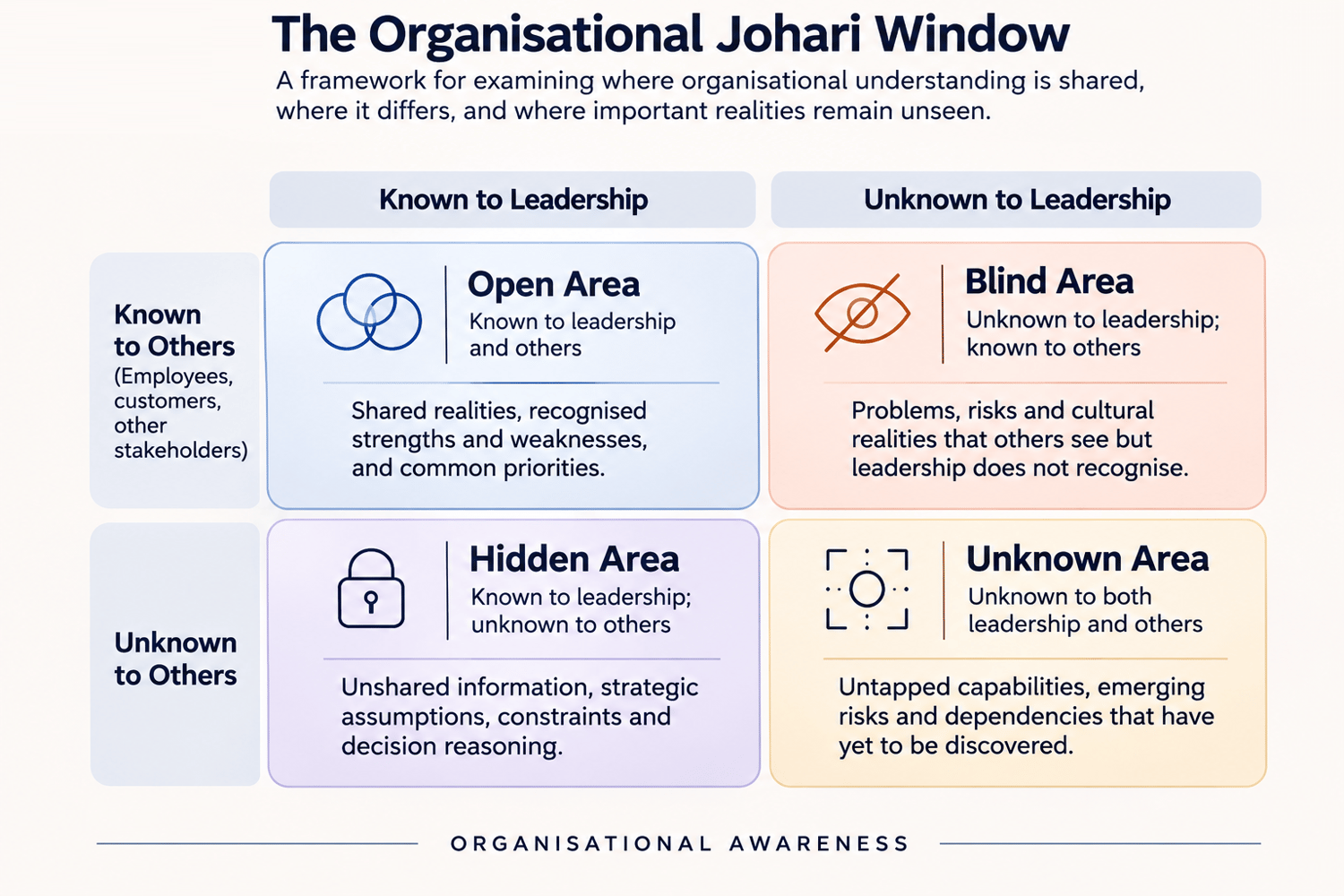
- Open Area: Known to oneself and known to others.
- Blind Area: Unknown to oneself but known to others.
- Hidden Area: Known to oneself but unknown to others.
- Unknown Area: Unknown to oneself and unknown to others.
At the individual level, the framework examines how feedback, disclosure, and interaction influence self-awareness.
At the organisational level, its application requires an important distinction.
An organisation does not possess a single consciousness or a unified body of knowledge.
Leadership, middle management, operational teams, customers, and other stakeholders may each understand different aspects of organisational reality.
What is obvious to one group may be invisible to another.
The Johari Window can therefore be adapted to compare the awareness of a defined organisational group, such as senior leadership, with that of other stakeholders.
This adaptation does not measure organisational awareness in the same way that an individual might assess personal self-awareness.
Instead, it provides a structured way to examine
where knowledge exists,
where understanding differs,
and where information fails to reach the people who need it.
These distinctions matter because organisational decisions are rarely made with complete information.
They depend on what decision-makers can see, what they believe, and how they interpret the information available to them.
2. Four Areas of Organisational Awareness
The Open Area: What the Organisation Understands Together
The Open Area represents realities recognised by both leadership and the stakeholders being considered.
These may include shared strategic priorities, acknowledged operational constraints, recognised performance problems, and commonly understood responsibilities.
Consider an organisation experiencing long customer service turnaround times.
Leadership recognises the problem.
Operational teams understand the causes.
Performance data supports their observations.
Although different stakeholders may disagree on the best solution, they are working from a sufficiently shared understanding of the issue.
This provides a foundation for coordinated action.
The value of the Open Area is not that everyone agrees.
It is that disagreement can occur within a shared understanding of reality.
When organisations lack this foundation, discussions become difficult to resolve.
Different departments may debate solutions while operating from incompatible assumptions about the problem itself.
Expanding the Open Area therefore strengthens organisational coherence by making relevant knowledge and interpretations available for collective examination.
However, openness does not require unrestricted information sharing.
Confidentiality, privacy, and legitimate strategic considerations remain important.
The objective is not for everyone to know everything, but for relevant knowledge to reach those responsible for decisions and execution.
The Blind Area: What Others See but Leadership Does Not
The Blind Area represents conditions recognised by employees, customers, or other stakeholders but not understood or acknowledged by leadership.
This is often where the greatest organisational risks develop.
Consider a company that regularly promotes its open-door policy.
Leadership conducts town halls, encourages feedback, and communicates its commitment to transparency.
Yet employees have learned that raising concerns may lead to questions about who is responsible rather than what needs to be resolved.
Over time, they become more selective about what they report.
Difficult information is softened.
Risks are escalated later.
Problems are discussed privately rather than through formal channels.
Leadership subsequently observes fewer complaints and concludes that employee confidence has improved.
Employees, however, may simply have learned that silence is safer.
The organisation appears aligned because contradictory information is no longer visible.
This is not necessarily a failure of communication channels.
The channels may exist and function exactly as designed.
The problem lies in the organisational conditions governing their use.
Several mechanisms can sustain these blind spots:
- Hierarchical filtering: Information is progressively simplified or softened as it moves upward.
- Performance incentives: Managers avoid reporting information that may threaten targets or reputations.
- Cultural expectations: Employees learn which concerns are acceptable and which are best left unspoken.
- Leadership assumptions: Decision-makers interpret evidence through established beliefs about the organisation.
- Defensive responses: Challenges are treated as criticism or threats to authority rather than opportunities for correction.
These mechanisms can reinforce one another.
As contradictory information becomes less visible, leadership may become increasingly confident in its understanding.
The absence of negative feedback can become mistaken for evidence that nothing is wrong.
This creates a dangerous form of organisational blindness.
The organisation is not merely unaware of certain problems.
Its own structures and behaviours may be preventing those problems from becoming visible.
The Hidden Area: What Is Known but Not Shared
The Hidden Area represents information known to one organisational group but unavailable to other relevant stakeholders.
For example, senior leadership may recognise that financial constraints will require difficult trade-offs.
However, departments continue receiving ambitious growth targets without sufficient explanation of those constraints.
Operational teams develop plans based on assumptions that leadership already knows are unrealistic.
When priorities change, employees perceive inconsistency.
Leadership may interpret their reactions as resistance.
Both are responding to different information.
The problem is not necessarily that the decision was wrong.
It is that the reasoning behind the decision was not sufficiently shared.
The Hidden Area may include strategic assumptions, unresolved conflicts, financial constraints, operational risks, and informal decision-making arrangements.
Not all hidden information is problematic.
Organisations have legitimate reasons to restrict access to certain information.
The distinction is between necessary confidentiality and information asymmetry that undermines coordination.
When people lack the context required to understand decisions, they construct their own explanations.
Different departments may consequently develop different interpretations of organisational priorities.
Over time, these interpretations influence behaviour, trust, and execution.
An organisation can communicate frequently while still leaving critical knowledge hidden.
Transparency is not measured by how much information is distributed, but by whether people have sufficient context to interpret and act appropriately.
The Unknown Area: What Has Yet to Be Discovered
The Unknown Area represents realities not yet recognised by either of the groups being examined.
These may include emerging risks, untapped capabilities, undocumented dependencies, or cultural behaviours that have not been tested under pressure.
An organisation may believe its operations are resilient because performance targets are consistently achieved.
Only when a long-serving employee leaves does management discover that several critical processes depended on undocumented knowledge and informal relationships.
The organisation had appeared stable.
Its underlying dependency remained unknown.
Similarly, a major disruption may reveal employees capable of exercising leadership well beyond their formal responsibilities.
The Unknown Area therefore contains both vulnerabilities and opportunities.
Unlike the Blind or Hidden Areas, these realities cannot always be uncovered through feedback or disclosure.
They may require experimentation, scenario testing, cross-functional exposure, and deliberate examination of assumptions.
An organisation cannot discover everything it does not know by asking only the questions it already knows to ask.
This is why organisational learning must extend beyond routine reporting.
Performance measurement reveals how an organisation operates against established expectations.
Exploration reveals whether those expectations adequately describe the system.
3. How Organisational Blind Spots Are Created
Organisational blind spots are often attributed to individual leaders.
A leader may be described as disconnected, unwilling to listen, or unaware of operational realities.
These explanations may sometimes be valid.
However, they overlook a more important possibility.
The organisation may be systematically producing the information gaps that leadership experiences.
Consider a project team that identifies a risk to delivery.
An employee raises the issue early, expecting the discussion to focus on resolving the underlying dependency.
Instead, management asks who is responsible for the potential delay.
The employee becomes the focus of scrutiny.
The immediate problem may eventually be resolved, but the experience changes how future concerns are reported.
Other employees observe the consequences.
The next risk is raised more cautiously.
Another is escalated only when unavoidable.
Eventually, management complains that employees are not sufficiently proactive.
Additional reporting requirements are introduced.
Yet the underlying conditions remain unchanged.
The organisation has increased reporting activity without improving the conditions for honest reporting.
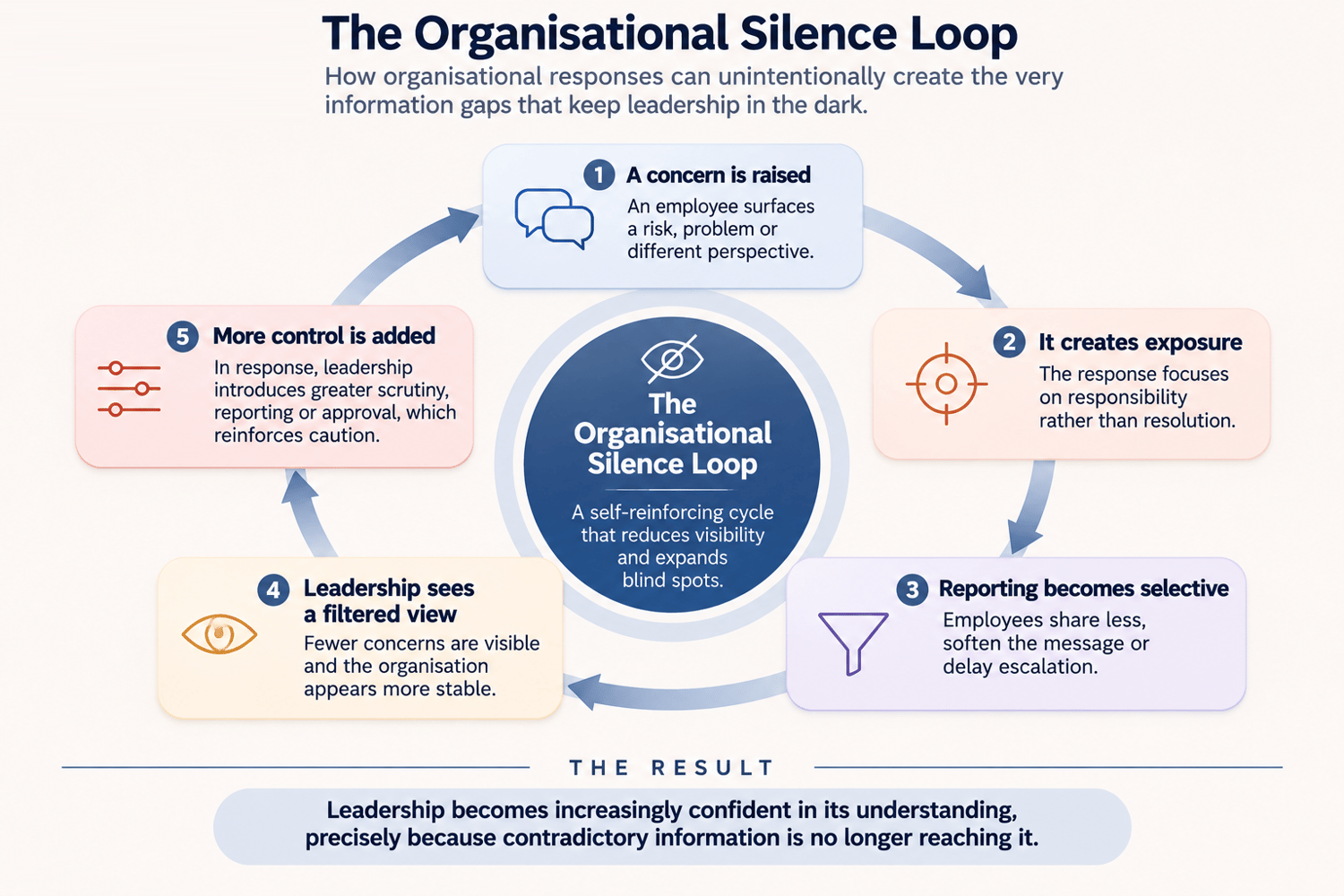
The resulting cycle is self-reinforcing:
- An employee identifies a concern.
- Raising the concern creates personal exposure.
- Employees become more selective about disclosure.
- Leadership receives increasingly filtered information.
- Problems become visible later.
- Leadership responds with greater control and scrutiny.
Each response strengthens the conditions that created the original problem.
The critical issue is not whether employees understand their responsibility to report risks.
It is whether the system makes reporting those risks a reasonable and constructive action.
When speaking up carries greater personal risk than remaining silent, information distortion becomes a predictable organisational outcome.
This is how leadership blind spots can become embedded in organisational structures rather than remaining isolated failures of awareness.
4. When Silence Is Mistaken for Alignment
One of the most common consequences of organisational blindness is the misinterpretation of agreement.
A strategy is presented.
Department heads express support.
Implementation plans are approved.
No significant objections are raised.
Leadership concludes that the organisation is aligned.
Yet agreement at the point of communication does not establish alignment in interpretation or execution.
One department may interpret the strategy as a requirement to reduce costs.
Another may prioritise service quality.
A third may focus on meeting delivery milestones.
Each believes it is supporting the same organisational direction.
Each subsequently makes decisions consistent with its own interpretation.
The resulting conflict appears during execution rather than during strategic discussion.
This is where the Johari Window becomes particularly useful.
Leadership's Blind Area may contain reservations and competing interpretations known to operational teams.
The Hidden Area may contain strategic assumptions that leadership did not communicate.
The Unknown Area may contain cross-functional dependencies that were never examined.
The Open Area may be limited to agreement on strategic language rather than its operational implications.
The organisation therefore shares a strategy without necessarily sharing its meaning.
Agreement establishes that people have accepted a direction. Alignment requires that they understand how that direction should influence their decisions.
An organisation cannot assume coherence merely because its employees use the same terminology or its departments report commitment to common objectives.
Coherence must be demonstrated through the consistency of decisions, priorities, and behaviour across organisational boundaries.
5. Why More Information Does Not Necessarily Improve Awareness
Organisations increasingly rely on dashboards, performance indicators, engagement surveys, risk registers, and reporting systems to understand their operations.
These tools provide valuable information.
However, information availability should not be confused with organisational awareness.
A dashboard may show improving productivity while employees compensate through unsustainable workloads.
A project report may indicate that milestones remain on schedule while unresolved dependencies accumulate.
An engagement survey may show favourable results while employees remain reluctant to express criticism.
The measurements may be accurate.
The problem is that they represent only the conditions they were designed to observe.
When leadership treats these measurements as a complete representation of organisational reality, the reporting system can reinforce existing assumptions.
This becomes particularly problematic when performance incentives encourage employees to optimise the measures rather than the outcomes those measures were intended to represent.
Departments may meet their KPIs while transferring costs, delays, or operational burdens to other functions.
Individual results appear successful.
The wider organisational outcome deteriorates.
From a Johari perspective, the Blind Area may contain consequences that the formal measurement system does not capture.
The Hidden Area may contain concerns recognised locally but excluded from management reporting.
The Unknown Area may contain dependencies that existing metrics were never designed to reveal.
More data does not automatically reduce these gaps.
It may simply provide more detailed evidence of what the organisation has already chosen to measure.
Measurement improves awareness only when the organisation is willing to question whether its indicators reflect the realities that matter.
The challenge is therefore not simply collecting information.
It is connecting evidence, experience, and organisational outcomes into a sufficiently coherent interpretation.
6. Using the Johari Window as an Organisational Diagnostic
The organisational Johari Window is most useful when applied to a defined issue rather than attempting to classify an entire organisation.
For example, leadership may examine its understanding of employee empowerment, project delivery, customer experience, or cross-functional decision-making.
The first step is to establish whose awareness is being compared.
The second is to identify where information and interpretations converge or differ.
Four diagnostic questions can guide the examination.
1. Open Area — Shared Understanding
Diagnostic Question: What do leadership and relevant stakeholders recognise and understand in common?
What It May Reveal: Shared priorities, acknowledged constraints, and common interpretations.
2. Blind Area — Leadership Blind Spots
Diagnostic Question: What do stakeholders experience or observe that leadership does not recognise?
What It May Reveal: Perception gaps, filtered feedback, and unacknowledged organisational problems.
3. Hidden Area — Information Asymmetry
Diagnostic Question: What does one group know that other relevant groups need but cannot access?
What It May Reveal: Information asymmetry, siloed knowledge, and unexplained decisions.
4. Unknown Area — Undiscovered Realities
Diagnostic Question: What assumptions, dependencies, risks, or capabilities remain untested?
What It May Reveal: Emerging vulnerabilities, hidden dependencies, and unrealised potential.
The purpose is not to produce four lists and declare the exercise complete.
It is to examine why those gaps exist.
For example, when employees report that decision-making is slower than leadership believes, the question is not simply whether leadership has received sufficient feedback.
The organisation should also examine:
- Where decisions are actually made.
- Which approvals are formally required and which occur informally.
- What incentives discourage independent judgement.
- How responsibilities and decision authority are distributed.
- Whether the consequences of escalation differ from the organisation's stated expectations.
These questions shift the diagnostic from perception to mechanism.
They help distinguish an isolated misunderstanding from a recurring organisational condition.
This distinction is essential because awareness of a problem does not explain what produces it.
Without understanding the mechanism, organisations risk addressing visible symptoms while leaving their underlying causes intact.
7. From Organisational Awareness to Coherence
The traditional Johari Window encourages expansion of the Open Area through feedback and appropriate disclosure.
Applied organisationally, this is a useful direction but not a sufficient outcome.
An organisation may become aware that employees fear speaking up while continuing to reward managers who suppress unfavourable information.
Leadership may recognise that decision rights are unclear without changing the structures that create ambiguity.
Departments may acknowledge competing priorities while continuing to optimise their individual performance measures.
In each case, the issue is visible.
Yet the organisation continues producing the same behaviour.
Shared awareness is a foundation for organisational coherence. It is not coherence itself.
Moving from awareness to coherent action requires several connected capabilities.
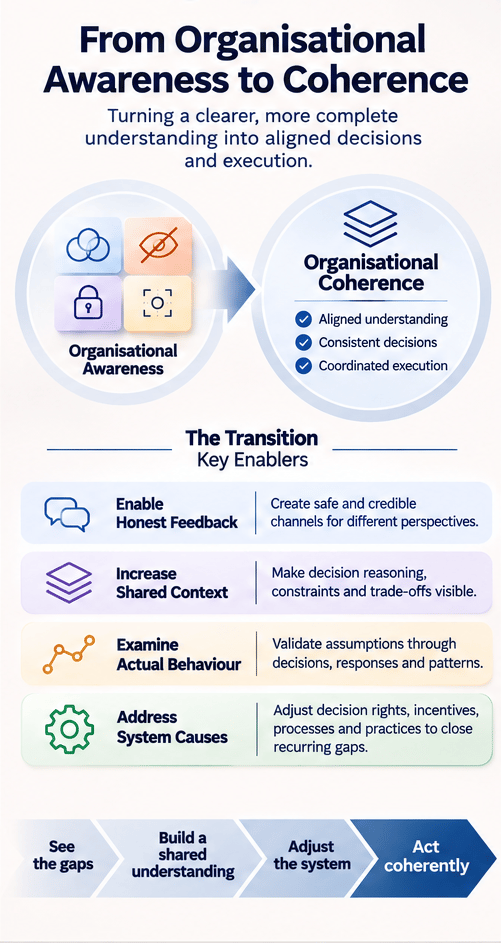
Make Feedback Safe and Consequential
Employees need credible opportunities to challenge assumptions and report problems.
However, psychological safety alone is insufficient if feedback produces no meaningful response.
The organisation must demonstrate that concerns can influence decisions and corrective action.
Accountability should support learning and resolution rather than discourage disclosure.
Make Decision Reasoning Visible
Communication should provide sufficient context for people to understand priorities, constraints, and trade-offs.
This enables departments to interpret organisational intentions more consistently.
It also reduces the need for employees to construct explanations from incomplete information.
Examine Behaviour Rather Than Relying on Declarations
Organisational culture is revealed through recurring decisions and responses.
What happens when someone challenges a senior manager?
How are cross-functional disagreements resolved?
Which behaviours are rewarded under performance pressure?
What happens when a department's KPI conflicts with the wider organisational outcome?
These questions reveal how the organisation actually functions.
Translate Understanding into Structural Change
Where recurring gaps are identified, the organisation must examine the systems sustaining them.
This may require changes to decision rights, reporting relationships, performance measures, escalation mechanisms, or management practices.
Without such changes, greater awareness may simply produce more detailed descriptions of existing dysfunction.
The aim is not merely to make organisational problems visible.
It is to develop the capability to respond to them coherently.
8. The Leadership Challenge: Seeing Beyond One's Own Perspective
Leadership occupies a particular position within the organisational information system.
It has access to strategic information that many employees do not possess.
At the same time, it is removed from operational experiences that frontline employees encounter daily.
Neither perspective is complete.
Leadership may understand strategic constraints while misunderstanding their operational consequences.
Employees may understand operational problems while lacking visibility into the broader trade-offs shaping leadership decisions.
The challenge is not to determine which group possesses the correct version of reality.
It is to establish how these partial perspectives can inform one another.
This requires leaders to distinguish between three things:
What they know.
What they believe.
What the organisation has actually demonstrated.
These are not always the same.
A leader may believe employees are empowered because authority has formally been delegated.
Yet actual behaviour may demonstrate that decisions still depend on informal approval.
The formal structure describes what should happen.
The lived experience reveals what does happen.
Organisational awareness requires examining the difference without automatically treating either perspective as complete.
It also requires accepting that some of the most useful information may challenge leadership's established understanding.
The objective is not to eliminate uncertainty.
It is to create an organisation capable of recognising uncertainty, questioning assumptions, and adjusting its understanding as new evidence emerges.
Conclusion: The Organisation Leadership Sees Is Not Always the Organisation That Exists
Every organisation operates with an incomplete understanding of itself.
Some realities are widely recognised.
Others are visible only to particular groups.
Some information remains concealed by organisational boundaries, confidentiality, or fear of consequences.
Other realities remain undiscovered because existing assumptions and measurements do not expose them.
The Organisational Johari Window offers a structured way to examine these gaps.
Its value, however, extends beyond identifying what is known and unknown.
It draws attention to the conditions that determine whether knowledge can move across organisational boundaries and become shared understanding.
An organisation does not become more coherent simply by collecting more feedback, producing more reports, or communicating more frequently.
It becomes more coherent when differing perspectives can be examined, important contradictions can be acknowledged, and shared understanding can influence decisions and behaviour.
The objective is not an organisation in which everyone knows everything.
It is an organisation in which the right information reaches the right people, assumptions can be challenged, and understanding can be translated into coherent action.
Because the greatest organisational blind spot may not be what leadership cannot see.
It may be what the organisation has learned not to show them.
Part of the Leadership & Culture Series from LUCID Methods.
Explore more frameworks, diagnostic perspectives, and systems-thinking insights through the LUCID Method — developed to help organisations build clarity, coherence, and transformation that holds over time.