

Trust Before Strategy: The Hidden Cost of Inconsistent Leadership
Most organisations do not lack strategy.
They have plans.
They have priorities.
They have transformation programmes, leadership retreats, performance measures and carefully prepared presentations explaining where the organisation needs to go.
Yet execution still weakens.
Decisions slow down.
Information becomes filtered.
Teams protect themselves.
Employees wait for confirmation before acting.
Leaders may see these behaviours as resistance, disengagement or a lack of accountability.
But something more fundamental may be happening.
People may understand the strategy.
They may simply not trust the leadership system responsible for carrying it.
Strategy tells people where the organisation wants to go.
Trust determines whether they are willing to move.
Trust Is Built Through Repeated Experience
Trust is often discussed as a relationship between individuals.
An employee trusts a manager because the manager is honest, fair or supportive.
That matters.
But organisational trust is not created by one good manager.
It is created when leadership behaviour remains sufficiently coherent across people, decisions and situations.
Employees observe what happens when targets are missed.
They observe how leaders respond when uncomfortable information surfaces.
They notice whether similar mistakes receive similar consequences.
They notice whether senior employees are held to the same standards as everyone else.
They notice whether leaders continue to uphold stated values when doing so becomes inconvenient.
Trust develops through these repeated observations.
Not through what the organisation promises.
Through what the organisation consistently does.
A leader may speak sincerely about openness.
But if another leader punishes disagreement, employees learn that openness depends on who is in the room.
A company may promote collaboration.
But if recognition goes only to individual visibility, employees learn to protect their contributions.
An organisation may encourage experimentation.
But if every unsuccessful attempt becomes a career risk, employees learn to wait for instructions.
The formal message may remain unchanged.
The lived lesson does not.
Inconsistent Leadership Creates Multiple Realities
Every leader brings different experience, judgement and personality.
That difference is not necessarily a problem.
Organisational consistency does not require every leader to think, speak or behave in the same way.
Consistency is not sameness.
It is coherence.
Different leaders may choose different approaches while still reinforcing common principles.
They can disagree while remaining clear about how disagreement will be resolved.
They can adapt to circumstances without making the organisation’s values appear conditional.
The problem begins when employees encounter different definitions of acceptable behaviour across the organisation.
One leader invites challenge.
Another interprets challenge as disrespect.
One leader expects initiative.
Another expects permission.
One leader addresses mistakes through learning.
Another searches for someone to blame.
One department shares risks early.
Another hides them until a solution is ready.
Employees are then required to navigate multiple leadership realities.
The same behaviour may be encouraged in one part of the organisation and punished in another.
The same information may be welcomed by one leader and treated as a threat by another.
The same organisational value may carry different meanings depending on the person applying it.
People no longer ask only:
“What is the right thing to do?”
They also ask:
“Who is involved?”
“How will this leader react?”
“Will I be supported if this goes wrong?”
This is not simply confusion.
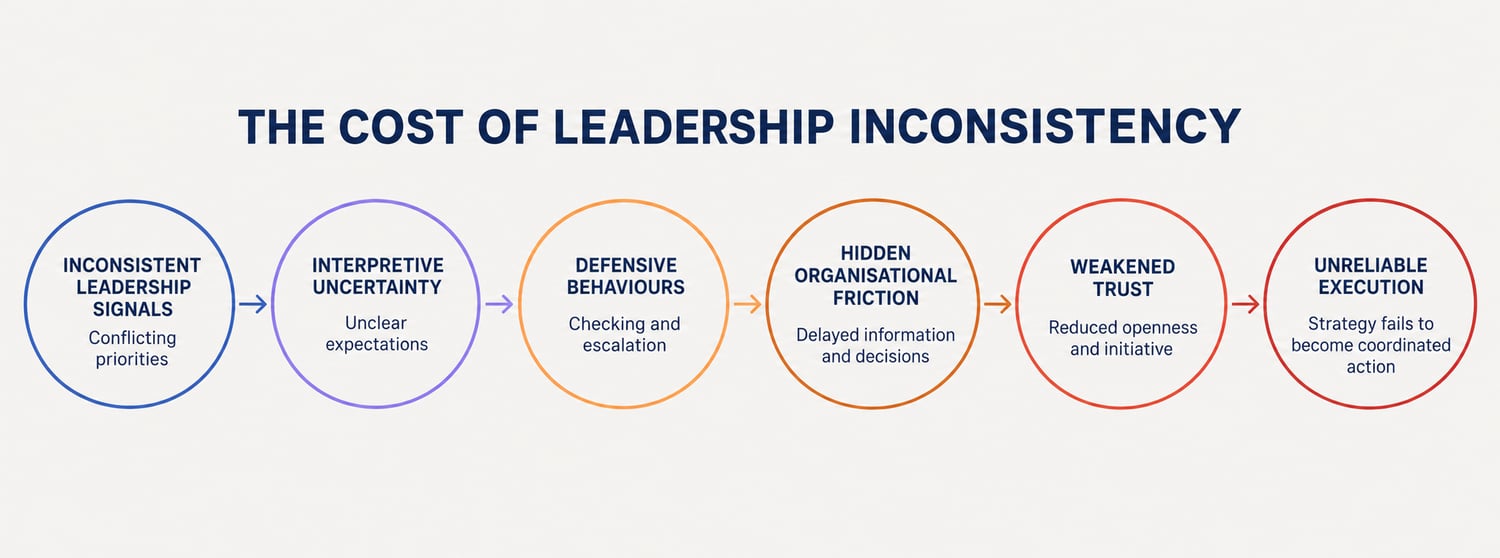
It is interpretive uncertainty.
People Adapt to the Leadership System They Experience
Employees do not remain passive in an inconsistent environment.
They adapt.
They learn which leaders require detailed evidence before making a decision.
They learn which problems should be raised immediately and which should be softened first.
They learn when the formal process matters and when an informal conversation matters more.
They learn whose approval is officially required.
They also learn whose approval is actually required.
The work still gets done.
The report is still submitted.
The meeting still takes place.
The deadline may still be met.
But people are compensating for the leadership system.
They hold pre-meetings before the real meeting.
They send additional emails to protect themselves.
They include more people in decisions than necessary.
They escalate matters that should have been resolved locally.
They delay difficult messages until they can predict the response.
They spend time managing the conditions surrounding the work instead of doing the work itself.
This is hidden friction.
It may not appear in a performance report.
But it consumes attention, weakens judgement and slows execution.
The organisation sees activity.
It may not see the effort required to keep that activity moving.
Inconsistency Makes Truth More Expensive
Strategy depends on reliable information.
Leaders need to know what is working, what is failing and where assumptions no longer hold.
But people do not share information only because it is relevant.
They also assess what sharing it may cost them.
Will the leader listen?
Will the concern be investigated?
Will the messenger become the problem?
Will the information be used for learning or blame?
If leadership responses are inconsistent, employees cannot predict the consequences of honesty.
Silence becomes safer.
Problems are softened.
Risks are delayed.
Reports become more reassuring as they move upwards.
Each layer may remove a little uncertainty, a little discomfort and a little bad news.
By the time information reaches senior leadership, it may be clear.
But no longer complete.
This creates a dangerous contradiction.
Leaders make decisions based on the information they receive.
Employees decide what information to provide based on how leaders have behaved.
When leadership behaviour makes truth costly, strategy becomes separated from reality.
The organisation may continue moving.
It may simply be moving with an increasingly inaccurate understanding of itself.
The Cost Extends Beyond Trust
The immediate consequence of inconsistency is uncertainty.
The deeper consequence is the gradual weakening of organisational capability.
When employees cannot predict how leaders will respond, they become cautious.
When accountability is selective, standards become negotiable.
When priorities change repeatedly without explanation, commitment becomes temporary.
When stated values are applied only when convenient, employees stop treating them as operational guidance.
Over time, the organisation teaches people to protect themselves.
Initiative becomes risk.
Honesty becomes exposure.
Collaboration becomes negotiation.
Accountability becomes political.
These behaviours may later be described as cultural problems.
But culture is not separate from leadership behaviour.
Culture is partly the accumulated interpretation of what leadership repeatedly allows, rewards, ignores and corrects.
Inconsistent leadership does not only reduce morale.
It changes what people believe is safe, worthwhile and necessary.
A Strong Strategy Cannot Correct a Weak Trust Environment
A strategy cannot specify every decision employees will need to make.
It provides direction.
People must still interpret that direction within their own roles, teams and situations.
That requires judgement.
Judgement requires some confidence that the organisation will support reasonable action taken in good faith.
Without that confidence, people reduce their exposure.
They wait.
They escalate.
They seek permission.
They avoid decisions that may later be questioned.
From the leadership perspective, this may look like a lack of ownership.
But ownership cannot be demanded independently of the conditions surrounding it.
If employees have repeatedly experienced shifting expectations, asking them to “take ownership” transfers risk without creating trust.
If leaders want initiative, they must create sufficient consistency around how initiative will be evaluated.
If they want openness, they must respond consistently when openness produces discomfort.
If they want collaboration, the organisation must not reward behaviours that encourage protection and competition.
Strategy describes the required behaviour.
The leadership system determines whether that behaviour is rational.
The Weakest Leadership Interface Shapes the Experience
Senior leaders may believe they are communicating consistently.
They may have agreed on the priorities.
They may use the same presentation and repeat the same messages.
But employees do not experience leadership through presentations alone.
They experience it through their immediate manager.
Through performance conversations.
Through resource decisions.
Through who gets promoted.
Through which behaviours are challenged.
Through what happens after a concern is raised.
A coherent message can become fragmented as it moves through different leadership layers.
Each leader interprets it.
Each leader translates it.
Each leader reinforces or weakens it through daily decisions.
This means the organisation’s leadership credibility is often determined by its weakest leadership interface.
One inconsistent leader can create uncertainty for an entire team.
Several inconsistent leaders can create separate cultures inside the same organisation.
A collection of capable individuals does not automatically create coherent leadership.
Individual competence matters.
But organisational consistency depends on how those leaders operate together.
Diagnosing Leadership Consistency
The question is not whether leaders always agree.
They will not.
The question is whether the organisation has enough coherence for employees to understand what remains stable.
Leaders can begin by examining several areas.
Are organisational priorities described consistently across leadership levels?
Are similar decisions guided by similar principles?
Are expectations applied fairly across roles and seniority?
Can employees raise difficult concerns without first calculating the personal risk?
When leaders disagree, is the disagreement resolved at the appropriate level, or passed down for employees to navigate?
Do recognition, promotion and resource decisions reinforce the behaviours the organisation claims to value?
And when leadership behaviour contradicts those values, what happens next?
These questions should not be answered only by leaders.
Leaders know what they intended.
Employees know what they experienced.
The difference between intention and experience is not a communication detail.
It is diagnostic evidence.
Building Trust Through Organisational Consistency
Trust cannot be restored through reassurance alone.
It must be supported by experience.
This requires clarity about the leadership principles that should remain stable even when circumstances change.
It requires leaders to understand where individual discretion is appropriate and where inconsistency creates risk.
It requires contradictions between leaders to be surfaced and resolved.
It requires explanations when priorities or decisions change.
It requires visible closure when employees raise serious concerns.
Most importantly, it requires alignment between what leaders say, what they decide and what the organisation rewards.
This does not mean every decision will be welcomed.
Employees can accept difficult decisions.
They can adapt to changing circumstances.
They can work through uncertainty.
What weakens trust is not change itself.
It is unexplained inconsistency.
A difficult but coherent decision can still build trust.
A positive message contradicted by experience cannot.
Trust Before Strategy
Organisations often begin with strategy.
They ask where they want to go.
They define priorities.
They identify capabilities.
They prepare the organisation for execution.
But strategy does not enter an empty system.
It enters an environment already shaped by previous decisions, leadership behaviour and employee experience.
If earlier commitments disappeared without explanation, employees will remember.
If honesty was punished, employees will remember.
If values were applied selectively, employees will remember.
A new strategy does not erase those lessons.
It must travel through them.
This is why trust must come before strategy.
Not because trust replaces strategic clarity.
Not because leaders must wait until every relationship is perfect.
But because strategy depends on people interpreting, communicating and acting together.
That becomes difficult when every action carries an additional question:
“Can I trust how the organisation will respond?”
Leadership consistency does not guarantee successful execution.
But inconsistency makes execution more expensive, more defensive and less reliable.
Before asking employees to believe in the strategy, leaders must examine whether the organisation has given them reason to trust the system carrying it.
Because strategy creates direction.
Consistency creates confidence.
And without confidence, even the clearest direction may not lead to coordinated movement.
Part of the Leadership & Culture Series from LUCID Methods.
Explore more frameworks, diagnostic perspectives, and systems-thinking insights through the LUCID Method — developed to help organisations build clarity, coherence, and transformation that holds over time.