

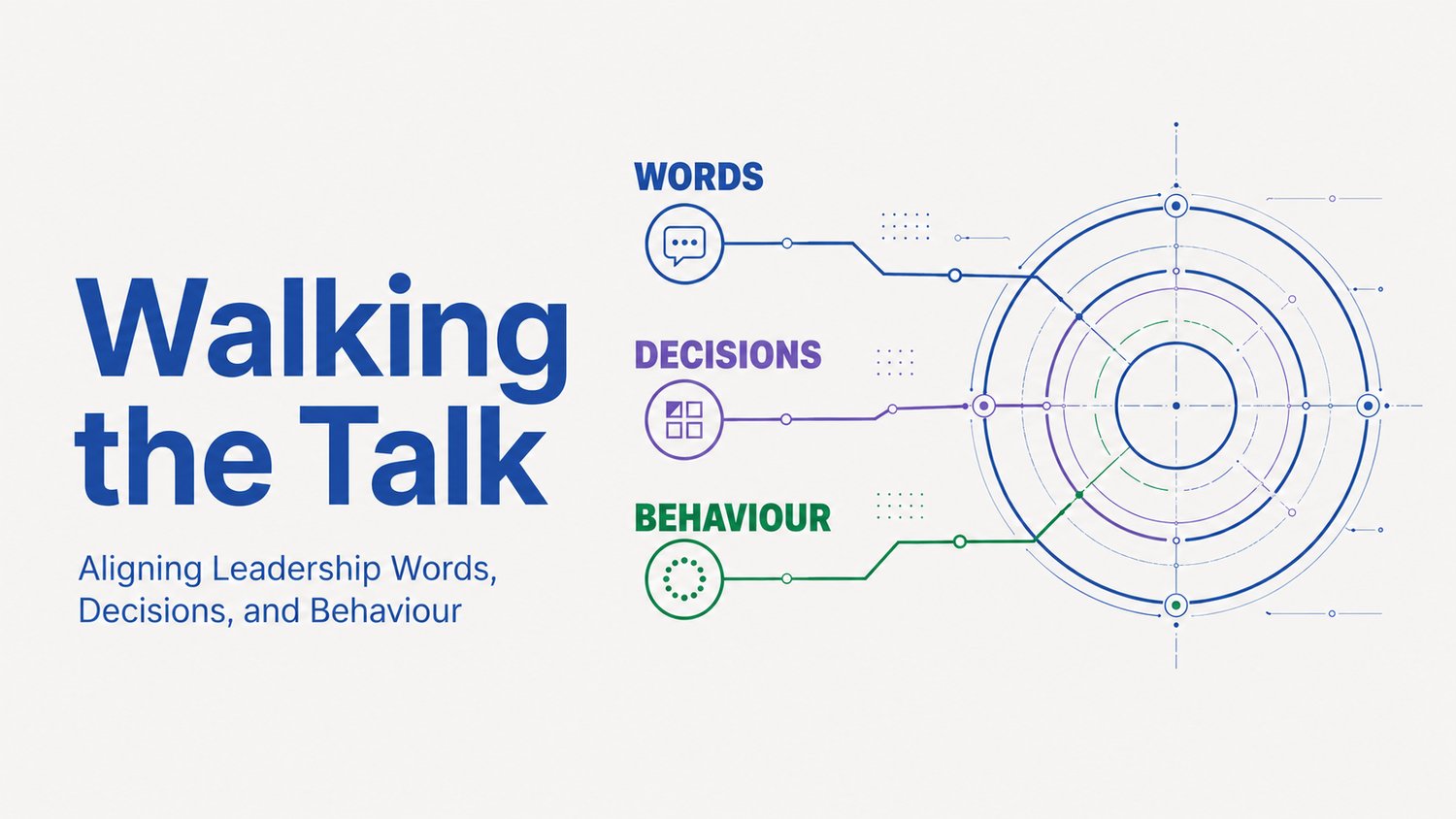
Walking the Talk: Aligning Leadership Words, Decisions, and Behaviour
Most leaders know what they are expected to say.
They speak about trust, collaboration, accountability, innovation, respect, and employee wellbeing.
These ideas appear in town halls, strategy presentations, leadership principles, and organisational values.
But culture is not shaped by words alone.
It is shaped by what happens after those words are spoken.
Employees observe what leaders say.
They also observe what leaders decide, how they behave, and what they repeatedly permit.
They compare all of them.
When the signals align, leadership becomes credible.
When they do not, employees learn which signal to believe.
Usually, it is not the words.
Employees Read the Whole Organisation
Leaders communicate through more than speeches and written messages.
They communicate through budgets, promotions, appointments, targets, timelines, incentives, and resource allocation.
They communicate through how they respond to disagreement, failure, pressure, and bad news.
They also communicate through what they ignore.
A leader may say:
“We want people to speak openly.”
Employees then observe what happens to the person who raises an uncomfortable issue.
A leader may say:
“Collaboration is one of our core values.”
Employees then notice whether individual performance is rewarded at the expense of collective outcomes.
A leader may say:
“Employee wellbeing matters.”
Employees then watch whether workloads remain unreasonable, boundaries are respected, and managers are held accountable for harmful behaviour.
The words communicate intention.
What happens afterwards communicates reality.
When the two conflict, employees adjust to the reality they experience.
Words, Decisions, and Behaviour
Walking the talk requires alignment across three interconnected signals.
Words define the stated intention
Words help people understand what the organisation claims to value.
They provide direction, create shared language, and establish expectations.
Without clear words, employees may struggle to understand what leadership wants the organisation to become.
But words are only the beginning.
They create an expectation that subsequent decisions and behaviour must either confirm or contradict.
The more strongly leaders declare a principle, the more closely employees will watch for evidence of it.
Decisions reveal actual priorities
Decisions show what matters when choices carry consequences.
A budget reveals priorities.
A promotion reveals priorities.
A deadline reveals priorities.
So does the decision to protect a high performer whose behaviour damages the people around them.
An organisation may say that it values long-term capability while repeatedly cutting learning budgets to protect short-term results.
It may say that customer experience matters while imposing targets that force employees to rush each interaction.
It may say that accountability applies to everyone while making exceptions for influential leaders.
Values become real only when they influence choices.
Without that influence, they remain statements of preference rather than organisational commitments.
Behaviour provides visible evidence
Behaviour shows employees how leadership principles are applied in practice.
How does a leader respond when challenged?
What happens when someone admits a mistake?
Can an employee question an assumption without being labelled difficult?
Does the leader remain respectful when under pressure?
A leader who invites disagreement but becomes defensive when questioned sends two different messages.
A leader who speaks about respect but interrupts or humiliates others defines a different standard through behaviour.
A leader who demands accountability but avoids acknowledging personal mistakes teaches employees that accountability flows downward.
People do not only observe leaders when everything is going well.
They pay particular attention when something important is at stake.
That is when leadership principles are tested—and when the organisation’s real boundaries become visible.
The Interpretation Gap
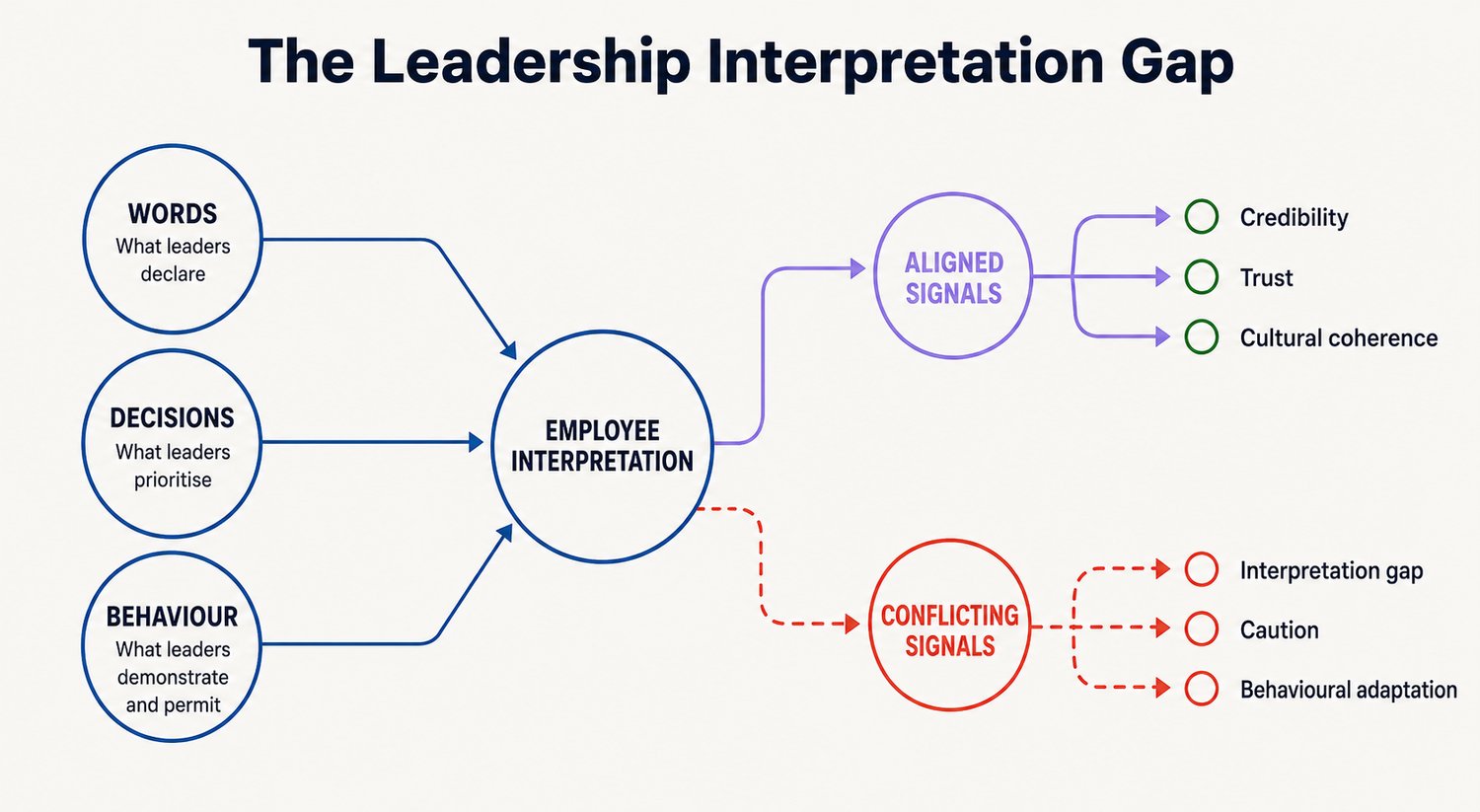
When words, decisions, and behaviour do not align, an interpretation gap forms.
Leadership may say:
“We encourage experimentation.”
But if every unsuccessful attempt is punished, employees interpret the message differently:
“Experiment only when success is already certain.”
Leadership may say:
“We trust our people.”
But if every minor decision requires several layers of approval, employees may conclude:
“You are responsible for the outcome, but you are not trusted to exercise judgement.”
Leadership may say:
“We value honest feedback.”
But if those who offer it are excluded, dismissed, or described as negative, employees learn that honesty is welcome only when it is comfortable.
The organisation is now communicating on two levels.
There is the stated message: what leadership wants people to hear.
Then there is the lived message: what employees learn through experience.
Employees must decide which message is safer to follow.
Over time, they become skilled at reading the organisation beneath its formal language.
They watch who succeeds, who gets protected, what gets rewarded, and what creates risk.
They may continue repeating the stated values.
But their behaviour will adapt to the system they actually experience.
Misalignment Is Not Always Hypocrisy
It is easy to describe every inconsistency as hypocrisy.
Sometimes it is.
But not every gap between words and action begins with dishonesty.
Leaders may genuinely believe in a principle without understanding what it requires operationally.
They may support collaboration while retaining incentives that encourage departments to protect their own interests.
They may value psychological safety while using performance systems that discourage employees from admitting uncertainty.
They may want innovation while keeping approval processes designed primarily to prevent deviation.
The belief may be sincere.
The surrounding system may simply be working against it.
This distinction matters because the purpose is not merely to judge individual leaders. It is to diagnose where organisational coherence is breaking down.
Leadership intention cannot compensate indefinitely for conflicting structures, incentives, and consequences.
Walking the talk therefore requires more than personal sincerity.
It requires alignment between what the organisation says it wants and what its systems make possible.
What Leaders Permit Also Communicates
Leaders shape culture through what they do.
They also shape it through what they allow others to do.
If a leader admits mistakes, others receive permission to be honest about theirs.
If a leader asks difficult questions without punishing uncomfortable answers, others learn that candour is possible.
If a leader confronts disrespectful behaviour—even when it comes from a strong performer—employees see that the stated values carry consequences.
The reverse is equally true.
When harmful behaviour is repeatedly ignored, silence becomes permission.
When exceptions are made for influential people, employees learn that standards depend on status.
When leaders say one thing but reward another, employees follow the reward.
What is tolerated once may be interpreted as an exception.
What is tolerated repeatedly becomes part of the culture.
The Organisational Cost of Misalignment
When leadership words, decisions, and behaviour tell different stories, the effect extends beyond cynicism.
The organisation becomes harder to navigate.
Trust weakens
Employees become cautious about leadership commitments because they do not know which ones will hold when circumstances change.
Communication becomes performative
People repeat approved language because it is expected, not because they believe it describes organisational reality.
Change loses credibility
New initiatives are treated as temporary campaigns. Employees wait to see whether leadership behaviour will change before investing their energy.
Accountability becomes selective
Standards appear to depend on seniority, influence, convenience, or performance.
Decision-making slows
Employees spend more time interpreting hidden expectations, seeking protection, and anticipating inconsistent reactions.
Difficult information disappears
When employees cannot predict how leaders will respond, they become more careful about what they disclose. Problems remain hidden until they become harder to manage.
Discretionary effort declines
People become less willing to contribute beyond what is formally required when leadership commitments appear unreliable.
The organisation may continue to operate.
But beneath the visible activity, coherence is weakening.
Walking the Talk Does Not Require Perfection
Alignment does not mean that leaders must never change direction.
Organisations face competing priorities, limited resources, and changing conditions. Leaders will sometimes need to revise decisions or make compromises that disappoint people.
Credibility does not require pretending that these tensions do not exist.
It requires acknowledging them honestly.
A leader might say:
“We remain committed to employee development. Current financial conditions require us to reduce the training budget, so we will protect the most critical learning needs and review the decision in six months.”
The decision may still be unpopular.
But the contradiction has been made visible rather than concealed.
People can often understand difficult trade-offs when the reasoning is clear.
What damages trust is not always the compromise itself.
It is continuing to repeat the original commitment as though nothing has changed.
Transparency does not remove every inconsistency. It helps people understand whether the inconsistency is a temporary constraint, a deliberate trade-off, or evidence that the stated value was never a real priority.
From Intention to Alignment
Walking the talk becomes more useful when treated as a diagnostic rather than a slogan.
Leaders can begin by asking five questions.
What are we asking people to believe?
Identify the messages communicated through organisational values, strategies, leadership statements, and public commitments.
What do our decisions tell them?
Examine budgets, promotions, targets, timelines, workloads, incentives, and resource allocation.
What priorities do these decisions reveal?
What behaviour do employees observe?
Consider how leaders respond to disagreement, uncertainty, failure, challenge, and pressure.
What would employees learn from watching these moments?
What contradictions are employees being asked to reconcile?
Look for gaps between stated expectations and operational reality.
Are people told to collaborate while being rewarded for competing?
Are they encouraged to take ownership while lacking the authority to decide?
Are they asked to speak openly while watching others suffer consequences for doing so?
What are we repeatedly permitting?
Examine not only what leaders model personally, but what they tolerate from others.
Every repeated exception teaches the organisation something about where its real boundaries lie.
These questions move the conversation away from whether leaders have good intentions.
They focus attention on whether the organisation produces coherent signals.
Coherence Is Built Through Repetition
One aligned action can create a positive impression.
A repeated pattern creates trust.
Employees need evidence that leadership principles will continue to hold when following them becomes inconvenient.
If leaders want openness, they must respond constructively to difficult information more than once.
If they want accountability, they must apply standards consistently—including to themselves and to high performers.
If they want collaboration, they must address the structures and incentives that reward internal competition.
If they want innovation, they must distinguish responsible experimentation from carelessness and respond accordingly.
Credibility accumulates through repetition.
Over time, employees become better able to predict how the organisation will respond.
They no longer need to interpret every statement cautiously or search for the hidden rule behind the official one.
That predictability is an important form of trust.
Leadership Coherence Is the Real Message
Every organisation tells two stories.
The first is intentional.
It appears in values, strategies, speeches, policies, and leadership principles.
The second is experiential.
It is revealed through decisions, behaviour, consequences, and repeated permission.
Culture forms through the relationship between these two stories.
Walking the talk means bringing leadership words, decisions, and behaviour into sufficient alignment that employees do not have to decide which one is real.
It does not require perfection.
It requires awareness of the signals being created, honesty about unavoidable tensions, and the willingness to correct contradictions rather than explain them away.
Words set expectations.
Decisions reveal priorities.
Behaviour provides evidence.
When all three tell the same story, leadership becomes credible.
And when leadership becomes credible, organisational coherence becomes possible.
Part of the Leadership & Culture Series from LUCID Methods.
Explore more frameworks, diagnostic perspectives, and systems-thinking insights through the LUCID Method — developed to help organisations build clarity, coherence, and transformation that holds over time.