

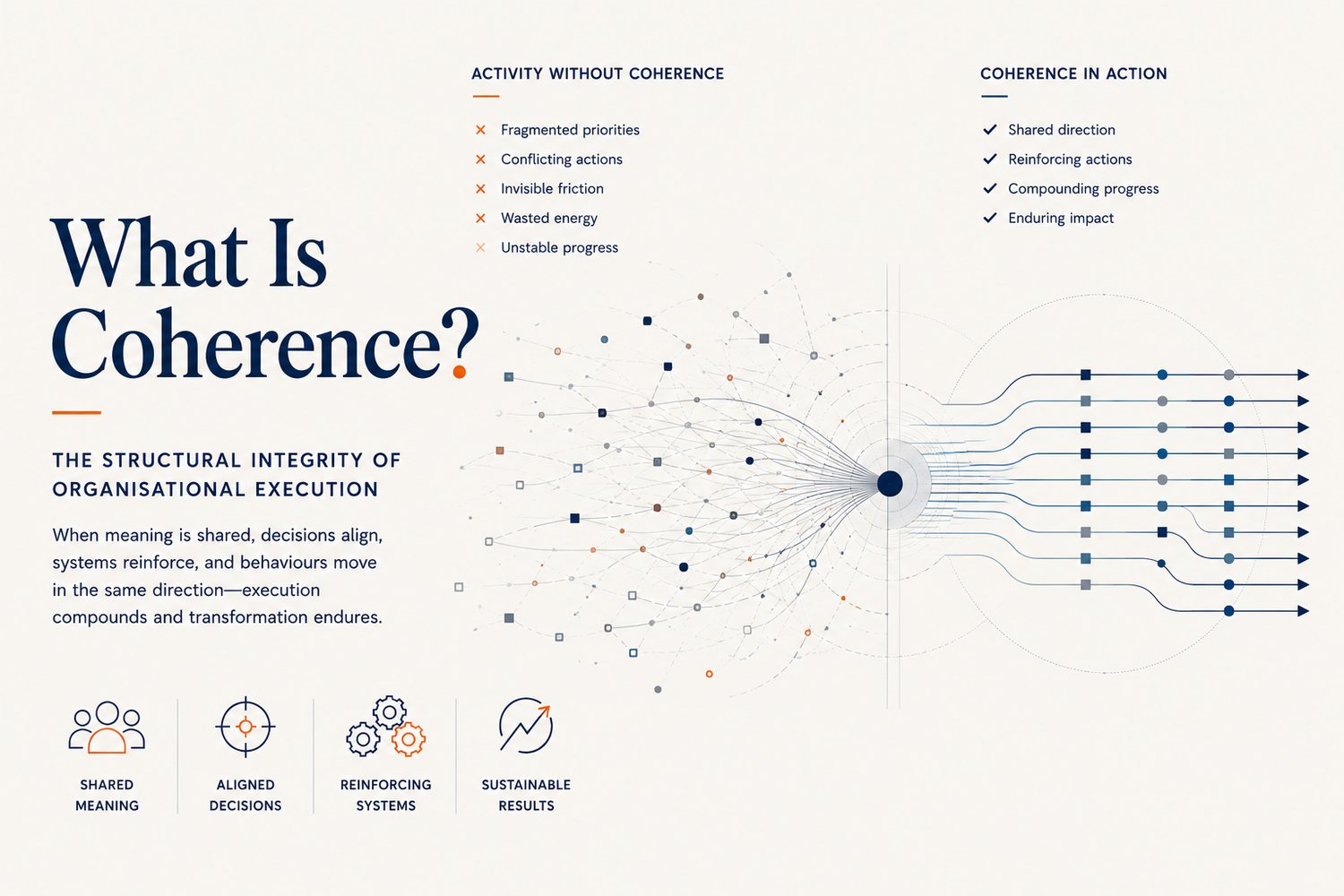
What Is Coherence?
Why Organisations Can Stay Busy While Quietly Losing Alignment?
Most organisations do not fail because people stop working.
They fail because execution slowly fragments beneath visible activity.
Meetings continue.
Projects continue.
Communication intensifies.
Dashboards remain active.
From the surface, the organisation appears engaged and productive.
Yet underneath that activity, something more important may already be weakening:
Coherence.
This is one of the most misunderstood dynamics inside organisational transformation.
Because activity is visible.
Coherence is structural.
And what is structural often remains invisible until execution quality begins deteriorating over time.
Coherence Is Not Agreement
Many organisations mistake coherence for:
- consensus
- harmony
- collaboration
- communication
- organisational culture
Those things may support coherence, but they are not coherence itself.
Coherence is better understood as:
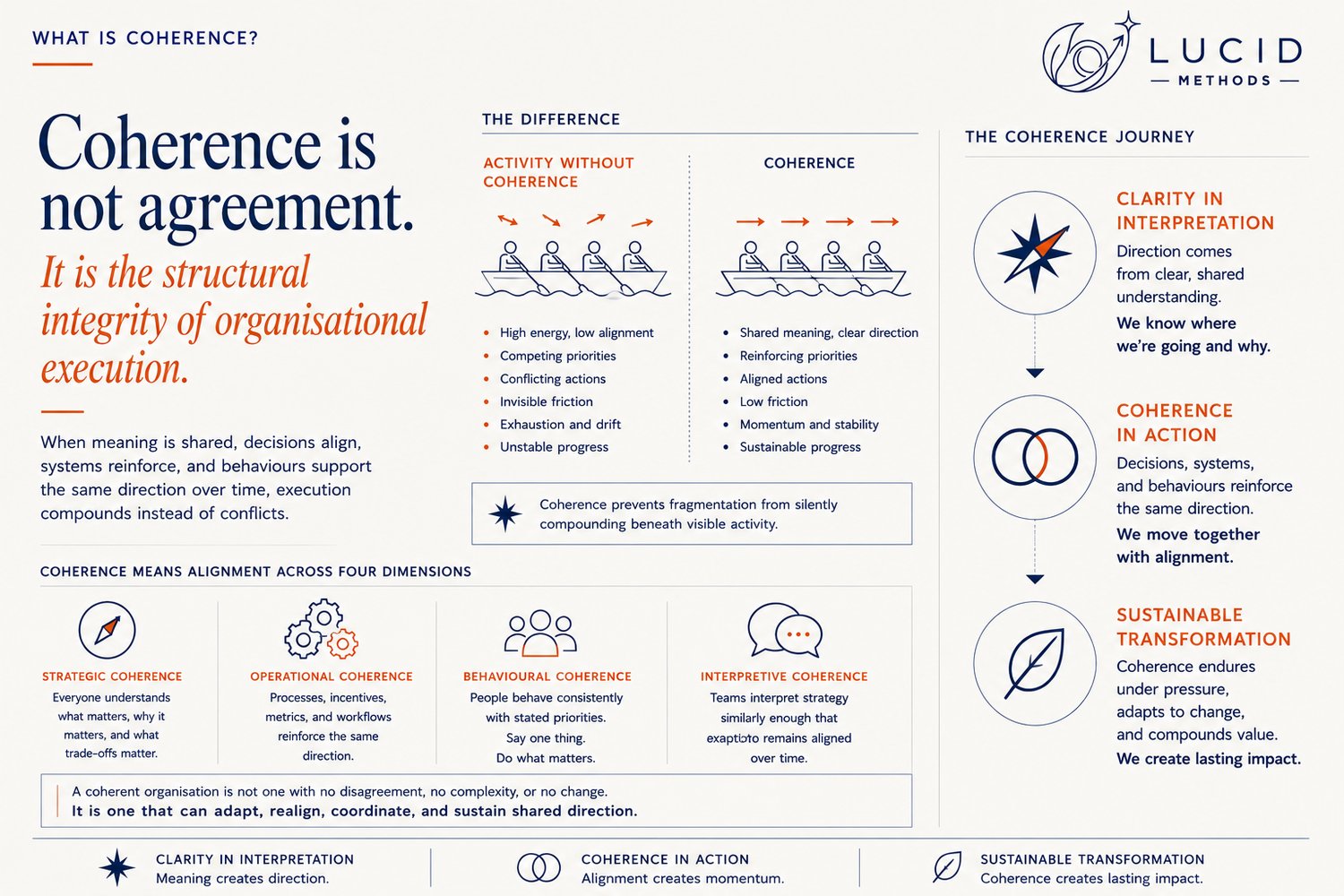
The degree to which people, decisions, systems, priorities, and behaviours reinforce the same direction over time.
A coherent organisation does not necessarily avoid disagreement.
It avoids fragmentation.
People may still debate.
Contexts may still shift.
Complexity may still exist.
But the system retains enough shared meaning and alignment for execution to remain stable under pressure.
Activity Without Coherence
Imagine a rowing team.
Everyone is rowing hard.
But:
- some interpret the destination differently
- some optimise for speed
- others optimise for stability
- priorities compete
- timing becomes inconsistent
- corrections increase constantly
The boat still moves.
But the effort becomes increasingly expensive.
Energy leaks into:
- friction
- rework
- confusion
- duplicated effort
- strategic drift
This is what many organisations experience during transformation.
The problem is not always low effort.
The problem is often fragmented movement.
Why Transformation Quietly Loses Coherence
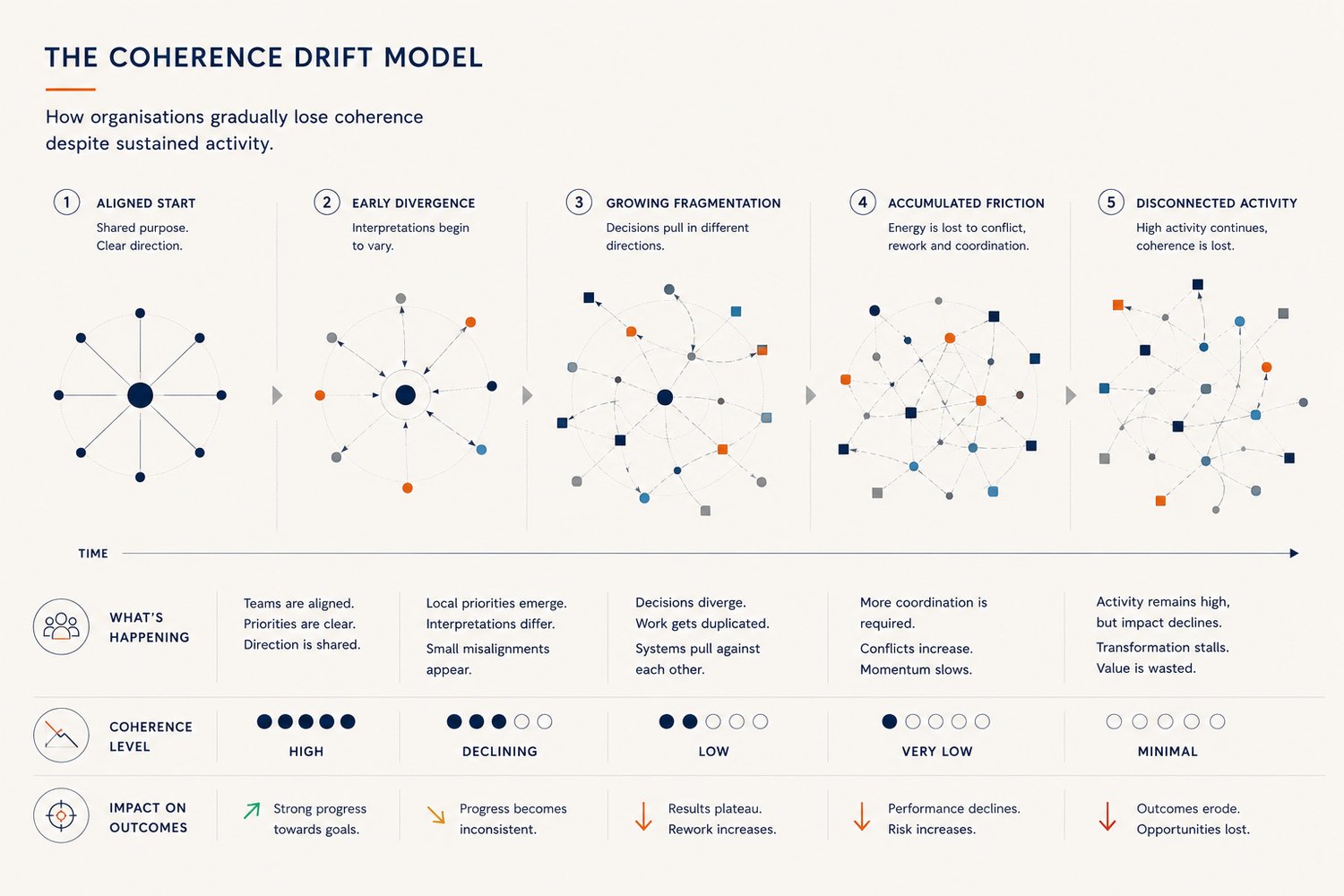
Most organisations begin transformation with relatively high alignment.
There is:
- a launch meeting
- strategic communication
- leadership messaging
- project structures
- shared enthusiasm
At that moment, coherence appears stable.
But over time:
- teams interpret priorities differently
- local constraints reshape decisions
- incentives diverge
- assumptions evolve
- pressures accumulate
- context changes
Without deliberate reinforcement, alignment slowly weakens beneath execution.
This is why organisations can look highly active externally while internally becoming increasingly fragmented.
The visible activity hides the structural decay.
The Four Dimensions of Organisational Coherence
Coherence is not a single condition.
It exists across multiple interconnected layers.
1. Strategic Coherence
People understand:
- what matters
- why it matters
- what trade-offs matter most
Without strategic coherence:
teams optimise for competing outcomes while believing they are aligned.
2. Operational Coherence
Processes, metrics, incentives, and workflows reinforce the same direction.
Without operational coherence:
systems begin rewarding behaviours that conflict with stated priorities.
3. Behavioural Coherence
People behave consistently with organisational intent.
Not merely speak about it.
This is where many organisations struggle.
They communicate one set of priorities while reinforcing another through incentives, decision-making, and leadership behaviour.
4. Interpretive Coherence
Teams interpret strategy similarly enough that execution remains aligned over time.
This is one of the most overlooked dimensions of transformation.
Because execution does not follow instruction alone.
It follows interpretation.
And once interpretation diverges, execution begins fragmenting quietly beneath visible activity.
Why Coherence Matters More Under Pressure
Weak systems can often appear stable during calm periods.
But pressure exposes coherence quality quickly.
Under stress:
- ambiguity increases
- local optimisation rises
- communication compresses
- assumptions diverge faster
- decision speed accelerates
When coherence is weak:
fragmentation compounds rapidly.
When coherence is strong:
organisations adapt without collapsing into internal conflict.
This is why coherence is not simply an operational advantage.
It is a resilience capability.
Coherence Is Not Static
One of the biggest misconceptions about alignment is the belief that it is achieved once.
It is not.
Coherence continuously drifts unless organisations actively maintain it.
Because:
- environments change
- priorities evolve
- people change
- assumptions age
- information shifts
- organisational memory fades
This means coherence must be:
- renewed
- reinforced
- recalibrated
- sustained
The strongest organisations are not the ones that avoid drift entirely.
They are the ones that recognise drift early and realign quickly.
What Coherent Organisations Do Differently
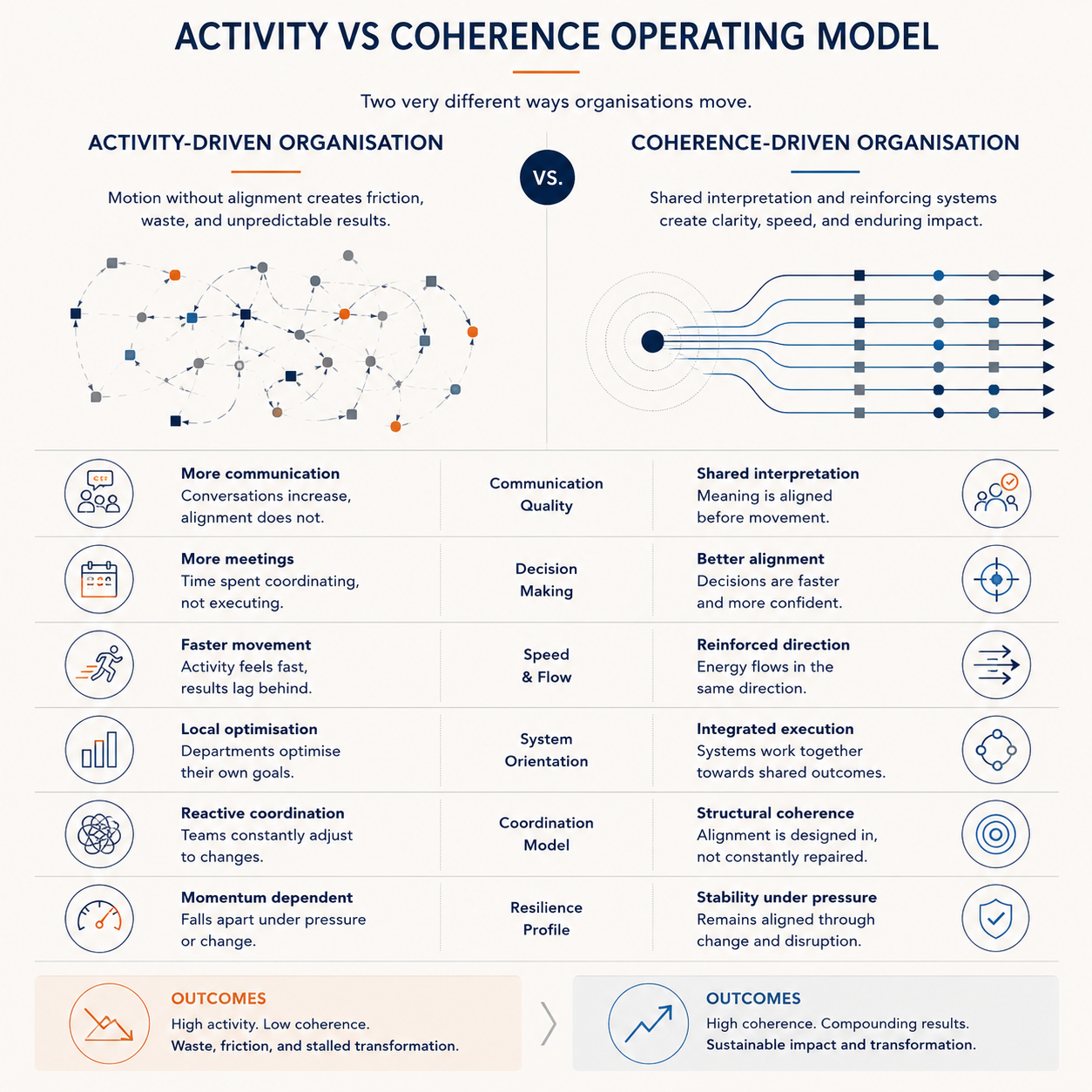
Coherent organisations intentionally reinforce:
- shared interpretation
- decision clarity
- aligned incentives
- cross-functional visibility
- communication loops
- adaptive coordination
They understand that transformation is not sustained through momentum alone.
It is sustained through reinforcement structures that keep execution aligned as complexity increases.
This is why coherence often feels slower initially.
It requires:
- clarification
- integration
- dialogue
- recalibration
- discipline
But over time, coherence reduces:
- friction
- rework
- escalation
- exhaustion
- strategic confusion
The organisation spends less energy fighting itself internally.
The Hidden Cost of Low Coherence
Low coherence rarely appears immediately.
It accumulates gradually.
Often through:
- duplicated work
- unclear ownership
- conflicting decisions
- slow coordination
- inconsistent execution
- strategic confusion
These costs are frequently treated as separate operational problems.
But they often originate from the same structural issue:
The organisation no longer shares sufficiently coherent meaning.
Coherence Sustains Transformation
Many transformation efforts focus heavily on:
- activity
- launch momentum
- communication volume
- execution pace
Far fewer focus on maintaining coherence as execution complexity increases.
Yet this is often the difference between:
- temporary movement
and
- sustainable transformation.
Because activity can sustain motion for a while.
Only coherence sustains direction under pressure.
Final Reflection
A coherent organisation is not one without disagreement, uncertainty, or complexity.
It is one where:
- meaning remains sufficiently shared
- systems reinforce the same direction
- decisions align over time
- execution compounds instead of conflicts
In other words:
Coherence is the structural integrity of organisational execution.
And without it, transformation rarely breaks suddenly.
It fragments quietly beneath visible activity.
Part of the Foundations Thinking Series from LUCID Methods.
Explore more frameworks, diagnostic perspectives, and systems-thinking insights through the LUCID Method — developed to help organisations build clarity, coherence, and transformation that holds over time.