

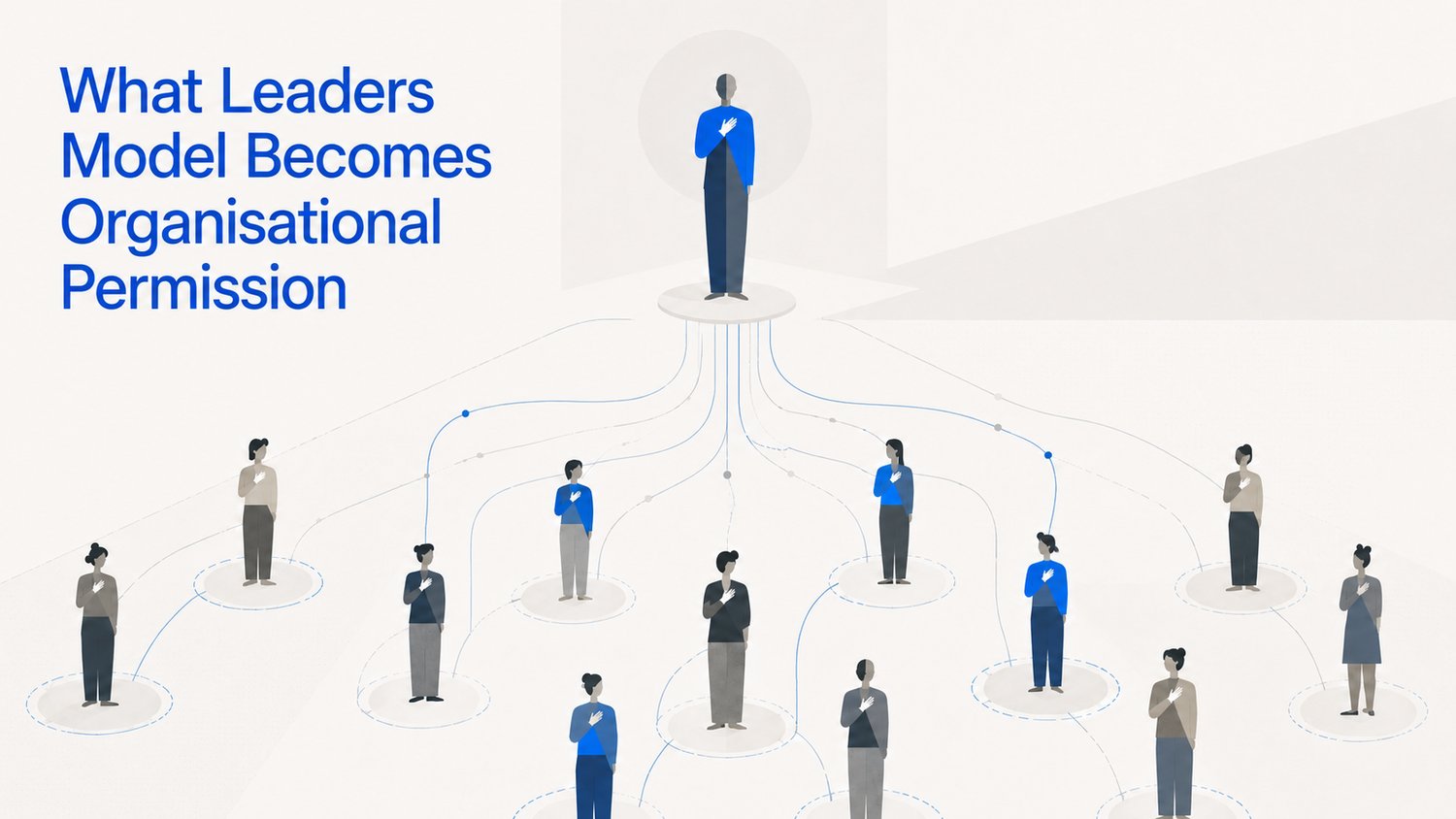
What Leaders Model Becomes Organisational Permission
Leaders are always teaching.
Not only when they speak at town halls, explain the organisation’s values, or conduct a performance review. They teach through what they notice, what they ignore, what they reward, what they tolerate, and how they behave when pressure removes the polish.
People watch these moments closely.
They are not merely observing a leader’s personality. They are learning the organisation’s unwritten rules.
When a leader interrupts others, the lesson is not simply that the leader is impatient. The lesson may become: status gives you the right to disregard people.
When a leader welcomes challenge in public but becomes defensive in private, the lesson is not simply that the leader had a bad reaction. The lesson becomes: speak up carefully, because openness has limits.
When a leader repeatedly bypasses a process to get a faster result, the lesson is not only that speed matters. The lesson may become: process is optional when the stakes are high enough—or when the person involved is senior enough.
What leaders repeatedly model becomes organisational permission.
People learn culture by interpreting behaviour
Organisations often describe culture as something communicated: a set of values, principles, or expected behaviours written into policies, displayed on walls, and repeated in leadership messages.
But employees do not experience culture primarily as communication. They experience it as interpretation.
They ask:
- What happens here when someone makes a mistake?
- Can a senior person be questioned?
- Does poor behaviour still get rewarded when performance is strong?
- Are deadlines more important than quality, wellbeing, or integrity?
- Who is allowed to disagree, and at what cost?
- Do the stated rules still apply when pressure rises?
The answers rarely come from the employee handbook. They come from watching what leaders do and what follows.
A single action can be dismissed as an exception. A repeated action becomes a pattern. A pattern from someone with authority becomes a signal. Once that signal is interpreted consistently, people begin adapting their behaviour around it.
This is how leadership behaviour travels beyond the leader.
Permission does not require an announcement
Leaders do not have to explicitly authorise a behaviour for it to spread.
Permission can be inferred.
If a manager routinely sends messages late at night and praises those who respond immediately, employees may conclude that constant availability is expected—even if the organisation speaks about wellbeing.
If a leadership team discusses difficult issues privately but presents artificial agreement to everyone else, managers below them may learn that maintaining an appearance of unity is safer than surfacing genuine tension.
If a high performer is allowed to belittle colleagues without consequence, the organisation has communicated something more powerful than any statement about respect: results can purchase exemption from values.
No formal decision was required. The organisation granted permission through repetition, visibility, and the absence of correction.
This is why silence matters too. When harmful behaviour is visible and leaders do not respond, employees cannot reliably distinguish between what leadership failed to notice and what leadership quietly accepts. They can only interpret what the system appears to permit.
Authority amplifies behaviour
The same action carries different weight depending on who performs it.
When an employee bends a rule, others may see an individual choice. When a leader bends the same rule, others may see a change in the rule itself.
Authority gives behaviour symbolic weight.
Leaders influence not only through formal decisions but also through social proof. Their actions signal which behaviours are safe, useful, rewarded, or necessary for success. Employees then reproduce those behaviours—not always because they agree with them, but because adaptation is rational.
If leaders dominate conversations, managers may begin doing the same.
If leaders conceal uncertainty, others may stop admitting what they do not know.
If leaders blame before they investigate, problems will be softened before they travel upward.
If leaders change priorities without acknowledging the consequences, teams may learn to treat commitments as temporary.
Over time, imitation becomes normalisation. Normalisation becomes expectation. Expectation becomes culture.
Pressure reveals the permissions that matter
It is easy to model values when little is at stake.
The more diagnostic moments occur when targets are missed, deadlines tighten, customers complain, risks emerge, or an inconvenient truth reaches the leadership table.
Under pressure, people watch what leaders protect first.
Do they protect the truth, or the appearance of control?
Do they seek understanding, or a person to blame?
Do they preserve decision discipline, or override others without explanation?
Do they invite challenge, or punish the person who raises it?
Do they continue treating people with respect, or regard respect as optional during urgency?
These moments are culturally formative because they clarify the real hierarchy of values.
If integrity is abandoned whenever delivery is threatened, employees learn that delivery is the higher value.
If psychological safety disappears when the subject becomes uncomfortable, employees learn that safety exists only for low-risk conversations.
Pressure does not merely test culture. It exposes which behaviours truly have permission.
Good intentions do not neutralise inconsistent signals
Most leaders do not intend to create fear, silence, exhaustion, or internal competition.
They may be moving quickly, protecting the organisation, or trying to maintain high standards.
But culture is shaped by impact and interpretation, not intention alone.
A leader may intend urgency. Employees may experience volatility.
A leader may intend confidence. Employees may interpret a refusal to acknowledge uncertainty.
A leader may intend accountability. Employees may learn that mistakes invite blame.
A leader may intend empowerment while continuing to reverse decisions made by others.
The spoken message says, “You have ownership.”
The modelled message says, “Your authority remains conditional on my agreement.”
When words and behaviour conflict, people generally trust behaviour.
It carries more risk, more consequence, and therefore more information.
This is not because employees are cynical. It is because they are trying to understand how the organisation actually works.
The permission chain
Leadership behaviour often moves through a recognisable chain:
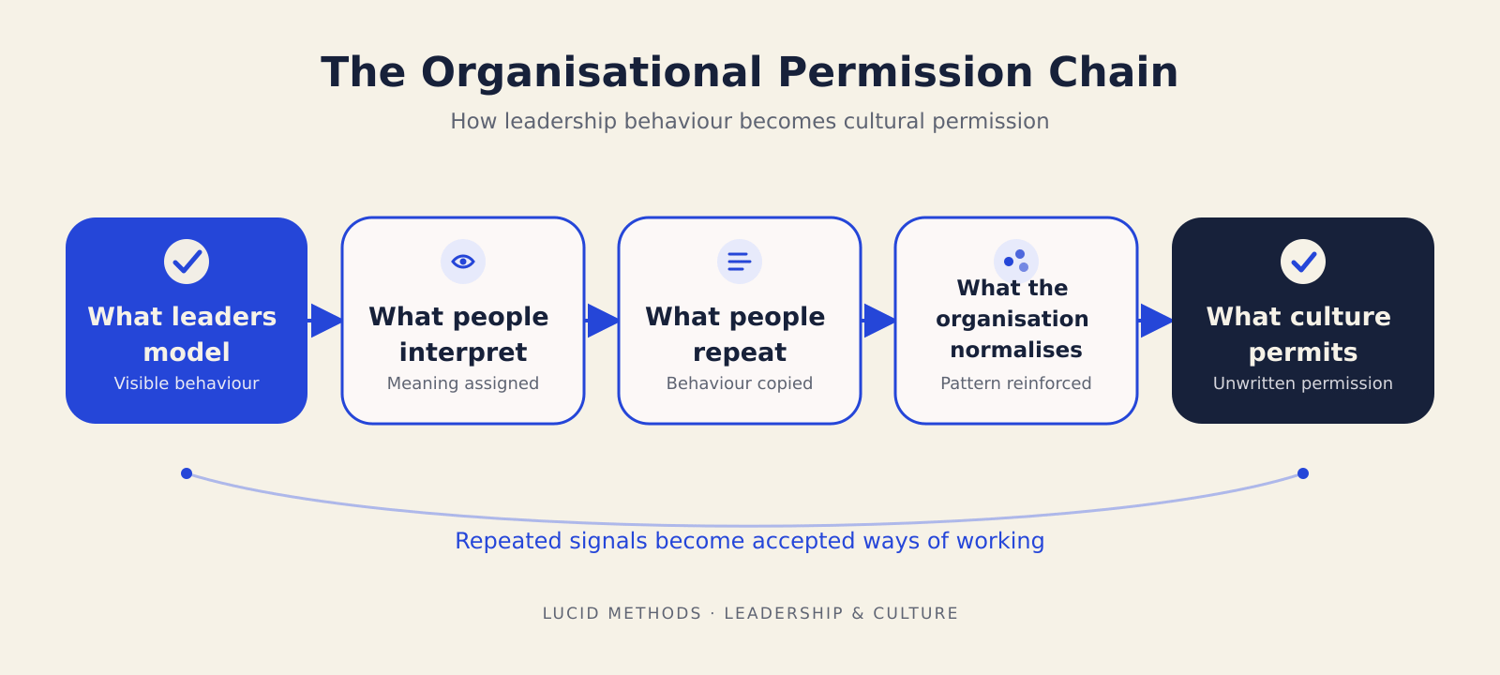
The permission chain
The chain can reinforce constructive behaviour.
A leader who admits uncertainty gives others permission to surface what they do not know.
A leader who changes their mind in response to better evidence gives others permission to value accuracy over ego.
A leader who addresses disrespect even when it comes from a strong performer shows that values remain operative when enforcement is costly.
The same chain can reinforce dysfunction.
A leader who withholds bad news until a solution is ready teaches others to manage appearances. A leader who avoids difficult conversations teaches managers that discomfort can be deferred. A leader who takes over whenever execution becomes messy teaches teams to wait for rescue rather than build capability.
In both cases, culture is not produced by the behaviour alone. It is produced by the behaviour’s replication and the system’s response to it.
Modelling requires coherence, not perfection
Leaders are human.
They will become frustrated, make inconsistent decisions, misread situations, and occasionally behave in ways that do not reflect their own standards.
Credible leadership does not require flawless performance.
It requires coherence—and repair when coherence breaks.
A leader who interrupts someone can recognise it and return the floor.
A leader who reacts defensively can revisit the conversation and acknowledge the effect.
A leader who overrides a process can explain why the exception was necessary, define its boundaries, and prevent the exception from silently becoming precedent.
Repair is itself a form of modelling.
It gives people permission to acknowledge impact, correct behaviour, and restore trust without pretending that mistakes never occur.
The danger is not every inconsistency. The danger is inconsistency without recognition, explanation, or correction.
That leaves employees to construct their own meaning—and the most cautious interpretation often travels fastest.
A leadership diagnostic
Leaders who want to understand the permissions they are creating can examine more than their intended message.
They can ask:
- What behaviour do people see from me repeatedly?
- What might they reasonably conclude from it?
- Which of my actions carry a different message from my words?
- What do I tolerate from strong performers that I would challenge in others?
- What happens when someone disagrees with me?
- Which values remain visible when pressure rises?
- When I make an exception, do I explain its limits?
- What behaviour is likely to be copied because I modelled it?
- When my behaviour causes harm, do people see me repair it?
These are not questions of image management.
They are questions of organisational design.
Leadership behaviour is part of the operating environment.
It affects what information moves, how decisions are made, which risks remain hidden, whether people take ownership, and what employees believe they must do to succeed.
Culture follows the clearest signal
Every organisation contains multiple messages.
There are stated values and observed priorities.
Formal policies and practical exceptions. Leadership speeches and everyday reactions.
Employees must decide which signals are most reliable.
They usually follow the signal with the clearest consequence.
If collaboration is praised but individual heroics are promoted, heroics will shape behaviour.
If candour is invited but dissent carries social cost, caution will prevail.
If wellbeing is communicated but exhaustion is admired, availability will become a measure of commitment.
Leaders therefore cannot separate who they are from the culture they create.
Their behaviour is not confined to the moment in which it occurs.
It becomes evidence. Evidence becomes interpretation. Interpretation becomes permission.
The question is not whether leaders are modelling culture.
They already are.
The question is whether the permissions they create are coherent with the organisation they say they want to build.
Where clarity becomes capability
Part of the Leadership & Culture Series from LUCID Methods.
Explore more frameworks, diagnostic perspectives, and systems-thinking insights through the LUCID Method — developed to help organisations build clarity, coherence, and transformation that holds over time.