

What leadership can—and cannot—systemise
In the earlier article, Leadership Is a System, Not a Personality, I argued that leadership should not depend entirely on the qualities of one person.
But this raises another question:
Can leadership really be systemised?
The answer is both yes and no.
Some parts of leadership can, and should, be built into the way an organisation operates.
Others remain deeply human.
They depend on judgement, courage, empathy and the willingness to take responsibility.
The distinction matters.
If we do not systemise enough, the organisation becomes dependent on particular individuals.
If we systemise too much, leadership can become rigid, procedural and disconnected from the people it is meant to serve.
The purpose is not to turn leadership into a checklist.
It is to understand what should remain consistent, what requires human judgement, and how the two can support each other.
Leadership is not only what a leader does
We often associate leadership with the person at the top.
We look at how they communicate, whether they inspire confidence,
how they make decisions and
how they respond when something goes wrong.
These qualities matter. But they are only one part of leadership.
Within an organisation, leadership is also shaped by:
- Who is allowed to decide
- Who is expected to take responsibility
- What information reaches decision-makers
- How disagreements are handled
- Which behaviours are rewarded or permitted
- Whether difficult issues can be raised safely
- What happens when stated expectations are ignored
These conditions affect how leadership is exercised, regardless of who occupies the role.
A strong individual may compensate for weak organisational conditions.
They may resolve every difficult issue, connect departments that do not communicate and carry knowledge that exists nowhere else.
This may look like effective leadership.
But it may also be a hidden dependency.
The real test comes when that person is absent or leaves.
If decisions stop, relationships break down or important knowledge disappears, the organisation may have had a capable leader—but it did not develop leadership as an organisational capability.
Personal leadership and organisational leadership
Personal leadership comes from the individual.
It includes character, judgement, credibility, empathy, experience and the ability to respond to a situation that may not have a clear answer.
Organisational leadership comes from the conditions that allow people to create direction, make decisions, coordinate their actions and remain accountable.
The two are connected, but they are not interchangeable.
Personal leadership will naturally differ between individuals. Every leader brings a different temperament, experience and way of relating to people.
Organisational leadership, however, should have some continuity. Employees should not have to rediscover what accountability, communication or acceptable behaviour means whenever they report to a different manager.
The purpose of systemising leadership is not to make every leader behave identically.
It is to prevent the organisation’s basic leadership capability from changing entirely with the personality in charge.
What can be systemised
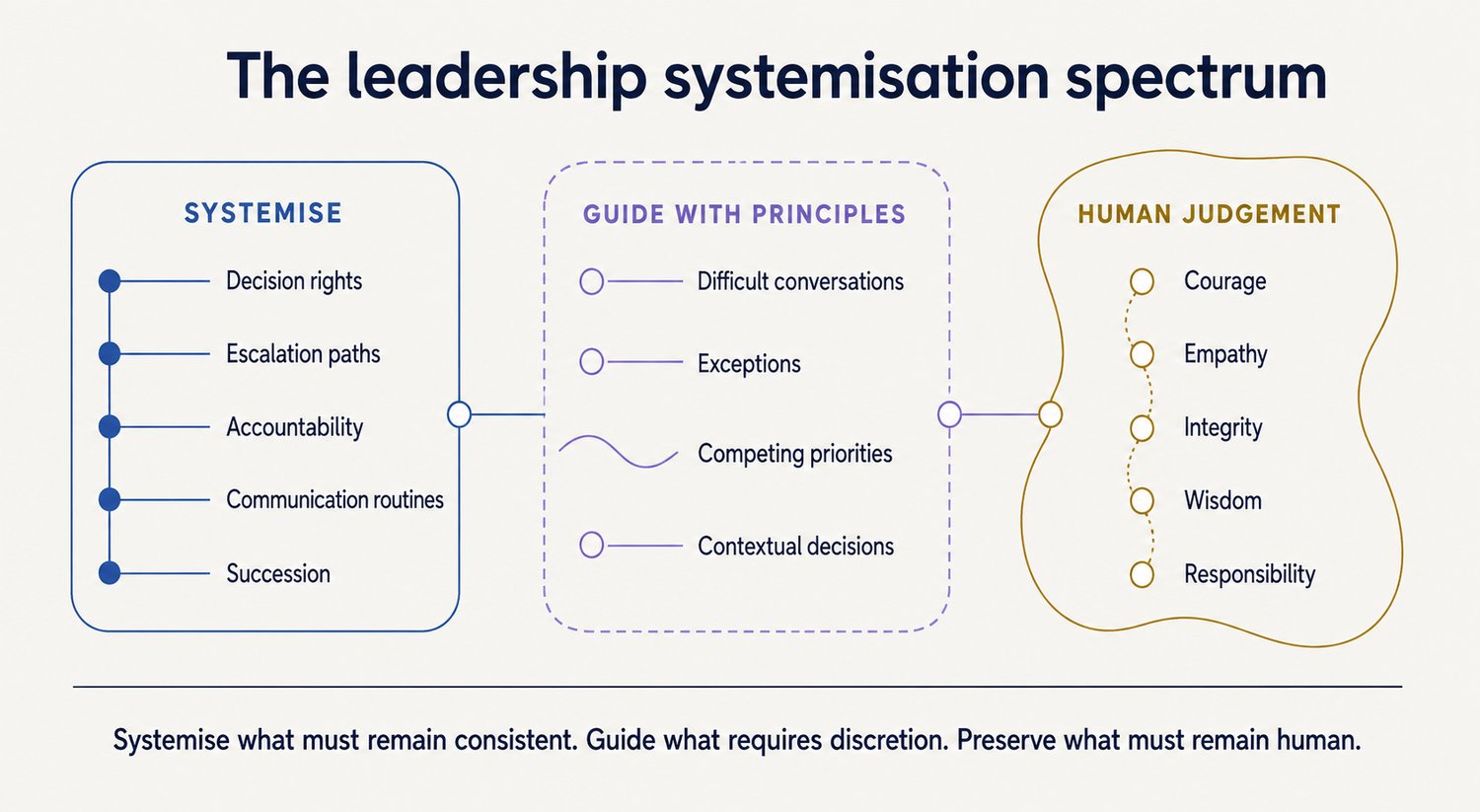
We cannot systemise leadership as a whole. But we can systemise many of the conditions through which leadership is exercised.
Direction
An organisation can define how priorities are established, communicated and reviewed.
People should not need access to private conversations to understand what matters or why a decision was made.
Decision-making
Decision rights can be made clear.
People should know who makes the decision, who should be consulted, who is responsible for carrying it out and who remains accountable for the outcome.
This reduces delay, duplicated effort and decisions that move repeatedly between departments because nobody is certain where authority sits.
Accountability
Roles, expectations, review mechanisms and consequences can be established.
Accountability should not depend entirely on whether an individual manager is willing to confront a difficult situation.
Communication and escalation
Regular briefings, feedback channels and escalation routes can be built into normal operations.
Important information should not move only through personal relationships. Employees should know where to raise an issue and what response they can reasonably expect.
Coordination
Cross-functional forums, handover practices and shared planning routines can help people see how their work affects others.
This reduces the need for one person to act as the permanent bridge between disconnected teams.
Leadership continuity
Succession planning, knowledge transfer and leadership development can reduce the disruption caused when someone leaves.
The objective is not to capture every piece of knowledge. It is to ensure that essential responsibilities and relationships do not remain locked inside one individual.
Culture
An organisation can reinforce its leadership expectations through recruitment, onboarding, performance reviews, promotion, recognition and consequences.
Values become credible when the different parts of the organisation support the same behaviour.
These mechanisms do not lead people by themselves.
They create the structure within which leadership takes place.
What cannot be fully systemised
The system can require a conversation.
It cannot guarantee that the conversation is handled with empathy.
It can establish an escalation process.
It cannot guarantee that someone will have the courage to deliver unwelcome news.
It can publish organisational values.
It cannot guarantee integrity when acting on those values comes with a personal cost.
It can provide a decision framework. It cannot predict every situation or tell a leader how to balance competing human needs.
Some parts of leadership remain personal:
- Moral courage
- Empathy
- Wisdom
- Integrity
- Presence
- Contextual judgement
- Trustworthiness
- The willingness to accept responsibility
- Knowing when an established rule should be questioned
These qualities can be encouraged, selected for and developed.
Their presence or absence can become more visible through the system.
But they cannot be produced by process alone.
There will also be situations where responsible leadership requires someone to challenge the system.
A policy may produce an unfair outcome.
A performance target may encourage the wrong behaviour.
A process designed for ordinary circumstances may fail in an exceptional one.
Following the system is not always the same as serving its purpose.
Leadership therefore requires both the discipline to work through agreed structures and the judgement to recognise when those structures need to change.
Leaders are part of the system
Leaders do not stand outside the system and simply operate it.
They shape it through the decisions they make, the questions they ask, the behaviour they reward and the problems they repeatedly ignore.
At the same time, the system shapes them.
Incentives influence what receives attention.
Reporting structures determine what information reaches them.
Organisational norms affect who feels safe enough to disagree.
Performance measures influence what leaders prioritise.
Leaders contribute to the system in four ways.
They design it by establishing responsibilities, decision rights and feedback mechanisms.
They work through it by using the agreed structures instead of bypassing them whenever they become inconvenient.
They model it by demonstrating whether the organisation’s stated expectations apply in practice.
They improve it by recognising recurring problems and changing the conditions that continue to produce them.
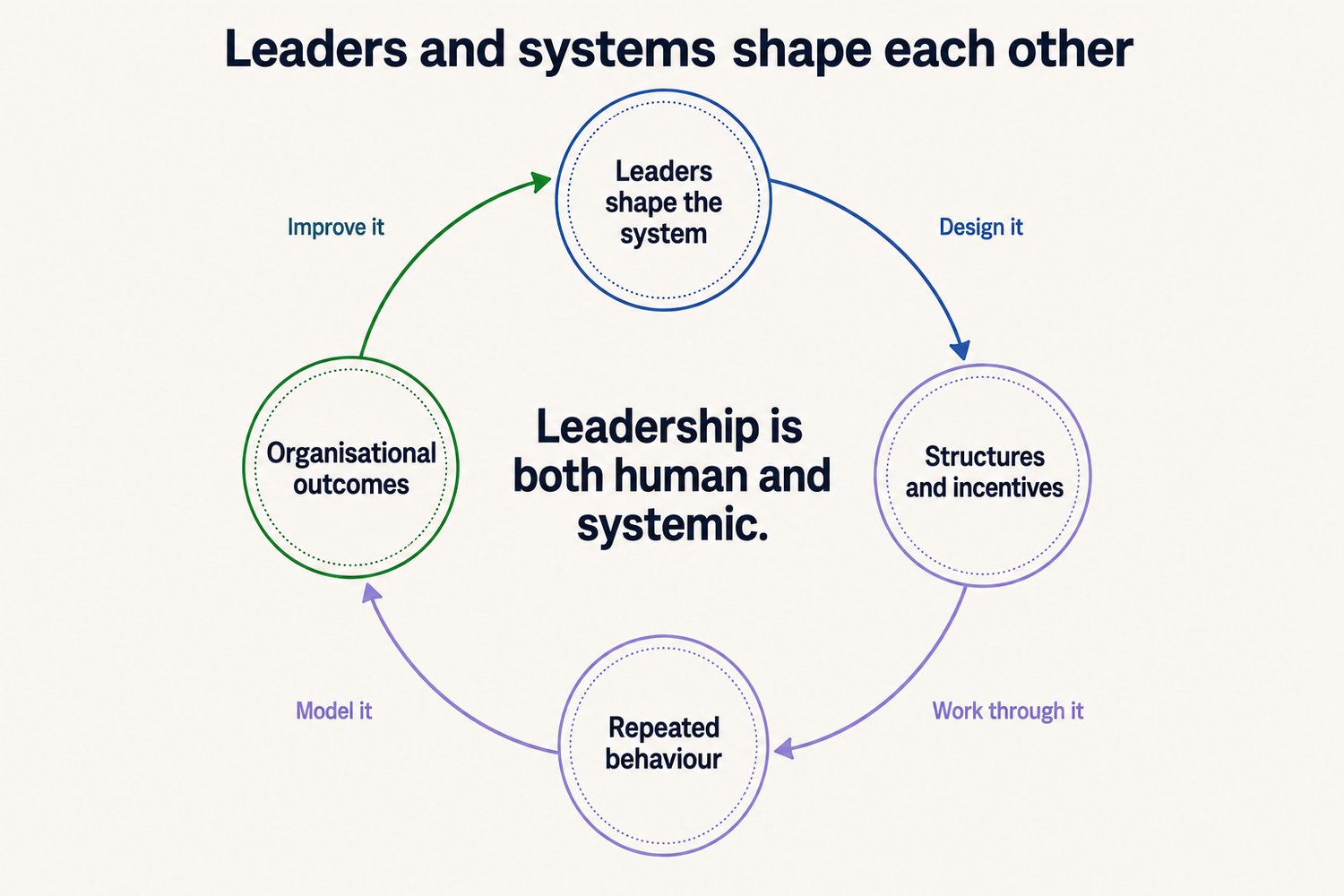
This is why systemising leadership does not reduce the importance of leaders.
It changes their role from being the person who must solve everything to being someone who also strengthens the organisation’s ability to respond without them.
Why this matters
When leadership is not sufficiently embedded, the organisation becomes vulnerable to inconsistency and dependency.
Different departments may operate according to different standards. Decisions may depend on access to a particular person.
Problems may remain unresolved until a senior leader intervenes.
Knowledge may disappear during a leadership transition.
Systemisation can create greater:
- Continuity, because essential practices can survive changes in personnel
- Clarity, because authority and responsibility are easier to understand
- Consistency, because expectations do not change entirely between leaders
- Accountability, because decisions and responsibilities are more visible
- Resilience, because the organisation is less dependent on one individual
- Scalability, because every difficult decision does not need to return to the same person
The objective is not to remove discretion.
It is to prevent essential organisational outcomes from depending entirely on individual discretion.
When systemisation becomes another problem
More structure does not automatically create better leadership.
Too many rules, committees and approval layers can slow decisions and weaken ownership.
People may follow the process while avoiding responsibility for the outcome.
Feedback channels may exist, but employees may learn that raising an issue changes nothing.
Measures may also become misleading.
Once a leadership indicator becomes a target, people may learn to improve the number without improving the condition it was intended to represent.
Consistency can become rigidity. Treating every situation in exactly the same way may appear fair while ignoring important differences in context.
There is also the danger of diffused accountability.
When something goes wrong, people may blame “the system” as though no individual made a choice within it.
Systems influence behaviour, but they do not remove personal responsibility.
A weak system may help explain why a problem keeps recurring.
It does not absolve leaders who can see the harm and continue to permit it.
A useful leadership system must therefore hold several tensions at the same time:
- Consistency without rigidity
- Accountability without fear
- Discretion without arbitrariness
- Continuity without complacency
- Structure without losing humanity
A diagnostic lens
The success of a leadership system should not be measured only by whether policies exist, meetings take place or forms are completed.
The more useful questions are:
- Are decisions made at the appropriate level?
- Do people understand where responsibility sits?
- Can difficult information reach those who need to hear it?
- Are expectations applied consistently across different levels and teams?
- Can the organisation identify and correct recurring problems?
- What stops working when a particular leader is absent?
- Does leadership capability remain when a respected leader leaves?
The final two questions often reveal the hidden dependencies.
If responsible leadership disappears with the individual, the organisation may have developed a strong leader.
It has not yet developed a strong leadership system.
Structure and humanity
Leadership cannot—and should not—be fully systemised.
Organisations still need people who can interpret context, exercise compassion, face uncomfortable realities and make responsible decisions when procedures are insufficient.
But relying on exceptional individuals is not a sustainable leadership model either.
What should be consistent must be built into the organisation. What requires human judgement must be recognised, developed and protected.
The system provides clarity, continuity and accountability.
The leader provides courage, empathy and judgement.
Neither is sufficient alone.
Leadership is therefore not a choice between people and systems.
It is the continuing work of aligning both—so that the organisation does not lose its capability when a leader leaves, and its leadership does not lose its humanity when structure is introduced.
A forthcoming LUCID Methods Leadership Systems Toolkit will provide practical ways to identify leadership dependencies, map decision rights and assess whether leadership capability is embedded across the organisation.
Part of the Leadership & Culture Series from LUCID Methods.
Explore more frameworks, diagnostic perspectives, and systems-thinking insights through the LUCID Method — developed to help organisations build clarity, coherence, and transformation that holds over time.