

When Change Management Becomes Change Theatre
Activity Is Not Adoption
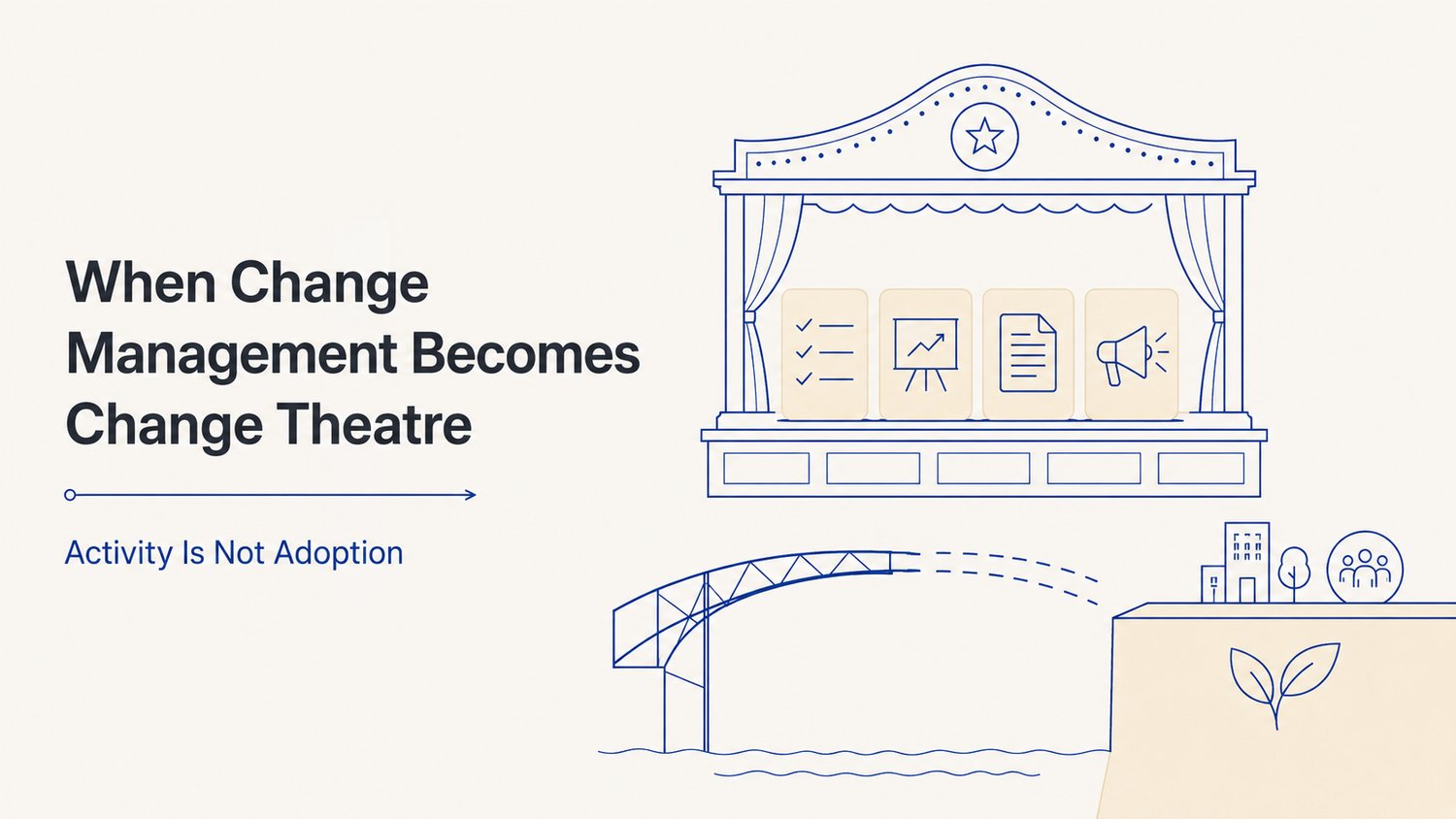
Change management becomes theatre when visible activity is completed while the conditions preventing change remain intact.
Most organisations do not neglect change management.
They fund it.
They appoint change leads. They prepare communication plans. They deliver training. They publish toolkits. They monitor completion.
On paper, the organisation is prepared.
Yet the new behaviour does not take hold.
The process changes. Workarounds remain.
The system goes live. Old assumptions survive.
Leaders endorse the programme.
Their decisions continue to reward the previous way of working.
The visible work has been completed.
The conditions shaping behaviour have not changed.
This is change theatre.
The Comfort of Visible Activity
Visible activity is reassuring.
It can be planned.
It can be assigned.
It can be reported.
Communications can be counted.
Training attendance can be measured. Readiness decks can be completed.
Stakeholder sessions can be scheduled.
Progress can be made visible to a steering committee.
These activities may be necessary.
But completion does not prove that change has occurred.
It proves only that the activity was completed.
The distinction matters because organisations often measure what is easiest to observe rather than what is most important to change.
When activity becomes evidence of success, the organisation stops asking whether behaviour, decisions or outcomes have changed.
This creates a comfortable arrangement.
Leadership receives assurance.
The project receives communication and training support.
The change team receives deliverables it can control.
Everyone can demonstrate movement.
No one has to confront the system.
Why Change Management Becomes an Order-Taking Function
Change teams often enter after the most consequential decisions have already been made.
The solution has been selected.
The timeline has been committed.
The governance structure has been established.
The trade-offs have been absorbed quietly.
The change practitioner is then asked to make people ready.
At that point, the role is no longer to shape the change.
It is to make an existing decision easier to accept.
This is why weak adoption is so often treated as a communication problem.
If people hesitate, explain more.
If they resist, engage more.
If they struggle, train more.
But communication cannot resolve contradictory incentives.
Training cannot correct unclear ownership.
Engagement cannot compensate for decisions people were never allowed to influence.
A compelling narrative cannot make an unworkable process workable.
Change management becomes performative when it is held responsible for outcomes but denied influence over the conditions producing them.
The System Surrounding Change Management
It is tempting to blame the profession.
Too many templates.
Too much certification.
Too much linear thinking.
Sometimes that criticism is justified.
But methods do not operate in isolation.
They adapt to what organisations fund, request and reward.
If leaders reward certainty, practitioners will produce confident plans.
If governance rewards milestone completion, teams will optimise for completed deliverables.
If disagreement threatens project approval, stakeholder alignment will be reported more confidently than it is experienced.
The surrounding system teaches the change function what it must produce to survive.
This does not remove professional responsibility.
Change practitioners must still challenge weak assumptions, surface human consequences and distinguish compliance from commitment.
But it places responsibility where it also belongs:
with leaders who determine what is funded, measured, protected and permitted.
Discuss your brandActivity, Adoption and Embedding Are Not the Same or product
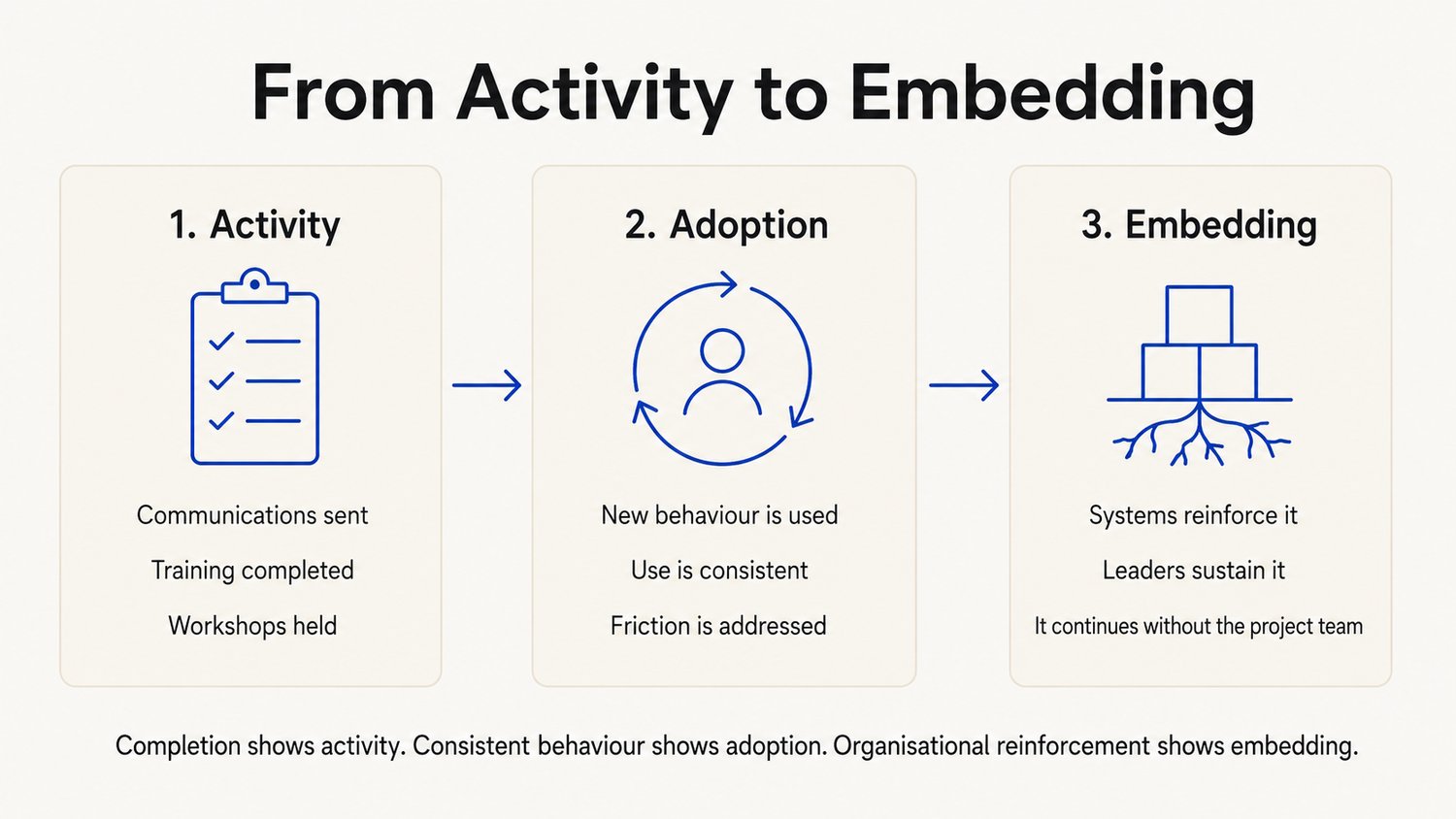
The confusion begins when three different conditions are treated as one.
- Activity. The organisation has communicated, trained, consulted, configured or launched.
- Adoption. People are using the new process, system or behaviour in practice.
- Embedding. The operating system reinforces the new behaviour so it continues when attention, pressure or leadership changes.
An organisation may complete every change activity without achieving adoption.
It may achieve adoption without embedding.
This is why go-live is a misleading finish line.
It marks the moment change becomes possible.
Not the moment change is complete.
What Change Management Cannot Own
But change management cannot own decisions that only leadership has the authority to make.
It cannot, by itself:
- resolve competing executive priorities;
- change performance measures and incentives;
- remove governance that delays or contradicts decisions;
- redesign an operationally unworkable solution;
- provide resources that were never allocated;
- repair trust while leadership behaviour continues to damage it;
- make leaders accept consequences they prefer to avoid.
When these conditions remain untouched, asking the change team to increase adoption is not accountability.
It is displacement.
Change management cannot compensate for an organisation that is unwilling to change the system producing its current behaviour.
From Change Delivery to Change Conditions
The better question is not whether the change plan has been completed.
It is whether the conditions required for change are present—and coherent.
Before declaring readiness, leaders and practitioners should be able to answer:
- Is the problem defined at the level of the system, or only at the level of symptoms?
- Does one person genuinely own the outcome?
- Do incentives, metrics and leadership behaviour reinforce the stated direction?
- Have stakeholders influenced the design, or only reacted to it?
- Is the required behaviour realistically possible within existing workloads and processes?
- What evidence will distinguish usage from meaningful adoption?
- What will sustain the change after the programme and its leadership attention move on?
These questions move change management away from producing artefacts—and towards designing the conditions in which change can hold.
They also make the boundaries of responsibility visible.
The Leadership Responsibility That Cannot Be Outsourced
Leaders bring change management into a programme because implementation has a human dimension.
That is sensible.
The problem begins when appointing a change team becomes a transfer of leadership responsibility.
Leadership responsibility is not fulfilled when the message is sent.
It is not fulfilled when training is delivered.
It is fulfilled when leaders make coherent decisions, accept trade-offs, remove structural contradictions and respond to what the organisation is telling them.
It continues after the programme loses visibility.
Change practitioners can make these responsibilities visible.
They cannot perform them on leadership’s behalf.
Beyond Change Theatre
Change management does need to change.
It must become less attached to certainty.
Less compliant with predetermined solutions.
More willing to challenge the system surrounding the work.
But organisations must change too.
Organisations must stop buying change management as assurance that disruption can be controlled.
Communication is not participation.
Training is not capability.
Activity is not adoption.
Real change is not demonstrated by how much change work has been completed.
It is demonstrated by what people do differently.
By what the system now reinforces.
And by what continues when no one is watching.
Until those conditions move, the organisation has not managed change.
It has managed the appearance of it.
Acknowledgement
This article was prompted by Justin Balaski’s LinkedIn post, “Can change management actually change?” His critique raised an important question: whether organisations ask change management to transform the conditions of change—or merely to make those conditions easier to accept.
Part of the Execution Architecture Series from LUCID Methods.
Explore more frameworks, diagnostic perspectives, and systems-thinking insights through the LUCID Method — developed to help organisations build clarity, coherence, and transformation that holds over time.