

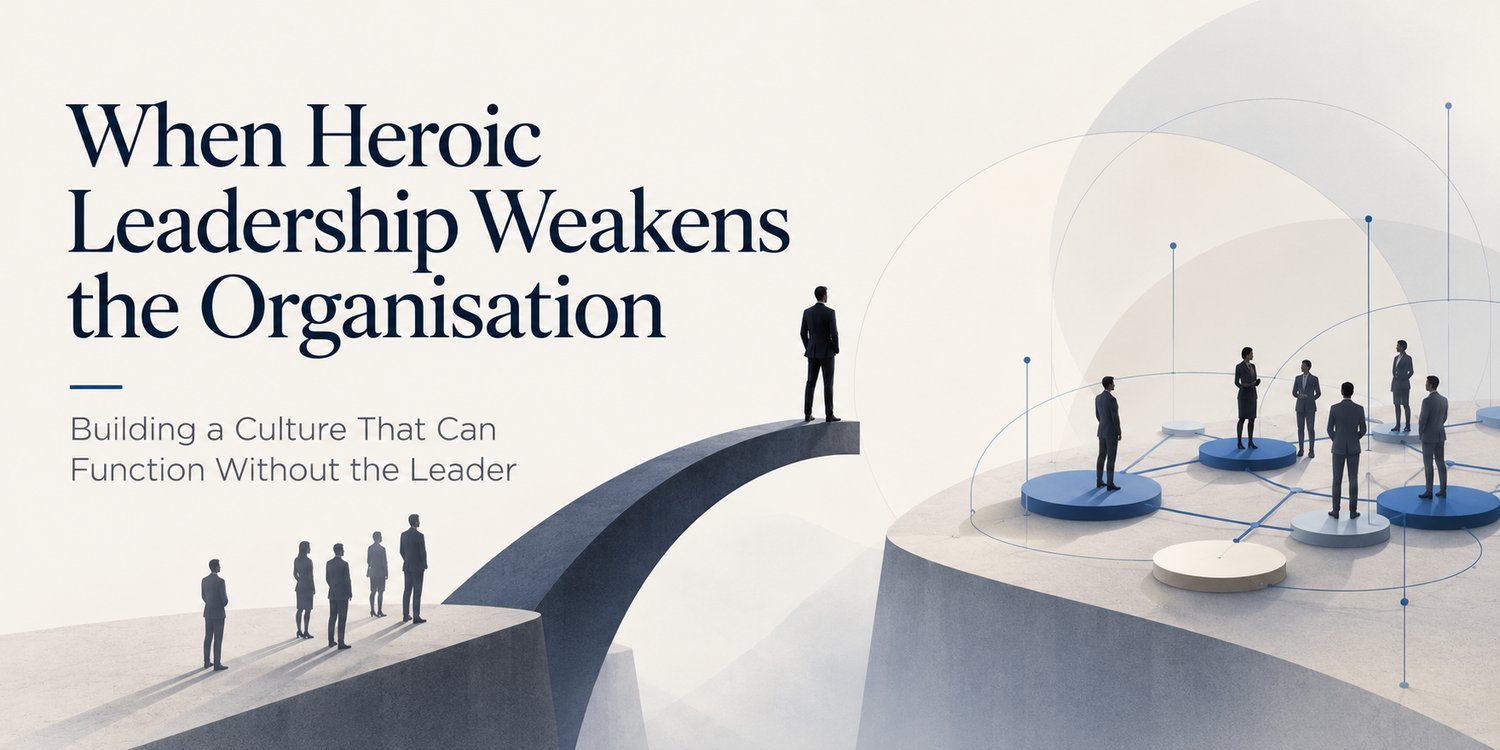
When Heroic Leadership Weakens the Organisation
Building a Culture That Can Function Without the Leader
There is a particular kind of leader that organisations tend to admire.
The one who always has an answer.
The one who steps in when things go wrong.
The one who can resolve conflicts, make difficult decisions,
and somehow keep everything moving when others cannot.
When a project is falling behind, this leader rescues it.
When departments cannot agree, this leader settles the disagreement.
When employees encounter uncertainty, this leader provides direction.
Such leaders are often described as indispensable.
And that is precisely where the problem may begin.
When an organisation becomes dependent on a leader's ability to solve problems, it may be developing confidence in the individual rather than capability within the organisation.
The distinction is easy to overlook.
After all, problems are being resolved.
Results are being delivered.
People are getting what they need.
From the outside, the organisation appears effective.
But beneath that effectiveness, something else may be happening.
People are becoming less willing to decide.
Managers are becoming more comfortable escalating than resolving.
Teams are learning to wait for direction rather than exercise judgement.
And the leader, despite working harder than ever, becomes increasingly necessary for the organisation to function.
The organisation has not necessarily become stronger.
It has become better at relying on someone strong.
When Good Intentions Create the Wrong Conditions
Heroic leadership does not usually begin with a desire for control.
Quite often, it begins with responsibility.
A leader sees a problem and wants to help.
An employee is struggling, so the leader provides an answer.
Two managers disagree, so the leader makes the decision.
A project is falling behind, so the leader becomes personally involved.
Each intervention appears reasonable.
It may even be necessary.
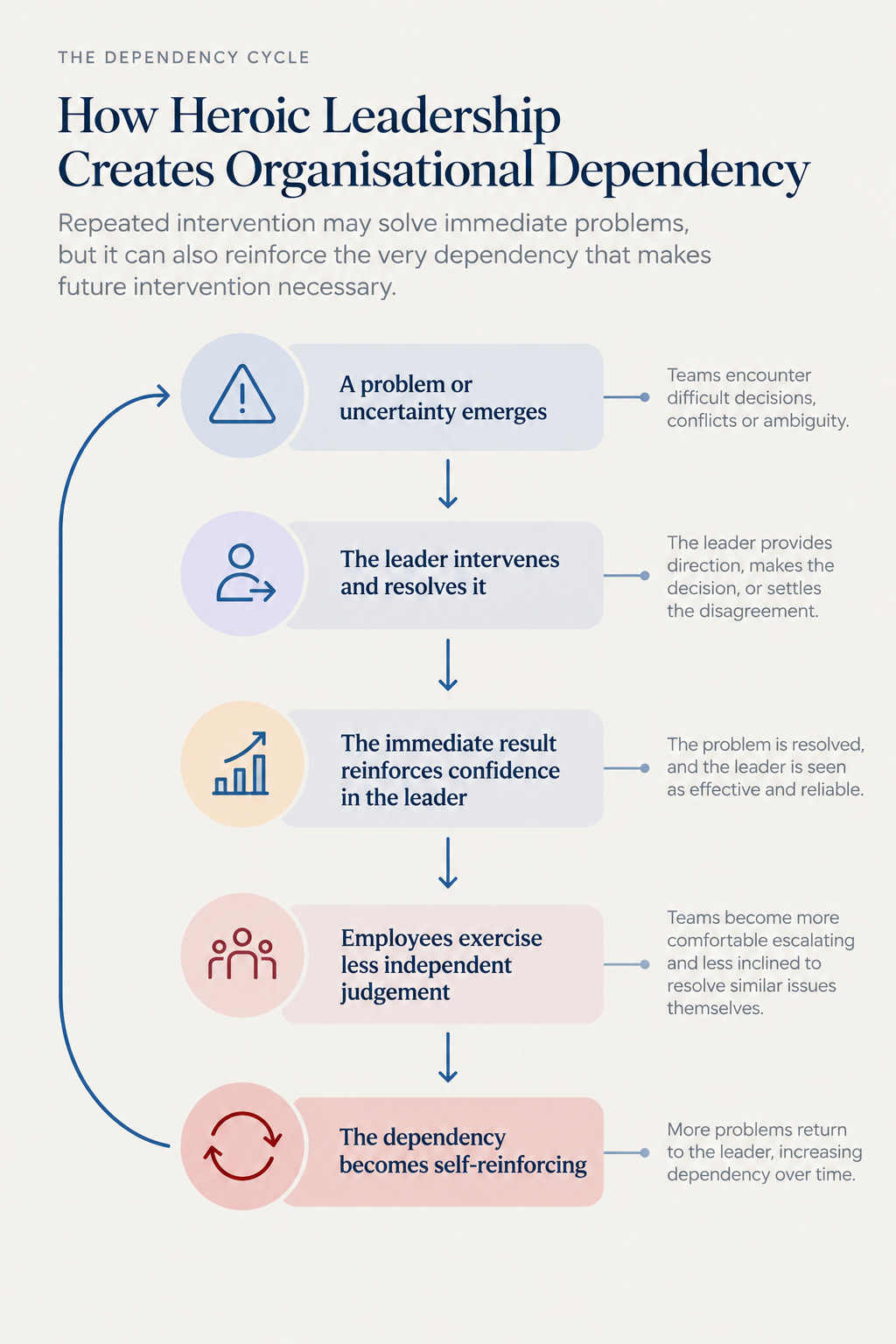
The difficulty arises when these interventions become habitual.
Instead of examining why employees are unable to resolve problems independently, the leader continues resolving those problems for them.
Instead of clarifying decision rights, the leader becomes the decision-maker.
Instead of addressing recurring coordination failures, the leader becomes the person who holds everything together.
Gradually, a pattern develops.
Employees encounter difficulties.
They approach the leader.
The leader resolves the problem.
Everyone moves on.
Until the next problem appears.
What makes this pattern particularly difficult to recognise is that it works.
At least in the short term.
The immediate problem disappears, and the leader's reputation for effectiveness grows.
But the conditions that produced the problem remain largely unchanged.
The organisation is learning who can solve its problems, rather than learning how to solve them.
The Difference Between Solving Problems and Building Capability
Consider two department heads facing the same situation.
Two teams are repeatedly disagreeing over priorities.
Both teams believe their work is urgent. Both have legitimate concerns. Neither is willing to compromise.
The first department head listens to both sides, determines which priority should take precedence, and instructs the teams accordingly.
The disagreement is resolved.
Work continues.
The second department head may make the same immediate decision.
But the intervention does not end there.
The department head examines why the disagreement occurred.
Were the priorities unclear?
Did the teams have different interpretations of organisational objectives?
Was there confusion over who had authority to make the decision?
Were competing performance measures encouraging departments to protect their own interests?
The second leader recognises that resolving the disagreement is only part of the responsibility.
The other part is ensuring that similar disagreements can be resolved without requiring the same intervention.
This is the difference between solving a problem and building organisational capability.
Both leaders may deliver the same immediate result.
But they leave behind different organisational conditions.
One has resolved an incident.
The other has begun addressing the system that produced it.
Leadership becomes sustainable when each intervention improves the organisation's ability to function without the same intervention being repeated.
When the Leader Becomes the System
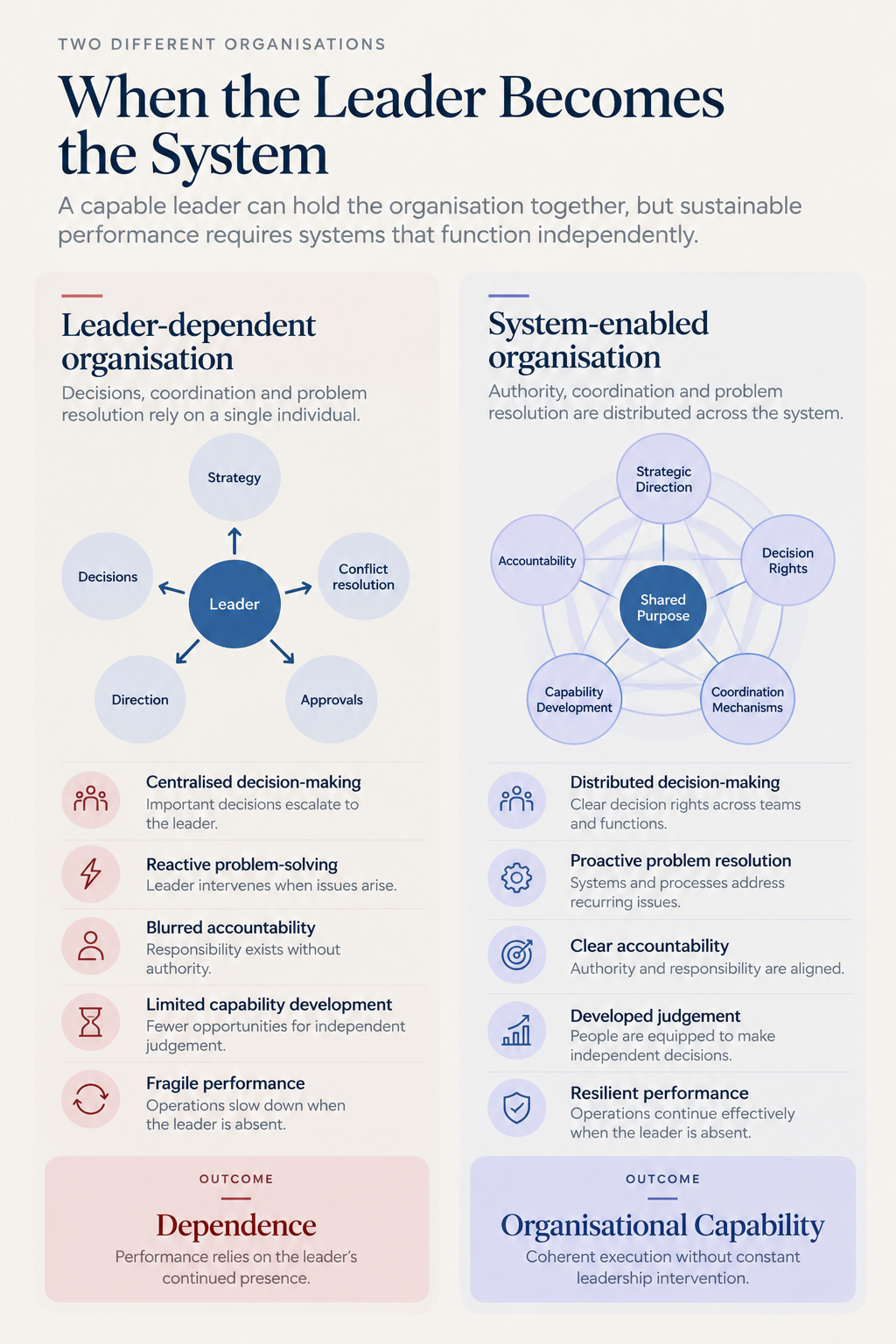
Every organisation requires mechanisms for making decisions, coordinating activities, resolving disagreements, and maintaining accountability.
These mechanisms may be formal, such as governance structures and defined decision rights.
They may also be informal, such as established working relationships, shared expectations, and accepted ways of handling difficult situations.
When these mechanisms are weak, leaders often compensate.
They provide clarity where responsibilities are ambiguous.
They coordinate where departments are disconnected.
They resolve disagreements where decision rights are unclear.
They enforce accountability where ownership is fragmented.
The organisation continues functioning because the leader bridges the gaps.
Over time, however, this compensation can conceal the underlying weaknesses.
A department may appear well coordinated because its head personally manages every important dependency.
A management team may appear aligned because its director resolves every disagreement.
An organisation may appear responsive because its chief executive makes decisions that should have been made several levels below.
The visible performance is real.
But so is the dependency.
This creates a form of organisational fragility that is not immediately apparent.
The organisation performs well under familiar conditions, particularly when the leader is available.
But when that leader is absent, overloaded, or replaced, the weaknesses become visible.
Decisions slow down.
Disagreements remain unresolved.
Employees become uncertain about what they can do.
The organisation struggles to maintain the same level of performance.
What appeared to be a leadership strength was also compensating for a structural weakness.
The leader was not simply operating within the system.
The leader had become part of the system's operating mechanism.
Why Employees Stop Taking Ownership
When employees repeatedly depend on a leader for decisions, it is tempting to conclude that they lack initiative.
But behaviour does not develop independently of organisational conditions.
People learn what is expected, accepted, and rewarded through experience.
Consider an employee who makes a reasonable decision within their area of responsibility.
The leader subsequently questions the decision, changes the approach, or expresses dissatisfaction because the employee did not seek approval first.
The employee learns something.
Not necessarily that the decision was wrong.
But that making decisions independently carries risk.
The next time a similar situation arises, the employee may choose to consult the leader before acting.
From the leader's perspective, this may appear to be a lack of confidence.
From the employee's perspective, it may be a sensible way to avoid unnecessary criticism.
Over time, employees learn that seeking approval is safer than exercising judgement.
Managers learn that escalating difficult decisions protects them from responsibility.
Teams learn that waiting for direction reduces the possibility of being blamed.
The organisation may then attempt to address this behaviour through training, empowerment initiatives, or performance management.
Yet the behaviour may be a consequence of the leadership environment itself.
Employees cannot be expected to demonstrate ownership consistently when the organisation repeatedly teaches them that authority remains elsewhere.
This does not mean employees should be free to make any decision they wish.
Accountability requires boundaries.
But those boundaries must be clear, consistent, and respected.
If employees are held accountable for outcomes while meaningful authority remains with their leader, responsibility becomes something they carry without fully controlling.
And when that happens, escalation becomes a rational response.
Discuss your brand The Hidden Cost of Always Having the Answeror product
Leaders who are experienced and capable often recognise solutions more quickly than the people around them.
They have encountered similar problems.
They understand the broader context.
They can anticipate consequences that others may not yet see.
Providing the answer may therefore seem like the most efficient approach.
And sometimes it is.
But efficiency must be considered beyond the immediate interaction.
A leader who spends five minutes providing a solution may save an employee an hour of investigation.
Yet if the employee never develops the ability to understand and resolve similar problems, that dependency remains.
The next problem requires another five minutes.
And the next.
Eventually, the leader becomes the point through which an increasing number of decisions must pass.
What began as efficiency becomes a bottleneck.
More importantly, employees lose opportunities to develop judgement.
Capability is not built simply by receiving correct answers.
It develops through understanding problems, evaluating alternatives, making decisions, and learning from consequences.
When leaders consistently remove these opportunities, they may unintentionally limit the growth of the very people they are trying to support.
The organisation becomes efficient at following the leader.
But not necessarily effective at thinking without the leader.
The Culture of Indispensability
Organisations do not merely tolerate heroic leadership.
They often reward it.
The manager who rescues a failing project receives recognition.
The director who personally resolves a major operational issue is praised for commitment.
The executive who remains involved in every critical decision is described as hands-on.
These behaviours are visible.
Their results are immediate.
They create compelling stories of leadership effectiveness.
By comparison, the leader who establishes clear decision rights, develops capable managers, and prevents recurring problems may attract less attention.
There is no dramatic intervention to celebrate.
Problems are resolved before they become crises.
Decisions are made without escalation.
Teams coordinate without constant supervision.
The organisation simply functions.
Ironically, this may be interpreted as evidence that the leader is contributing less.
A culture that celebrates heroic intervention more than sustainable capability can therefore reinforce the very dependencies it should be reducing.
Leaders learn that being needed demonstrates value.
Employees learn that difficult situations should be referred upwards.
And organisations continue mistaking individual indispensability for leadership effectiveness.
When leadership recognition depends on being the person who saves the day, there is little incentive to build an organisation that no longer needs rescuing.
Building a Culture That Can Function Without the Leader
The alternative to heroic leadership is not passive leadership.
Nor is it simply telling employees to become more independent.
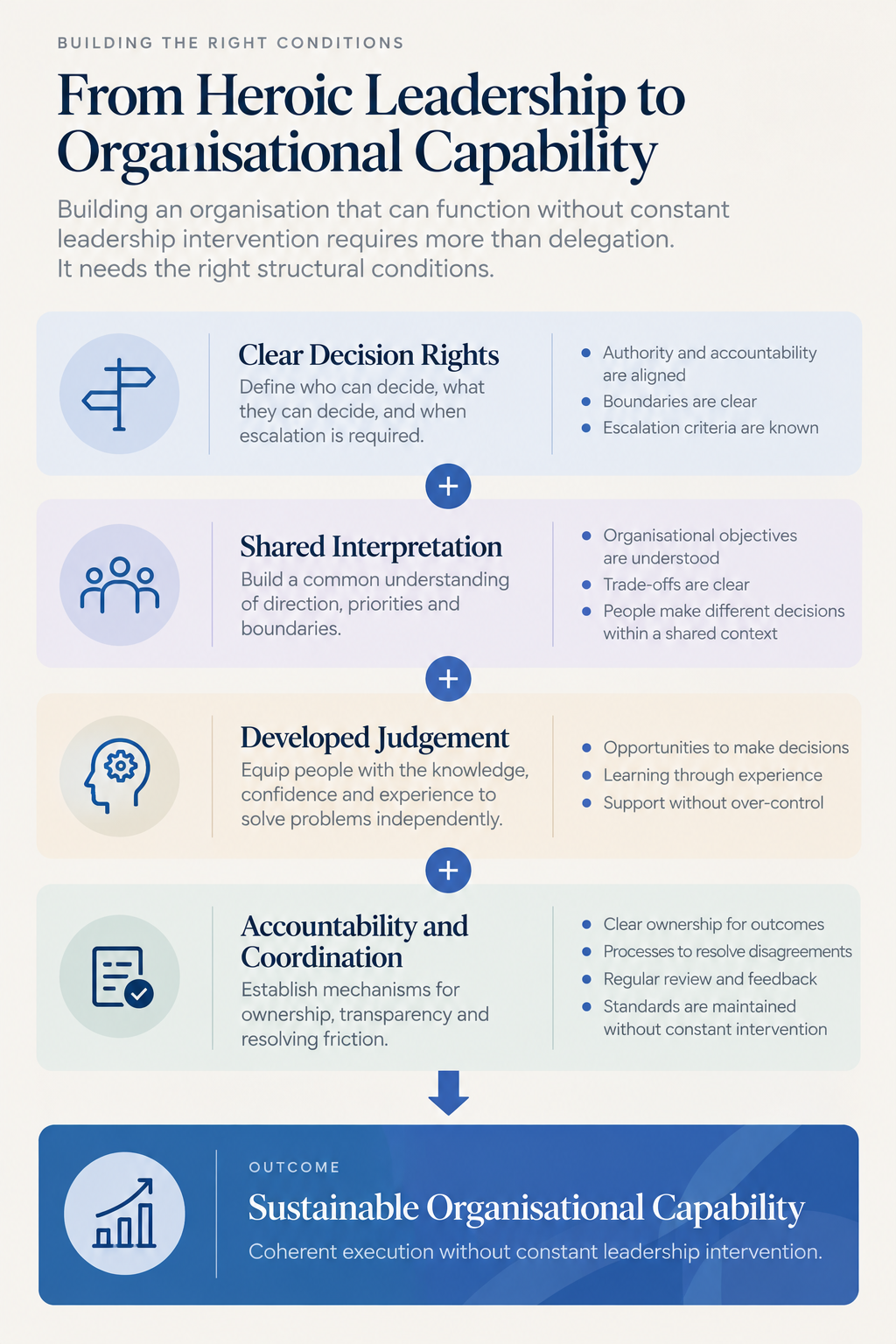
An organisation cannot develop genuine autonomy through encouragement alone.
People need the conditions that make independent judgement possible.
Clarity Before Autonomy
Employees must understand what they are responsible for, which decisions they can make, and when escalation is necessary.
Without this clarity, autonomy becomes uncertainty.
A manager may be told to take ownership but remain unsure whether a decision will be supported.
An employee may be encouraged to act independently but discover that approval is still expected.
Delegation becomes meaningful only when authority, accountability, and expectations are aligned.
Shared Interpretation Before Decentralisation
An organisation cannot function coherently simply because everyone has permission to make decisions.
People must also understand the direction within which those decisions should be made.
What matters most?
Which priorities take precedence when resources are limited?
What risks are acceptable?
What principles should guide trade-offs?
Without shared interpretation, independent decisions can produce fragmented execution.
Teams may act confidently while moving in different directions.
The objective is not to eliminate differences in judgement.
It is to establish sufficient coherence that people can make different decisions without undermining the organisation's overall direction.
Capability Before Expectation
Leaders sometimes become frustrated when employees fail to demonstrate initiative.
But initiative requires more than willingness.
It requires the knowledge, judgement, confidence, and authority to act.
These capabilities develop through experience.
Leaders must therefore be prepared to allow employees to make decisions that may differ from their own preferences.
They must distinguish between an unacceptable decision and a reasonable decision they would not personally have made.
They must also recognise that learning involves uncertainty and, occasionally, mistakes.
This does not mean abandoning standards.
It means developing people to meet those standards without requiring constant supervision.
Accountability Without Constant Intervention
Accountability does not require leaders to control every decision.
It requires clear expectations, appropriate authority, transparent outcomes, and meaningful review.
When something goes wrong, the leader's response matters.
If every mistake results in authority being withdrawn, employees will learn to avoid taking responsibility.
If mistakes are ignored, accountability loses meaning.
The challenge is to maintain standards while preserving opportunities for judgement and learning.
This requires leaders to examine not only what went wrong, but why.
Was the decision unreasonable?
Was the employee insufficiently prepared?
Were expectations unclear?
Or did the organisational system create conditions in which a poor decision became more likely?
Different causes require different responses.
Treating every failure as an individual performance problem may leave the underlying organisational weaknesses untouched.
A Diagnostic Question: What Happens When the Leader Is Absent?
One of the simplest ways to examine organisational dependency is to consider what happens when a leader is unavailable.
Not for an afternoon.
But for a meaningful period.
Which decisions would stop?
Which disagreements would remain unresolved?
Which employees would become uncertain about their responsibilities?
Which projects would lose direction?
And which activities would continue without difficulty?
The purpose of these questions is not to determine whether the leader is important.
Leadership should matter.
The purpose is to understand how the leader matters.
Does the leader provide strategic direction, develop capability, maintain accountability, and strengthen coordination?
Or does the organisation depend on the leader to perform functions that should already exist within its operating structure?
These are very different forms of dependence.
Some decisions legitimately require senior authority.
Some situations require specialised expertise.
And during a crisis, centralised leadership may be necessary.
The concern arises when routine organisational functioning depends on the continued availability of one individual.
If the organisation cannot make ordinary decisions without the leader, the issue may not be the employees' lack of initiative.
It may be the organisation's lack of decision architecture.
The LUCID Perspective: From Individual Strength to Organisational Coherence
At LUCID Methods, leadership effectiveness is considered in relation to the conditions it creates within the organisation.
Clarity, alignment, accountability, and execution cannot depend entirely on the continued intervention of a single individual.
They must become part of how the organisation functions.
A leader may create temporary alignment by personally resolving disagreements.
But sustainable alignment requires shared interpretation.
A leader may accelerate execution by making decisions for others.
But sustainable execution requires clear authority and coordinated decision-making.
A leader may maintain accountability through constant supervision.
But sustainable accountability requires ownership, appropriate authority, and consistent expectations.
This is the difference between maintaining performance through individual effort and building the organisational capability to sustain performance.
Heroic leadership can create the appearance of coherence.
But if that coherence disappears when the leader steps away, it has not been sufficiently embedded within the organisation.
The leader has been compensating for the system rather than strengthening it.
The objective is therefore not to make leadership unnecessary.
It is to ensure that leadership creates conditions in which the organisation can function coherently without continuous personal intervention.
The value of leadership should increasingly be reflected in the capability of the organisation, not the indispensability of the individual.
Leadership Requires Knowing When Not to Intervene
For some leaders, the most difficult part of developing organisational capability is resisting the temptation to provide the answer.
It can be uncomfortable to watch someone take longer to reach a conclusion.
It can be frustrating when a manager chooses a different approach.
It can feel inefficient to allow a team to work through a disagreement that the leader could resolve in minutes.
But not every delay is waste.
Not every difference in judgement is a problem.
And not every situation requires the leader's intervention.
Sometimes, stepping back allows employees to develop the confidence and judgement they need.
Sometimes, asking a question creates more value than providing an answer.
And sometimes, allowing a team to resolve its own difficulties reveals whether the organisation's structures and expectations are sufficiently clear.
Of course, stepping back must not become an excuse for avoiding responsibility.
Leaders remain accountable for creating the conditions in which others can succeed.
They must intervene when risks exceed acceptable boundaries, when authority is insufficient, or when unresolved issues threaten wider organisational outcomes.
The distinction lies in whether intervention strengthens future capability or merely restores immediate performance.
A useful question for leaders to ask is:
Am I intervening because the organisation genuinely needs my authority, or because it is easier for me to provide the answer?
The answer may be uncomfortable.
But it can reveal whether leadership behaviour is enabling or limiting organisational development.
The Real Measure of Leadership
There will always be situations that require decisive leadership.
Organisations face crises, uncertainty, competing priorities, and difficult decisions.
Strong leaders must be prepared to act when necessary.
But the ability to intervene should not become the foundation upon which the organisation depends.
An organisation that requires constant rescuing has not necessarily developed strong leadership.
It may simply have become accustomed to being rescued.
The more meaningful question is what remains after the leader steps away.
Can people make sound decisions?
Can teams resolve disagreements?
Can managers exercise authority without repeatedly seeking reassurance?
Can the organisation maintain direction, accountability, and execution without continuous intervention?
If the answer is yes, the leader has contributed something more enduring than personal performance.
They have helped build organisational capability.
And that may be the more difficult achievement.
Because heroic leadership makes the leader visible.
Effective leadership makes the organisation capable.
The ultimate measure of leadership is not how much the organisation needs the leader today.
It is how much stronger the organisation has become because of their leadership.
Part of the Leadership & Culture Series from LUCID Methods.
Explore more frameworks, diagnostic perspectives, and systems-thinking insights through the LUCID Method — developed to help organisations build clarity, coherence, and transformation that holds over time.