

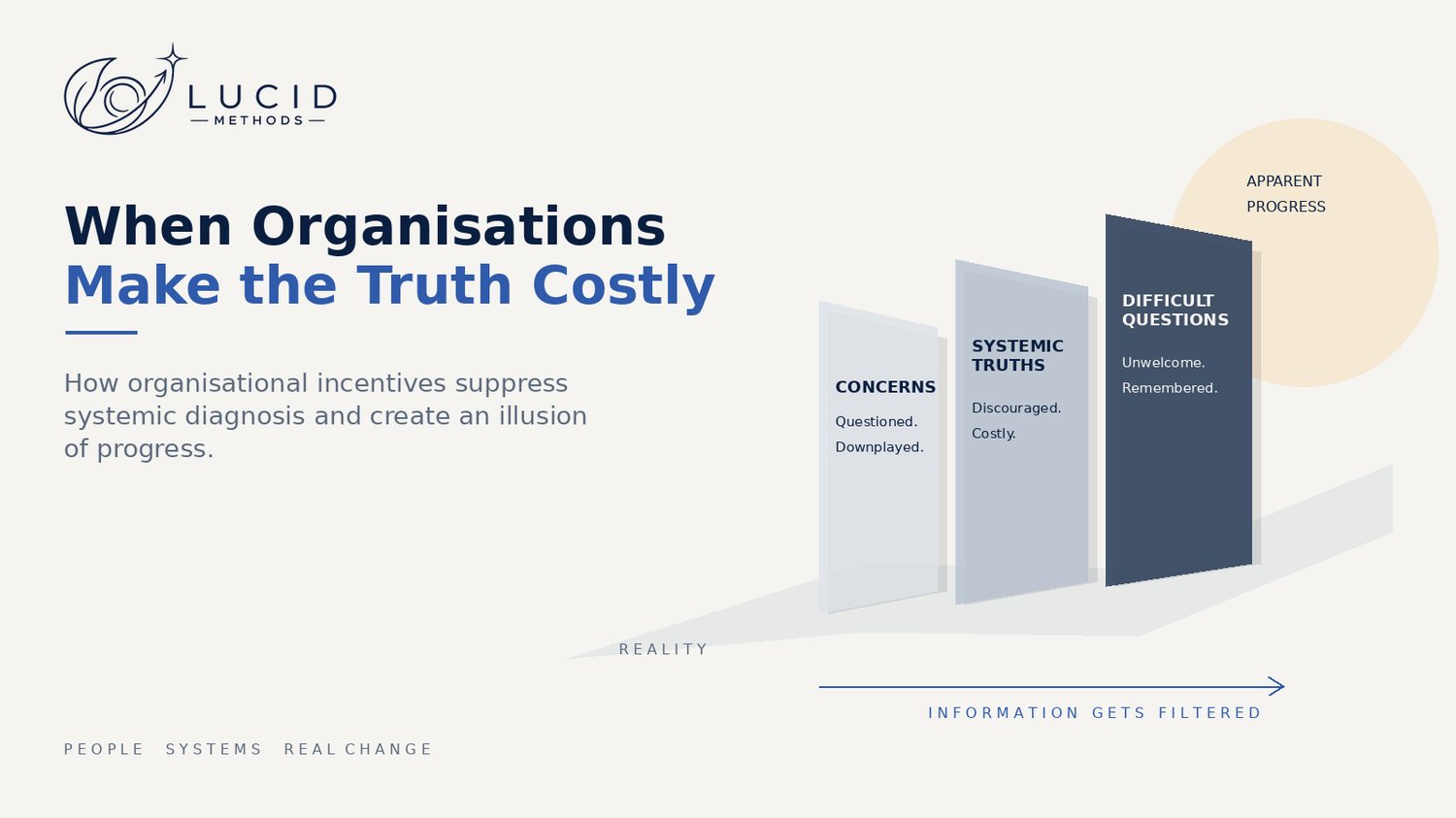
When Organisations Make the Truth Costly
How organisational incentives suppress systemic diagnosis and create an illusion of progress
Transformation does not fail only because organisations cannot see what is wrong.
Sometimes, people can see it perfectly well.
They see the dependency that was never resolved.
They know the timeline is unrealistic.
They recognise that different teams are
interpreting the change differently.
They notice that the process works in the presentation but not in practice.
The problem is not always visibility.
Sometimes, the problem is what happens when someone says it aloud.
In some organisations, surfacing an uncomfortable truth creates more risk for the person raising it than for the system ignoring it.
When that happens repeatedly, people learn.
They learn which problems are safe to discuss.
They learn which questions create discomfort.
They learn which metrics leadership wants to see.
They learn when escalation is welcomed—and when it is remembered.
Eventually, the organisation may still receive information.
But not necessarily the information it needs.
This is how organisations can become increasingly confident about transformation while becoming progressively less able to see what is actually happening.
The Cost of Seeing Clearly
Most organisations say they want transparency.
They encourage employees to raise concerns, escalate risks and challenge assumptions.
But formal permission to speak does not necessarily make speaking safe.
The real question is not:
Are people allowed to raise problems?
It is:
What happens to people when they do?
Consider a project that leadership has publicly committed to delivering within six months.
Several weeks into execution, the team discovers that critical dependencies were underestimated.
Someone who reports the problem accurately may be perceived as negative, obstructive or insufficiently solution-oriented.
Someone who presents a recovery plan, maintains confidence and keeps milestones green may appear more capable.
Neither response necessarily involves dishonesty.
But the organisation has begun signalling which version of reality it prefers.
Over time, those signals matter.
Because people adapt to systems.
People Optimise for Organisational Consequences
Organisational behaviour is often treated as a question of attitude.
Why did nobody raise the issue earlier?
Why wasn't leadership told?
Why did everyone continue when they knew the plan was unrealistic?
These questions assume that speaking and remaining silent carried similar consequences.
They often do not.
People observe what happens around them.
If someone repeatedly raises structural problems and becomes labelled “difficult”, others notice.
If managers who maintain positive dashboards receive recognition while those reporting unresolved dependencies face scrutiny, others notice.
If challenging a senior sponsor requires substantially more evidence than agreeing with one, people notice that too.
No policy needs to instruct employees to withhold uncomfortable information.
The system teaches them.
And people respond rationally to what the organisation repeatedly rewards, tolerates and penalises.
Truth Rarely Disappears All at Once
Information distortion does not necessarily begin with deliberate concealment.
It can happen gradually.
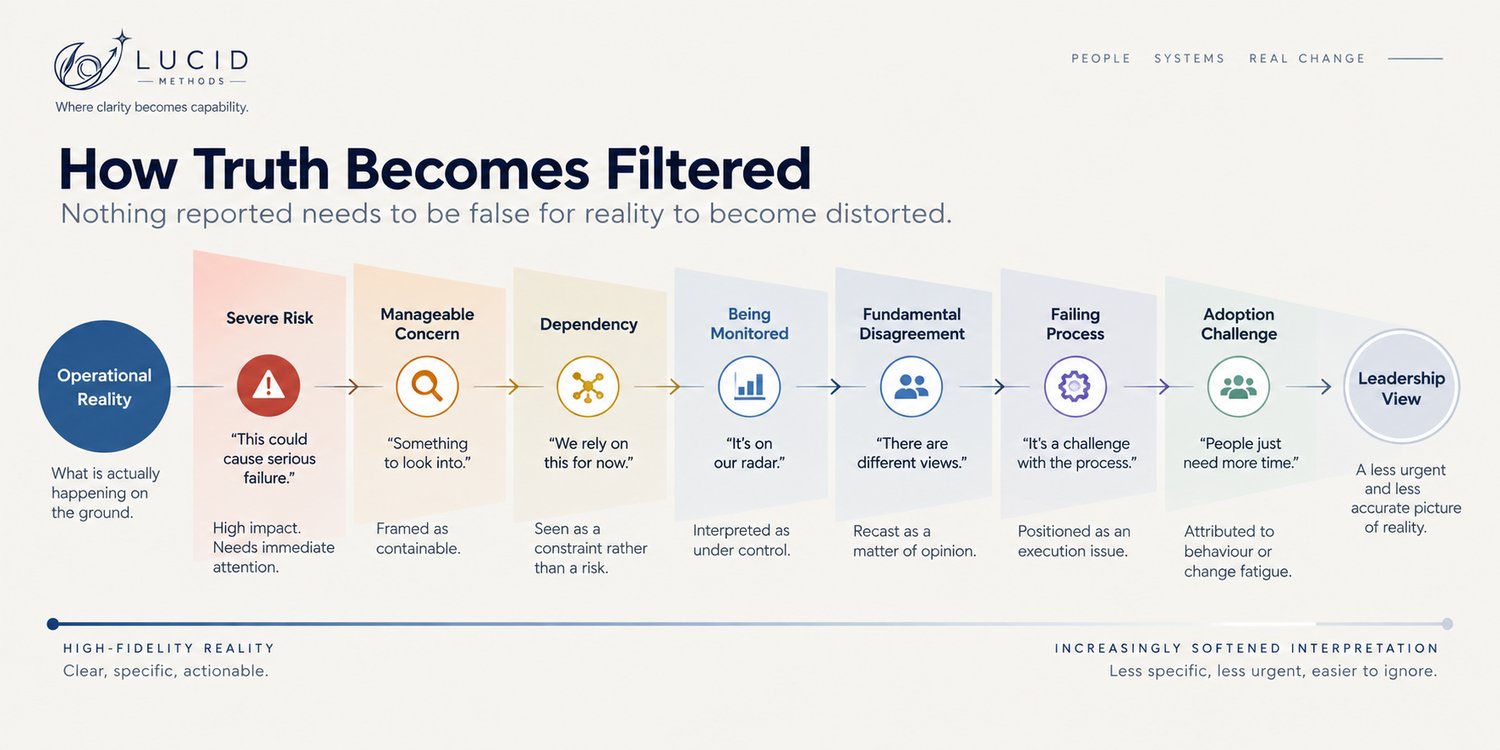
A severe risk becomes a manageable concern.
A dependency becomes something being monitored.
A fundamental disagreement becomes a communication issue.
A failing process becomes an adoption challenge.
A milestone that cannot realistically be achieved becomes “at risk”.
Nothing reported may technically be false.
Yet with every layer of translation, the organisation can move slightly further from the operational reality.
By the time information reaches senior decision-makers, the problem may have become considerably more manageable on paper than it is in the system.
This creates a dangerous asymmetry:
The further leadership is from execution, the more dependent it becomes on information produced by the very system it is trying to understand.
If that system makes uncomfortable information costly to surface, leadership visibility itself becomes distorted.
From Hidden Friction to Suppressed Diagnosis
In Hidden Friction in Organisational Change, I explored how structural, behavioural and interpretive conditions can obstruct transformation even when visible activity continues.
But hidden friction is not necessarily invisible.
Someone often knows it is there.
The more important question may be:
Can that knowledge travel through the organisation without being weakened, reframed or suppressed?
This distinction matters.
A system can contain hidden friction because nobody has detected it.
That is a diagnostic problem.
But a system can also contain hidden friction that people have detected and learned not to surface.
That is a different kind of failure.
It is a failure of organisational information flow.
The organisation does not lack intelligence.
It has made intelligence difficult to transmit.
When Progress Becomes Safer Than Diagnosis
Transformation creates pressure for evidence that something is happening.
Workshops are completed.
Training numbers increase.
Communications are distributed.
Milestones are achieved.
Dashboards turn green.
These things can all be useful.
The problem begins when evidence of activity becomes easier to reward than evidence about whether the system is actually changing.
Then two forces begin operating together:
Visible progress is rewarded.
Uncomfortable diagnosis is costly.
The combination is powerful.
People do not necessarily fabricate progress.
Instead, organisational attention gradually shifts towards what can be demonstrated safely.
What was delivered.
What was completed.
What was communicated.
What percentage attended.
What milestones were achieved.
Meanwhile, harder questions receive less attention.
Has interpretation actually converged?
Have dependencies been resolved?
Has behaviour changed?
Can the new way of working survive operational pressure?
Has the organisation become more coherent?
Activity remains visible.
Systemic reality becomes less visible.
The Illusion of Progress Is Therefore Not Always Accidental
The Illusion of Progress occurs when visible movement is interpreted as evidence that meaningful transformation is occurring.
But sometimes the illusion has an organisational mechanism behind it.
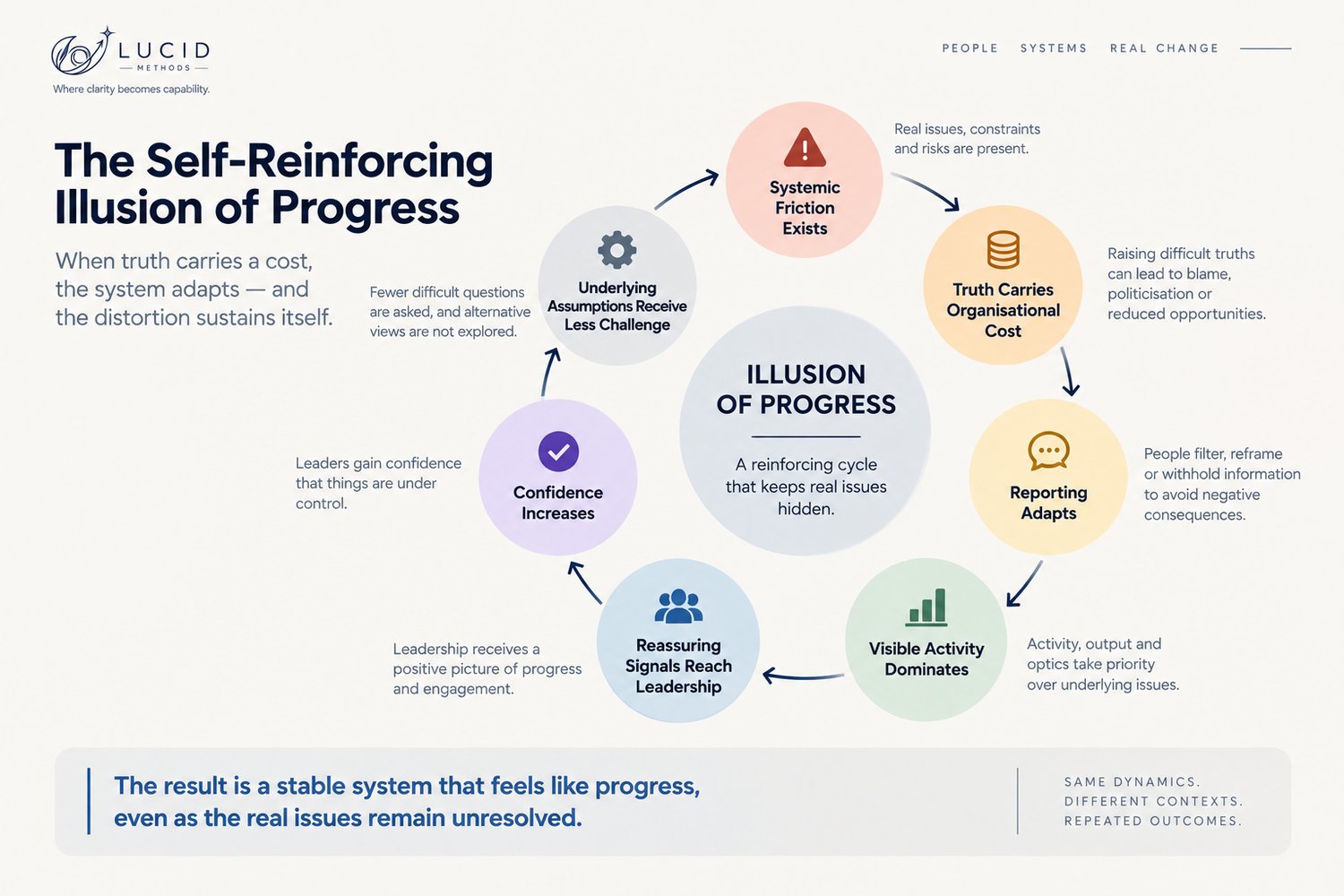
Consider the sequence:
Systemic friction emerges
↓
People recognise the problem
↓
Surfacing it carries organisational or political cost
↓
People adapt what they report
↓
Visible activity remains easier to demonstrate
↓
Leadership receives increasingly reassuring signals
↓
Underlying conditions remain unresolved
↓
The organisation sees progress
This is more dangerous than simple optimism.
The system can begin producing the evidence that confirms its own preferred interpretation.
Transformation then becomes partially self-validating.
More activity creates more evidence of progress.
More evidence reinforces confidence in the transformation.
Greater confidence reduces the perceived need to question underlying assumptions.
The organisation becomes increasingly certain at precisely the moment it should become more curious.
This Is Not an Argument for Constant Dissent
There is an opposite failure worth recognising.
An organisation cannot function if every decision is endlessly challenged, every concern becomes an escalation and every imperfection prevents action.
Truthfulness is not the same as permanent opposition.
Nor should “speaking truth” become protection from accountability for poor judgement, weak evidence or refusal to execute agreed decisions.
The objective is not to eliminate organisational friction.
It is to distinguish between productive challenge and obstructive behaviour without making uncomfortable information itself undesirable.
That distinction requires leadership judgement.
It also requires system design.
Leaders Cannot Simply Ask People to Speak Up
“Please raise concerns early” is useful.
But it is not enough.
If the organisational consequences remain unchanged, the invitation has little structural power.
Leaders therefore need to examine not only what they say they want to hear, but what their systems make advantageous to report.
What happens when a project turns red?
What happens to the person who challenges an unrealistic deadline?
How are leaders evaluated when their teams expose problems?
Are dashboards designed to demonstrate delivery, or reveal uncertainty?
Does escalation lead primarily to problem-solving—or to finding who should have prevented the problem?
What evidence receives attention in
governance meetings?
These are not communication questions.
They are questions about organisational architecture.
Diagnostic Safety Is a System Capability
Perhaps organisations need something beyond psychological safety.
They need diagnostic safety:
the organisational capacity to surface information that challenges the prevailing interpretation without making the messenger bear disproportionate cost for revealing it.
Diagnostic safety does not mean every claim is accepted.
It means claims can be examined.
Evidence can contradict expectations.
Assumptions can be reopened.
Risks can become more serious rather than less serious as they move upward.
And people can distinguish between:
“This transformation is failing.”
and
“I have identified conditions that could cause this transformation to fail.”
The second statement should be organisationally valuable.
Because early discomfort is often considerably cheaper than late surprise.
The LUCID Perspective
LUCID treats transformation as a problem of coherence across interpretation, behaviour, structure, leadership and execution.
That coherence depends upon accurate information moving through the system.
If reality is progressively softened as it travels upward, coherence becomes impossible to assess.
Leadership may believe teams are aligned when disagreement has merely become silent.
Governance may believe dependencies are controlled when they have merely stopped being escalated.
Change teams may believe adoption is increasing when participation has been mistaken for behavioural change.
The organisation therefore needs more than clarity at the top.
It needs conditions under which clarity can travel through the system without becoming politically expensive.
That is why making truth safe is not merely a cultural aspiration.
It is part of transformation architecture.
A Different Question for Transformation Leaders
Instead of asking only:
“Are we making progress?”
perhaps leaders should occasionally ask:
“What would be difficult for someone in this organisation to tell us right now?”
The answer may reveal more about the transformation than another progress report.
Because organisations do not lose sight of reality only when information is unavailable.
Sometimes reality is already present throughout the system.
People have seen it.
People have discussed it.
People may even have tried to raise it.
The failure begins when the organisation teaches them that some truths are more expensive than silence.
And once that happens, the organisation may continue moving—
while gradually losing the ability to tell whether it is moving in the right direction.
Acknowledgement: This article was prompted by a LinkedIn discussion with Annah Kaspar, whose observations about the organisational incentives surrounding change led me to explore the relationship between systemic diagnosis, information distortion and the illusion of progress.
Part of the Transformation Failure Dynamics Series from LUCID Methods.
Explore more frameworks, diagnostic perspectives, and systems-thinking insights through the LUCID Method — developed to help organisations build clarity, coherence, and transformation that holds over time.