

Why Difficult Questions Require Leadership Readiness
“Any questions?”
It is a familiar invitation at the end of a leadership presentation.
Someone raises a hand.
“Why are we proceeding when the teams responsible for delivery have not agreed on who owns the exceptions?”
The question creates a pause.
The plan has been presented,
the timeline has been shared,
and the room was beginning to move towards agreement.
The leader now has a choice.
They can examine the ownership gap, or they can explain why everyone needs to move forward.
Neither response is necessarily hostile. But each tells the organisation something about what happens when new information challenges an established direction.
The real test is whether the question is allowed to influence the decision.
Difficult questions expose a point of tension
Some questions are difficult because the answer is unknown.
Others are difficult because the answer may already be visible, but acknowledging it would create an obligation.
“Who owns the exceptions?” may mean that work has been left between two departments.
“Why did we not consult the frontline team?” may mean that the people most affected were brought in after the decision was made.
“Will this target increase waiting times?” may mean that one measure of success is being achieved at the expense of another.
The discomfort comes from the possibility that the question is valid. If it is, the leader may need to revise a plan, explain a trade-off or accept that an earlier assurance was premature.
That is why difficult questions require readiness. The leader has to be prepared for the answer to matter.
An invitation is not the same as readiness
Organisations often encourage employees to speak up. Leaders ask for feedback, hold town halls and leave time for questions.
Those practices create opportunities to speak. They do not determine what happens to the information people provide.
Imagine a team member asks how customers who need assistance will use a new self-service process. The leader thanks them and says, “We will make sure no one is left behind.”
The response sounds reassuring. Yet the team still does not know how assistance will be provided, who will provide it or whether staffing levels can support it.
The question has been acknowledged without being examined.
If this happens often enough, employees learn to distinguish between being permitted to ask and being able to affect the work. They may continue attending discussions while withholding the detail that could improve a decision.
Leadership can then mistake participation for meaningful input.
The pressure to preserve coherence
A leader may have good reasons for wanting to maintain momentum.
A deadline has been agreed.
Other teams are waiting. Senior stakeholders expect progress.
A difficult question can threaten the coherent account the leader has worked to build: the problem is understood, the plan addresses it, and delivery is under control.
The temptation is to protect that account.
A leader may answer at the level of intention: “We have considered the operational impact.” They may point to the amount of work already completed. Or they may suggest that the person raising the issue is reluctant to change.
These responses can make the plan appear settled without showing whether the concern has been resolved.
The distinction matters. A coherent presentation is not evidence of a coherent system. A plan can read well while ownership remains unclear, capacity is overstated or different teams understand the same instruction differently.
The question may be the first visible sign of that gap.
How questions become labelled as resistance
A concern does not always arrive in polished language.
Someone may say, “This won’t work,” when what they mean is that a specific step fails during the busiest hour of the day.
Another person may ask why a previous approach is being repeated when they have seen its consequences firsthand.
Their wording may be broad.
Their proposed alternative may be weak.
The underlying observation may still be useful.
When a leader responds to the manner of the question before investigating its basis, the organisation can turn information about execution into a judgment about attitude.
The concern becomes “resistance”.
The person becomes “difficult”.
The operational issue remains.
A more useful response is to ask what the person expects to happen and why.
“Walk me through the case you are
concerned about.”
That does not concede the point.
It gives both parties something concrete to test.
What silence can mean afterwards
A poorly handled question rarely produces an immediate announcement that people will stop speaking up.
The effect is quieter.
Next time, someone raises a less consequential question.
A colleague discusses the risk privately but leaves it out of the meeting.
A team creates a workaround instead of escalating a recurring problem.
From the leader’s perspective, the next discussion may seem smoother.
But the organisation has lost access to part of its own knowledge.
This is particularly costly during change.
The people closest to delivery often know where processes bend, where handovers fail and which exceptions occur more frequently than the plan assumes.
They cannot always see the wider strategic picture.
Leaders cannot always see the details of daily execution.
Questions connect those views.
If the connection weakens, both sides work with an incomplete picture.
Leadership readiness has three parts
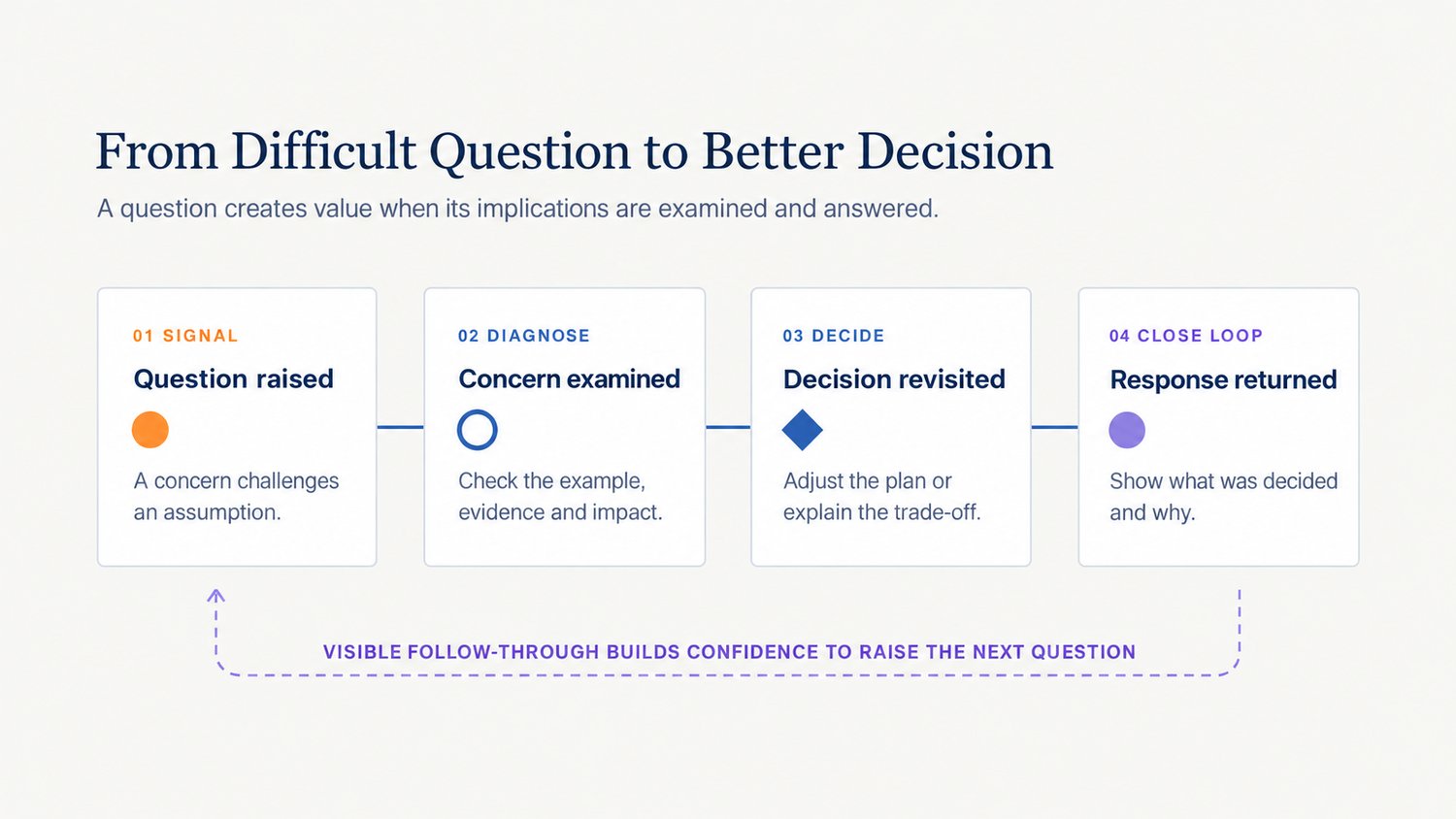
Readiness begins with the ability to receive a question without treating it as a verdict on the leader or the whole plan.
A question can be uncomfortable and still be useful.
The leader does not need to answer immediately.
They need to understand what is being raised.
Readiness then requires the ability to examine it.
What has the person observed?
Which assumption does the question test?
Who else can verify the concern? Is the issue a missing fact, an unclear responsibility or a genuine trade-off?
Finally, readiness requires the ability to respond with consequence.
The leader explains what was found, what will change or why the original decision stands.
If the leader promises to investigate and never returns, the organisation learns that questions can enter the conversation but do not reliably enter the decision process.
When the question changes nothing
Not every difficult question should change a decision.
A concern may be based on incomplete information.
A suggested solution may create a larger problem elsewhere.
The organisation may understand the risk and decide to accept it.
What matters is whether the leader can show how the issue was considered.
“We checked the cases you raised. They occur rarely, and the service team already has a process for handling them.
We are proceeding, but we will monitor those cases during the first month.”
Or:
“You are right that this will add work during the transition.
We cannot move the deadline, so we are reducing other demands on the team for those two weeks.”
Both responses make the reasoning visible.
They allow people to understand the decision even if it is not the one they preferred.
An unexplained dismissal leaves them to guess whether the concern was considered at all.
Prepare for the implications before inviting the question
Leaders can prepare more honestly by asking what they are willing and able to do with the answers they receive.
Which parts of the plan can still change?
Which constraints are fixed?
Who has authority to resolve issues that cross departments?
How will concerns be recorded, investigated and answered?
These are practical questions.
They prevent a leader from inviting open discussion when there is no route for the information to affect the work.
They also make it possible to set clear expectations.
If the strategic direction is settled, the leader can ask where implementation may fail. If the decision is still open, they can explain what evidence will inform it.
If there is a fixed constraint, they can name it rather than allowing people to assume it is negotiable.
Clarity about the boundaries of a discussion makes the invitation more credible.
The question behind the question
When a difficult question is raised, leaders may hear, “Is your plan wrong?”
The more useful question is often:
“What does this reveal that the plan does not yet account for?”
Sometimes the answer is a missing detail.
Sometimes it is a conflicting priority.
Sometimes it is a gap between what leadership believes has been agreed and what teams are actually prepared to deliver.
Those gaps are easier to address before execution exposes them.
Leadership readiness is visible in what happens at that point.
It is the willingness to let reality inform the plan, even after the plan has been presented with confidence.
An organisation does not become stronger because its leaders have immediate answers to every difficult question. It becomes stronger when those questions can reveal what needs attention—and when someone is prepared to act on what they reveal.
Part of the Leadership & Culture Series from LUCID Methods.
Explore more frameworks, diagnostic perspectives, and systems-thinking insights through the LUCID Method — developed to help organisations build clarity, coherence, and transformation that holds over time.