

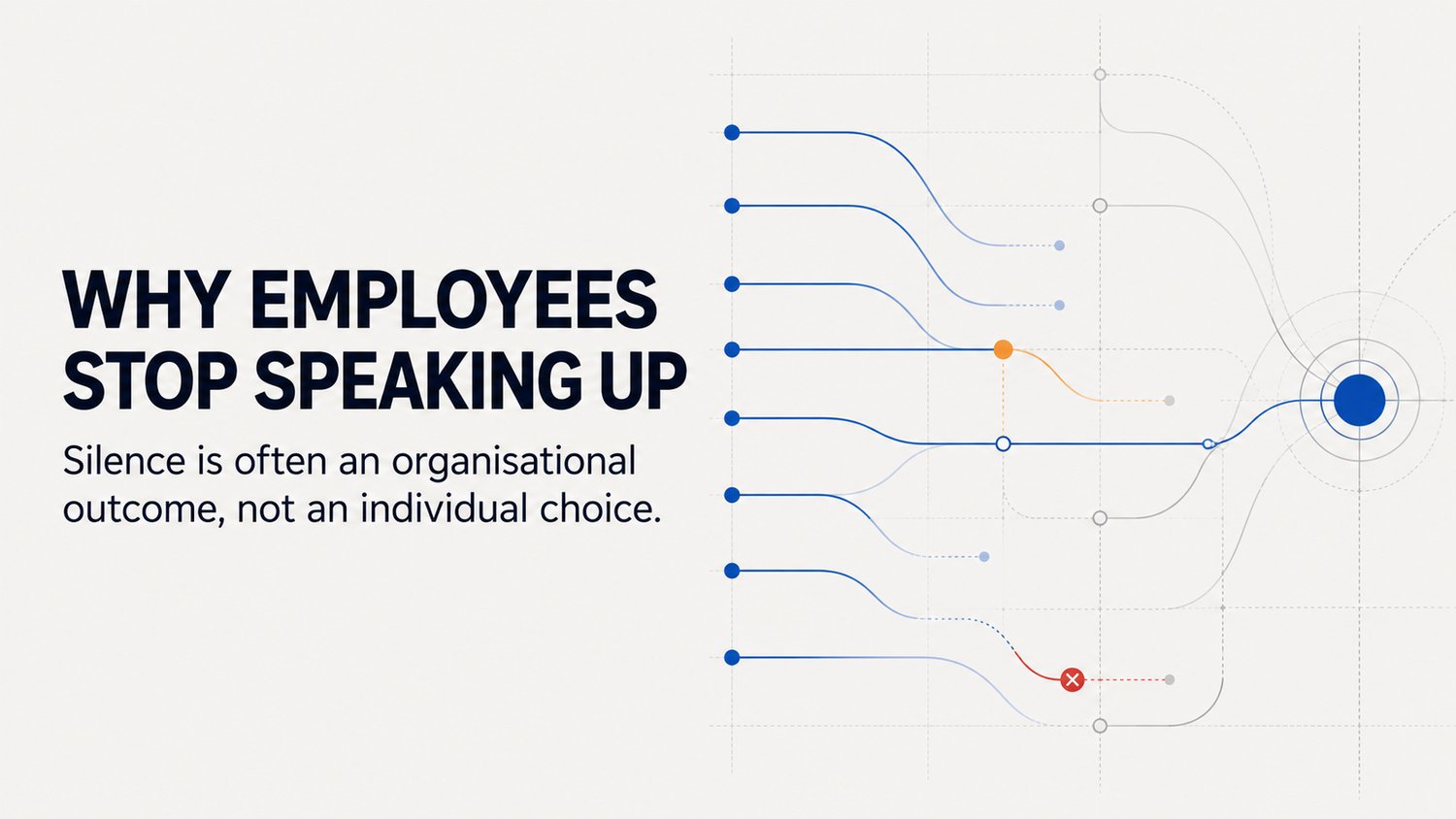
Why Employees Stop Speaking Up
Silence is often an organisational outcome, not an individual choice
A quiet meeting can look like agreement.
A lack of questions can look like clarity.
Few complaints can look like satisfaction.
But silence does not necessarily mean that people have nothing to say.
Sometimes, it means they have learned that saying it changes nothing.
Employees rarely stop speaking up because they suddenly stop noticing problems.
They still see the flawed process, the unrealistic deadline, the customer frustration, the decision that does not quite make sense.
What changes is their calculation of whether speaking is worth it.
And that calculation is shaped by the organisation itself.
Silence Is Often Learned
Most employees do not arrive at work intending to remain silent.
They observe.
They watch what happens when someone questions a decision.
They notice whether concerns are explored or dismissed.
They see whether leaders become curious or defensive.
They remember whether previous feedback led to action, explanation—or nothing at all.
Over time, these experiences accumulate.
An employee raises a concern and is told they are being negative.
Someone challenges an assumption and becomes known as “difficult.”
A team is invited to provide feedback, but the decision has already been made.
People repeatedly identify the same problem, yet nothing changes and nobody explains why.
Each incident may appear minor in isolation.
Together, they teach a lesson:
Speaking up has a cost, but may have little value.
Once that lesson becomes established, silence becomes rational.
Employees Are Constantly Reading the System
When leaders ask, “Why didn’t anyone tell me?”, the answer may lie in what happened the last time someone tried.
Employees do not respond only to formal policies or leadership statements.
They respond to patterns.
An organisation may say:
“We welcome honest feedback.”
But employees also observe:
Who gets listened to?
What kinds of questions make leaders uncomfortable?
What happens to people who disagree?
Are difficult messages acknowledged—or quietly avoided?
Does raising a problem lead to curiosity, defensiveness or blame?
These experiences become signals.
And repeated signals eventually become expectations.
If leaders consistently demonstrate that difficult information is welcome, people learn that candour is possible.
If leaders repeatedly punish, dismiss or ignore it, people learn something else.
The organisation does not need to formally instruct employees to remain silent.
It only needs to make silence feel safer than speaking.
The Cost–Value Calculation of Speaking Up
Before raising a difficult issue, employees often make an implicit calculation.
What might this cost me?
Perhaps reputation.
Perhaps relationships.
Perhaps opportunities.
Perhaps simply the emotional effort of another uncomfortable conversation.
Then comes another question:
Will saying something make any difference?
This distinction matters.
Psychological safety is often discussed in terms of whether people feel safe enough to speak. But safety alone may not be sufficient.
People also need to believe that speaking has value.
An employee may feel perfectly safe expressing an opinion yet eventually stop doing so if every suggestion disappears into a void.
When the perceived cost of speaking rises while its perceived value falls, silence becomes increasingly attractive.
This is not necessarily disengagement.
It may be adaptation.
Invitation Is Not the Same as Permission
Leaders often try to encourage openness by saying:
“My door is always open.”
“Please challenge me.”
“I want everyone to speak freely.”
These invitations matter.
But employees judge permission less by what leaders say than by what leaders do when someone actually accepts the invitation.
The real test begins when the feedback is inconvenient.
When someone questions the preferred strategy.
When an employee points out a contradiction.
When a junior colleague challenges the assumptions of someone senior.
When the message creates discomfort rather than reassurance.
Leadership readiness is revealed at precisely these moments.
If openness is welcomed only when the message is comfortable, employees quickly discover the boundary.
They learn which conversations are genuinely open—and which are open only in principle.
What Happens After Someone Speaks Matters
Speaking up is not a single interaction between an employee and a leader.
It is also a public signal.
Others are watching.
Imagine someone raises a legitimate concern during a meeting.
The leader interrupts them, dismisses the issue and moves on.
The immediate effect involves one employee.
The organisational effect can be much larger.
Everyone else has just received information about what happens when difficult issues are raised.
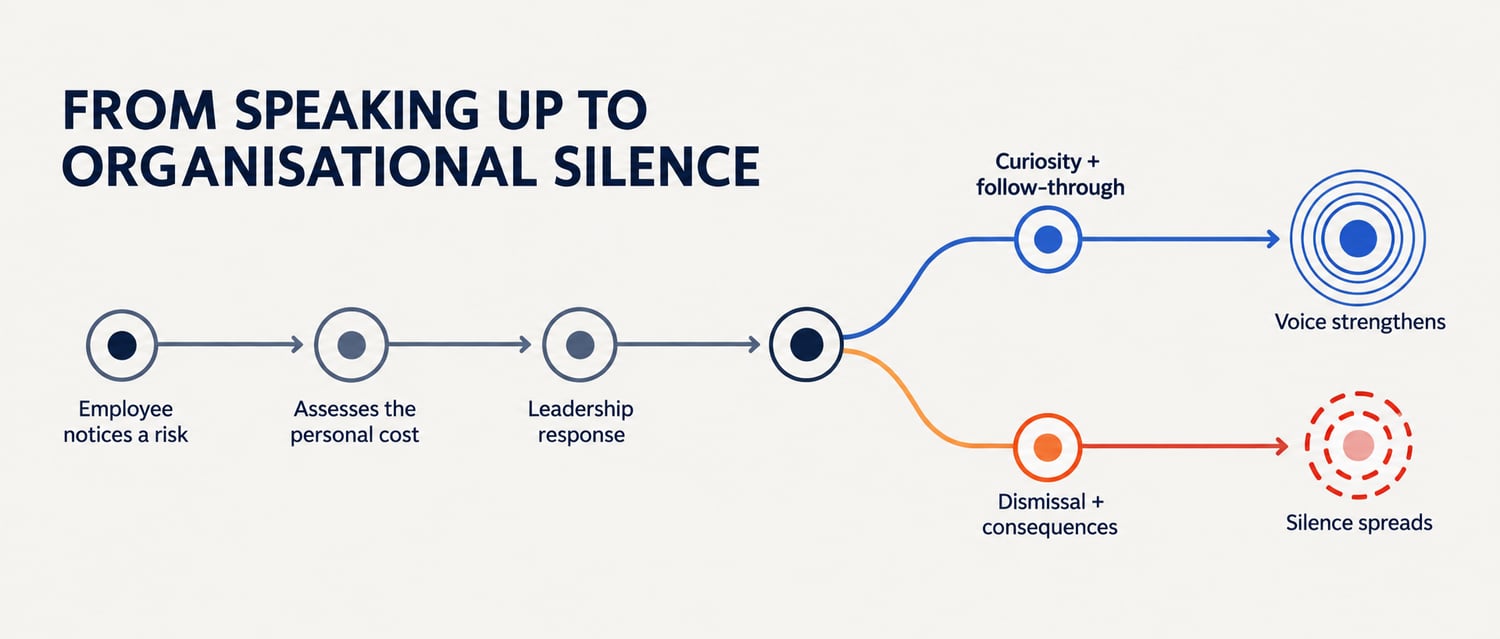
The opposite is also true.
A leader who pauses, asks questions, acknowledges uncertainty and follows up afterwards sends another signal:
Difficult information can enter this system without being punished.
This does not mean leaders must agree with every concern.
Listening is not agreement.
Psychological safety does not require every suggestion to be implemented.
But people need to see that speaking leads somewhere.
Sometimes that means action.
Sometimes it means investigation.
Sometimes it simply means a clear explanation of why the organisation has chosen not to act.
What damages trust is often not rejection itself.
It is disappearance.
Silence Can Become Self-Reinforcing
Once employees begin withholding concerns, leaders receive less information.
With less information, leaders may conclude that things are going well.
That conclusion reinforces existing decisions.
Employees then observe that leadership appears increasingly disconnected from what they are experiencing.
So they speak even less.
A reinforcing cycle develops:
Concerns are discouraged
→ fewer concerns are raised
→ leaders see fewer problems
→ leaders assume greater alignment
→ employees become even less willing to speak.
Eventually, organisational silence can create the appearance of coherence while concealing growing misalignment underneath.
By the time the problem becomes visible through turnover, customer complaints, project failure or declining performance, the organisation may ask:
“Why did nobody say anything?”
Someone may have.
The system simply stopped hearing them.
Restoring Voice Requires More Than Asking for Feedback
Leaders sometimes interpret the absence of disagreement as evidence that a team is aligned.
That assumption can be dangerous.
Healthy teams are not necessarily quiet teams.
They may contain disagreement, difficult questions and competing perspectives.
What distinguishes them is not the absence of tension, but the ability to process tension without turning it into interpersonal threat.
A team that never disagrees may indeed be highly aligned.
Or it may have learned that disagreement is pointless.
From the outside, these conditions can look remarkably similar.
The difference becomes visible only when leaders examine how the organisation responds to dissent.
Restoring Voice Requires More Than Asking for Feedback
Once silence has become learned behaviour, another survey or town hall may not be enough.
Employees need evidence that the conditions have changed.
That evidence is built through repeated leadership behaviour.
Leaders can begin by examining several questions:
- What happens when someone tells us something we do not want to hear?
- Do we distinguish disagreement from resistance?
- Do employees know what happened to the concerns they previously raised?
- Are leaders visibly willing to reconsider their own assumptions?
- When we cannot act on feedback, do we explain why?
- Are people rewarded for surfacing risks early—or blamed for bringing bad news?
- Do senior leaders receive the same version of reality experienced by people closer to the work?
These questions move the conversation away from:
“Why aren't employees speaking?”
towards a more useful question:
“What has the organisation taught people about speaking here?”
Silence Is Organisational Data
Employee silence should not automatically be interpreted as apathy.
It can be information.
It may indicate fear.
It may indicate futility.
It may reflect exhaustion after repeated attempts to be heard.
Or it may simply indicate that employees have learned how the system works.
That makes silence a leadership diagnostic.
When people stop raising problems, leaders should resist the temptation to focus only on the behaviour of those who became quiet.
The more important question is what conditions made quietness sensible.
Because organisations shape behaviour not only through policies and instructions, but through repeated experience.
People notice what is welcomed.
They notice what is ignored.
They notice what carries consequences.
And eventually, they adapt.
The LUCID Perspective
At LUCID Methods, organisational coherence is not simply alignment between strategy, processes and stated values.
It is also alignment between what leaders say they want and what the system teaches people to do.
An organisation cannot credibly say it values openness while repeatedly discouraging difficult conversations.
It cannot ask employees to raise risks while penalising those who bring inconvenient information.
It cannot claim to value learning while treating questions as resistance.
When these contradictions persist, employees do not necessarily challenge them forever.
They adapt to them.
And sometimes that adaptation looks like silence.
The challenge for leaders, therefore, is not simply to encourage people to speak.
It is to create an environment in which speaking remains worthwhile.
Because when employees stop speaking up, the organisation does not merely lose voices.
It loses information about itself.
Part of the Leadership & Culture Series from LUCID Methods.
Explore more frameworks, diagnostic perspectives, and systems-thinking insights through the LUCID Method — developed to help organisations build clarity, coherence, and transformation that holds over time.