

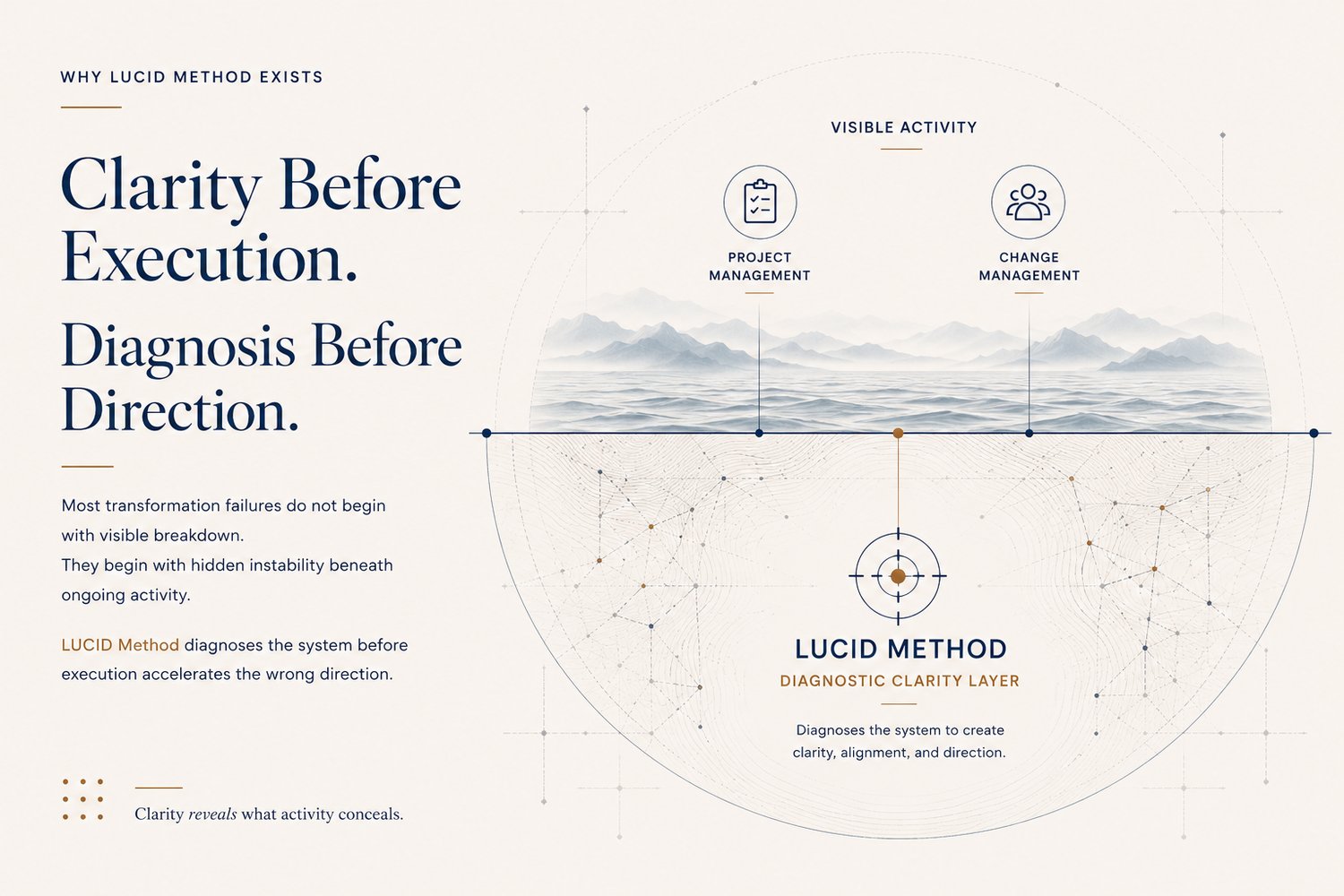
Why LUCID Method Exists
Most organisations already have project managers.
Many already have change management frameworks, transformation offices, agile coaches, governance systems, and implementation playbooks.
Yet transformation failure remains persistently high.
The issue is rarely the absence of activity.
The issue is that organisations often begin executing before they fully understand the conditions they are operating within.
Projects continue moving.
Meetings continue happening.
Communication increases.
Roadmaps expand.
But beneath visible activity, hidden instability accumulates quietly through fragmented interpretation, unresolved friction, misaligned assumptions, behavioural resistance, structural ambiguity, and execution drift.
By the time failure becomes visible, the underlying conditions have often been forming for months or years.
The Limitation of Conventional Approaches
Project Management Focuses on Execution
Traditional project management disciplines are designed to coordinate delivery:
- timelines
- milestones
- resources
- dependencies
- governance
- implementation tracking
These systems are essential.
But project management assumes the organisation already understands:
- what problem it is solving
- where instability exists
- where alignment is weakening
- whether the system itself is structurally ready for change
Execution can therefore become highly organised while still accelerating the wrong direction.
Change Management Focuses on Adoption
Change management frameworks help organisations:
- communicate change
- manage stakeholder engagement
- support behavioural transition
- reduce resistance
- improve adoption
These functions are also necessary.
But many resistance patterns are not communication problems alone.
People often resist because:
- priorities conflict
- incentives misalign
- trust has degraded
- ownership remains unclear
- interpretation differs across teams
- operational friction accumulates beneath the surface
Without diagnosing these deeper structural conditions, organisations may attempt to “manage change” while the underlying instability remains unresolved.
Where LUCID Method Operates
LUCID Method operates at a different layer.
It is not designed to replace project management or change management.
It exists to help organisations diagnose:
- why execution weakens
- where coherence begins fragmenting
- how hidden friction accumulates
- where interpretation diverges beneath apparent alignment
- why transformation collapses despite sustained activity
The method focuses on diagnostic clarity before escalation.
Because organisations rarely fail from lack of effort alone.
They fail when activity continues while structural instability remains unseen.
Three Different Questions
Project Management
Core Question:
Are we executing effectively?
Change Management
Core Question:
Are people adapting successfully?
LUCID Method
Core Question:
Are we correctly diagnosing the system we are trying to change?
Why Diagnostic Clarity Matters
Most transformation failures do not occur suddenly.
Failure accumulates gradually through:
- interpretive drift
- fragmented ownership
- attention decay
- hidden dependency strain
- behavioural friction
- unresolved systemic contradictions
The visible breakdown appears late.
The instability begins much earlier.
LUCID Method was developed to help organisations identify these conditions before collapse becomes measurable at the surface.
Because clarity is not communication alone.
Clarity is shared interpretation held consistently across the system.
LUCID Method Is Designed For
LUCID Method is designed for leaders, consultants, operators, strategists, and transformation teams who need to:
- diagnose hidden execution failure patterns
- understand organisational friction more clearly
- improve alignment across complex systems
- reduce behavioural and operational instability
- strengthen long-term transformation coherence
- move beyond surface-level transformation activity
It is not a replacement for execution frameworks.
It is a diagnostic system for understanding why execution becomes unstable in the first place.
Part of the Foundations Thinking Series from LUCID Methods.
Explore more frameworks, diagnostic perspectives, and systems-thinking insights through the LUCID Method — developed to help organisations build clarity, coherence, and transformation that holds over time.