

Why Middle Management Determines Success—and When It Becomes the Bottleneck
A leadership team agrees on a new direction.
The priorities are announced.
The presentation is clear.
Department heads acknowledge what needs to change.
Yet, several months later, familiar patterns remain.
Teams continue to protect their own targets.
Decisions move slowly between departments.
Employees receive different explanations of what matters.
Problems surface only after they have become difficult to contain.
From the top, this may look like resistance.
From the frontline, it may feel like another initiative competing with the work already underway.
Between these perspectives sits middle management.
This is where organisational direction encounters operational reality.
Where broad intentions become decisions about time, resources, exceptions and behaviour.
Where employees learn what leadership’s words mean in practice.
Middle management determines whether an organisation’s intentions become a coherent way of working.
The same position also gives it the capacity to become a bottleneck.
Understanding both possibilities requires looking beyond whether individual managers are capable or committed.
It requires examining the conditions under which they are expected to deliver.
Where Direction Becomes Daily Decisions
Senior leaders can establish an ambition: become more customer-focused, improve collaboration, accelerate delivery or strengthen accountability.
But an ambition does not settle the decisions that employees face each day.
What happens when responding to a customer requires another department to miss its internal deadline?
Which work stops when a new priority arrives?
Who can approve an exception?
What should a team do when two leaders give conflicting instructions?
Middle managers interpret these questions through the decisions they make.
They allocate attention.
Explain priorities.
Resolve competing demands.
Decide what to escalate and what to handle locally.
Their responses give employees a practical understanding of the organisation’s direction.
Consider an organisation that promises faster customer resolution.
One manager allows employees to resolve routine issues within clear limits.
Another requires approval for every exception.
A third encourages speed but continues to assess employees mainly on procedural compliance.
The same strategy now produces three different operating realities.
The announcement may be consistent. Its interpretation is not.
This is why middle management matters so much: employees experience organisational priorities through the choices made closest to their work.
The Middle Carries Information in Both Directions
Middle management also shapes what senior leadership can see.
Frontline teams encounter the details that rarely appear in a strategy presentation: recurring customer frustrations, impractical procedures, missing resources and dependencies that delay delivery.
Managers determine whether these details travel upward with their meaning intact.
A capable manager can distinguish an isolated complaint from a recurring pattern.
They can explain why a target is becoming difficult to achieve, what trade-off is being made and which decision requires leadership attention.
But information can also become progressively less useful as it moves upward.
A capacity problem becomes a scheduling issue.
A conflict between departmental targets becomes a coordination challenge.
A growing operational risk becomes something the team is “monitoring closely”.
Sometimes this filtering reflects poor judgment.
Sometimes managers have learned that raising a difficult issue attracts criticism without producing support.
Either way, the consequence is similar: leadership receives a more reassuring picture than the organisation’s actual condition warrants.
The quality of execution depends partly on the quality of information that middle management allows the organisation to confront.
Without that visibility, leaders may continue asking for results while leaving the conditions preventing those results unresolved.
How Middle Management Creates Coherence
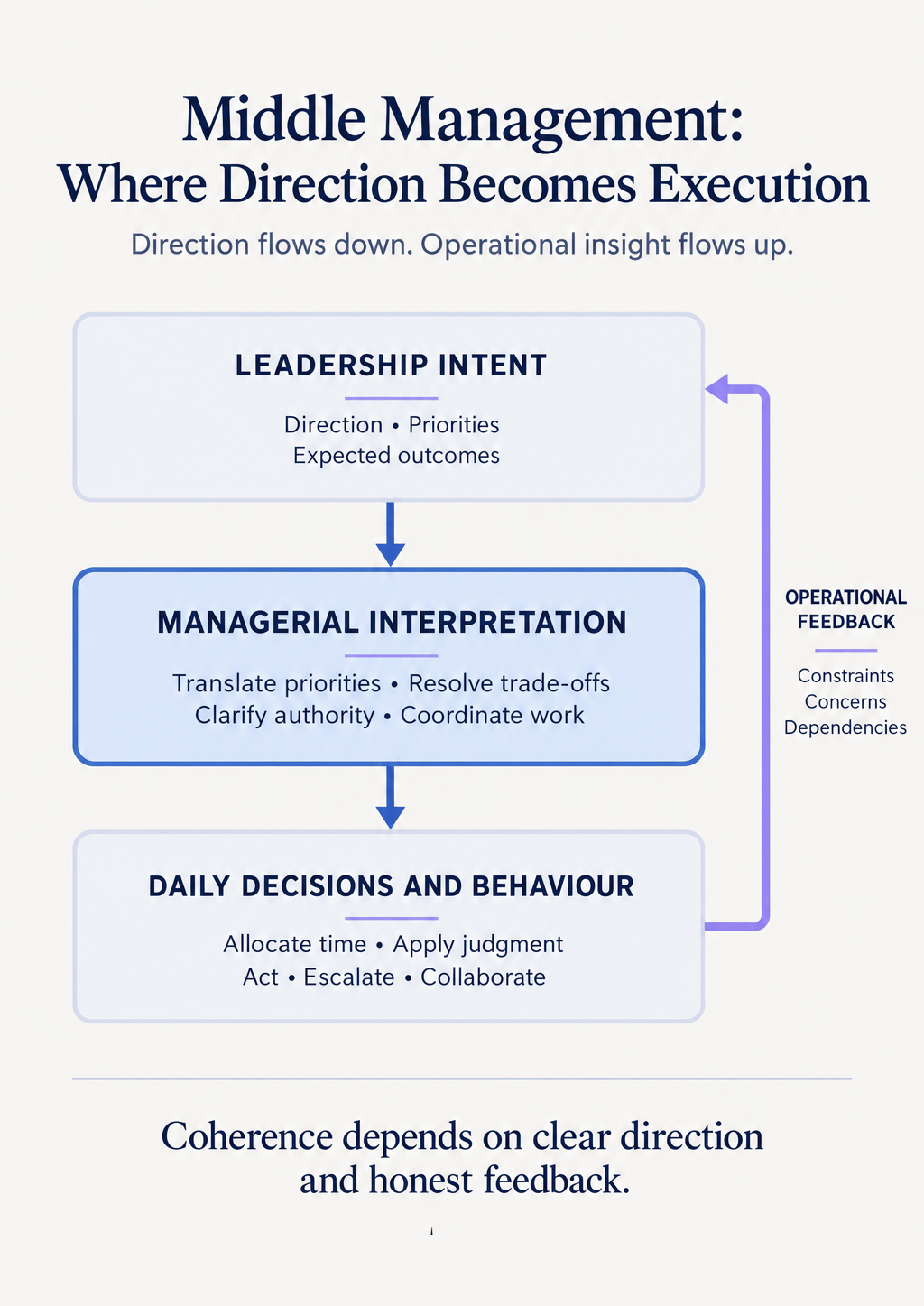
Effective middle management connects three things: organisational intent, operational constraints and employee judgment.
It makes direction specific enough to guide action.
Instead of repeating “customer experience is our priority”, a manager explains which customer problems deserve immediate attention, where employees have discretion and when an issue needs escalation.
It also makes trade-offs visible.
If a new initiative requires substantial work, the manager identifies what must be delayed, reduced or stopped.
Existing commitments do not disappear simply because a new priority has been announced.
And it helps teams understand dependencies beyond their own responsibilities.
A department may meet its target while creating additional work elsewhere.
A manager who sees the wider process can recognise that local success may be contributing to organisational friction.
These activities are easy to underestimate because their value often appears as problems that never develop.
A misunderstanding is resolved before it spreads. A dependency is addressed before a deadline slips. A difficult concern reaches the right person while there is still time to respond.
Middle management creates coherence through these ordinary decisions, repeated over time.
When Coordination Becomes Congestion
The bottleneck begins when too much work depends on passing through the manager.
Routine decisions wait for approval.
Employees defer matters they could reasonably resolve.
Cross-functional questions remain in a queue because only one person is permitted to negotiate the answer.
The manager becomes increasingly busy, while the team becomes increasingly dependent.
This can happen when a manager equates responsibility with personal control.
Reviewing every decision may feel like protecting quality.
Keeping every relationship may feel like ensuring consistency.
Over time, however, the team has fewer opportunities to develop judgment.
The manager’s availability becomes a limit on everyone else’s progress.
Yet the same pattern can emerge from organisational design.
A manager may be accountable for results but lack authority over staffing, budgets or process changes.
They may be expected to move quickly while navigating several approval layers.
Their team may have been given additional responsibilities without any corresponding reduction in existing work.
In these conditions, telling the manager to delegate more does not resolve the underlying constraint.
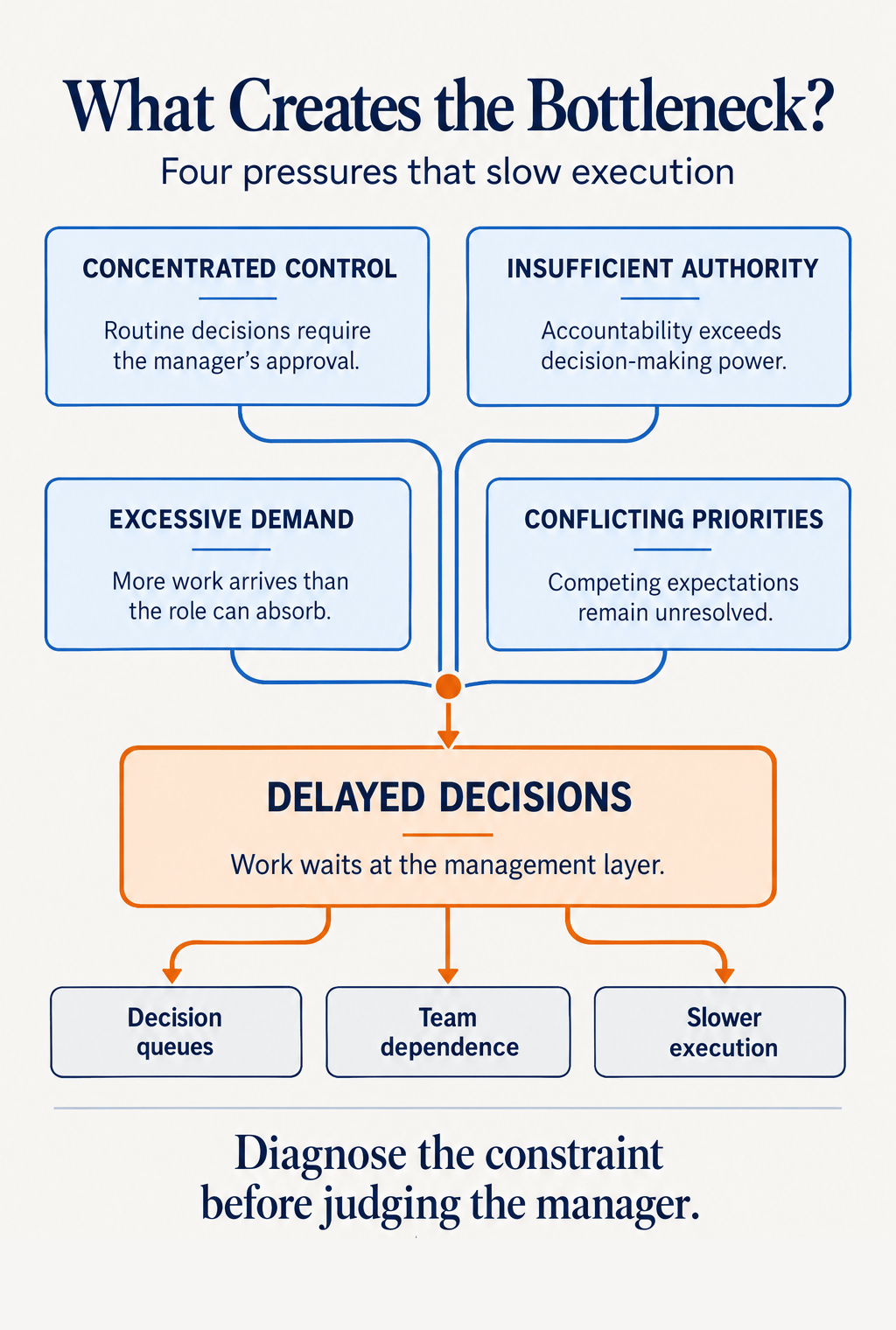
A bottleneck can reveal concentrated control, insufficient authority, excessive demand—or a combination of all three.
The visible delay is the starting point for diagnosis.
Discuss your brand or prThe Pressure to Absorb Contradictionsoduct
Middle managers often sit b etween demands that have not been reconciled.
Leadership asks for innovation while rewarding predictability.
Employees are encouraged to collaborate while departments compete for resources.
Managers are told to develop their people while being assessed mainly on immediate output.
Someone must deal with these contradictions when they reach daily work.
Frequently, middle management absorbs them.
Managers work longer hours, negotiate informal exceptions and ask their teams to make additional effort.
This can preserve delivery temporarily.
It can also conceal the fact that the organisation is relying on arrangements it cannot sustain.
A manager who continually compensates for unclear priorities may appear highly effective.
But the organisation becomes dependent on their personal effort rather than a workable operating system.
When that person leaves, takes leave or reaches their limit, the unresolved contradictions become visible.
The question is therefore not simply whether middle managers are keeping things moving.
It is whether progress depends on them repeatedly repairing conditions that leadership has left unresolved.
When Managers Protect the Appearance of Progress
A different bottleneck develops when maintaining confidence takes priority over surfacing reality.
Managers may hesitate to report that a deadline is unrealistic, that employees do not understand the change or that a process is failing.
Instead, they reassure upward and apply pressure downward.
Senior leaders hear that delivery remains on track
Employees hear that they need to try harder.
The underlying problem receives little attention.
This can gradually weaken trust in both directions.
Employees become less willing to raise concerns because previous concerns produced more pressure.
Leaders become frustrated when problems appear late because earlier reports suggested that everything was manageable.
It is tempting to attribute this entirely to a manager’s lack of courage.
That may be part of the explanation.
But leadership should also examine what happens when managers provide unwelcome information.
Are they helping to resolve the issue?
Asked for evidence and options?
Or treated as if identifying a constraint demonstrates a failure to lead?
The response teaches managers what kind of reporting the organisation values.
A Diagnostic Lens: What Is the Middle Being Asked to Hold?
Before concluding that middle management is the problem, examine the work and decisions concentrated there.
Five questions can help:
- Are priorities actionable? Can managers explain what takes precedence when demands conflict?
- Does authority match accountability? Can they make the decisions necessary to achieve the results expected of them?
- Where do decisions accumulate? Which approvals repeatedly wait, and why must they pass through that person?
- What happens to difficult information? Do concerns reach leadership early, with their implications intact?
- Is the team becoming more capable? Are employees developing judgment, or becoming increasingly reliant on managerial intervention?
These questions distinguish different problems that can look similar from a distance.
A capability gap may require coaching. An overloaded role may require redesign.
Conflicting targets may require a leadership decision.
Unnecessary approvals may require clearer boundaries for employee discretion.
The intervention should address the mechanism producing the delay.
Strengthening the Layer That Carries Execution
Improving middle management begins with making its task workable.
Senior leaders need to resolve competing priorities rather than pass them downward as simultaneous expectations.
They need to specify decision rights and provide a reliable way to escalate matters that exceed those rights.
Managers, in turn, need to make their reasoning visible.
Explaining why a decision was made helps employees develop judgment.
Defining clear limits allows routine work to proceed without repeated approval.
Raising constraints early gives the organisation time to respond.
Cross-functional problems also need a place to be resolved. Informal relationships can help, but delivery should not depend entirely on whether two managers happen to get along.
Finally, managerial performance should include the capability being built around the manager.
A team that can make sound decisions within clear boundaries is better positioned to sustain delivery than one that requires constant rescue.
What the Middle Reveals About Leadership
Middle management is often where the organisation’s unresolved questions become operationally unavoidable.
It reveals whether priorities are coherent, authority is sufficient, feedback is usable and expectations can be met within the resources available.
This does not remove individual responsibility.
Managers can obstruct decisions, suppress concerns and retain control unnecessarily.
Those behaviours need to be addressed.
But treating every bottleneck as an individual failure leaves the wider conditions untouched.
The more useful leadership question is:
What are we asking middle management to translate, reconcile and carry—and have we made that task possible?
Where the answer is clear, middle management can turn direction into coordinated action.
Where it is not, the middle becomes the place where ambiguity accumulates, decisions wait and organisational intent loses its force.
Part of the Leadership & Culture Series from LUCID Methods.
Explore more frameworks, diagnostic perspectives, and systems-thinking insights through the LUCID Method — developed to help organisations build clarity, coherence, and transformation that holds over time.