

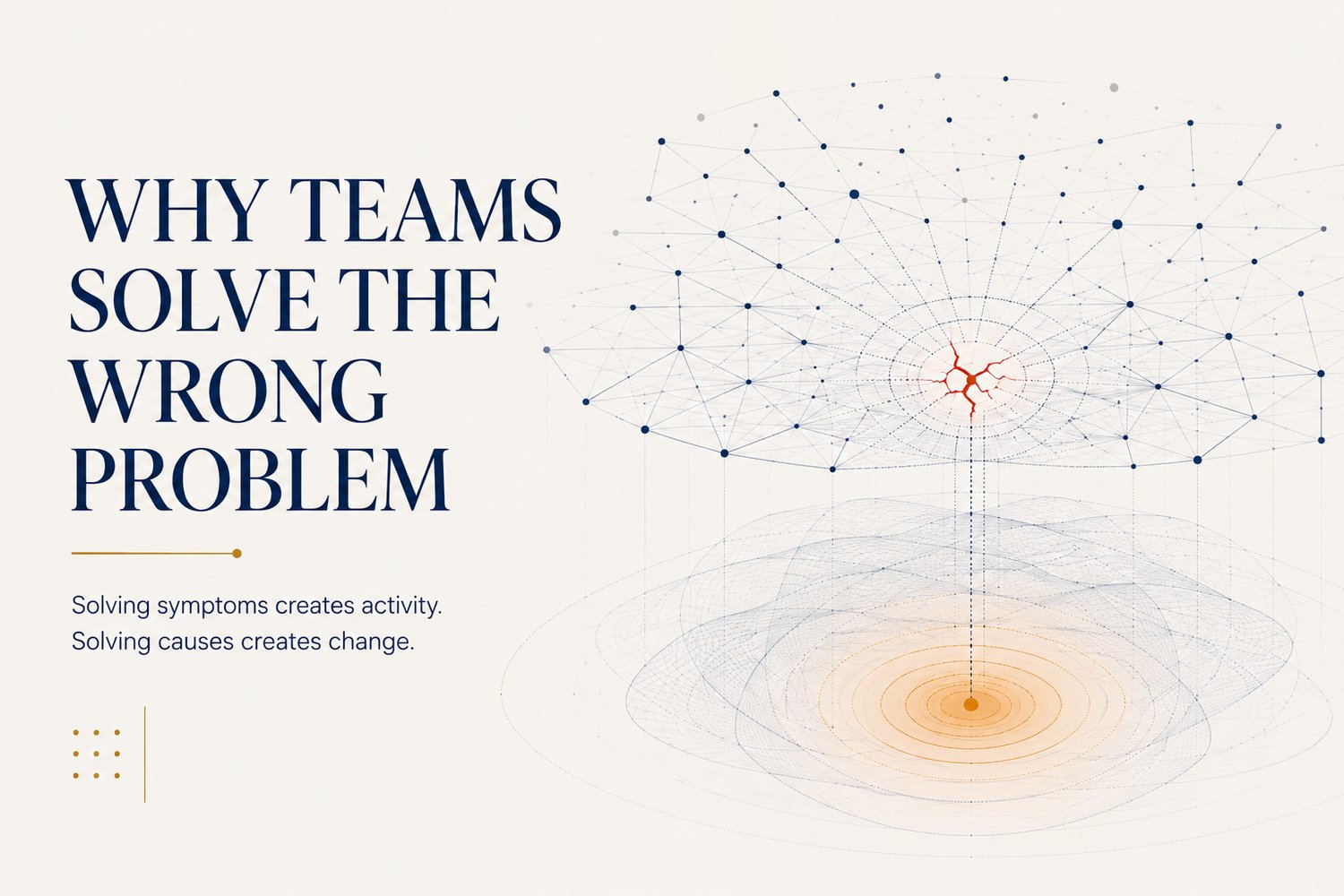
Why Teams Solve the Wrong Problem
Most teams do not fail because they are unwilling to solve problems.
They fail because they are solving the wrong ones.
When performance declines, deadlines slip, adoption stalls, or customers complain, organizations naturally respond by searching for solutions. New processes are introduced. Additional training is delivered. More meetings are scheduled. New technology is purchased.
Activity increases.
Yet the underlying issue remains.
Months later, the same symptoms reappear.
The organization concludes that the solution was ineffective. In reality, the solution may have been perfectly reasonable. It was simply applied to the wrong problem.
The challenge is rarely a lack of effort.
The challenge is misdiagnosis.
The Human Tendency to Solve What We Can See
Most organizational problems first appear as visible symptoms.
A project misses milestones.
A department experiences high turnover.
A transformation initiative loses momentum.
Customer satisfaction declines.
These symptoms are real, measurable, and often urgent.
Because they are visible, they attract immediate attention.
The problem is that symptoms are not causes.
Symptoms are evidence that something is happening somewhere within the system. They do not necessarily reveal why it is happening.
When organizations confuse symptoms with causes, they begin treating indicators rather than the conditions generating those indicators.
The result is temporary relief without lasting improvement.
The Cost of Misframing
Every problem statement contains an assumption.
The moment a team says:
"Our issue is employee resistance."
or
"Our issue is poor execution."
or
"Our issue is communication."
They have already framed the problem.
That framing determines where attention goes, what data gets collected, which stakeholders become involved, and what solutions appear reasonable.
If the framing is incorrect, every subsequent action becomes less effective.
Organizations often spend months optimizing solutions to the wrong problem because nobody challenges the original diagnosis.
The greater the investment, the harder it becomes to reconsider.
A Common Transformation Example
Consider a digital transformation initiative struggling with adoption.
Employees continue using old processes despite extensive communication and training.
Leadership concludes that the problem is resistance to change.
The response is predictable:
- More communication
- Additional training
- Stronger sponsorship messaging
- Reinforcement campaigns
Yet adoption remains low.
Why?
Because resistance was never the problem.
Further investigation reveals that employees understand the change perfectly well. Their concern is that the new process introduces additional work without eliminating existing responsibilities.
The issue is not resistance.
The issue is workflow design.
Months of effort were invested solving a problem that did not exist.
Symptoms Travel Upstream
One reason organizations struggle with diagnosis is that causes and symptoms rarely exist in the same place.
A symptom often appears far downstream from its origin.
For example:
- Symptom > Possible Root Cause
- Missed deadlines > Unclear decision rights
- Low adoption > Conflicting incentives
- Poor collaboration > Misaligned objectives
- Employee frustration > Process complexity
- Frequent rework > Shared interpretation failure
The visible issue may be execution.
The underlying issue may be structural.
This distinction matters because structural problems cannot be solved through behavioural interventions alone.
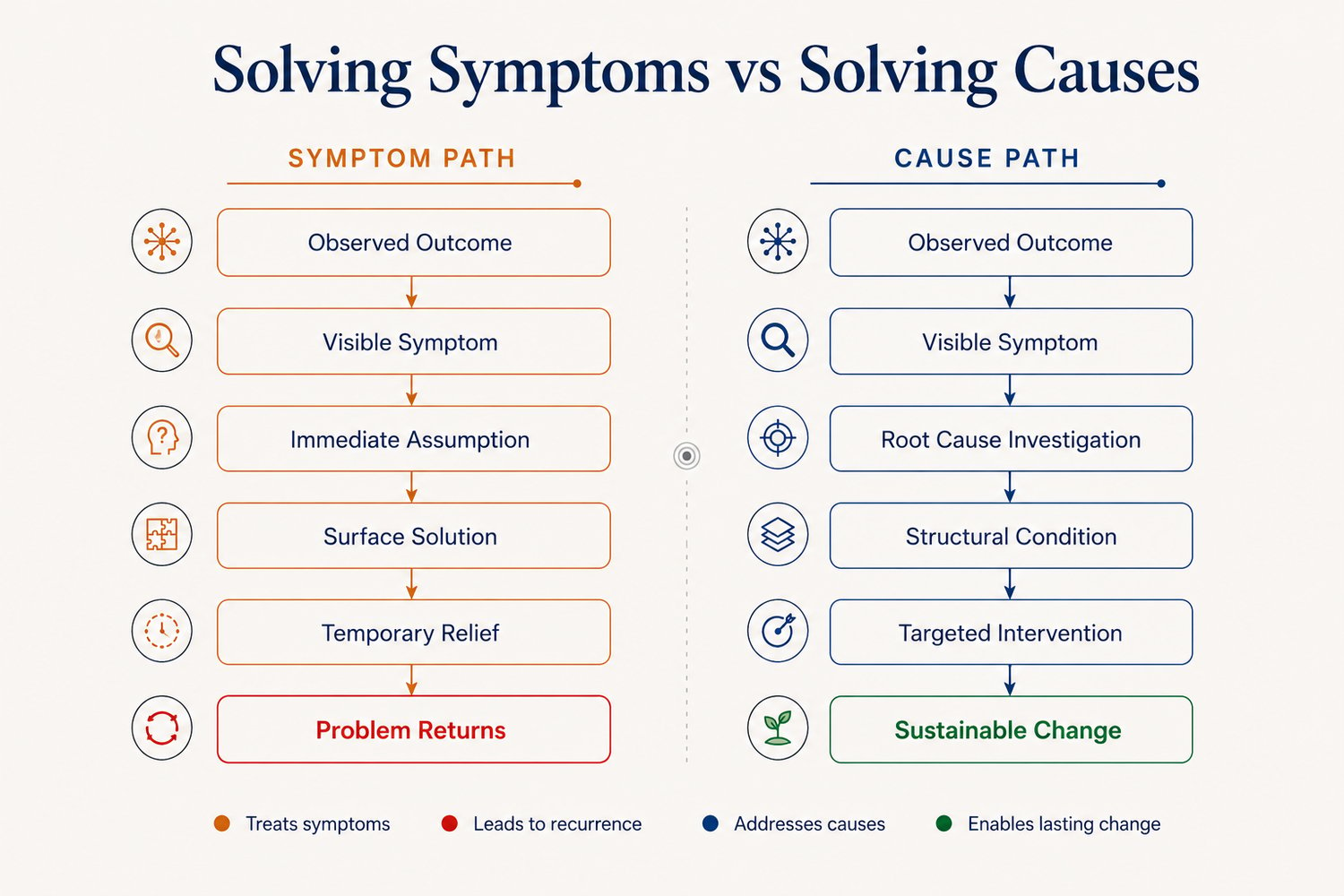
The distinction between symptom-focused intervention and cause-focused diagnosis is often the difference between recurring problems and sustainable change.
Why Smart Teams Get It Wrong
Misdiagnosis is not a sign of incompetence.
In fact, highly capable teams often fall into the same trap.
Several forces contribute to this:
Urgency
Pressure encourages rapid action.
Diagnosis feels slow.
Action feels productive.
As a result, teams often begin solving before they fully understand.
Expertise Bias
Experts naturally interpret problems through the lens of their expertise.
A technology leader may see a systems issue.
A communications specialist may see a messaging issue.
A change manager may see an adoption issue.
Each perspective may be valid, but none may represent the complete picture.
Organizational Incentives
Leaders are often rewarded for delivering solutions rather than questioning assumptions.
The pressure to act can become stronger than the discipline to diagnose.
The Difference Between a Symptom and a System Condition
A useful diagnostic question is:
"If we solved this issue perfectly, would the symptom disappear permanently?"
If the answer is uncertain, the team may still be looking at a symptom.
For example:
- Training may improve capability.
- Communication may improve awareness.
- Governance may improve oversight.
But if the underlying system continues generating confusion, friction, or conflicting interpretations, the symptom will eventually return.
True diagnosis identifies the conditions that repeatedly generate the observed outcome.
The LUCID Perspective
Within LUCID, many organizational failures emerge from hidden structural conditions rather than visible operational symptoms.
Teams often focus on:
- Adoption problems
- Delays
- Escalations
- Rework
- Stakeholder resistance
These are observable outcomes.
The deeper causes frequently involve:
- Interpretation Drift
- Hidden Friction
- Dependency Exposure
- Coherence Decay
- Structural ambiguity
Because these conditions are less visible, they are often overlooked.
Yet they continue shaping behaviour long after surface interventions have been deployed.
This is why activity can increase while outcomes remain unchanged.
The organization is treating effects while causes remain intact.
Diagnosis Before Solution
Effective organizations resist the urge to immediately solve.
Instead, they first ask:
- What exactly are we observing?
- What evidence supports our assumptions?
- What alternative explanations exist?
- Where did this symptom originate?
- What system condition is producing this outcome?
These questions slow the rush toward solutions.
But they significantly improve the quality of intervention.
The goal is not simply to solve problems faster.
The goal is to ensure the problem being solved is the correct one.
Clarity Begins With Problem Definition
Many transformation failures begin long before execution.
They begin at the moment a problem is defined incorrectly.
Once the wrong problem enters planning, governance, communication, and execution, the entire system becomes optimized around a flawed assumption.
This creates a dangerous illusion:
everyone is working hard, yet little is improving.
The organization is not suffering from a lack of solutions.
It is suffering from a lack of diagnostic clarity.
Because before solving a problem, teams must first ensure they understand what problem actually exists.
Key Takeaway
Organizations rarely struggle because they cannot solve problems.
They struggle because they solve symptoms instead of causes.
Sustainable improvement begins when teams move beyond visible issues and identify the structural conditions generating them.
Diagnostic clarity is not a luxury—it is the foundation of effective transformation.
Part of the Diagnostic Thinking Series from LUCID Methods.
Explore more frameworks, diagnostic perspectives, and systems-thinking insights through the LUCID Method — developed to help organisations build clarity, coherence, and transformation that holds over time.